Best Defensive Teams World Cup 2026: Hardest to Beat

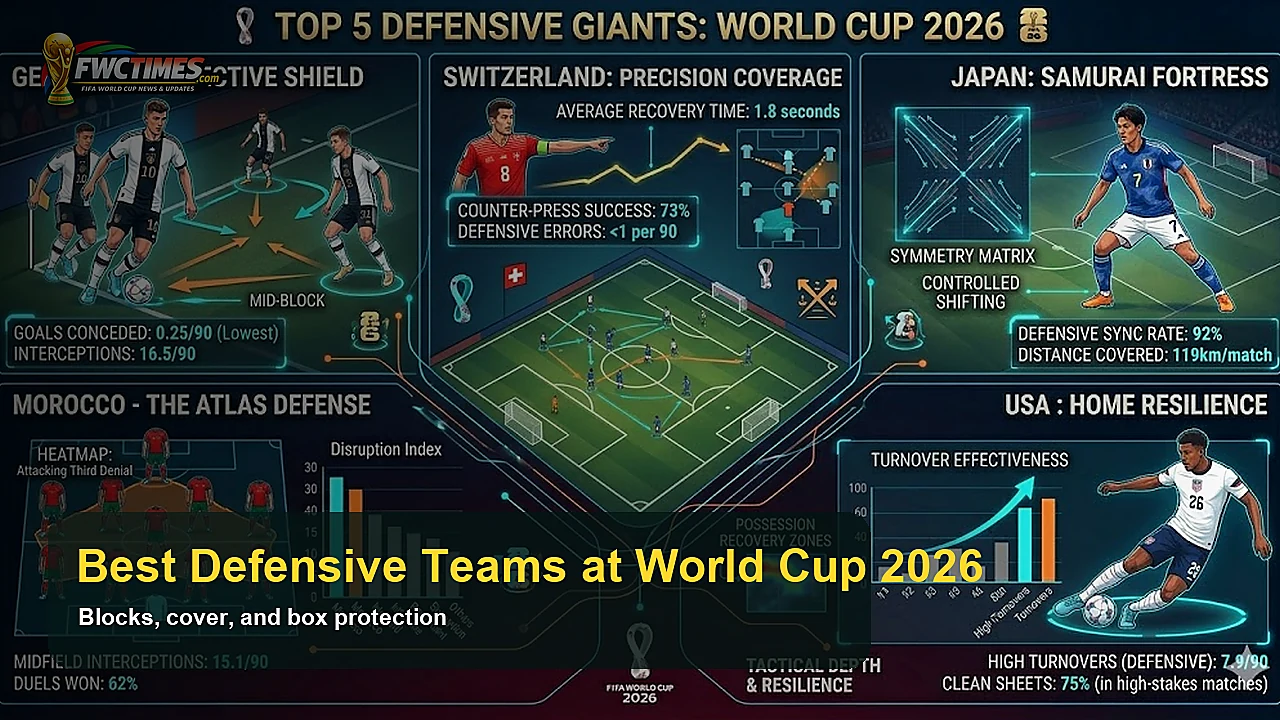
The best defensive teams World Cup favorites rely on structured blocks and midfield pivots to restrict opponent chances. In a tournament expanded to forty-eight teams, defensive stability is the most reliable path to the knockout rounds. In fact, teams with disciplined rest defenses can prevent direct transitions and protect the box across the matches. This tactical guide analyzes the hardest teams to break down in the competition.
The physical load of the expanded schedule dictates how coaches organize their defensive blocks. Playing matches across three host nations under summer heat makes high pressing unsustainable over long periods. As a result, the top defensive sides drop into compact mid-blocks or low-blocks to conserve player energy. This defensive economy of effort is what enables squads to maintain structure during the final half-hour of matches.
The history of the tournament shows that defensive resilience is what ultimately decides the knockout stages. France and Argentina won recent titles by combining elite individual defenders with rigid midfield protection. The coaching staff of these tournament favorites has prioritized central compactness to force opponents into low-value wide areas. The tournament’s top defensive units enter the group stage aiming to keep consecutive clean sheets.
England’s Unbeaten Qualifying Roster
England enters the tournament with the most statistically dominant defensive record from the qualifying period. Under their coaching staff, England did not concede a single goal across their eight qualifying matches. The system utilizes a narrow 4-2-3-1 shape that relies on a double pivot to shield the central defenders. The 4-2-3-1 formation World Cup guide compares these shapes to show how dual pivots manage central spaces.
The double pivot screens the space in front of the center-backs, intercepting line-breaking passes and collecting loose balls. This structure allows England’s fullbacks to push high without leaving the center of the pitch exposed to direct counters. England’s defensive line coordinates their height to keep the team compact, preventing opponents from playing between units. This tactical discipline is what makes England the hardest team to score against in Group Stage.
France and Argentina’s Resilient Central Blocks
The France playing style World Cup 2026 model runs on athletic recovery speed and elite center-back depth. France conceded only four goals in six qualifying matches, demonstrating their defensive efficiency under Didier Deschamps. The system focuses on defending the penalty area with a numerical advantage, utilizing physical duels to clear crosses. France drops into a narrow mid-block out of possession, compression space in the defensive third.
Argentina’s defensive phase combines central compactness with intense counter-pressing triggers. Lionel Scaloni’s squad conceded only 14 goals in 18 highly competitive CONMEBOL qualifying matches to top the South American standings. The system relies on Romero’s anticipation and Martinez’s shot-stopping ability to secure the box. The Argentina playing style World Cup 2026 guide details how Scaloni’s liquid shapes manage transition defense.
Morocco and the Netherlands’ Zonal Mastery
Morocco continues to run one of the most organized low-block systems in international football. Morocco drops into a narrow 5-4-1 block, closing down central channels and forcing the ball-carrier wide. This zonal discipline prevents opponents from pulling the center-backs out of position during transitions. Once they recover the ball, they launch quick transitions down the flanks using the speed of Achraf Hakimi.
The Netherlands utilizes their deep pool of elite centre-backs to control matches out of possession. Under Ronald Koeman, the Dutch backline features Virgil van Dijk’s leadership and recovery pace to manage defensive line depth. The Netherlands can shift between a back-four and a back-five depending on opponent pressure. The possession football World Cup guide explains how central defenders manage build-up phases under pressure.
Post-Qualifying Defensive Statistics
Qualifying numbers highlight the defensive stability of the tournament’s top seeds. These statistics demonstrate why defensive organization is favored over open attacking models. Studying these records reveals the blueprint for knockout success.
| Team | Goals Conceded | Qualifying Matches | Defensive Style | | :— | :—: | :—: | :— | | **England** | 0 | 8 | Dual-Pivot 4-2-3-1 | | **France** | 4 | 6 | Mid-Block 4-3-3 | | **Argentina** | 14 | 18 | Central Diamond | | **Morocco** | 5 | 8 | Compact 5-4-1 |
This record shows that the top defensive sides enter the tournament with established structures. The squads enter the group stage with a clear understanding of their marking duties. This defensive cohesion makes them the favorites to progress deep into the knockout rounds.
Key Vulnerabilities of Elite Defenses
The biggest tactical risk for defensive units is the space left behind when the team attempts to counter-press. If the midfielders step up to win the ball and fail, the opponent can exploit the open center. This failure leaves the center-backs exposed to fast runners breaking from deep positions. This risk requires perfect synchronization between the midfield screen and the defensive line.
Top defensive sides can also struggle when fullbacks are caught in 1v1 overloads on the flanks. If the wide midfielders fail to track back, the fullback must defend two opponents simultaneously. This overload opens space for crosses into the box, testing the aerial capacity of the center-backs. This challenge makes wide coordination and goalkeeper command critical factors for defensive success.
Expert Verdict
Defensive organization will decide the champions of the 2026 World Cup. England and France possess the most structured defensive blocks, combining individual quality with midfield protection. The physical challenges of the expanded tournament schedule will test the depth of every defensive roster. The key to winning the trophy will be maintaining clean sheets during the high-variance knockout matches.
If the top defensive units avoid individual errors, they will dominate their groups. The high altitudes in Mexico and summer heat in the USA will test low-block endurance. Coaches who rotate their defensive lines effectively will keep their key center-backs fresh. England’s dual-pivot system looks the most structurally secure model to survive the tournament.