How Argentina Play at the 2026 World Cup

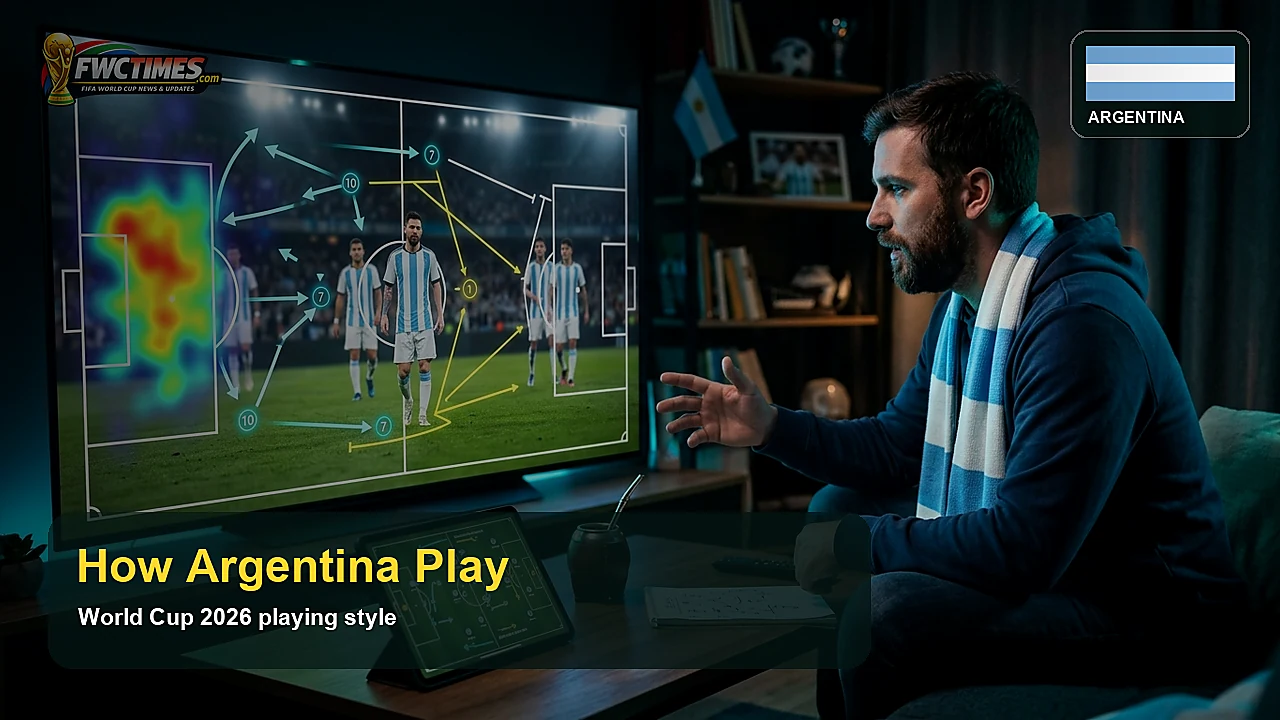
Argentina arrive at the 2026 FIFA World Cup as defending champions with a tactical identity that has matured beyond the one that lifted the Qatar trophy. Lionel Scaloni’s system runs on collective spatial control, a relentless midfield engine, and the genius of a 38-year-old Messi operating in a protected zone where he cannot be neutralised. The squad finished CONMEBOL qualifying in first place, conceding just 10 goals across 18 matches — the best defensive record on the continent. Everything about this team is built to go deep into the tournament, and the system tells you exactly why.
The System Scaloni Built
Argentina nominally line up in a 4-3-3, but calling it that undersells what the structure actually does. Scaloni runs what analysts now describe as a liquid formation — a shape that shifts between 4-3-3, 4-2-3-1, and 4-1-4-1 depending on the phase of play, the opposition’s block, and how much territory Argentina are willing to concede. When they build from the back, the shape often morphs into a 3-2-5, with a centre-back stepping forward and a full-back tucking in to create a numerical midfield advantage. In transition, the same eleven players can hold a deep 4-4-2 compact block within seconds of losing the ball.
The departure of Angel Di Maria after 2022 removed the natural asymmetric width from the right wing that defined the Qatar system. Scaloni responded by shifting width responsibility to the full-backs. Nahuel Molina on the right provides overlapping runs and crossing service, creating wide overloads that pull defenders away from the central channels. Nicolas Tagliafico on the left works the same width while holding his defensive shape more tightly, acting as a balance to Molina’s forward aggression. This structural shift changed Argentina’s attacking geometry entirely, and so far it has worked cleanly.
The system is not built around individual moments. It runs on collective spatial manipulation — the idea that all eleven players compress and expand together, forcing opponents into pressing traps or dragging them out of defensive shape. That coordination is what makes the 4-3-3 liquid. The formation is not a fixed starting point; it is the result of eight players moving in sync to create the space one or two others will exploit. For a full breakdown of how this shape works globally at the tournament, the 4-3-3 formation World Cup guide covers the structural principles in detail.
Messi’s Role at 38
Lionel Messi is Argentina’s captain at his sixth World Cup, and his role in 2026 looks different from any previous tournament. He operates as a free-roaming number ten, nominally part of the front three but spending most of the match dropping into deeper pockets between the lines. Scaloni’s staff call it the Quarterback 10 — a position where Messi works within a roughly 20-yard radius, conserves physical output, and delivers the line-breaking passes that unlock defences. He does not track runners. He does not press high. His midfield provides that cover so he can be decisive in the moments that matter.
As of early June 2026, Messi is managing muscle fatigue and inflammation in his left hamstring, sustained in a May 24 Inter Miami match. He has been training individually at Argentina’s Kansas City camp, away from the main group, on a carefully managed day-by-day plan. The Argentina medical staff and Scaloni have expressed quiet confidence that he will be ready for the opening group match against Algeria on June 16. He is expected to miss the pre-tournament friendly against Honduras, with the Iceland warm-up match remaining a day-by-day decision.
Even when Messi performs at partial capacity, his presence alone reshapes what opponents do. Defences assign a marker to track him everywhere he moves, which in turn opens the channels that Enzo Fernandez and Alexis Mac Allister use to arrive late. Messi scored 8 goals in 12 qualifying appearances — more than any other Argentine player — and those numbers came from this conserved, surgical approach rather than high-mileage wing play.
The Midfield That Makes It Work
The three-man midfield carries the operational weight of Scaloni’s entire system. Each player occupies a specific functional role, and none of the three are interchangeable.
Enzo Fernandez — The Deep Pivot
Enzo Fernandez sits deepest in the midfield trio. He shields the back four, acts as the primary distributor in build-up, and breaks defensive lines with his passing range across short and long distances. When Argentina are under pressure, Fernandez drops between the centre-backs to create a temporary three-man defensive shape, giving the full-backs the confidence to push forward. His reading of when to play forward and when to recycle is central to how Argentina control tempo.
Rodrigo De Paul — The Box-to-Box Engine
De Paul covers more ground than any other Argentina player in the starting eleven. He acts as the team’s pressing trigger — his movement tells teammates when to step up and suffocate the opponent. When Molina pushes forward on the right, De Paul slides across to cover the right-flank space vacated. His energy allows the system to press high without leaving gaps, and his willingness to do ugly defensive work is what gives Messi his protected zone. Without De Paul, the Quarterback 10 role does not function.
Alexis Mac Allister — The Half-Space Creator
Mac Allister operates as the connector between Argentina’s defensive phase and their final-third entry. He finds half-spaces between opposition lines, links the midfield to the front three, and arrives with a goal-scoring threat from distance. His late runs into the box are a consistent source of secondary chances in open play, and his technical ability under pressure makes him the most versatile piece in the midfield. When Scaloni needs to shift the team’s shape mid-match, it is usually Mac Allister’s positioning that changes first. The 4-2-3-1 formation World Cup guide explores how this type of connector role functions inside a double-pivot system.
How Argentina Press and Defend
Argentina’s defensive system operates on two distinct modes, and Scaloni drills the squad to switch between them cleanly.
The high press is the primary out-of-possession weapon. Argentina step up as a coordinated unit, forcing opponents to play backward toward their own goal. The trigger is usually De Paul closing the ball-carrier, at which point the entire team compresses. The 3-second counter-press rule means that any player near the ball within three seconds of Argentina losing possession must apply immediate pressure rather than dropping into shape. That rule prevents the transition moments that hurt compact teams.
When the high press is not the right option — usually against deeper, more physical opponents — Argentina drop into a rigid low block. The shape becomes a 4-1-3-2 or a compact 4-4-2, with the midfield travelling together in tight horizontal layers. They push opponents toward the sidelines, isolating the ball-carrier in a wide area where support takes time to arrive. Argentina conceded just 10 goals in 18 CONMEBOL qualifying matches using this flexible defensive approach. That figure is not luck — it reflects a system that knows exactly when to press and when to absorb. The high press World Cup guide breaks down the mechanics of this approach across top teams.
The vulnerability in the system comes when the press is broken. If an opponent plays through the initial press with a quick forward line, Argentina can be exposed in the channels between the full-backs and the centre-backs. Molina’s forward positioning is especially risky in those moments, since Tagliafico and the central pairing must cover his space. Against pace and directness, that transition moment is where Argentina can be hurt.
The Strikers and Their Separate Functions
Julian Alvarez and Lautaro Martinez fill the two striker options, and Scaloni uses them for different tactical purposes rather than rotating on form alone.
Alvarez is the default starter in the 4-3-3. His constant movement and intense pressing make him the ideal front-three partner in a high-press system — he forces defenders to play quickly and creates the pressure channels that Argentina’s midfield exploits. He scored 4 goals in CONMEBOL qualifying and provides physicality in the press that Messi’s role cannot cover. Alvarez is functional as well as effective; his runs open space for others to arrive.
Lautaro Martinez is the box-finisher Scaloni turns to when Argentina need direct goal-scoring output. He wins physical duels in the penalty area, has a clinical first touch inside 18 yards, and can hold the ball long enough for the midfield to arrive in support. He also scored 4 qualifying goals in a more restricted role, suggesting his output per chance is high. When Argentina need a goal in the last 20 minutes of a knockout match, Martinez is the switch Scaloni reaches for. Both players contribute to Argentina’s attacking depth and ensure the front line functions whether the game calls for pressing or presence.
Youth Injection — Paz, Barco, and Simeone
Scaloni added three younger players to the squad who change the dynamic off the bench and signal where Argentine football is heading beyond Messi’s era.
Nico Paz brings creativity between the lines and suits either an advanced midfield or wide attacking role. His close control in tight spaces gives Argentina an alternative way to break deep blocks. Valentin Barco operates on the left side as a technically versatile left-back or wide player — his inclusion gives Scaloni an option to shift formation without changing personnel. Giuliano Simeone brings wide attacking energy off the bench, pressing intensity, and direct running that gives Argentina a different look in the final third when the match opens up. None of these three are expected to start group games, but in a 48-team format that adds a Round of 32, squad depth and freshness will determine who is still functioning in the last weeks of July.
How 2026 Differs from Qatar 2022
The version of Argentina that won the World Cup in Qatar was a different machine from the one arriving in 2026. The changes are structural, personnel-driven, and deliberate.
In 2022, Di Maria operated as a natural wide threat from the right wing, creating asymmetric width that required no full-back involvement at that side. In 2026, width comes entirely from Molina and Tagliafico making runs from deep. That change made the team more compact through the middle but also more predictable in how it attacks wide areas. Messi’s role shifted too — he played more as a winger-hybrid in Qatar, contributing to wider phases. In 2026, he sits in a purer Quarterback 10 position with less territory to cover. That change preserves his physical capacity across a long tournament but asks the midfield to do more.
The squad now includes Nico Paz and Giuliano Simeone as youth additions who did not exist in the 2022 setup. The core chemistry of the 2022 winners remains intact, but the system has been tightened around sustainability rather than individual expression. Whether that evolution makes the team harder or easier to beat will become clearer from the round of 16 onward.
Argentina’s Injury Concerns Pre-Tournament
Beyond Messi’s hamstring management, Scaloni is handling a broader set of fitness concerns across the squad. Goalkeeper Emiliano Martinez is managing a fractured finger and monitoring his recovery ahead of the opening match. Defender Cristian Romero is still working through knee ligament recovery and remains day-by-day in terms of availability. Reports indicate approximately ten squad members are managing physical niggles of varying severity as of early June.
The 48-team expanded format adds the Round of 32 as a new requirement, meaning Argentina must play at least four matches before reaching the quarter-finals. That extra match load is a direct challenge for a squad where several key players are on the wrong side of 30. Scaloni’s management of the playing squad across the group stage and early knockouts will be as important as his tactical decisions.
Expert Verdict
Argentina enter the 2026 World Cup as the most tactically coherent team in the competition. Scaloni has built a system that does not depend on any single position other than Messi, and even Messi’s role has been redefined to extend his functional shelf life deep into the knockout rounds. The liquid 4-3-3 is difficult to pin down because it genuinely changes shape, and the defensive record in qualifying — 10 goals conceded in 18 matches — proves this is not a team that wins by attacking alone. The midfield trio is among the best collective units at the tournament, and the full-back width system is mature enough that it no longer feels like a compromise for losing Di Maria.
The biggest risk is physical, not tactical. A Messi hamstring issue at 38, a Martinez finger fracture, and Romero’s knee recovery all sit inside the squad’s danger zone simultaneously. If Messi misses even one knockout match, the system loses the one player no tactical replication can replace. Scaloni’s blueprint is good enough to win the tournament. The question is whether the players inside it stay healthy long enough to execute it. For a broader read on where Argentina sit among the title contenders, the World Cup 2026 predictions guide sets out the full picture from a tournament perspective.
Frequently Asked Questions
What formation does Argentina use at World Cup 2026?
Argentina’s primary shape is a liquid 4-3-3 that flexes into different structures depending on the phase of play. In build-up, the team often shifts into a 3-2-5, with a centre-back stepping forward and a full-back tucking into midfield. When defending deep, the shape compresses into a 4-4-2 or 4-1-4-1 block. Scaloni also uses 4-2-3-1 and 5-3-2 in specific match situations, making the formation label less useful than understanding how all eleven players move as a unit.
What is Messi’s role in Argentina’s 2026 system?
Messi operates as a free-roaming Quarterback 10, nominally part of the front three but spending most of his time in deeper pockets between the opposition’s lines. He works within a roughly 20-yard radius, conserving physical energy while delivering line-breaking passes that unlock defences. His midfield trio — Fernandez, De Paul, and Mac Allister — covers the defensive work so Messi can focus purely on creative output. He scored 8 goals in 12 qualifying appearances from this restricted but precise position.
Who are Argentina’s key midfielders in the 2026 squad?
The three-man midfield is built on specific functional roles rather than interchangeable parts. Enzo Fernandez is the deep pivot and primary distributor who shields the back four. Rodrigo De Paul covers the most ground and acts as the pressing trigger for the entire team. Alexis Mac Allister operates as the half-space connector, linking the defensive phase to the final third while arriving late with a goal-scoring threat. All three have been first-choice starters since the 2022 World Cup win.
What are Argentina’s biggest weaknesses at World Cup 2026?
The most significant risk is physical — Messi at 38 is managing a hamstring issue, Emiliano Martinez has a fractured finger, and Cristian Romero is recovering from knee ligament work. Around ten squad members entered the tournament managing physical niggles. Tactically, the main vulnerability is the transition moment when Argentina’s high press is beaten cleanly — Molina’s forward positioning leaves space behind him, and pace on the counter can stretch the back line. The expanded 48-team format adds a Round of 32, increasing the physical load across a longer tournament.