4-3-3 Formation at World Cup 2026: Shape, Tactics, and Key Teams

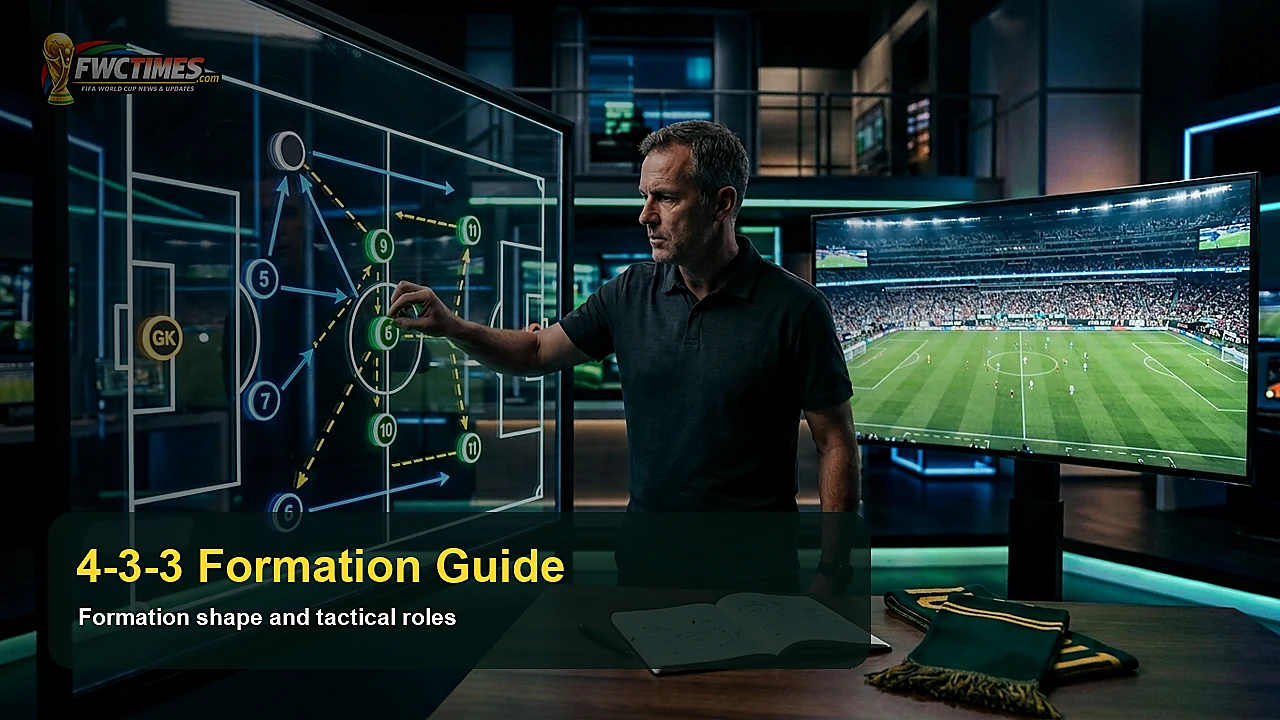
Spain, Argentina, France, and Germany all arrive at the 2026 FIFA World Cup running some version of the 4-3-3. The formation dominates because it solves three problems at once: it creates width in attack, builds natural midfield triangles for possession, and sets automatic pressing angles from the front three. In a 48-team tournament with up to eight matches for finalists, the system’s squad rotation logic makes it even more valuable. Coaches can rotate players in any of the eleven positions without changing the shape or the team’s tactical identity.
The 4-3-3 is not new. Brazil used a version of it at the 1962 World Cup in Chile, when winger Mario Zagallo dropped into midfield to add defensive cover and transform the 4-2-4 into a three-man engine room. Rinus Michels then rebuilt the concept entirely with Ajax and the Netherlands in the 1970s, turning the shape into the vehicle for Total Football. That Michels blueprint — high press, fluid positional interchange, collective pressing triggers — is still the intellectual ancestor of what Spain and Germany run today.
What changed in 2026 is the intensity. PPDA data from qualifying shows a downward trend across top sides toward more aggressive pressing structures. The 4-3-3 suits that trend because the front three already sit in natural press positions when the opponent has the ball deep. Teams drop into a compact 4-1-4-1 or 4-5-1 out of possession, then spring back into their attacking shape the moment they recover the ball.
Which Teams Use the 4-3-3 at World Cup 2026
Spain’s Vertical Pressing Version
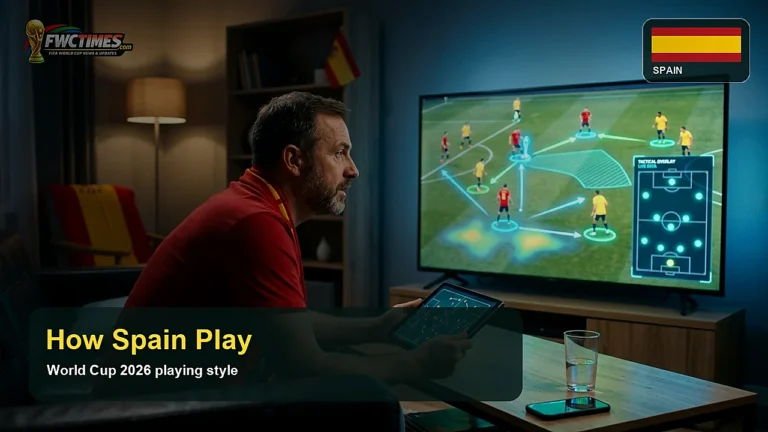
Spain’s 4-3-3 under Luis de la Fuente looks almost nothing like the Tiki-Taka of the 2010 era. The shape is now built around vertical speed and high-intensity pressing rather than patient recycling. Rodri operates as the anchor pivot, reading lines and screening the back four, while Pedri functions as a mezzala who runs beyond the striker from deep. On the right wing, Lamine Yamal provides the pace and direct dribbling to stretch defensive lines immediately. Spain’s system on the ball regularly morphs into a 3-2-5 shape when both fullbacks invert, creating overloads in the wide channels that opponents struggle to cover.
Spain’s pressing triggers are among the sharpest in this tournament. The front three hold their shape until a specific cue — a back-pass, a poorly weighted switch — then all three attack the ball simultaneously. That collective pressing angle is exactly what makes the high-press style of football so effective at the World Cup level. When Rodri stays compact and the press fires clean, Spain can win the ball back in the opponent’s half in three to five seconds.
Argentina’s Liquid 4-3-3 with Messi at Its Heart
Argentina’s system is looser in structure than Spain’s, which makes it harder to mark and harder to disrupt. Lionel Scaloni builds around Messi as a free-roaming quarterback, letting him drift between the lines and find space rather than pinning him to the right wing. Enzo Fernandez holds the pivot role and covers the most ground of any player in the squad. Rodrigo De Paul brings box-to-box energy and diagonal runs, while Alexis Mac Allister connects the midfield and attack as the system’s rhythm controller. Argentina’s playing style at World Cup 2026 is built on this midfield engine rather than individual brilliance at the top.
The flexibility of Argentina’s 4-3-3 is its biggest weapon. Scaloni can shift to a mid-block without changing the shape on paper, because the front three and midfield three already understand when to press and when to hold their line. When Argentina win the ball back, the transition from defensive block to attacking move is fast and direct.
France, Germany, and the Shape-Shifting Versions
France run a fluid 4-3-3 that frequently morphs into a 4-2-3-1 depending on the opponent. Antoine Griezmann operates as the hybrid number ten — sometimes sitting in the mezzala spot, sometimes dropping deeper to link play. The system prioritises counter-attacking speed over sustained possession. France are most dangerous when they absorb pressure and release their front three into space behind a high line. Germany’s 4-3-3 under Julian Nagelsmann is arguably the most intense pressing version in the tournament. Florian Wirtz and Jamal Musiala both play as inverted wide forwards, cutting inside to overload the half-spaces and create shooting angles rather than crossing from wide positions.
Portugal offer a different version again. Bruno Fernandes, Vitinha, and Ruben Neves form one of the more technically complete midfield engines in the competition. Portugal shift between a 4-3-3 and a 3-4-2-1 depending on whether they are controlling the ball or pressing into a compact block. Brazil run a fluid attacking shape built around Vinicius Junior in a free role — with Rodrygo unavailable after a torn ACL, rotation up front becomes critical for the Brazilians in the knock-out rounds. Uruguay under Marcelo Bielsa use a high-press 4-3-3 that can shift to a 4-2-3-1 when sitting deeper, which is characteristic of Bielsa’s approach regardless of available personnel.
What the 4-3-3 Actually Does in Possession
The most visible shift happens when both fullbacks invert. When they push narrow and high, the shape on the ball becomes a 3-2-5, with three defenders holding the line, two pivots in front of them, and five players in and around the final third. That 3-2-5 possession shape creates width through the wingers while the centre of the pitch stays compact and difficult to press. Opponents who try to press the back three get drawn out of position, which opens lanes for the pivots to drive forward.
Midfield triangles are the possession logic of the 4-3-3. With three central midfielders, the shape creates 3v2 numerical advantages in the middle of the pitch on a rolling basis. The pivot holds depth while the two eight-roles provide forward and diagonal passing options at all times. Ball circulation becomes fast and almost automatic because every player has two clean passing angles at any moment. That recycling efficiency is why Spain can dominate PPDA numbers in qualifying — the system creates the ball security that enables the press to be held in place without risk.
How Pressing Works From the Front Three
The front three in a 4-3-3 press as a unit, not as individuals. Each winger sets the angle for the striker, who then triggers the press by stepping toward the ball-carrier. At the same time, the near-side midfielder breaks forward to cut passing lanes in behind the press. That coordinated movement is what separates the high press from a disorganised forward chase. Teams that execute it well can force turnovers in the opponent’s defensive third, which is where the most dangerous scoring opportunities in modern football originate. Spain, Germany, and Austria — who shift from a 4-2-3-1 into a 4-3-3 when they dominate possession — all build their press on this three-player coordination model.
Altitude and heat at the 2026 venues add a dimension that press-heavy teams must plan for. Mexico’s high-altitude stadiums reduce aerobic capacity and slow recovery between press cycles. Texas and Florida summer heat affects how long a team can sustain the intensity of a ten-second press. Squads running a 4-3-3 need depth in all three midfield positions, because managing press intensity across 104 matches in a 48-team tournament is as much a fitness question as a tactical one.
The Weaknesses Teams Will Try to Exploit
The 4-3-3 has specific vulnerabilities that well-organised opponents target deliberately. The space behind the pivot is the most exposed area. If a high-press team commits both eight-roles forward and the opponent plays through the press quickly, the holding midfielder is left 1v2 or facing a runner in behind. Morocco, who use a compact 5-4-1 low block, specifically look to win the second ball in central midfield and release runners through this channel. Defending teams that use a 4-4-2 can flood the midfield and neutralise the triangle advantage by matching up numerically.
Full-backs in a 4-3-3 face constant 1v1 situations if the wide forwards do not track back. Many high-profile 4-3-3 teams ask their wingers to press high and stay forward to maintain the attacking shape. That creates space for opposition fullbacks and wingers to combine down the flank. Low-block teams like Saudi Arabia and South Korea at this tournament specifically look to play wide and stretch the shape, then switch the ball quickly to the exposed fullback. Compact 5-3-2 and 5-4-1 formations also give the 4-3-3’s front three very little space to exploit in behind, which forces the team into a more patient build-up that neutralises the shape’s natural strengths.
What Happens When Two 4-3-3 Teams Meet
Mirror matchups between two 4-3-3 sides are among the most tactically absorbing contests in modern football. Both teams have the same structural advantages, so the battle moves to individual quality in the key duos. The pivot vs. pivot battle often decides the game — whichever team has the better holder at the base of midfield controls the tempo. Rodri for Spain is the benchmark: a player who rarely loses the ball, reads passing lanes before they open, and controls vertical rhythm. In a Spain vs. Argentina 4-3-3 mirror matchup, Rodri vs. Enzo Fernandez would be the most decisive single contest on the pitch.
Wing quality also separates teams in mirror games. In a 4-3-3 vs. 4-3-3 matchup, wingers face each other’s fullbacks constantly, so pace, directness, and 1v1 success rates become the key differentiator. Lamine Yamal on Spain’s right side is arguably the best winger in this tournament at this metric. The team that wins the pressing battle in the first fifteen minutes of a mirror game usually dictates the rest of the match, because the formation is so sensitive to midfield control.
The 48-Team Format and What It Changes for 4-3-3 Teams
With 104 matches across the 2026 tournament and up to eight games for a team reaching the final, squad rotation is no longer optional. It is built into every pre-tournament plan. The 4-3-3 is specifically well-suited to this demand because it is position-agnostic at the level of individual player profiles. A team can swap the left eight-role for a fresher player with the same movement profile and the system functions without any restructuring. Spain’s squad depth in central midfield — Pedri, Fabian Ruiz, Merino, and others — means Rodri is the only genuinely irreplaceable piece. Argentina’s depth in the wide roles gives Scaloni real options across the front three without changing the system’s logic.
Teams without that depth face a different calculation. If Brazil lose their first-choice front three to injury or suspension, the attacking personnel changes materially even though the shape stays the same. The 48-team format rewards squads, not just starting elevens. Coaches running a 4-3-3 with genuine depth in all six attacking positions — both wide roles, both eight positions, the pivot, and the striker — arrive at this tournament with a structural advantage that accumulates across eight games. Teams that rely on a specific player in a specific position to make the shape work are one yellow card away from a tactical crisis.
Expert Verdict
The 4-3-3 will be the dominant tactical framework at World Cup 2026. Spain runs the best version of it right now. Their pressing structure, their 3-2-5 possession shape, and Rodri’s ability to anchor the system without ever being caught out of position gives them a structural edge that no other team in the tournament matches at every line simultaneously. Argentina are the second-most dangerous because Messi’s free-roaming role adds an unpredictability that a structured pressing system cannot fully account for. France have the individual quality to win games in spite of tactical imperfections, which makes them dangerous even when the system doesn’t run cleanly.
The key tactical risk for every 4-3-3 team is the pivot. Remove Rodri from Spain’s system and the entire press structure loses its anchor. That one position sits at the intersection of possession security and defensive organisation. Any team that can drag the holding midfielder out of position — through a quick switch or a runner breaking from deep — gains immediate access to Spain’s back four. Morocco proved at the 2022 World Cup that a disciplined low block can frustrate a possession-dominant side across 90 minutes. The 4-3-3 will dominate 2026, but the teams that beat it will do so by winning the ball in transition and targeting the space the pivot leaves behind.