Possession Football Teams at the 2026 World Cup

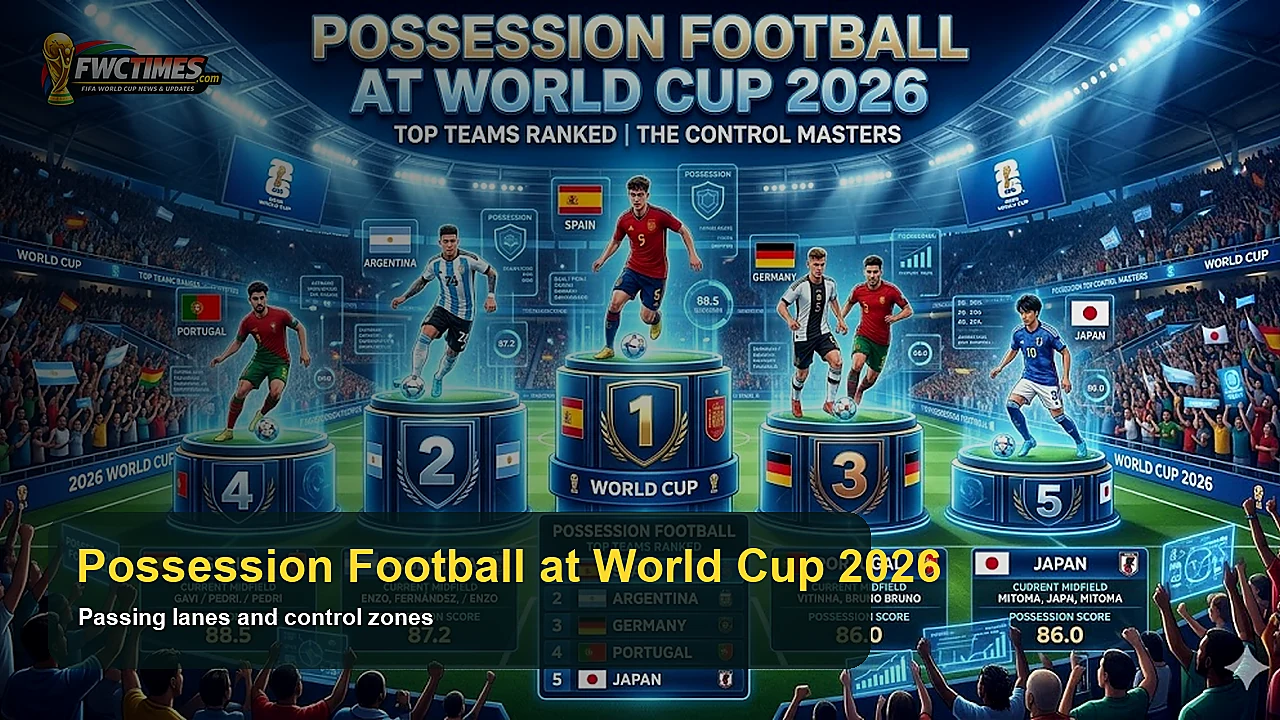
The battle for possession football World Cup 2026 teams show will determine which contenders control the tournament’s tempo. Teams like Spain, Germany, and Argentina use high-volume passing and positional play to dictate match conditions. In fact, keeping the ball has become a defensive necessity rather than just an attacking strategy. This tactical breakdown explores how the top possession sides build their play to survive the expanded schedule.
The physical constraints of a three-nation tournament highlight the value of controlled possession. Traveling across different time zones and playing in summer humidity drains player energy quickly. By keeping the ball, possession teams force their opponents to run, conserving their own physical output. As a result, squads can manage their energy levels across the potential eight-match schedule.
Modern possession play has moved away from the slow, horizontal passing of the past. Today’s elite teams emphasize vertical speed and high-intensity transitions once they break the opponent’s lines. The goal is to isolate creative wide players in 1v1 situations rather than keeping possession for its own sake. This directness makes the style far more dangerous and unpredictable than in previous World Cup cycles.
Core Principles of Modern Possession Play
The Build-Up Phase and Midfield Pivots
The build-up phase starts from the goalkeeper and central defenders, who look to draw the opponent’s press. By passing short inside their own third, they create space in behind the opponent’s midfield line. This phase relies on a disciplined midfield pivot to receive the ball under pressure and turn forward. The pivot acts as the metronome, deciding when to play quickly and when to recycle.
If the opponent presses high, the pivot can drop between the centre-backs to create a temporary back three. This adjustment provides a numerical advantage that helps play through the first line of pressure. On top of that, it allows the fullbacks to push high and stretch the opponent’s defensive block. The 4-3-3 formation World Cup guide shows how teams use these build-up structures to control matches.
Half-Space Exploitation and Rotations
The half-spaces, located between the center of the pitch and the flanks, are the primary target for possession teams. Coaches position their most creative central midfielders in these zones to link up with the wide forwards. By receiving the ball in these pockets, playmakers can turn and attack the opponent’s back line directly. This positioning forces the opponent’s defenders to step out, opening gaps in behind.
To keep these spaces open, teams use constant positional rotations. A wide midfielder might tuck inside, while the fullback overlaps to occupy the winger’s space. This movement prevents the opponent from using rigid man-marking schemes to shut down the play. The 4-2-3-1 formation World Cup guide explains how teams coordinate these midfield rotations.
Spain’s Vertical Possession Style
Spain has evolved from the slow Tiki-Taka of the 2010 era into a vertical pressing system under Luis de la Fuente. De la Fuente keeps the core possession DNA but demands immediate forward play once spaces open. Spain’s qualifying campaign, which featured five wins in six matches, showed the power of this vertical approach. Rodri remains the metronome, anchoring the midfield and directing the flow of play.
Spain’s system relies on Lamine Yamal and Nico Williams to provide explosive threat on the flanks. The midfielders, including Pedri and Gavi, look to release these wingers in 1v1 situations quickly. By combining possession control with vertical pace, Spain has become far less predictable than in past cycles. The high press World Cup guide breaks down how Spain uses this possession structure to set up their press.
Germany’s Box Midfield Dominance
Germany uses a highly structured possession system under head coach Julian Nagelsmann. Nagelsmann utilizes a box midfield build-up to control the central zones of the pitch. This shape is created by the double pivot and two advanced midfielders working in close proximity. This structure allows Germany to overload central areas and pass through the opponent’s midfield block.
This box system maximizes the creative output of Jamal Musiala and Florian Wirtz. Musiala and Wirtz operate in the half-spaces, changing positions constantly to confuse defenders. Germany’s qualifying campaign, highlighted by a 6-0 win over Slovakia, proved the effectiveness of this central dominance. This possession structure allows Germany to control matches while protecting their back line against transitions.
Argentina’s Liquid Possession Shape
Argentina utilizes a fluid attacking system under Lionel Scaloni to control possession. Scaloni builds the system around Messi as a free-roaming quarterback, playmaking from deep pockets. In possession, the shape shifts into a 3-2-5, with Nahuel Molina providing width on the right flank. This fluid shape allows Argentina to create overloads while keeping midfield balance.
The midfield trio of Enzo Fernandez, Rodrigo De Paul, and Alexis Mac Allister carries the physical load of the system. Fernandez distributes from deep, De Paul covers wide space, and Mac Allister connects the phases of play. This midfield engine provides the ball security that allows Messi to operate in his protected zone. The Argentina playing style World Cup guide details Scaloni’s liquid tactical approach.
Expert Verdict
Possession football remains the most sustainable path to winning the 2026 World Cup. The physical demands of the expanded tournament will punish teams that rely purely on counter-attacking energy. Spain and Argentina enter the tournament with the most mature possession systems in the field. Both squads can control the ball to rest during matches, preserving their energy for the final rounds.
The key to success with this style is avoiding possession without penetration. Teams that pass horizontally without attacking the half-spaces will get frustrated by compact low blocks. The champion will be the team that combines possession security with explosive vertical speed. This tactical balance is what will break down the tournament’s most disciplined defenses.