How Germany Play at the 2026 World Cup

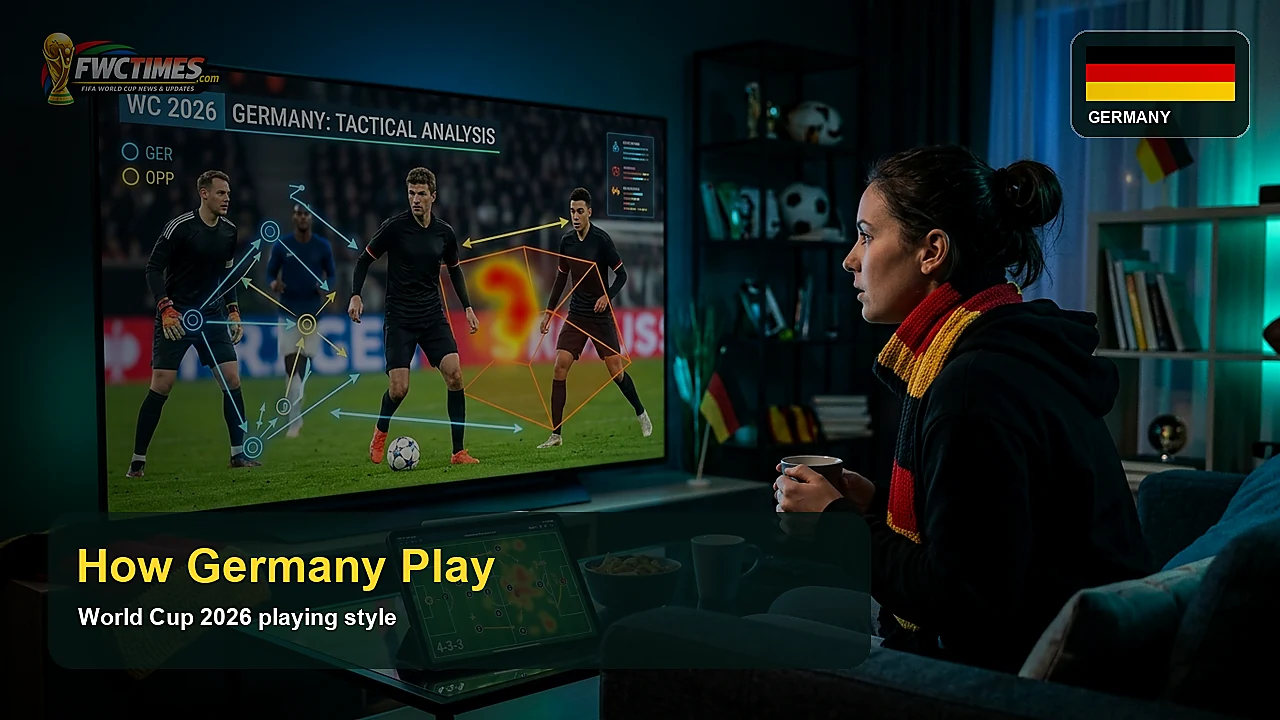
The Germany playing style World Cup 2026 approach runs on a fluid 4-2-3-1 system installed by head coach Julian Nagelsmann. Nagelsmann has built the shape around extreme proximity, central overloads, and aggressive counter-pressing transitions. In fact, Germany won UEFA Group A with 15 points, sealing their ticket with a 6-0 victory over Slovakia. This tactical setup focuses on quick vertical passing in the central channels to unlock opponent blocks.
This tournament is a significant test for Nagelsmann’s youthful tactical project. The coaching staff has moved away from the possession-heavy models of the past, prioritizing direct transition play. The integration of young attacking playmakers gives Germany a highly dynamic final third. As a result, the squad can change their attacking geometry fluidly during matches.
The physical load of the 48-team format influences Germany’s pressing strategy. Nagelsmann demands intense counter-pressing, aiming to win the ball back within four seconds of a turnover. The travel demands between host cities require smart squad management to sustain this physical intensity. This recovery focus is what decides Germany’s ability to advance deep.
Nagelsmann’s Fluid 4-2-3-1 System
Julian Nagelsmann has installed the 4-2-3-1 formation as Germany’s primary tactical platform. The system uses a double pivot to shield the defense and initiate the build-up play. In possession, the shape shifts into a 3-2-5 structure as the fullbacks push high to provide width. This rotation allows the midfielders to tuck inside and flood the central channels.
Germany uses a box build-up structure in midfield to control possession and overload the opponent. This box is created by the double pivot and the advanced playmakers working in close proximity. This close distance allows for rapid vertical passes that bypass the opponent’s midfield. The 4-2-3-1 formation World Cup guide shows how other contenders organize their midfields against this shape.
The Attacking Trio and Position Rotations
The system relies on a fluid attacking trio of Jamal Musiala, Florian Wirtz, and Lennart Karl. Musiala operates in the central and right half-spaces, using his close control to beat defenders in tight areas. Wirtz cuts inside from the left flank, acting as the primary playmaker in the final third. Karl provides direct speed on the right wing, stretching the opponent’s defensive line.
Nagelsmann encourages constant position changes among these three creative players. This fluid movement makes it extremely difficult for opponents to use man-marking schemes. When Wirtz cuts inside, Musiala drops deep or Karl runs centrally to fill the open space. The possession football World Cup guide explains how central rotations help break down low blocks.
Counter-Pressing and Transitional Speed
Germany’s defensive phase runs on an intense Gegenpressing system that targets immediate ball recovery. The front four coordinates pressure the moment the ball is lost, aiming for a four-second transition. This aggressive press prevents the opponent from launching counterattacks before the defense is set. The high press World Cup guide explores the mechanics of this coordinated pressure.
If the initial press is beaten, Germany drops into a compact mid-block. The shape becomes a narrow 4-4-2, with the wide midfielders lining up with the double pivot. They protect the central areas, forcing the opponent wide where the sidelines can isolate the ball-carrier. This defensive organization helps protect the back four against quick transitions.
UEFA Qualifying Standings and Statistics
Germany qualified directly by winning UEFA Group A with 15 points. The squad recorded five wins and one loss across their six qualifying matches. They scored 17 goals while conceding four, showing their balanced attacking style. Germany enters Group E alongside Ecuador, Cote d’Ivoire, and Curacao.
| Statistic | Value | | :— | :— | | Group Position | 1st (Group A) | | Matches Played | 6 | | Wins | 5 | | Draws | 0 | | Losses | 1 | | Goals Scored | 17 | | Goals Conceded | 4 |
The qualification campaign was highlighted by a dominant 6-0 win over Slovakia in November 2025. This result responded to an early 2-0 defeat against the same opponent. The bounce-back showed the team’s tactical resilience under Nagelsmann.
Key Vulnerabilities of the German System
The biggest tactical risk is Germany’s defensive fragility during chaotic transitions. If the opponent bypasses the initial four-second press, the back four is left exposed. The high defensive line leaves massive space in behind for fast attackers to exploit. This vulnerability requires perfect timing from the centre-backs to intercept long passes.
The system also places a massive physical demand on the double pivot. The midfielders must run constantly to support the press and cover the defensive channels. In the summer heat, this physical load can cause defensive gaps to open late in matches. Germany must use their squad depth to rotate the central midfielders.
Expert Verdict
Germany enters the 2026 World Cup with a highly creative system that is dangerous against any opponent. Nagelsmann has successfully built a dynamic attacking unit that thrives in tight spaces. The fluid 4-2-3-1 shape and the Musiala-Wirtz combination give Germany a championship floor. The key to their campaign will be improving defensive stability during opponent transitions.
If they can balance their counter-press with a secure rest defense, Germany will reach the final rounds. Their group match against Ecuador will be a significant test of their transition defense. Nagelsmann’s tactical adjustments must focus on protecting the space behind his high defensive line. Germany is built to outplay opponents, but they must defend to win.