World Cup 2026 VAR Officiating: Technology Guide


The World Cup 2026 VAR officiating system runs on expanded review powers and connected ball sensors to ensure accuracy. The International Football Association Board (IFAB) has updated the review protocols to speed up match flow and reduce controversial calls. In fact, the 2026 tournament is the most technologically advanced event in football history, using AI to track players. This guide explains how this officiating technology works.
The physical load of the expanded 104-match schedule requires rapid decision-making from the officiating team. Long review delays increase player fatigue and disrupt match rhythm, especially in the high temperatures of North American host venues. As a result, FIFA upgraded offside and tracking systems to deliver instant 3D rendering data to the referees. This speed of review is essential for maintaining the tempo of matches.
The history of the tournament shows that officiating decisions can shape the destiny of national teams. The introduction of VAR in 2018 established a new standard, which has been expanded for the 2026 matches. The coaching staff of the top-seeded nations has analyzed these technology updates to adapt their tactical structures. The match officials enter the group stage having completed extensive training in the virtual review rooms.
Upgraded Semi-Automated Offside Technology (SAOT)
FIFA has upgraded its Semi-Automated Offside Technology to track more individual data points per player. The system uses specialized tracking cameras mounted under the stadium roof to capture player skeletal structures in real time. This tracking data allows the AI to construct an instant 3D model of the exact offside line. The high press World Cup guide explores how high-line defensive structures interact with these precise offside calls.
The official match ball, the Trionda, contains internal motion sensors that track ball speed, trajectory, and contact moments. This connected ball sensor transmits data to the review room five hundred times per second, establishing the exact kick point. The combination of player tracking and ball data allows the system to determine offsides within seconds. The 4-3-3 formation World Cup guide compares defensive line shapes to show how offside traps are executed.
Expanded VAR Powers under IFAB Protocols
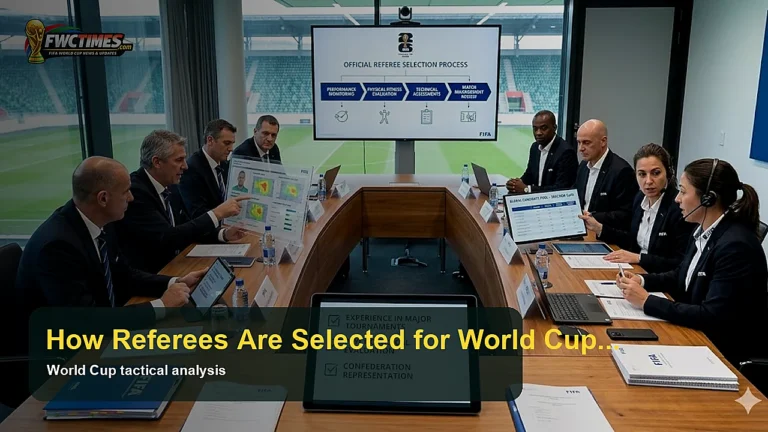
The IFAB has expanded the scenarios where Video Match Officials can intervene during matches. The updated protocol allows reviews for set-piece infringements committed immediately before a goal is scored or a penalty is awarded. VAR officials can also review incorrect second yellow cards, correcting clear errors that affect match outcomes. The World Cup 2026 referees selection guide details the officials trained to manage these expanded reviews.
Mistaken identity cases and incorrect corner kick decisions can also be reviewed, provided the check is completed instantly. This expansion prevents major officiating errors without adding lengthy delays to the play. The 2026 Tactical Trends guide explains how these real-time reviews affect team strategies. The on-field referee makes the final decision after viewing the pitchside monitor when a review is triggered.
Official Match Officiating Technology Stats
The technology suite utilized by the officiating team combines ball sensors, cameras, and AI tracking. These systems coordinate to deliver instant data to the match officials. This unified approach eliminates visual blind spots.
| Technology Component | Main Function | Tracking Frequency | Review Outcome | | :— | :— | :—: | :— | | **Trionda Match Ball** | Connected contact tracking | 500 Hz | Precise kick-point detection | | **SAOT Cameras** | Skeletal player tracking | Real-Time | Instant 3D offside rendering | | **Referee View** | First-person camera feeds | Real-Time | On-field review assistance | | **VAR Room** | Multi-Angle video review | Real-Time | Decision correction support |
This data shows that FIFA has built a highly integrated officiating environment to manage the expanded tournament. The match officials enter the group stage with standard guidelines on when to initiate reviews. This technical coordination is essential for ensuring fair matches.
Key Challenges of the Technological System
The biggest challenge facing the technology setup is the communication speed between the VAR room and the on-field referee. If the transmission of data is delayed, the referee can restart play before the review is completed. Referees are instructed to delay restarts when a check is active, which can frustrate players and spectators. This challenge requires perfect synchronization between the broadcast team and the match officials.
The system also faces adaptation challenges due to the diverse styles of play represented at the tournament. Referees must use the Referee View cameras to evaluate subjective situations like tackle intensity and handballs. The USA coaching change guide shows how teams adapt their physical contact levels to match refereeing standards. The technology provides the data, but the final interpretation remains human.
Expert Verdict
The World Cup 2026 VAR officiating technology will improve match flow and reduce major errors. The integration of the Trionda connected ball and upgraded SAOT will deliver offside decisions with unprecedented speed. The expansion of review scenarios to set-pieces and second yellow cards corrects critical on-field errors. The key to the system’s success will be the referees’ willingness to trust the data.
If the officials manage reviews efficiently, they will prevent matches from becoming disjointed. The opening fixtures will show how the five-second countdown rules and ten-second substitution exit rules are monitored. How to Watch World Cup 2026 Tactically guide shows how fans can track these technical decisions during broadcasts. FIFA has established a new standard for sports technology, but human consistency remains the ultimate decider.