Japan playing style World Cup 2026: Team Tactics

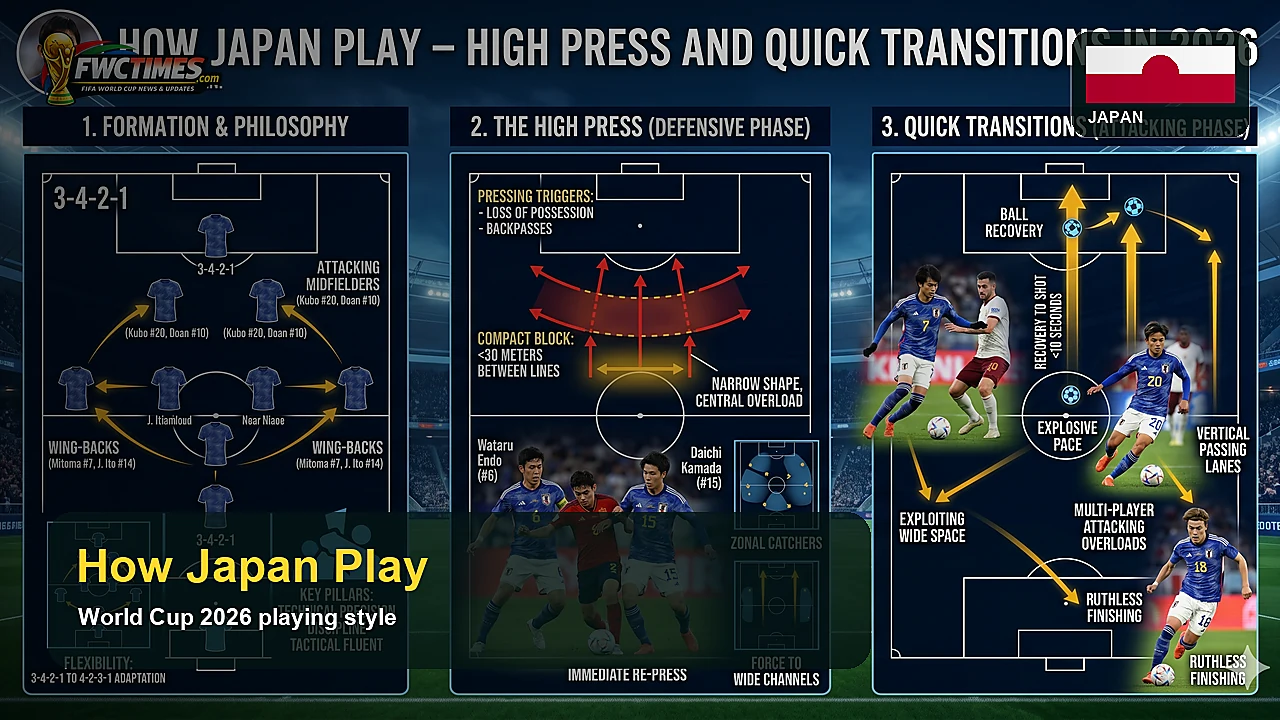
The Japan playing style World Cup 2026 approach runs on a highly adaptable 3-4-3 system under head coach Hajime Moriyasu. Moriyasu has established a chameleon philosophy that shifts from possession-based play to a low-block counter-attack. In fact, Japan secured their eighth consecutive tournament appearance with a dominant qualifying campaign. This tactical flexibility allows the Samurai Blue to compete with elite football nations.
The physical load of the expanded 48-team schedule makes rotation a central part of Japan’s tournament plan. Moriyasu relies on a deep roster to sustain their high-intensity transition game across matches. As a result, the team can press aggressively without suffering from physical decline. This squad depth is what makes Japan a dangerous opponent in the knockout rounds.
The history of the tournament shows that Japan can upset major powers with organized defensive blocks. During the 2022 campaign, they defeated both Germany and Spain using quick transition counter-punches. The coaching staff has refined this transition logic to build a more stable team shape. Samurai Blue enters the tournament hoping to reach the quarter-finals for the first time.
The Chameleon 3-4-3 System
Hajime Moriyasu has modernized the team’s traditional setup to prioritize tactical flexibility. The system shifts between a 3-4-3 in possession and a compact 5-4-1 out of possession. This defensive shift closes wide channels and forces opponents to play through a crowded center. The 3-5-2 formation World Cup guide shows how similar back-three shapes control central spaces.
In possession, the wide centre-backs step into the half-spaces to support the midfield build-up. This movement creates passing triangles with the wing-backs and central midfielders, facilitating quick ball circulation. The double pivot provides security behind the attack, preventing opponents from executing direct counterattacks. The possession football World Cup guide explains how these build-up patterns control matches.
Kubo as the Creative Spark
Takefusa Kubo serves as the primary playmaker in Japan’s attacking transitions. Operating as an inverted winger or central playmaker, he exploits pockets of space between the lines. Kubo uses his dribbling ability to challenge defenders in 1v1 situations and create shooting angles. His decision-making allows Japan to unlock compact defensive blocks.
Kubo’s link-up play with Ritsu Doan and Kaoru Mitoma is critical for stretching opponent defenses. These wide forwards make diagonal runs into the box while the wing-backs maintain width on the touchlines. This movement stretches the opponent’s defensive line, opening space for central midfielders to arrive late. The 4-3-3 formation World Cup guide compares these wide rotations to traditional wing play.
Coordinated Pressing and Organized Chaos
The defensive phase runs on a coordinated mid-block that triggers aggressive pressing waves. The front three isolates the opponent’s centre-backs, forcing them to make hurried passes. The midfielders then step up to intercept these passes and launch immediate transitions. The high press World Cup guide explores the mechanics of this coordinated pressure.
If the opponent plays through the press, Japan drops into a narrow 5-4-1 block. Wataru Endo anchors this defensive structure, screening the back line and winning aerial duels. They compress the space in the defensive third, isolating the ball-carrier and forcing turnovers. This defensive discipline is why Japan maintained an excellent record in qualifying.
Asian Qualifying Standings and Statistics
Japan qualified directly by topping their AFC Group with impressive numbers. The squad recorded six wins in the second round, scoring 24 goals without conceding once. They continued their dominant run in the third round, finishing above Australia and Saudi Arabia. Japan enters Group F alongside Netherlands, Sweden, and Tunisia.
| Statistic | Value | | :— | :— | | Group Position | 1st (Third Round) | | Second Round Goals | 24 | | Second Round Conceded | 0 | | Top Scorer | Ayase Ueda (8 Goals) | | Top Playmaker | Junya Ito (10 Assists) |
This record shows that Japan’s vertical approach has improved their scoring efficiency. The squad enters the tournament with a clear understanding of their tactical roles. This statistical dominance makes them one of the most dangerous non-European teams.
Key Vulnerabilities of the Japanese System
The biggest tactical risk is their vulnerability to aerial cross overloads. Because the wide centre-backs often step out to press, the penalty area can be left exposed. Physical opponents look to exploit this space with direct crosses to tall strikers. This weakness requires perfect communication between the goalkeeper and central defenders.
The system also depends heavily on Wataru Endo’s physical conditioning. If Endo is unavailable or fatigued, Japan loses the defensive anchor that screens the back line. The backup midfielders struggle to match his reading of the game and physical presence in duels. This dependency makes Endo a critical component of the defensive structure.
Expert Verdict
Japan enters the 2026 World Cup with a mature system that combines defensive discipline with rapid transitions. Moriyasu has created a team that can adapt to any opponent’s playing style. The tactical flexibility of the 3-4-3 shape and Kubo’s individual quality give Japan a high ceiling. The key to their tournament will be managing physical fatigue at high altitudes.
If they can maintain their pressing intensity, Japan will challenge Netherlands in Group F. The match against the Dutch will be a significant test of their transition defense. Moriyasu’s structured rotations should keep the squad fresh for the knockout rounds. Japan has the tools to surprise the tournament, but they must defend their box against crosses.