South Korea playing style World Cup 2026: Tactical Guide

The South Korea playing style World Cup 2026 approach runs on a transition-based system structured by head coach Hong Myung-bo. Hong has shifted his team toward a defensive-minded shape to secure results against high-level opponents. In fact, South Korea finished their qualifying matches with an unbeaten record, scoring 40 goals while conceding only eight. This tactical evolution combines compact mid-block defending with explosive speed in transition.
The physical load of the expanded 48-team schedule dictates South Korea’s tactical choices. Group A matches are played at high-altitude venues in Mexico, which significantly affects recovery times between high-intensity pressing cycles. As a result, Hong has adopted a safety-first defensive model to preserve player stamina across the matches. This physical management is essential for navigating a demanding group stage campaign.
The history of the tournament shows that South Korea relies heavily on the individual form of their elite stars. The current setup focuses on releasing wide attackers quickly into open space when possession is recovered. The coaching staff has selected versatile defenders to ensure defensive stability behind these transitions. The squad enters the group stage aiming to secure a place in the knockout rounds.
Shifting to the 3-4-2-1 Formation
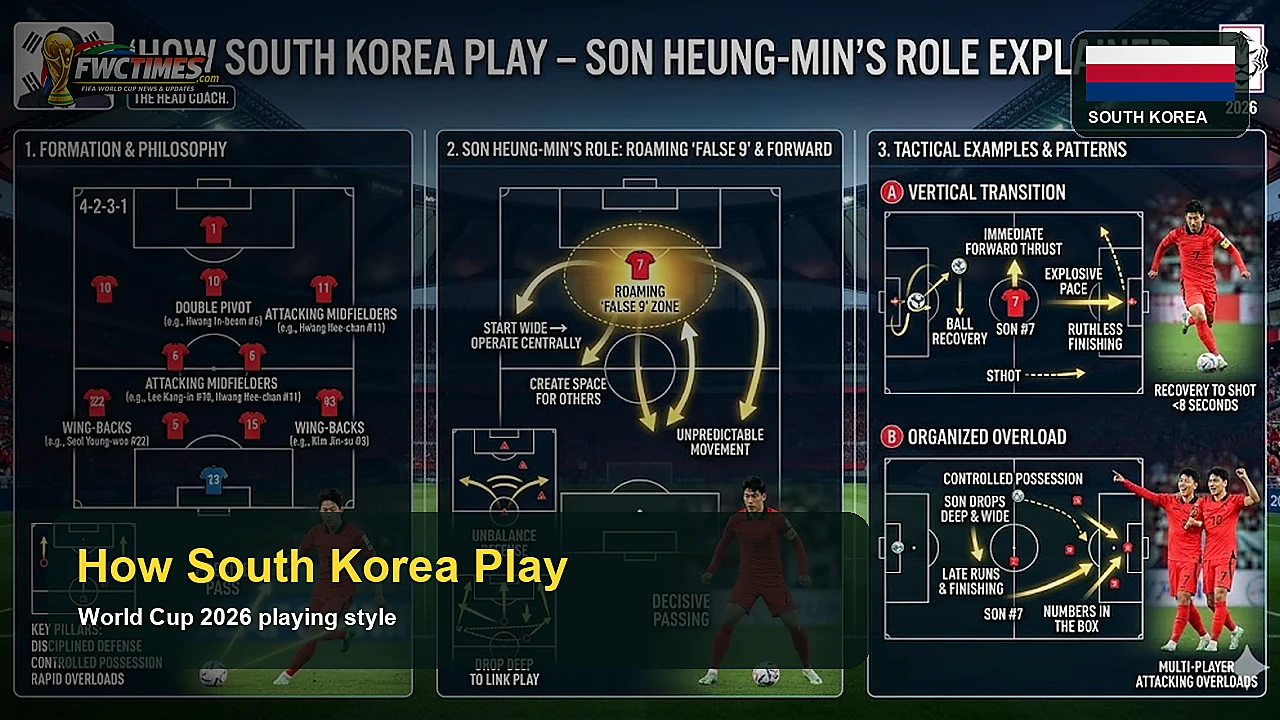
Hong Myung-bo has modernized South Korea’s tactical structure by introducing a three-at-the-back system. The team has shifted away from the traditional 4-2-3-1 shape to prioritize defensive solidity in the box. This new 3-4-2-1 formation features three central defenders and active wing-backs who cover the flanks. The 4-2-3-1 formation World Cup guide compares these shapes to show how back-three lines offer more protection.
In possession, the shape allows the midfield to control central spaces and recycle possession safely. The double pivot screens the central defenders, stopping opponent transitions before they reach the defensive third. The wing-backs push high to provide width, delivering crosses and stretching the opposition’s defensive lines. The 3-5-2 formation World Cup guide shows how wing-back movement supports attacking phases.
Son Heung-min as the Attacking Focal Point
Captain Son Heung-min remains the primary attacking threat and leader in South Korea’s tactical system. Operating as a central striker or narrow wide forward, Son exploits spaces behind the opponent’s defensive line. His speed and clinical finishing make him a constant threat during vertical transitions. Son scored ten goals during qualifying to lead the team’s attacking output.
Lee Kang-in supports Son by acting as the primary creative playmaker in the half-spaces. Lee uses his vision and passing range to feed line-breaking passes into Son’s path. This combination of creative playmaking and direct running is South Korea’s main weapon. The possession football World Cup guide explains how playmakers operate in tight spaces to unlock defenses.
Safety-First Compact Zonal Block
The defensive phase runs on a compact mid-block designed to force opponents into wide channels. The team drops narrow, closing down central spaces and isolating the ball-carrier. Wataru Endo and similar defensive pivots in Asian football demonstrate how midfield screens disrupt creative players. South Korea’s system relies on synchronized movement to maintain this compact shape.
If the opponent beats the mid-block, South Korea drops into a low block of five defenders. Kim Min-jae leads this defensive unit, using his physical presence and anticipation to clear crosses. They focus on maintaining numerical superiority inside the penalty box, preventing clean shots. This defensive discipline is why South Korea conceded so few goals during their qualifying campaign.
Qualifying Record and Statistics
South Korea secured direct qualification by topping their AFC third-round group with impressive numbers. The squad recorded an unbeaten run, demonstrating high efficiency at both ends of the pitch. South Korea enters Group A alongside co-hosts Mexico, South Africa, and Czech Republic.
| Statistic | Value | | :— | :— | | Group Position | 1st (Third Round) | | Matches Played | 16 | | Goals Scored | 40 | | Goals Conceded | 8 | | Top Scorer | Son Heung-min (10 Goals) |
This record shows that South Korea’s transition model has delivered consistent results. The squad enters the tournament with a clear understanding of their defensive duties. This defensive stability makes them a tough opponent in Group A.
Key Vulnerabilities of the Korean System
The biggest tactical risk is their over-reliance on individual star players. If Son Heung-min or Kim Min-jae suffers from fatigue or injury, the system’s effectiveness declines. Opponents look to isolate these key players, forcing South Korea to find alternative solutions. This dependency requires other squad members to step up during challenging moments.
The system also faces a wing-back depth issue on both flanks. Because Hong’s three-back system requires high-level wing-backs, any drop in stamina exposes the space behind them. Fast counter-attacking teams look to exploit these wide areas during transitions. The Mexico playing style World Cup guide shows how their group opponents target wide spaces.
Expert Verdict
South Korea enters the 2026 World Cup with a rigid system that prioritizes defensive stability. Hong Myung-bo has created a compact unit that is difficult to break down. The transition to the 3-4-2-1 shape and Son’s vertical threat give South Korea a clear identity. The key to their tournament will be adapting to high-altitude venues in Mexico.
If they can maintain defensive discipline, South Korea will challenge Mexico in Group A. The match against the co-hosts will be a significant test of their wing-back resilience. Hong’s defensive focus should keep them competitive in low-scoring matches. South Korea has the tools to progress, but they must avoid defensive errors in wide areas.