
What Is an Inside Forward in Football?

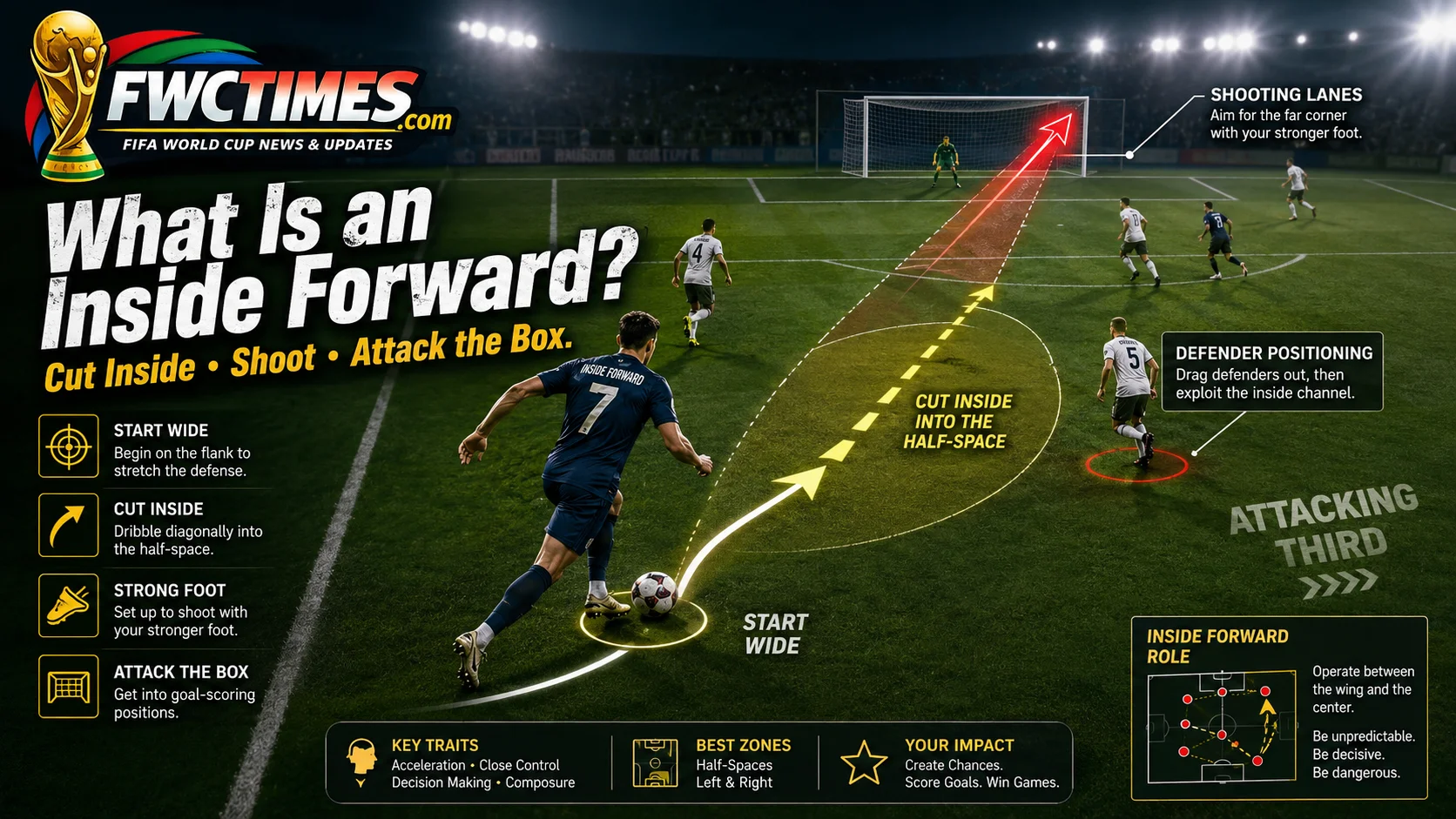
An inside forward in football is a wide attacker who moves inside toward goal. The inside forward football role starts from the flank but attacks central scoring zones.
The role differs from a touchline winger because the main threat comes inside. Inside forwards shoot, combine, press, and attack spaces between full-back and centre-back.
Quick Answer
An inside forward starts wide but makes runs into the half-space and penalty area. He often plays on the opposite side to his stronger foot.
The role works best with an overlapping full-back and a central forward who creates space. Without those movements, the attack can become narrow.
Inside Forward Football Role Explained
The inside forward begins from a wide attacking position. Then he moves inside to receive, shoot, or make a run behind defenders.
A right-footed inside forward often plays from the left. A left-footed inside forward often plays from the right.
That setup creates better shooting angles. The player can cut inside onto his stronger foot and aim across the goalkeeper.
FIFA Training Centre front-three material explains how wide players can run into spaces left by a dropping number 9. That movement suits inside forwards.
The inside forward also changes how defenders mark. A full-back must decide whether to follow inside or protect the wide lane.
If the full-back follows, the overlapping runner can attack the outside. If he stays wide, the inside forward can receive between lines.
That decision creates hesitation in the defensive block. Even a short delay can open a clean shooting lane.
How Inside Forwards Create Chances
Inside forwards create chances by attacking the channel between full-back and centre-back. That channel is hard to defend because it belongs to two defenders.
The run can happen with or without the ball. With the ball, the player dribbles inside and opens a shooting or passing angle.
Without the ball, he makes a diagonal run behind the defensive line. A midfielder or false 9 can then play the pass into space.
FIFA wing-play material also highlights inside movement by wide midfielders. That movement can drag defenders away and free the full-back outside.
These patterns depend on tactical formations. A 4-3-3 gives inside forwards more attacking height than a flat 4-4-2.
Timing matters because the role needs separation. If the inside forward moves too early, the defender can pass him on.
Inside Forward vs Winger
A winger usually keeps width and attacks the outside lane. He creates crosses, isolates full-backs, and stretches the defensive line.
An inside forward starts wide but moves toward goal more often. He looks for shots, cutbacks, combinations, and far-post arrivals.
UEFA analysis of modern wing play notes the value of inverted wide players. Their inward movement can create shooting angles and open lanes for full-backs.
The difference affects team balance. A team using inside forwards must get width from full-backs, wing-backs, or wide midfield rotations.
The role also connects with the false 9 in football. When the striker drops, inside forwards can attack the empty central space.
A classic winger can still score, and an inside forward can still cross. The labels describe main tendencies rather than fixed limits.
Inside Forward Types and Tactical Duties
| Role Type | Main Zone | Key Action | Best Support |
|---|---|---|---|
| Inside forward | Half-space | Cuts inside to score | Overlapping full-back |
| Traditional winger | Touchline | Crosses from wide | Box striker |
| Inverted winger | Wide to inside | Creates or shoots | Underlapping midfielder |
| Wide forward | Front line | Runs beyond defence | Creative number 10 |
| Second striker | Central channel | Links and finishes | Main striker |
The inside forward needs goal threat, not just dribbling. Coaches want him to arrive in the box when attacks reach the far side.
He also presses from outside to inside. That angle can force play toward midfield pressure instead of letting defenders pass forward.
Defensive discipline still matters. If the inside forward stays too narrow, the full-back may face wide overloads alone.
Good inside forwards read the full-back behind them. If the full-back overlaps, they move inside. If he stays, they may hold width.
The role can create service for a poacher in football. Low shots, cutbacks, and rebounds often land near central finishers.
Connection to FIFA World Cup 2026
At FIFA World Cup 2026, inside forwards can punish teams that defend narrow. Their diagonal runs can turn wide possession into central danger.
Mohamed Salah gives Egypt a proven right-sided attacker in this mould. FIFA named him in Egypt’s 27-player preliminary squad on May 20, 2026.
The FWCTimes report on Egypt’s World Cup 2026 squad also names Omar Marmoush. Their movement can stretch back lines from wide and central zones.
Inside forwards may also shape the World Cup 2026 top scorers race. Wide attackers who arrive centrally can score like strikers.
Frequently Asked Questions
What is inside forward football?
Inside forward football describes a wide attacker who moves into central scoring zones. The player starts from the flank but attacks the half-space and penalty area.
What does an inside forward do tactically?
An inside forward cuts inside, shoots, combines, and makes diagonal runs behind defenders. He also presses from wide areas and supports central attacks.
Who are famous inside forwards?
Mohamed Salah is a leading modern example because he starts wide and attacks central scoring zones. Many modern wide forwards share similar inside-forward traits.
How is an inside forward different from a winger?
A winger usually keeps width and crosses more often. An inside forward moves inside more often to shoot, combine, or attack the box.
Will inside forwards matter at World Cup 2026?
Yes, inside forwards should matter at World Cup 2026 because compact defences leave space in wide-to-central channels. Players like Salah can turn those spaces into shots.
Conclusion
The inside forward role gives a team a wide player with striker-like movement. It works best when the team balances width, support, and central runs.
World Cup 2026 should reward inside forwards who combine timing with sharp finishing. Stay tuned to FWCTimes.com for the latest FIFA World Cup 2026 updates.
Read Also: What Is a Winger in Football?
