False 9 in Football: Tactical Guide and Real Examples

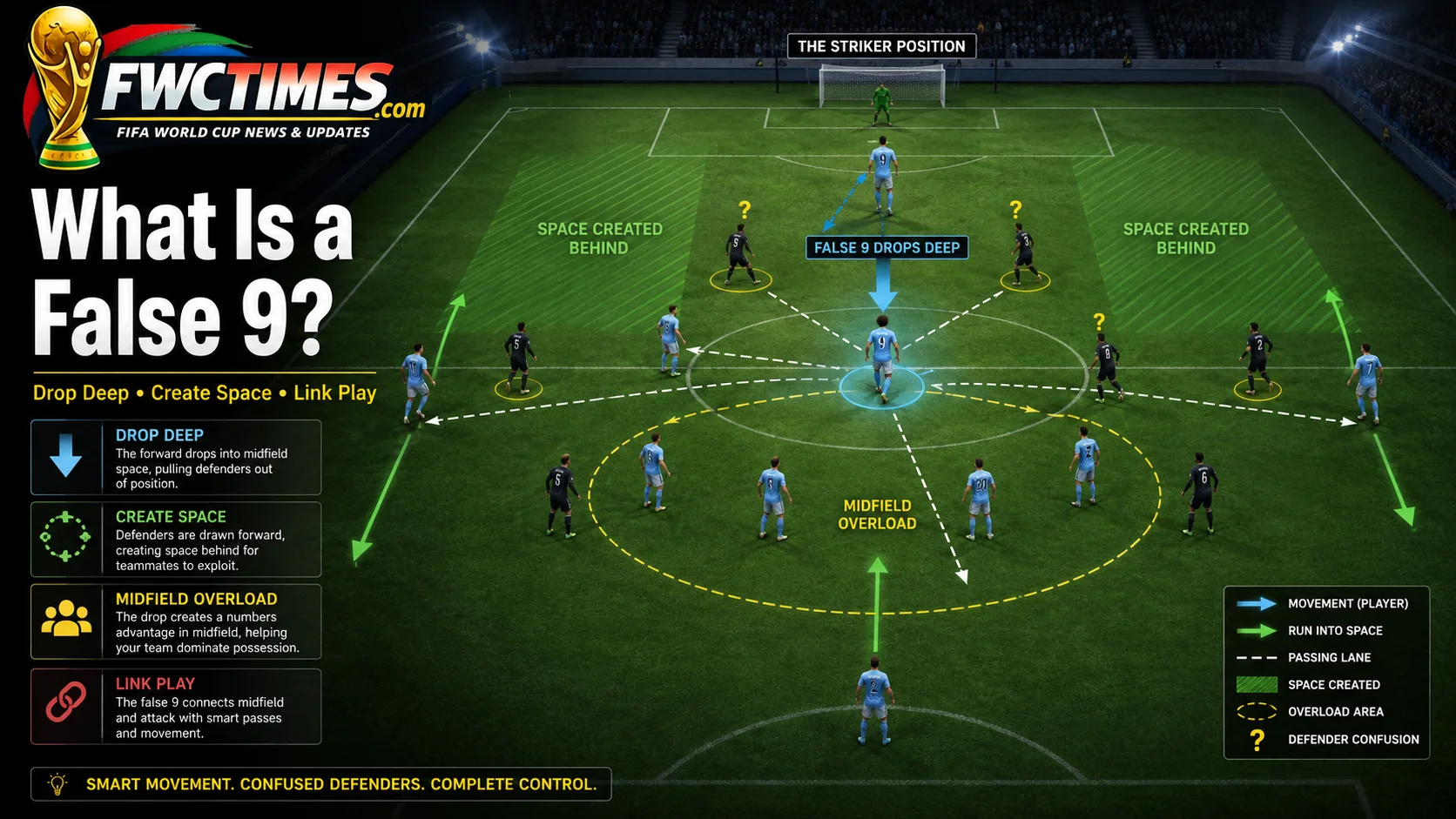
The false 9 in football is a tactical role where a player starts as. The central striker but drops into midfield to receive the ball and create play. By vacating the space occupied by a conventional number 9. The false 9 forces opposing centre-backs into an immediate dilemma that no training drill can fully prepare them for.
This movement creates a numerical overload in the central midfield zone. Giving the attacking team an extra passing option between the opposition’s defensive and midfield lines. The system works only when wide forwards or advanced midfielders. Attack the spaces left vacant by the false 9’s dropping movement.
Tactical Movement of the False 9 in Football
The false 9 begins each attacking sequence by positioning near. The opposition’s centre-backs to pin them in their defensive shape and as the build-up develops. The player drops sharply into the space between the opposition’s. Midfield and defensive lines to receive a pass facing forward.
Once the false 9 receives the ball in this deeper position. They must combine with teammates since defenders will press immediately to close the space down and short. One-touch combinations through the congested midfield area release the ball into the wide. Channels or over the top of the defensive line for runners arriving at pace.
Striking Roles in Football Compared
| Role Type | Starting Zone | Main Action | What Teammates Must Do |
|---|---|---|---|
| False 9 | Central striker zone | Drops between lines to create | Attack the spaces vacated centrally |
| Classic centre forward | Last defensive line | Attacks goal and holds position | Deliver crosses and through balls |
| Target forward | Against centre-backs | Holds up the ball under pressure | Support runners from midfield |
| Second striker | Just behind the main forward | Links play and finishes | Partnership with the front target |
The key distinction between the false 9 and a classic centre forward. Is how each player relates to the opposition’s defensive line throughout the match. A traditional number 9 stays high, attacks aerial balls, and uses physical presence against centre-backs as their primary tool. The false 9 creates purely through movement, intelligence.
A target forward provides a different threat by using physicality to. Shield the ball and bring midfield runners into play from deep and rather than dropping to collect. The second striker works in close combination with a partner forward and operates. In a more defined area of the pitch than the free-roaming false 9.
History of the False 9 in Football
Tactical Role of False 9 In Football
The concept of a withdrawn central forward has existed in football for over a century. Long before the modern tactical label emerged and similar roles appeared in the late 1890s at English club. In South American football during the 1920s at River Plate in Argentina. Matthias Sindelar performed a withdrawn centre-forward role for the Austrian Wunderteam during the 1930s.
Johan Cruyff applied similar principles as a manager at Barcelona during the 1980s and early 1990s. Using Michael Laudrup in central creative positions that drew from the same tactical concept. In 2006, Luciano Spalletti deployed Francesco Totti as a false 9 for AS Roma following an injury crisis. And Totti’s intelligent movement from that season influenced a generation of coaching thinking in Italy and across Europe.
Guardiola, Messi, and the 2009 El Clásico
Pep Guardiola’s deployment of Lionel Messi as a false 9 in the El Clásico on May 2. 2009, is widely regarded as the moment the tactic entered mainstream global football consciousness and the day before. Guardiola told Messi to move from his usual wide right position into a central role. With the specific goal of creating numerical superiority in midfield against Real Madrid’s defensive structure.
Messi’s unique combination of dribbling ability, passing intelligence. And Positional awareness made him the ideal player for the role at that specific moment in his career. Guardiola later refined the approach by deploying Cesc Fàbregas as a false 9 when Messi was unavailable. Proving the system could function with different player profiles when the tactical structure was well-organized.
False 9 at the FIFA World Cup 2026
The false 9 role could prove especially effective at the 2026 World Cup. Where compact defensive blocks will be a common tactical feature across many group-stage and knockout matches. Teams with technically gifted attackers who possess the intelligence to drop and create. In midfield will find the tactic useful against nations that defend with deep and organized defensive lines.
Argentina has historically used Lionel Messi’s movement in and around the false 9 position to devastating effect. And His presence in central creative areas shapes how opponents design their defensive systems against the South American nation. Spain also has the technical midfield quality to support a false 9 in their possession-based system. Since their build-up structure creates the deep passing options required to deploy the tactic effectively.
Frequently Asked Questions
What is a false 9 in football?
A false 9 is a central striker who drops into. Midfield rather than staying positioned near the opposition’s defensive line and the movement creates a tactical dilemma. Who must decide whether to follow the runner into midfield or hold. Their position and let the player receive the ball with time and space.
What does a false 9 do tactically?
A false 9 links the midfield and attack by receiving the. Ball in the space between the opposition’s defensive and midfield lines. The player creates passing combinations, draws defenders out of position. And Allows wide forwards and midfield runners to exploit the central space left vacant by their dropping movement.
Who made the false 9 famous in modern football?
Lionel Messi made the modern false 9 famous under Pep Guardiola at Barcelona. Most notably in the 6-2 El Clásico victory over Real Madrid at the Santiago Bernabéu on May 2, 2009. Guardiola moved Messi from the right wing into a central dropping. Role specifically to create midfield overloads against Real Madrid’s defensive shape.
How is a false 9 different from a centre forward?
A centre forward stays positioned near the opposition’s defensive line, using physical presence, aerial ability. And Direct running to create and score goals and a false 9 drops into midfield to receive. Create chances through passing and movement rather than direct confrontation with defenders. The false 9 role requires exceptional technical ability and tactical intelligence.
Could teams use a false 9 at World Cup 2026?
Yes and the false 9 role could be effective at the 2026 World Cup. Particularly against compact defensive blocks that many national teams will use in the group stage. Nations with technically gifted central attackers who understand how to create space through. Movement rather than direct running will find the system useful against well-organized opponents.