Central Midfielder Role Football Explained for Fans

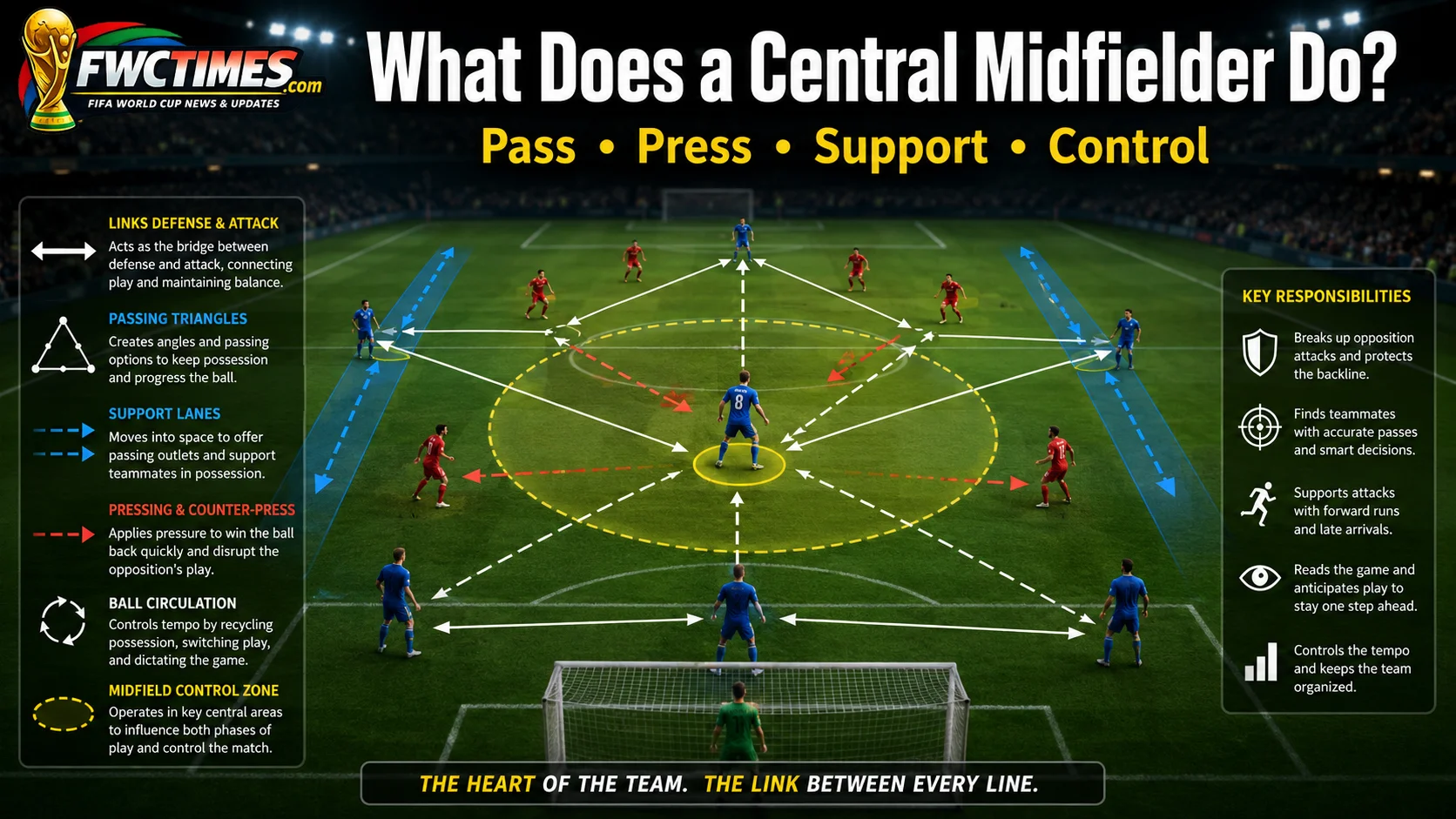
The central midfielder role football teams depend on is one of. The most technically and physically demanding positions in the modern game. Central midfielders serve as the bridge between the defensive unit and the attacking line, controlling tempo, progressing the ball. And Contributing to both phases across the full 90 minutes and often described as the team’s heartbeat.
Modern tactical trends have pushed the central midfielder role toward even greater versatility. Blurring the traditional lines between the defensive number 6, the box-to-box number 8 and and The creative number 10. Coaches in 2026 increasingly demand all-round central midfielders capable of adjusting their position, duties. And Balance between defensive and attacking work based on how a match unfolds in real time.
Central Midfielder Role Football Guide
The primary duty of a central midfielder is ball progression — receiving. From defenders or the goalkeeper under press and advancing the play into higher and more dangerous areas. This requires excellent spatial awareness before the ball arrives, with elite midfielders scanning left, right. And Behind multiple times per possession to identify which passing option will break the opposition’s first defensive line.
Tempo control is the second major duty and involves deciding. When to retain possession patiently and when to play a vertical. Penetrating pass that exploits a gap in the opposition’s defensive shape. Elite central midfielders read the defensive structure of the opponent in real time and adjust the.
Tactical Role of Central Midfielder Role Football
Defensively and central midfielders must provide the first layer of cover in front of the backline by closing. And Tracking runners who arrive late from deeper positions. Positional discipline in defensive shape is often more important than individual tackling ability. Since a midfielder who is in the correct position can prevent.
Covering the spaces left by attacking full-backs is another defensive responsibility that central midfielders carry. Particularly in modern formations where wide defenders push high and leave large areas behind them on the flanks. When a full-back joins an attack. The nearest central midfielder shifts slightly wider to cover the defensive corridor that the full-back has vacated.
Key Skills Every Central Midfielder Needs
Scanning the pitch before receiving the ball is the most. Fundamental cognitive habit that separates elite central midfielders from average ones. Players who check their surroundings two or three times before the ball reaches. Them already know where they will play their first touch before it arrives.
Passing proficiency across the full spectrum — from short sharp combinations. To long-range switches and defence-splitting through-balls — is another non-negotiable skill requirement. Elite central midfielders cover between 10 and 12 kilometres per match at professional level. With a significant proportion of that distance covered in high-intensity sprints during transition phases.
| Midfielder Type | Primary Priority | Tactical System | Key Attribute |
|---|---|---|---|
| Holding / CDM (No. 6) | Protect defence | 4-3-3, 4-2-3-1 | Positional discipline, interceptions |
| Box-to-Box CM (No. 8) | Link play, two-way running | 4-3-3, 4-4-2 | Stamina, goal threat, pressing |
| Creative / Attacking CM (No. 10) | Generate chances | 4-2-3-1, 3-4-3 | Vision, dribbling, final-third delivery |
| Hybrid / Modern CM | Multiple duties, positional fluidity | 3-2-2-3, relational setups | Tactical intelligence, versatility |
Central Midfielder Formations and Tactical Systems
In a 4-3-3 formation. The central midfield trio consists of one holding midfielder and two more dynamic central midfielders who take. Turns supporting both the defence and the attack depending on which side of the pitch the play develops. The structure gives the team strong central coverage while allowing the two advanced midfielders to.
The 3-2-2-3 and other hybrid positional structures are increasingly used. At club level by coaches influenced by Guardiola’s positional principles. And Their ideas are filtering through to international football in time for the 2026 tournament and in these setups. Central midfielders are less defined by their position number and more by.
Frequently Asked Questions
What is the central midfielder role in football?
The central midfielder role is the positional framework that covers the middle of the pitch from a tactical perspective. Requiring players to link the defensive and attacking units through ball progression, tempo control and and Two-way running. Central midfielders operate in the most congested area of the pitch. Making quick decisions under opponent pressure while scanning for teammates in space ahead of them.
What are the key skills for a central midfielder in football?
Pre-scan frequency — the habit of checking surrounding space before receiving the. Ball — is the most important cognitive skill for a central midfielder. As it allows them to make faster and more accurate passing decisions under pressure and passing proficiency across. From short sharp combinations to long switches and defence-splitting through-balls.
How does a central midfielder control the tempo of a match?
A central midfielder controls tempo by deciding in real time whether to maintain patient possession. Or play a sudden vertical pass that exploits a gap in the opposition’s defensive shape. When a team needs to slow the game down — to protect a lead and manage a tired squad. Or disrupt the opponent’s rhythm — the central midfielder slows their pass selection and prioritises safe circulating possession.
What formations suit the central midfielder role best?
The 4-3-3 formation is widely considered the most natural home for the central midfielder role. As the three-man midfield provides clear structural roles for a holding. Midfielder and two more dynamic central runners who support both phases. The 4-4-2 is another classic system that relies on two central midfielders.
Will central midfielders decide World Cup 2026?
Central midfield quality will be one of the most decisive. Positional factors across all phases of the World Cup 2026. Historically, teams with dominant midfields — controlling possession, winning second balls. And Creating more chances than they concede — advance further in tournaments.
Conclusion
The central midfielder role in football remains the most tactically rich and physically demanding position in the modern game. From pressing triggers and defensive lane coverage to tempo control and late box arrivals. The demands placed on central midfielders at the elite level are broader than any other outfield position. At World Cup 2026 and the nations with the deepest and most versatile central midfield squads.