Centre Forward Football Explained for Fans

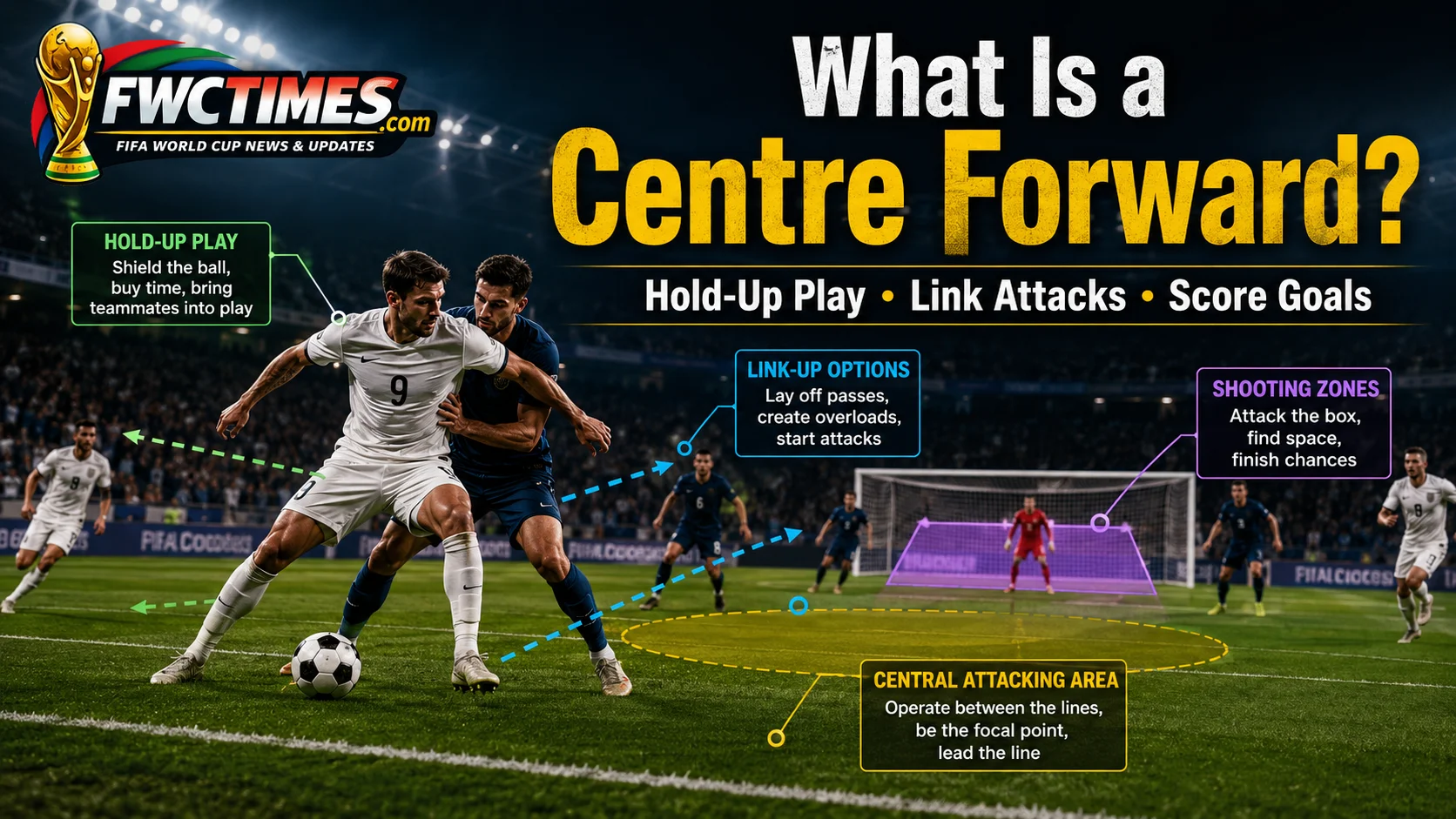
The centre forward football role is the most watched and most scrutinised position on the pitch. Combining the responsibility of finishing attacks with the physical and tactical demands of linking play, pressing defenders. And Creating space for teammates. A centre forward — often called the number 9 or striker — plays closest to.
The role has evolved enormously in the modern era. FIFA Training Centre analysis of Qatar 2022 showed that players in the number 9 role scored 58 goals. During the tournament — up from 52 at Russia 2018 — despite taking fewer total shots per match. On top of that.
Centre Forward Football Guide
A centre forward’s primary duty is to convert team attacks into goals by arriving in the right positions. Making clinical decisions under pressure and and Executing shots and headers with precision in the most congested moments. Beyond scoring. The centre forward gives teammates a central reference point around which the team builds its entire attacking flow.
Pressing has become an increasingly important additional duty for modern centre forwards and when a team loses possession. The centre forward becomes the first defender. Responsible for blocking the opposition goalkeeper’s short passing options and forcing play toward the sidelines where the pressing. Teams at the 2026 World Cup are likely to use.
Tactical Role of Centre Forward Football
The centre forward’s movement before receiving the ball is often. More important than what they do with it once it arrives and checking short against tight marking. Spinning in behind a high defensive line, drifting laterally across centre-backs to create blind-spot runs. And Attacking the near or far post during crosses all.
Hold-up play is the second major movement skill and involves a centre forward receiving the ball with their. Shielding it from a defender using their body. And Either turning when space opens or laying the ball off to a supporting midfielder arriving at pace. Players with exceptional hold-up ability and like the target-man archetype.
Centre Forward vs Striker: Is There a Difference?
In common football language and the terms centre forward and striker are used interchangeably to. Describe the most advanced central player in the attacking line. A subtle distinction does exist at the tactical level — the. Label “striker” traditionally emphasises the primary goal-scoring function of the role.
The false 9 represents a distinct variation where the player. Wearing the number 9 shirt drops significantly deeper into midfield. Pulling their marker out of the defensive line and creating space for attacking runners from other positions. This role became widely discussed when Lionel Messi used it.
| Forward Type | Main Duty | Key Trait | Best Tactical Fit |
|---|---|---|---|
| Target forward | Hold up play, aerial duels | Physical strength, aerial dominance | Crossing teams, 4-4-2 |
| Poacher | Finish close-range chances | Sharp movement, penalty-area instinct | Teams with wide creators |
| Pressing forward | Force defensive errors | High work rate, pressing triggers | High-press systems, 4-3-3 |
| False 9 | Drop between lines to disrupt | Technical ability, passing vision | Fluid attacking systems |
| Complete forward | Score, link play, and press | All-round skill and athleticism | Elite front lines |
Centre Forwards to Watch at World Cup 2026
At the 2026 World Cup and the centre forward position will produce some ‘s most memorable moments. With several of football’s most clinical finishers competing for the Golden Boot. Portugal have confirmed Cristiano Ronaldo in their 2026 World Cup squad. Giving them a clear central penalty-box reference with decades of tournament.
Squad rotation will be more common among centre forwards at World Cup 2026 than at any previous edition. Given the physical demands of potentially eight matches across three countries with significant travel distances between venues. Coaches will manage their primary striker’s minutes carefully through the group stage to ensure peak physical condition. This Means backup forwards who can hold up play, press effectively and and Score when given limited minutes.
Frequently Asked Questions
What is the centre forward role in football?
The centre forward is the most advanced central player in a football team’s attacking structure. Responsible for scoring goals, creating space through movement, holding up play. And Pressing opposition defenders when the team is without the ball and often wearing the number 9 shirt. The centre forward serves as the primary reference point for the team’s attack — every pass, cross.
What is the difference between a centre forward and a striker in football?
In most modern football contexts. Centre forward and striker are used interchangeably to describe the central player who leads the attacking line. A subtle tactical distinction exists in that “striker” emphasises the goal-scoring function — the player as the final. Link-up combinations and and Space creation through movement and in practice.
What are the different types of centre forwards in football?
Target forwards rely on physical strength and aerial dominance to hold up play and win headers. Making them most effective in teams that deliver frequent crosses and long balls into the box. Poachers specialise in finding space inside the penalty area to finish close-range chances from rebounds, cutbacks. And Through-balls, using sharp movement and instinctive positional sense rather than volume involvement.
How important is the number 9 role at World Cup tournaments?
FIFA Training Centre analysis of Qatar 2022 found that players in the number 9 role scored 58 goals. During the tournament — up from 52 at Russia 2018 — despite taking fewer total shots per match. Showing that the efficiency and precision of the role has improved significantly in recent editions. The on-target rate for centre forwards also increased from 36 percent in 2018 to 41 percent in 2022.
Which centre forwards could be decisive at World Cup 2026?
Cristiano Ronaldo has been confirmed in Portugal’s 2026 World Cup squad. And provides one of the clearest central penalty-box references in the tournament. Bringing decades of experience and a record of performing in high-pressure knockout matches and beyond Ronaldo, teams like. And Brazil all carry multiple forward options capable of starting knockout matches at the highest level.
Conclusion
The centre forward football role remains the most scrutinised and most consequential position in the modern game. Combining the responsibility of clinical finishing with the tactical demands of pressing, holding up play. And Creating space for teammates across 90 minutes of elite competition and at World Cup 2026, the quality, movement. And Efficiency of each nation’s number 9 will be one of the defining stories.