World Cup 2026 Changes From 2022 Explained

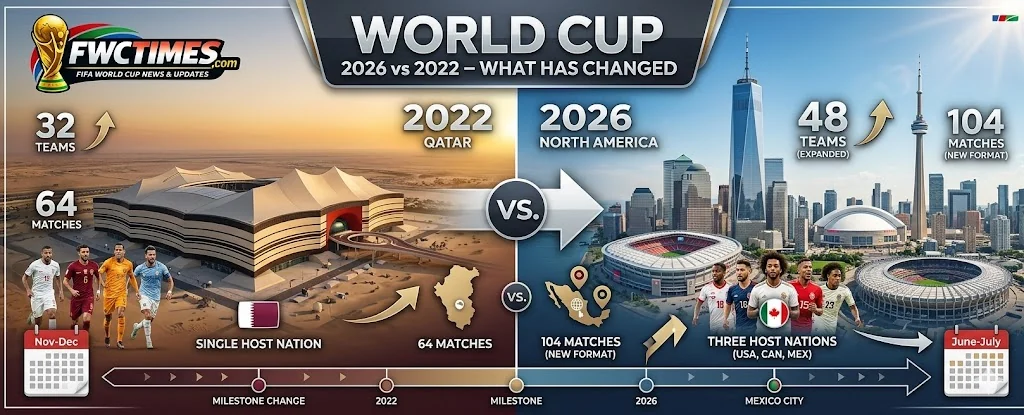
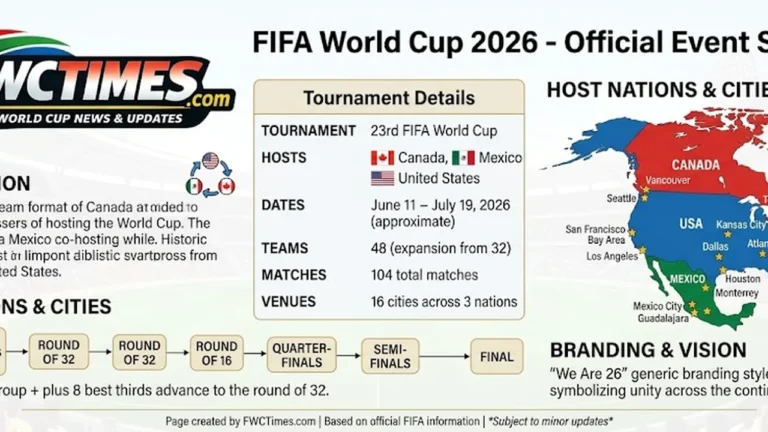
The World Cup 2026 changes from 2022 go far beyond a simple team count increase. The tournament expands from 32 to 48 nations, from 64 to 104 matches, from 8 to 12 groups. And From a Round of 16 to a brand new Round of 32. The FIFA World Cup 2026 also shifts from one host country to three — the United States, Mexico.
The 2022 Qatar edition ran across 8 cities packed within a 70-kilometer radius. Making it the most geographically compact World Cup in history. The 2026 version spans 16 host cities across a continent. With matches from Vancouver in the northwest to Miami in the southeast.
World Cup 2026 Changes from 2022: Side-by-Side Comparison
The table below captures the most important structural differences between the two tournaments. Finalists in 2026 will play eight matches rather than the seven required in 2022. This Adds significant physical and logistical demands. The tournament’s 39-day duration in 2026 also exceeds the 29-day Qatar schedule by ten days, meaning players, staff.
| Feature | World Cup 2022 (Qatar) | World Cup 2026 (USA/Mexico/Canada) |
|---|---|---|
| Participating teams | 32 | 48 |
| Total matches | 64 | 104 |
| Groups | 8 groups of 4 | 12 groups of 4 |
| Knockout start | Round of 16 | Round of 32 |
| Host nations | 1 (Qatar) | 3 (Canada, Mexico, USA) |
| Host cities | 8 cities | 16 cities |
| Schedule dates | Nov 20 – Dec 18, 2022 (Winter) | June 11 – July 19, 2026 (Summer) |
| Tournament duration | 29 days | 39 days |
| Matches for finalists | 7 | 8 |
| Max squad size | 26 players | 26 players |
The New Round of 32 and Its Impact on the Competition
The Round of 32 is the most significant structural addition to the World Cup format in decades. After the group stage ends and all 32 advancing teams — the top two from each. Plus the eight best third-place finishers — enter a single-elimination bracket immediately. This means even teams that finish third in their group.
The third-place qualification route is one of the most discussed changes between 2022 and 2026. In Qatar, only the top two teams from each group advanced. This means A third-place finish ended a team’s tournament immediately and in 2026. Finishing third in a group does not automatically eliminate a team.
Tactical Role of World Cup 2026 Changes From 2022
Qatar 2022 offered a uniquely compact experience — fans booked one hotel. In case of the entire tournament and travelled to different stadiums daily using public transport. That model is impossible in 2026, since the USA, Canada. And Mexico span multiple time zones and thousands of kilometers.
Climate also varies far more dramatically in 2026 than it did in Qatar. The controlled indoor and semi-indoor venues of Qatar maintained relatively consistent conditions for players and fans. A group-stage match in Mexico City sits at altitude above 2,200 meters. While a simultaneous fixture in Miami plays out in tropical heat and humidity.
Scheduling and Timing: Summer vs Winter
The return to a traditional June–July summer schedule is one. Of the most welcome changes for most of the football world. Qatar’s November–December 2022 window forced all major European leagues to pause mid-season, disrupting club football across every top division. Players arrived at the 2022 tournament without a normal pre-season build-up.
The summer timing also supports larger public audiences in Europe and Latin America. Where outdoor viewing and fan festivals are a core part of the World Cup experience. Qatar’s winter evenings saw fan zones and outdoor gatherings in some markets. Yet, The summer model works far better for the scale of public engagement that the tournament generates.
Frequently Asked Questions
What are the main World Cup 2026 changes from 2022?
The most significant changes are the expansion from 32 to 48 teams. The increase in total matches from 64 to 104. And The addition of a new Round of 32 knockout stage. The tournament moves from one host country (Qatar) to three (Canada.
How does the Round of 32 differ from the 2022 knockout format?
In 2022 and teams advanced directly from the group stage to the Round of 16. With only 16 of the 32 competing teams progressing and in 2026. All 32 advancing teams — the top two from each of the 12 groups plus the. Eight best third-place finishers — enter a new Round of 32 before the Round of 16 begins.
Can third-place group finishers still advance in 2026?
Yes, the eight best third-place finishers across all 12 groups advance to the Round of 32 in 2026. In 2022. Finishing third in a group immediately ended a team’s tournament, since only 8 groups produced a top two. The expanded 12-group format in 2026 creates 12 third-place finishers.
How does the geographic scale of 2026 compare to 2022?
The 2022 Qatar tournament ran across 8 stadiums within a 70-kilometer radius. Making it the most geographically compact World Cup in history. The 2026 edition spans 16 host cities across three countries and multiple time zones. From Vancouver in the northwest of North America to Miami in the southeast.
Why does the 2026 World Cup last longer than the 2022 edition?
The 2026 World Cup runs for 39 days. From June 11 to July 19, compared to the 29-day Qatar 2022 schedule. The extra 10 days reflect the larger number of matches —. 104 versus 64 — spread across 16 host cities in three countries.
The Bigger Picture: What All These Changes Mean
The gap between Qatar 2022 and the 2026 World Cup is the largest structural. Shift between consecutive editions since the tournament expanded from 16 to 24 teams in 1982. Every element — from group-stage format and knockout structure to. Host logistics and broadcast scheduling — has changed at scale.
The return to a summer schedule, the three-country co-hosting model. And The 48-team field are all components of a long-term. FIFA strategy to grow the global reach of the World Cup. Read our guides on World Cup 2026 groups and the World Cup 2026 schedule PDF.