Tunisia: World Cup 2026 Squad, Fixtures, Standings & Kits

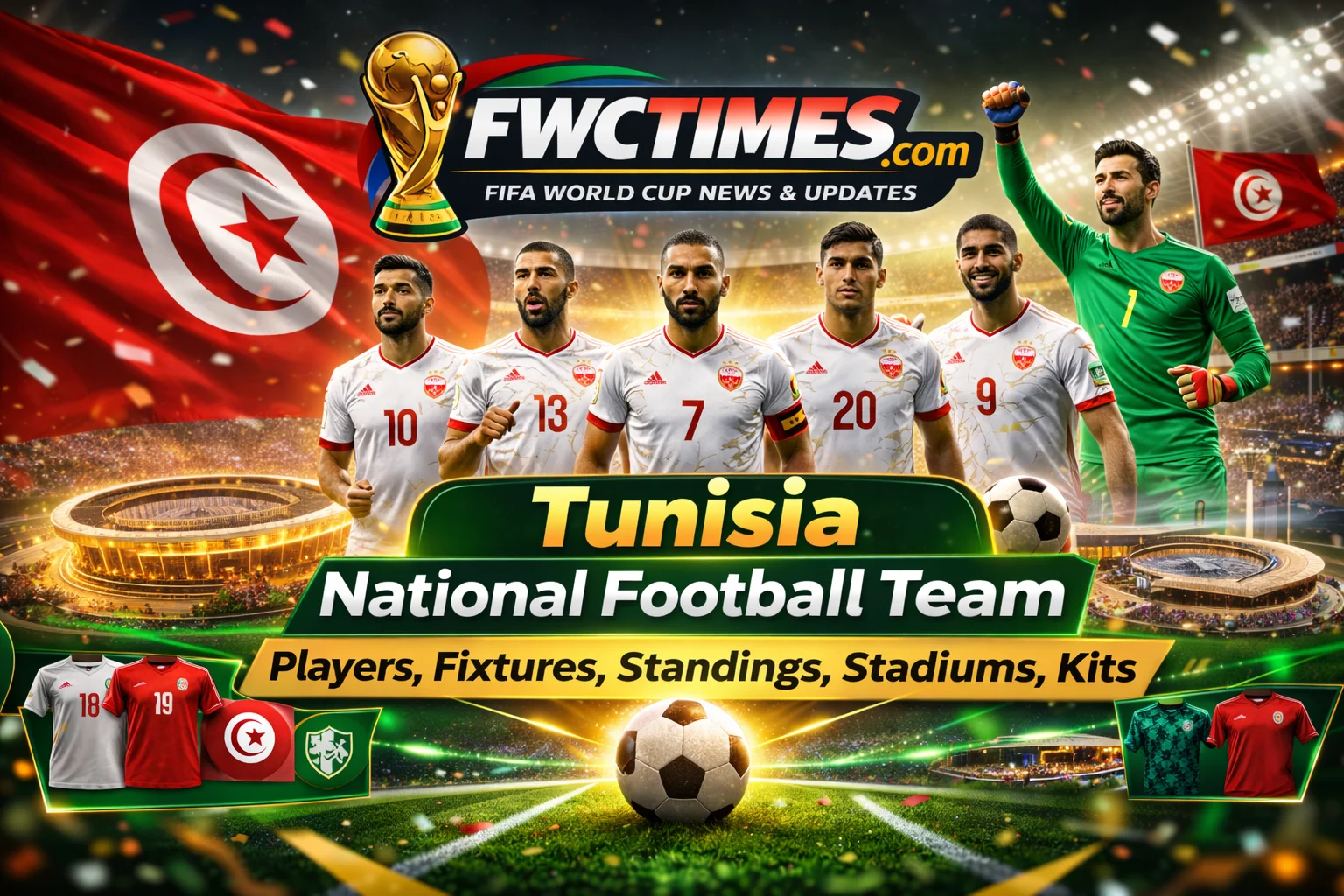
Tunisia — FIFA World Cup 2026
Group F · Coach: Sabri Lamouchi · Eagles of Carthage
Tunisia arrive at the 2026 FIFA World Cup with the most statistically dominant qualifying campaign in the history of the tournament — nine wins, one draw, zero losses, 22 goals scored, and zero goals conceded across 10 CAF Group H matches, making them the first nation in World Cup history to qualify with a clean sheet record across an entire campaign. Coach Sabri Lamouchi announced his final 26-man squad on May 15, 2026, building on the generation that came within 16 minutes of beating France 1-0 at the 2022 World Cup before being eliminated by goal difference despite winning that final group match. The Eagles of Carthage return for their seventh World Cup with their most technically diverse squad in years, while Morocco — Africa’s 2022 semi-finalists and the continent’s benchmark — serves as the reminder of how far African football has travelled and how much Tunisia still want to reach for the first time.
Drawn into Group F alongside 2022 quarter-finalists the Netherlands, Japan, and Sweden, Tunisia face the tournament’s most demanding group for an African qualifier. Captain Ellyes Skhiri of Eintracht Frankfurt leads with 81 international caps, while Hannibal Mejbri of Burnley provides Premier League creativity in midfield. The most compelling storyline in the squad is Rani Khedira of Union Berlin — the younger brother of Germany’s 2014 World Cup winner Sami Khedira, who chose to represent Tunisia rather than follow his brother’s path with Germany. The youngest player in the squad is 18-year-old Rayan Elloumi of Vancouver Whitecaps — and at 21, Khalil Ayari of Paris Saint-Germain is the headline youth selection that confirms Tunisia’s forward-looking generation has arrived.
Contents
What should fans know about Tunisia at World Cup 2026?
Tunisia are competing at the 2026 FIFA World Cup in the United States, Mexico, and Canada. They are placed in Group L and are managed by Sabri Lamouchi. The tournament runs from June 11 to July 19, 2026.
Tunisia World Cup 2026 Squad — Eagles of Carthage Official Roster
Sabri Lamouchi announced Tunisia’s final 26-man squad on May 15, 2026. The group blends experienced European-based players with new domestic talent — clubs represented include Eintracht Frankfurt, Burnley, Norwich City, Union Berlin, FC Augsburg, OGC Nice, FC Lorient, Servette, BSC Young Boys, Celtic, FC Copenhagen, Hannover 96, PSG, and Vancouver Whitecaps. Goalkeeper Aymen Dahmen, who kept all 10 qualifying clean sheets, leads from goal. The notable omission is Mohamed Ali Ben Romdhane, Tunisia’s top CAF qualifying scorer, who did not make the final 26 despite scoring the decisive qualifying goal against Equatorial Guinea.
Goalkeepers

Defenders
Midfielders
Forwards
Tunisia’s captain and the squad’s most experienced player with 81 international caps — a defensive midfielder at Eintracht Frankfurt who brings Bundesliga quality, Champions League experience, and the leadership that a squad with 17 first-time World Cup players urgently needs. Skhiri is the midfield shield around whom Lamouchi’s entire defensive structure is built — a player whose positioning, ball-winning, and ability to recycle possession under pressure make him one of African football’s finest midfielders of his generation. His presence allows Hannibal Mejbri and Anis Ben Slimane the freedom to play higher and more creatively in front of him.
The Burnley midfielder making his second consecutive World Cup appearance — a technically gifted, high-energy central midfielder whose Premier League experience and pressing intensity give Tunisia a midfield quality that most African squads at the tournament cannot match. Hannibal graduated through Manchester United’s academy before moving to Burnley and establishing himself in the Championship and then the Premier League. His combination of pace, vision, and aggressive ball-winning in central areas makes him Tunisia’s most complete midfielder and Lamouchi’s first-choice starter alongside Skhiri in the engine room.
The 21-year-old Paris Saint-Germain forward who is the most high-profile young talent in the squad — a technically skilled, quick attacker whose selection at PSG represents one of the most remarkable club affiliations of any African player at the 2026 World Cup. Ayari’s inclusion reflects Lamouchi’s confidence in the new generation that is coming through alongside the experienced core of Skhiri and Hannibal. His pace, close control, and ability to create from wide positions give Tunisia an attacking option that none of the Group F sides will have specifically prepared for, and his World Cup debut could be the moment that announces him to the global game.
The Union Berlin midfielder who chose to represent Tunisia rather than follow his older brother Sami Khedira — Germany’s 2014 World Cup winner — in representing the country of their birth. Born in Stuttgart to a Tunisian father, Rani Khedira brings Bundesliga discipline, technical quality, and physical midfield presence that complements Skhiri’s defensive base and Hannibal’s creative instincts. His decision to choose Tunisia over Germany makes him one of the most uniquely positioned players at the 2026 tournament — a midfielder whose career could have taken a very different national team path and who chose African football instead.
The Lorient centre-back who has been one of the most consistent defenders in Ligue 2 and the anchor of Tunisia’s defensive structure that kept a clean sheet across all 10 CAF qualifying matches — a record unique in World Cup history. Talbi brings Ligue 1 experience, aerial dominance, and the defensive leadership that explains why Tunisia’s qualifying record was so extraordinary. His partnership with Dylan Bronn of Servette gives Tunisia a central defensive pairing built on European football experience and the collective understanding that a perfect qualifying campaign requires.
The Celtic forward who provides Tunisia with Scottish Premiership experience and direct attacking threat from wide positions — a player whose form at Celtic has given Lamouchi a proven performer in a high-pressure European club environment. Tounekti’s inclusion alongside Ayari, Achouri, and Elloumi gives Tunisia an attacking group with more European depth than any previous Eagles of Carthage squad at a World Cup. His understanding of Hannibal’s movement from midfield — developed through playing against and alongside similar profiles in European football — makes him one of Lamouchi’s most tactically flexible attacking options.
Tunisia Tactics Under Lamouchi — Zero Conceded and the Next Step
Sabri Lamouchi has built Tunisia around the 4-3-3 / 4-1-4-1 defensive identity that produced the most impenetrable qualifying campaign in World Cup history — a system anchored by Skhiri as the single defensive pivot, protected by a back four that maintained 10 consecutive clean sheets across the CAF campaign. Hannibal Mejbri operates as the press-trigger and box-to-box runner from central midfield, with Rani Khedira providing the physical midfield balance on the opposite side. In attack, Tunisia use the width of Ayari and Tounekti from wide positions to create space for the central striker — Achouri or Tounekti through the middle — while Skhiri’s ability to switch possession quickly from deep gives the system its offensive transition quality.
The June 25 final group match against the Netherlands at Kansas City is the tactical examination that defines Tunisia’s 2026 tournament. The Netherlands’ pressing system and technical quality in midfield will test whether Skhiri’s single pivot can absorb the volume of possession that a Dutch side generates in transition. The key for Tunisia is replicating the defensive discipline of their qualifying campaign — keeping their shape under pressure and making Group F opponents work for every chance. Tunisia beat France 1-0 in the 2022 World Cup group stage (though France had rested their starters) — a result that confirmed Tunisia are capable of performing against elite European opposition when their defensive structure is at its most organised.
| Formation | Style | Key Shape | Primary Strength |
|---|---|---|---|
| 4-1-4-1 | Low block + fast counter | Skhiri single pivot; Hannibal + Khedira wide; Ayari right wing | Defensive solidity and set pieces |
| 4-3-3 | High press + width | Three-man mid; Ayari + Tounekti wide; central striker runs | Pace on the counter-attack |
| 4-4-2 | Compact shape + two fwd | Double pivot; Hannibal + Skhiri; Achouri + Tounekti up front | Set-piece threat and physicality |
Group F Fixtures — Tunisia at WC 2026
Matchday viewing routes are covered in the where to watch Tunisia football guide before kickoff.
Tunisia’s Group F schedule runs entirely across Mexican and American venues with a clear progression in difficulty. The June 14 opener against Sweden in Monterrey is the must-win fixture — Sweden are making their World Cup return after a long absence and represent the most winnable Group F match for the Eagles of Carthage. The June 21 match against Japan in Monterrey is more demanding — Japan are the AFC’s strongest side, ranked inside the top 20 in the world, and will press aggressively across 90 minutes in a way that Tunisia’s qualifying opponents could not. The June 25 finale against the Netherlands at Arrowhead Stadium in Kansas City is Tunisia’s stiffest Group F test — the Dutch are one of Europe’s three or four most technically complete squads and will examine every aspect of Lamouchi’s defensive system.
Use the Tunisia FIFA World Cup 2026 TV schedule to match the Group F fixtures with local kickoff times and official broadcast access.
| Date | Match | Venue | City |
|---|---|---|---|
| Jun 14, 2026 | Sweden vs Tunisia | Estadio BBVA | Monterrey, Mexico |
| Jun 21, 2026 | Japan vs Tunisia | Estadio BBVA | Monterrey, Mexico |
| Jun 25, 2026 | Tunisia vs Netherlands | Arrowhead Stadium | Kansas City, MO |
Group F — FIFA World Cup 2026
| Team | Pld | W | D | L | GF | GA | Pts |
|---|---|---|---|---|---|---|---|
| 🇳🇱 Netherlands | 0 | 0 | 0 | 0 | 0 | 0 | 0 |
| 🇯🇵 Japan | 0 | 0 | 0 | 0 | 0 | 0 | 0 |
| 🇸🇪 Sweden | 0 | 0 | 0 | 0 | 0 | 0 | 0 |
| 🇹🇳 Tunisia | 0 | 0 | 0 | 0 | 0 | 0 | 0 |
The Netherlands enter Group F as clear favourites — a technically excellent squad with the width, pace, and pressing quality that makes them one of Europe’s top eight sides. Japan arrive as AFC’s strongest qualifier, ranked inside the world’s top 20 with a squad combining elite European club experience across Bundesliga, La Liga, and Premier League football. Sweden return to the World Cup as a European qualifier with a competitive squad built around collective organisation and physical intensity. Tunisia’s target is to progress from the group stage for the first time in their seven World Cup appearances — a historic milestone that would require defeating Sweden in the opener and accumulating enough points from the Japan and Netherlands matches to finish in the top two.
CAF Qualifying — Tunisia’s Perfect Historic Campaign
Tunisia produced the most statistically dominant qualifying campaign in World Cup history — topping CAF Group H with 28 points from 10 matches, nine wins, one draw, zero losses, 22 goals scored, and zero goals conceded. No nation in 96 years of World Cup qualification had ever completed a full campaign without conceding a single goal. The clean sheet was preserved across all 10 matches against Equatorial Guinea, Namibia, Malawi, Liberia, and São Tomé and Príncipe. Tunisia’s campaign included a decisive 1-0 win over Equatorial Guinea on September 8, 2025, that sealed qualification. Fellow African qualifiers Senegal and Algeria earned places at the tournament from separate CAF groups, but neither matched Tunisia’s extraordinary defensive record across the campaign. Goalkeeper Aymen Dahmen kept 10 consecutive competitive clean sheets in a performance that may never be replicated at any future World Cup.
CAF Group H — 1st Place · 9W 1D 0L · 22 GF · 0 GA · 28 Points · First WC qualifier with 0 goals conceded
| Team | Pld | W | D | L | GF | GA | Pts |
|---|---|---|---|---|---|---|---|
| 🇹🇳 Tunisia | 10 | 9 | 1 | 0 | 22 | 0 | 28 |
| 🇬🇶 Equatorial Guinea | 10 | 5 | 2 | 3 | 14 | 9 | 17 |
| 🇳🇦 Namibia | 10 | 4 | 2 | 4 | 10 | 12 | 14 |
| 🇲🇼 Malawi | 10 | 3 | 2 | 5 | 8 | 14 | 11 |
| 🇱🇷 Liberia | 10 | 2 | 1 | 7 | 7 | 16 | 7 |
| 🇸🇹 São Tomé | 10 | 1 | 0 | 9 | 3 | 20 | 3 |
Tunisia 2026 World Cup Kits
Tunisia’s 2026 World Cup kits draw from the red and white of the Tunisian national flag — the crescent and star of the Hilal al-Ahmar translated into football colours that the Eagles of Carthage have worn at every World Cup since their debut in 1978. The home kit returns with the iconic red base and white detailing, while the away kit uses white as the primary colour with red trim. The kits are produced under the current Tunisian Football Federation supplier agreement. The same red shirt was worn when Wahbi Khazri scored against France at the 2022 World Cup — a goal that gave Tunisia a famous 1-0 victory in their final group match, though it was not enough to prevent elimination on goal difference.
Tunisia at the World Cup — Full Tournament History
Tunisia have appeared at the FIFA World Cup seven times — 1978, 1998, 2002, 2006, 2018, 2022, and 2026 — and have never passed the group stage in any of their six previous appearances. Their most historic moment came at their debut in 1978 in West Germany, when Tunisia beat Mexico 3-1 to become the first African nation to win a match at the FIFA World Cup. In that same tournament they drew 0-0 with eventual third-place finisher West Germany — a result that confirmed the competitiveness of an African nation at the highest level 12 years before the continent became a regular qualifier. At the 2022 World Cup in Qatar, Tunisia beat France 1-0 in their final group match — the first time an African nation had beaten France at a World Cup — but were eliminated by goal difference despite the win. Their most agonising exit remains 2022’s mathematics: a win, and still going home. In 2026, Tunisia carry the weight of six group-stage eliminations and the motivation of a qualifying record that has never been matched in the tournament’s history.
| Year | Stage | Notable Result |
|---|---|---|
| 1978 | Group stage | Debut — beat Mexico 3-1 (first African WC win); drew West Germany 0-0 |
| 1998 | Group stage | Lost to England 0-2, Colombia 1-1 (draw), Romania 1-2 |
| 2002 | Group stage | Lost to Russia 0-2, Japan 0-2; beat Belgium 1-1 (draw) |
| 2006 | Group stage | Lost to Saudi Arabia 2-2 (draw), Spain 1-3, Ukraine 0-1 |
| 2018 | Group stage | Beat Panama 2-1; lost to England 1-2, Belgium 2-5 |
| 2022 | Group stage | Beat France 1-0 (Khazri goal); eliminated on goal difference |
| 2026 | TBD | Group F: Netherlands, Japan, Sweden — CAF perfect qualifiers |
The Eagles of Carthage carry a unique burden: seven World Cup appearances and zero knockout rounds. No team with Tunisia’s level of consistent African qualification has remained so completely in the group stage across so many appearances. The qualifying record of 2026 — the most dominant in the tournament’s history — raises the question of whether this squad has the tactical quality and individual depth to finally break the cycle. Skhiri, Hannibal, Ayari, and Khedira represent the best midfield generation Tunisia have assembled. The Group F draw against the Netherlands and Japan is genuinely difficult — but a win over Sweden in the opener gives Tunisia the platform to compete for second place and write the first new chapter in their World Cup story since Senegal‘s 2002 quarter-final demonstrated what African football can achieve when the structure and quality combine at the right moment.
Frequently Asked Questions
More World Cup 2026 Team Guides
Explore more FIFA World Cup 2026 team guides — Tunisia’s Group F rivals and fellow African qualifiers.