Algeria: World Cup 2026 Squad, Fixtures, Standings & Kits

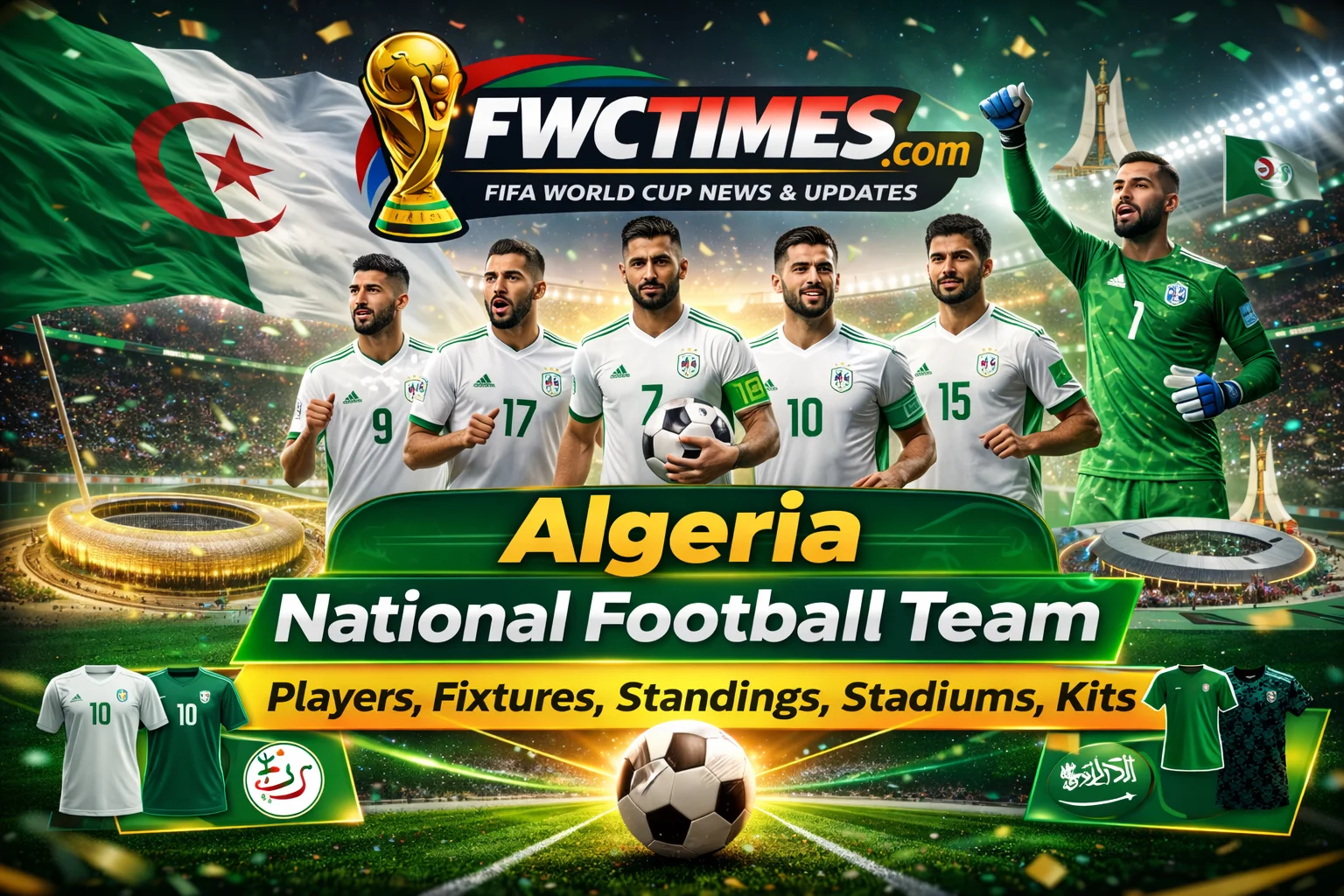
Algeria are back at the FIFA World Cup for the first time since reaching the round of 16 in Brazil 2014. Les Fennecs qualified from CAF Group G with one of the most dominant campaigns on the continent — 25 points from 10 matches, eight wins, one draw, one loss — and arrive in North America with a squad that blends European top-flight experience with the leadership of one of Africa’s greatest-ever players, Riyad Mahrez, at his final World Cup.
Drawn into Group J alongside defending World Cup champions Argentina, Austria, and Jordan, Algeria face a group that requires their very best across every minute of the three matches. Vladimir Petković — the Swiss-Serbian coach who previously led Switzerland at the 2018 World Cup — has built a system around defensive solidity and rapid transitions, with Manchester City’s Rayan Aït-Nouri bombing forward from left back, Ibrahim Maza pulling strings from Bayer Leverkusen’s midfield, and Mohamed Amoura — the top African scorer in all of World Cup qualifying with 10 goals — leading the line alongside Mahrez. Algeria topped their qualifying group with the same 25-point total as Ghana, both nations serving as the benchmark for African excellence in the 2026 qualification campaign.
Algeria — FIFA World Cup 2026
Group J · Manager: Vladimir Petković · Les Fennecs Are Back
Contents
What should fans know about Algeria at World Cup 2026?
Algeria are competing at the 2026 FIFA World Cup in the United States, Mexico, and Canada. They are placed in Group G and are managed by Vladimir Petkovic. The tournament runs from June 11 to July 19, 2026.
Algeria World Cup 2026 Squad — Les Fennecs
Vladimir Petković finalised his 26-man squad on May 31, 2026 — and the headline story was the shock exclusion of Ismaël Bennacer, with no official reason given. The confirmed squad reflects the breadth of Algerian footballing talent spread across Europe: Bundesliga representatives at Dortmund and Leverkusen, Premier League presence at Manchester City and Crystal Palace, Ligue 1 experience at Lille, Nice, and Marseille, and Dutch football contributions from Twente and Feyenoord. Mahrez leads as captain from the Saudi Pro League, with Luca Zidane — son of Zinedine Zidane — included as one of three goalkeepers in what is itself one of the most compelling personal stories in the entire tournament squad.
Goalkeepers

Defenders
Midfielders
Forwards
Key Players to Watch at the 2026 World Cup
Six players define Algeria’s ceiling at this World Cup. Mahrez brings the leadership and match-turning quality of a player who has won everything at club level. Amoura is the most prolific African scorer in the entire qualifying campaign. Aët-Nouri gives Algeria the most dynamic attacking option from a defensive position in the group. Maza is the Bundesliga-quality creative force who can unlock any defence from midfield. Chaïbi provides the technical elegance that allows the system to breathe. And Bensebaini adds the physical authority needed to contain the physical threats in Group J across three matches in ten days.
Algeria’s greatest modern player and the emotional anchor of everything Petkovic builds going forward. Mahrez has 113 caps, 38 international goals, and a club career that produced Premier League titles with Leicester and Manchester City, a UEFA Champions League, and a Saudi Pro League championship with Al Ahli. He captained Algeria to the 2019 Africa Cup of Nations title with a decisive free-kick in the semi-final against Nigeria. At 35, this is his last World Cup — and he intends to make it count.
The top African scorer across the entire 2026 World Cup qualifying campaign — 10 goals in the group stage, more than any other player on the continent. Amoura has 19 international goals in 42 caps and brings a physical, explosive forward game to Algeria’s attack that no defender in the group can simply shut down. His pace, timing of runs, and clinical finishing make him the most dangerous outright goalscorer in Petkovic’s squad — and possibly the most underrated forward at the entire 2026 tournament.
One of the most exciting attacking full-backs at the entire 2026 World Cup. Aët-Nouri plays for Manchester City and has established himself as one of the best left backs in the Premier League — an overlapping, energetic presence who delivers quality crosses, takes on defenders at pace, and contributes directly to goals at both club and international level. He gives Algeria a dimension on the left flank that European opponents with a high defensive line will find genuinely difficult to manage.
The most exciting young talent in Algerian football and one of the brightest midfield prospects at the entire tournament. Maza plays for Bayer Leverkusen — the reigning Bundesliga champions — and brings a creativity, composure, and passing range that is genuinely elite for a player at his age. His ability to find space between lines and release teammates with precision gives Algeria a technical quality in midfield that opponents at this level will struggle to contain.
The creative playmaker who links Maza’s deeper contributions with the forward line. Chaibi operates as an advanced midfielder at Eintracht Frankfurt — technically clean, two-footed, and constantly looking for the pass that breaks defensive lines rather than simply maintaining possession. He arrived in the Algeria squad as a next-generation talent and has outgrown that label rapidly. At this World Cup, he is a starter and a key weapon in Petkovic’s system.
The powerfully built left back from Borussia Dortmund who gives Algeria physicality, aerial dominance, and a direct goal threat from set-pieces. Bensebaini is one of the most complete defenders in this Algeria squad — technically accomplished enough to build from the back and physically imposing enough to handle any winger in the tournament. With Aët-Nouri pushing forward, Bensebaini provides the defensive cover and discipline that prevents Algeria from being exposed on the left side.
Tactics and Formation Under Vladimir Petković
Vladimir Petkovic’s Algeria operate in a disciplined 4-2-3-1 that prioritises defensive compactness before offensive expression. Boudaoui and Zerrouki form the double pivot, providing the defensive screen that allows the more creative players — Maza, Chaibi, and Mahrez — to operate in higher positions without defensive responsibility. The system is built to absorb pressure from superior teams and then release Amoura and Aët-Nouri on transitions at pace. Clean sheets in five of their last seven matches in qualifying reflect how seriously Petkovic takes the defensive foundation.
Against Argentina on June 16, Petkovic will almost certainly set up with a low defensive block and rely on Mahrez, Amoura, and Aët-Nouri to create danger on the counter. The Jordan fixture on June 22 is the match where Algeria can express themselves — Maza and Chaibi given freedom to control the game from midfield. Against Austria on June 27, Petkovic may shift to a more aggressive 4-3-3 with Gouiri replacing Chaibi in a higher-intensity pressing shape designed to win the group match that ultimately decides whether Algeria advance from Group J.
| Formation | Style | Key Shape | Primary Strength |
|---|---|---|---|
| 4-2-3-1 | Compact block, fast transitions | Boudaoui/Zerrouki pivot; Mahrez right; Amoura CF | Defensive solidity |
| 4-3-3 | High press, wide overloads | Maza + Chaibi press; Ait-Nouri overlaps relentlessly | Width and pace |
| 4-4-2 | Mid-block, twin striker aggression | Amoura + Gouiri press CBs from front two | Physical intensity |
Group J Fixtures — Algeria at WC 2026
Matchday viewing routes are covered in the where to watch Algeria football guide before kickoff.
Local broadcast times are listed in the Algeria FIFA World Cup 2026 TV schedule.
Algeria’s Group J draw is brutally challenging at the top but offers a genuine path through the lower half. The Argentina opener on June 16 at Arrowhead Stadium in Kansas City is the match every neutral will watch — two North African footballing nations facing the defending World Cup champions, with Mahrez leading Algeria and Messi presumably leading Argentina. The Jordan fixture on June 22 in Santa Clara is the group’s most winnable match — and dropping points there would be catastrophic for Algeria’s progression hopes. The Austria game on June 27 back in Kansas City closes the group, and could well be a straight shootout for a place in the round of 32.
| Date | Match | Venue | City |
|---|---|---|---|
| Jun 16, 2026 | Argentina vs Algeria | Arrowhead Stadium | Kansas City, MO |
| Jun 22, 2026 | Jordan vs Algeria | Levi’s Stadium | Santa Clara, CA |
| Jun 27, 2026 | Algeria vs Austria | Arrowhead Stadium | Kansas City, MO |
Group J — FIFA World Cup 2026
| Team | Pld | W | D | L | GF | GA | Pts |
|---|---|---|---|---|---|---|---|
| 🇦🇷 Argentina | 0 | 0 | 0 | 0 | 0 | 0 | 0 |
| 🇦🇹 Austria | 0 | 0 | 0 | 0 | 0 | 0 | 0 |
| 🇯🇴 Jordan | 0 | 0 | 0 | 0 | 0 | 0 | 0 |
| 🇩🇿 Algeria | 0 | 0 | 0 | 0 | 0 | 0 | 0 |
Argentina are the overwhelming group favourites — defending champions, led by Lionel Messi in what is expected to be his final World Cup, with a squad that won the 2021 Copa América and 2022 World Cup in succession. Austria arrive as one of Europe’s most improved sides, well-organised and capable of causing upsets. Jordan qualified via the AFC route with genuine spirit and organisation. Algeria’s most realistic route through the group is second place — a result that would require beating Jordan comfortably, holding Austria to a draw or winning their direct fixture, and managing the Argentina match without conceding multiple goals.
CAF World Cup Qualifying — How Algeria Got Here
Algeria dominated CAF Group G to qualify directly for the 2026 World Cup, finishing with 25 points — a record that placed them among the top-performing African qualifiers alongside Ghana. They won eight of their ten matches, kept clean sheets in five of their final seven games, and secured qualification with a 3-0 win over Somalia in October 2025 — Mahrez scoring the goal that confirmed their place. Mohamed Amoura was the attacking revelation of the campaign, finishing as the top African scorer in the entire global qualifying process with 10 goals. It was, by every measure, a dominant and commanding campaign.
CAF Group G — 8W 1D 1L · 25 Points · Topped Group, Direct Qualification
| Team | Pld | W | D | L | GF | GA | Pts |
|---|---|---|---|---|---|---|---|
| 🇩🇿 Algeria | 10 | 8 | 1 | 1 | 22 | 5 | 25 |
| 🇬🇳 Guinea | 10 | 4 | 3 | 3 | 14 | 12 | 15 |
| 🇺🇬 Uganda | 10 | 5 | 3 | 2 | 16 | 11 | 18 |
| 🇲🇿 Mozambique | 10 | 5 | 3 | 2 | 14 | 10 | 18 |
| 🇧🇼 Botswana | 10 | 3 | 1 | 6 | 9 | 18 | 10 |
| 🇸🇴 Somalia | 10 | 0 | 1 | 9 | 2 | 21 | 1 |
Algeria 2026 World Cup Kits
Algeria’s 2026 World Cup kits are produced under their current supplier agreement and draw on the national colours of white and green from the Algerian flag. The home kit is predominantly white with a green crescent and star detail — one of the cleanest and most striking kits at the tournament. The away kit reverses the palette to deep green with white trim, echoing the flag’s left half. Both kits carry the Fennec Fox badge that symbolises the cunning, desert-adapted spirit Algeria’s football identity has been built around since their historic 1982 debut.
Algeria at the World Cup — Full Tournament History
Algeria have now appeared at the FIFA World Cup five times — 1982, 1986, 2010, 2014, and 2026 — but their history at the tournament is defined by a single unjust elimination and one exceptional run. The 1982 debut in Spain remains one of the most celebrated moments in African football: Algeria beat West Germany 2-1 in one of the biggest upsets in World Cup history, then finished with four points — only to be eliminated by the notorious ‘Disgrace of Gijón,’ in which West Germany and Austria played a 1-0 result that suited both European sides and eliminated Algeria on goal difference. The 2014 round of 16 run in Brazil, where Algeria pushed Germany all the way before losing 2-1 in extra time, remains their best-ever World Cup result.
| Year | Stage | Notable Result |
|---|---|---|
| 1982 | Group stage | Beat West Germany 2-1; eliminated by Disgrace of Gijón — 4 pts, 5 goals |
| 1986 | Group stage | 1 draw, 2 losses — 1 point, eliminated |
| 2010 | Group stage | 1 draw, 2 losses — 1 point, 0 goals scored |
| 2014 | Round of 16 | Best result: beat South Korea, drew Russia; lost to Germany 2-1 in extra time |
| 2026 | TBD | Group J: Argentina, Austria, Jordan |
The 1982 Disgrace of Gijón changed the rules of football forever — FIFA introduced simultaneous final group matches in every subsequent tournament as a direct consequence of that match. But for Algeria, the injustice remains a defining wound. The 2026 World Cup offers the chance to write a new chapter — a squad with genuine European club quality, a captain at his last tournament with nothing left to prove and everything left to win, and a coach who understands what it takes to compete at a World Cup. Forty-four years after Gijón, Algeria arrive in North America believing the unfinished business of 1982 can finally be settled on the pitch.
Frequently Asked Questions
More World Cup 2026 Team Guides
Explore more 2026 FIFA World Cup team guides — Algeria’s African rivals and other nations competing in North America.