Morocco: World Cup 2026 Squad, Fixtures, Standings & Kits

Morocco — FIFA World Cup 2026
Group C · Manager: Mohamed Ouahbi · History Made. Now Go Further.
Morocco return to the FIFA World Cup as the highest-ranked African nation and the only team from the continent that has ever reached a semi-final — aiming in 2026 to go one step further and reach the first World Cup final in African football history. The Atlas Lions qualified from CAF Group E with a perfect eight wins from eight matches, 22 goals scored, just two conceded, and 24 points — becoming the first African nation to book their 2026 ticket — before arriving in North America under new head coach Mohamed Ouahbi, who took over from the legendary Walid Regragui on March 5, 2026, just three months before the tournament began. Morocco are ranked 8th in the FIFA world rankings as of June 2026.
Drawn into Group C alongside Brazil, Scotland, and Haiti, Morocco face a group defined by the opener on June 13 — a rematch with Brazil, who they have never beaten at a World Cup, at MetLife Stadium in New Jersey. The squad that Ouahbi inherits is one of extraordinary depth: Achraf Hakimi of PSG captains from right-back, Brahim Díaz of Real Madrid creates from the front, and Sofyan Amrabat — the 2022 semi-final’s breakout midfielder — anchors the engine room at Real Betis. Morocco’s Group C is simultaneously their biggest challenge and their greatest stage. Algeria, Ghana, and Senegal are Africa’s other representatives in the tournament — but Morocco carry the continent’s deepest World Cup pedigree into 2026.
Contents
What should fans know about Morocco at World Cup 2026?
Morocco are competing at the 2026 FIFA World Cup in the United States, Mexico, and Canada. They are placed in Group F and are managed by Mohamed Ouahbi. The tournament runs from June 11 to July 19, 2026.
Morocco World Cup 2026 Squad — Atlas Lions Official Roster
Mohamed Ouahbi announced Morocco’s final 26-man squad on May 26, 2026. The group reflects the remarkable spread of Moroccan talent across elite European football — PSG, Real Madrid, Manchester United, Marseille, Crystal Palace, Fulham, PSV, Stuttgart, Roma, Real Betis, Girona, and Sunderland all feature. Nine players return from the 2022 World Cup semi-final squad, including Bounou, Hakimi, Aguerd, Mazraoui, Amrabat, and Ounahi, providing the institutional experience that a new-generation squad like this needs. Notable absences include Sofiane Boufal and Youssef En-Nesyri, whose omissions reflect Ouahbi’s confidence in the new attacking options available to him.
Goalkeepers

Defenders
Midfielders
Forwards
Morocco’s Key Players at the 2026 World Cup
Six players define Morocco’s ceiling in Group C and beyond. Hakimi provides the world-class attacking full-back quality that no opponent can simply ignore. Brahim Díaz offers the Real Madrid technical creativity that makes Morocco genuinely different from any other African team in the tournament. Amrabat provides the defensive midfield anchor that protected the back four in 2022 and must do so again in 2026. Bounou gives Morocco a goalkeeper whose big-game composure is confirmed. El Khannouss provides the next-generation creative energy. And El Kaabi gives Ouahbi a recognised centre-forward option that his other attacking choices lack.
Morocco’s captain and one of the world’s finest right-backs — a player who redefined what an attacking full-back can contribute at the highest level. Hakimi at PSG recorded six assists and created 23 chances in 12 Champions League starts in 2025-26, helping PSG reach consecutive Champions League finals. He carries 95 international caps into the tournament and was himself a pivotal presence across Morocco’s 2022 semi-final run. A hamstring injury raised concerns in April 2026 but coach Ouahbi has confirmed him fit — and when Hakimi is fully available, Morocco are a fundamentally different attacking team.
The 25-year-old Real Madrid forward who is the most technically gifted player in the Morocco squad and the creative engine around whom Ouahbi’s attacking system is designed to rotate. Born in Málaga to Moroccan parents, Díaz has scored 13 goals in 24 international appearances, including five in five games at the 2023 AFCON — winning the tournament’s top scorer award. He brings the close-control dribbling, vision, and composure in tight spaces that only regular Real Madrid football can develop — and at this World Cup he is Morocco’s most match-turning individual talent.
The midfielder who became the symbol of Morocco’s 2022 World Cup identity — a relentless, physically exceptional ball-winner whose tenacity and reading of the game neutralised Spain and Portugal in consecutive knockout rounds. Amrabat at Real Betis has maintained that form at club level and arrives at 2026 as one of nine survivors from the 2022 semi-final squad. He is the defensive foundation of everything Morocco build — and his presence in the engine room gives Ouahbi the security to allow Hakimi and Brahim Díaz their freedom.
The goalkeeper who saved two penalties in the 2022 quarter-final shoot-out against Spain — a performance that defined Morocco’s run to the last four and confirmed him as one of the best goalkeepers in the world at that moment. Bounou at Al-Hilal in the Saudi Pro League has continued to perform at an international standard, and his shot-stopping ability, composure on the line, and distribution quality make him the cornerstone of Morocco’s defensive structure at this World Cup, just as he was in Qatar 2022.
The 21-year-old VfB Stuttgart midfielder who represents the next generation of Moroccan talent following in the footsteps of the 2022 heroes. El Khannouss is a dynamic, technically clean central midfielder — quick in the press, sharp in combination play, and comfortable carrying the ball through tight spaces in the Bundesliga. He gives Ouahbi the energy and creativity in the middle third that the ageing Ounahi and Amrabat partnership alone cannot always provide, and his debut World Cup will be watched by every top European club.
The Olympiacos striker who provides Morocco with their most natural centre-forward presence — a physical, direct target man who finished as the group’s top scorer during CAF qualifying with four goals in the 2026 campaign. El Kaabi is capable of holding the ball, finishing in the box, and pressing from the front to force errors in the defensive line. He gives Ouahbi a different attacking option from the wide creativity of Brahim Díaz and Ezzalzouli — a focal point that stretches defences vertically and creates space for the more technical players arriving from depth.
Morocco Tactics Under Mohamed Ouahbi — 2022 Legacy Evolved
Mohamed Ouahbi inherits the 4-3-3 / 4-1-4-1 defensive identity that made Morocco the most difficult team to beat at the 2022 World Cup — a system built around Amrabat’s single pivot, the width of Hakimi bombing forward from right-back, and the collective pressing that Regragui had refined across three months in Qatar. Ouahbi is expected to maintain this structural framework while giving Brahim Díaz more freedom as an advanced ten or second striker — a tactical evolution that makes Morocco more attack-minded than the defensive-first 2022 version, without sacrificing the defensive solidity that is the squad’s defining quality.
Against Brazil on June 13 in New Jersey — Morocco’s opener and arguably the most anticipated group-stage match of the tournament — Ouahbi will almost certainly deploy a deep defensive block with Amrabat shielding the back four and the width players pressing Brazil’s fullbacks aggressively whenever they receive the ball. Hakimi’s fitness will determine how dangerous Morocco are on the counter: when fully fit, his runs from right-back behind Brazil’s defensive line are one of the most difficult offensive movements in global football to defend against. The Jordan and Türkiye coaches have both publicly cited Morocco 2022 as their tactical inspiration — a confirmation of how deeply this Atlas Lions style has shaped African and Asian football.
| Formation | Style | Key Shape | Primary Strength |
|---|---|---|---|
| 4-1-4-1 | Low block + fast counter | Amrabat single pivot; Hakimi overlaps; Diaz free role | Defensive solidity |
| 4-3-3 | High press, wide attack | Amrabat + Saibari + El Khannouss three-man mid | Midfield intensity |
| 4-2-3-1 | Controlled possession | Double pivot frees Diaz as #10; El Kaabi leads the line | Technical control |
Group C Fixtures — Morocco at WC 2026
Matchday viewing routes are covered in the where to watch Morocco football guide before kickoff.
Local broadcast times are listed in the Morocco FIFA World Cup 2026 TV schedule.
Morocco’s Group C schedule presents one of the most compelling fixture lists of any team in the 2026 tournament. The opener against Brazil on June 13 at MetLife Stadium is the match football fans around the world will watch above all others in the group stage — the first African semi-finalists against the most successful World Cup nation in history. The Scotland fixture on June 19 at Gillette Stadium in Boston is where Morocco are expected to take maximum points. The Haiti match on June 24 in Atlanta closes the group — Haiti are debutants and Morocco should have enough quality to finish their campaign with a convincing win.
| Date | Match | Venue | City |
|---|---|---|---|
| Jun 13, 2026 | Brazil vs Morocco | MetLife Stadium | East Rutherford, NJ |
| Jun 19, 2026 | Scotland vs Morocco | Gillette Stadium | Foxborough, MA |
| Jun 24, 2026 | Morocco vs Haiti | Mercedes-Benz Stadium | Atlanta, GA |
Group C — FIFA World Cup 2026
| Team | Pld | W | D | L | GF | GA | Pts |
|---|---|---|---|---|---|---|---|
| 🇧🇷 Brazil | 0 | 0 | 0 | 0 | 0 | 0 | 0 |
| 🇲🇦 Morocco | 0 | 0 | 0 | 0 | 0 | 0 | 0 |
| 🇬🇧 Scotland | 0 | 0 | 0 | 0 | 0 | 0 | 0 |
| 🇭🇹 Haiti | 0 | 0 | 0 | 0 | 0 | 0 | 0 |
Brazil are the group’s overwhelming favourites — the most successful World Cup nation in history with five titles, arriving in 2026 with a squad combining the pace and technical quality of Vinícius Jr and Rodrygo with a midfield of extraordinary depth. Scotland qualify for their first World Cup in 28 years and arrive with tactical organisation and set-piece quality that can cause any side problems across a single match. Haiti make their World Cup debut — a historic moment for Caribbean football. Morocco’s ambition is second place, which would mean out-performing Scotland and Haiti and holding Brazil to a result in the opener that keeps morale and momentum intact for the rest of the group.
CAF Qualifying — Morocco’s Perfect Campaign
Morocco dominated CAF Group E with a perfect campaign — eight wins from eight matches, 24 points, and a goal difference of +20. They were the first African nation to qualify for the 2026 World Cup, securing their place months before any other CAF side. The campaign featured a 6-0 demolition of Congo DR, back-to-back 5-0 and 2-1 wins over Niger, and a brace of 2-0 wins over Tanzania. Morocco conceded just two goals across the entire qualifying campaign — a defensive record that confirms the Atlas Lions’ structural identity has not changed despite the coaching transition from Regragui to Ouahbi. South Africa and Algeria were the only other African nations to top their qualifying groups without losing a match, but neither matched Morocco’s goal difference or point-per-game dominance.
CAF Group E — 8W 0D 0L · 22 GF · 2 GA · 24 Points · First African Nation to Qualify for 2026
| Team | Pld | W | D | L | GF | GA | Pts |
|---|---|---|---|---|---|---|---|
| 🇲🇦 Morocco | 8 | 8 | 0 | 0 | 22 | 2 | 24 |
| 🇳🇪 Niger | 8 | 4 | 3 | 1 | 12 | 8 | 15 |
| 🇹🇿 Tanzania | 8 | 3 | 1 | 4 | 9 | 11 | 10 |
| 🇿🇲 Zambia | 8 | 2 | 3 | 3 | 8 | 12 | 9 |
| 🇨🇩 Congo DR | 2 | 0 | 1 | 1 | 1 | 6 | 1 |
Morocco 2026 World Cup Kits
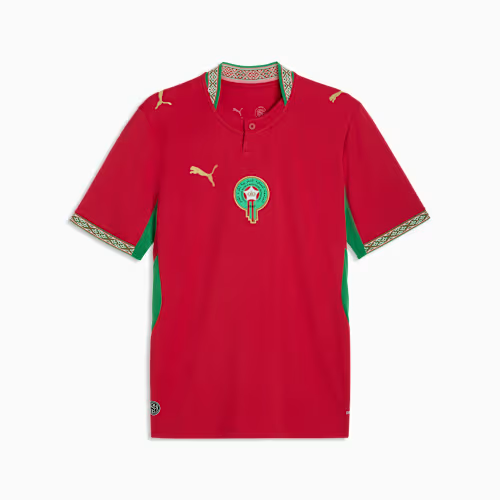
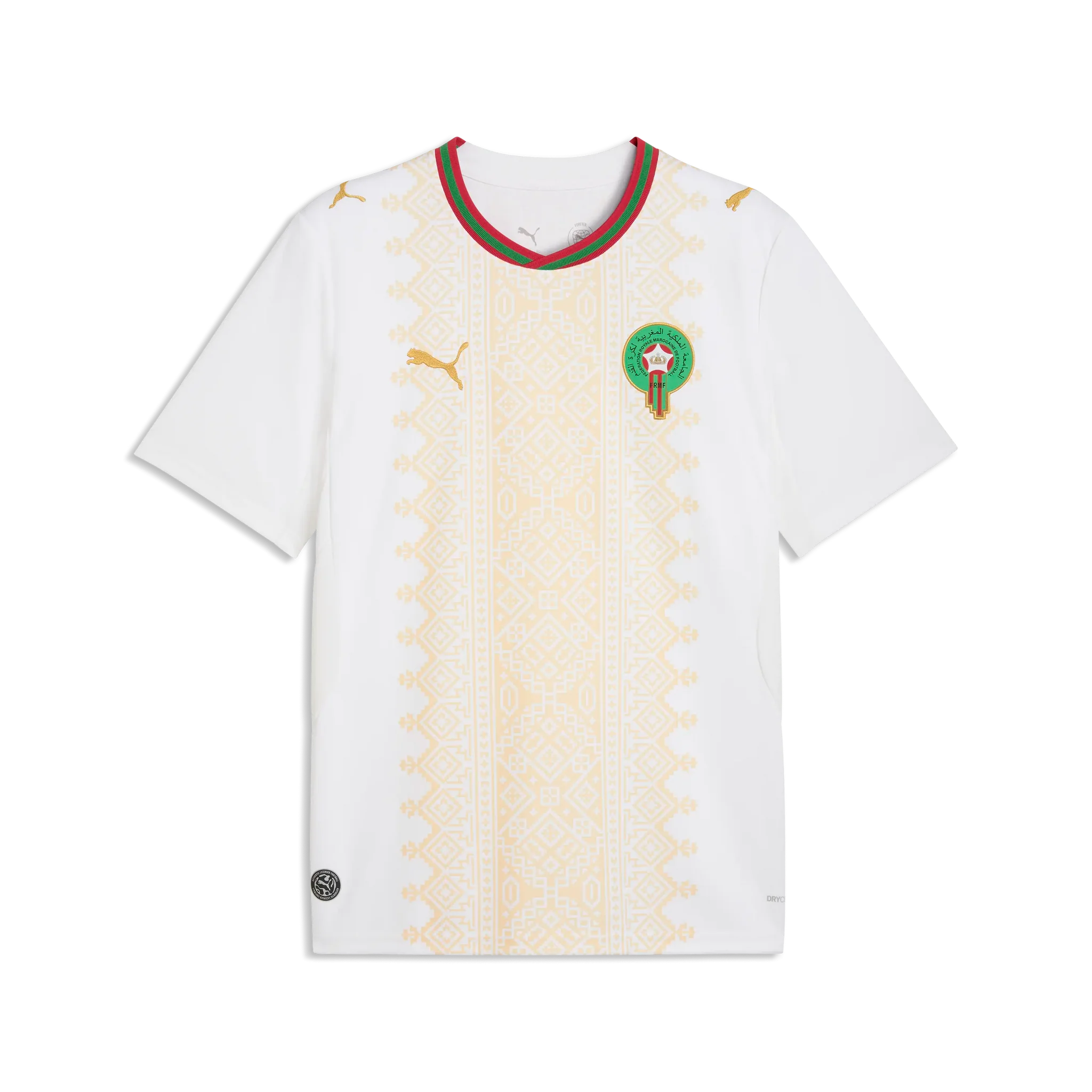
Morocco’s 2026 World Cup kits are produced under their current supplier agreement and draw on the red and green of the Moroccan flag — colours that have become synonymous with some of the most dramatic World Cup moments in football history. The home kit features a bold red base with green detailing and the green pentagram from the national flag woven into the collar design. The away kit uses white as the primary colour with red trim. The first 2026 fixture against Brazil will see Morocco wear red — a colour confirmed by the Moroccan Football Federation ahead of the tournament, as Brazil play in their iconic yellow. The kits carry the weight of 2022 and the ambition of 2026 on every thread.
Morocco at the World Cup — Full Tournament History
Morocco have appeared at the FIFA World Cup seven times — 1970, 1986, 1994, 1998, 2018, 2022, and 2026 — and their history is defined by two breakthrough moments separated by 36 years. In 1986, Morocco became the first African team to top a World Cup group and advance to the knockout stage, only to lose to West Germany 1-0 in the round of 16. In 2022, they became the first African and Arab team to reach a World Cup semi-final — beating Spain on penalties in the round of 16, Portugal 1-0 in the quarter-finals, and losing to France 2-0 before a 1-2 defeat to Croatia in the third-place match. In that 2022 group stage, Morocco beat Canada 2-1, a result that contributed to Morocco’s seven-point haul from three matches and confirmed their dominance at group level before the iconic knockout runs began.
| Year | Stage | Notable Result |
|---|---|---|
| 1970 | Group stage | Debut — 1 draw, 2 losses |
| 1986 | Round of 16 | First African team to top a WC group; lost to West Germany 1-0 |
| 1994 | Group stage | Lost to Belgium, Saudi Arabia, Netherlands |
| 1998 | Group stage | Beat Scotland 3-0 but eliminated on goal difference |
| 2018 | Group stage | Lost to Iran, Portugal and Spain — eliminated |
| 2022 | 4th place | Beat Spain (pens), Portugal 1-0; lost to France 0-2 in SF |
| 2026 | TBD | Group C: Brazil, Scotland, Haiti — FIFA ranked 8th in world |
The trajectory is unmistakable: 1986 (R16), 2022 (SF), and now 2026 with the deepest squad Morocco have ever assembled at a World Cup. Nine players who featured in Qatar 2022 return for the North American edition — including Bounou, Hakimi, Aguerd, Amrabat, and Ounahi — providing the institutional memory that separates a squad that knows what it takes from one that is learning. Ouahbi’s challenge is to take what Regragui built and push it one round further. For a country that has spent 40 years proving African football can compete at the very highest level, reaching a World Cup final in 2026 would be the definitive statement.
Frequently Asked Questions
More World Cup 2026 Team Guides
Explore more 2026 FIFA World Cup team guides — Morocco’s African rivals and other nations competing in North America.