Canada: World Cup 2026 Squad, Fixtures, Standings & Kits


Canada are co-hosts of the 2026 FIFA World Cup — their third-ever appearance at the tournament and their first as a host nation. Jesse Marsch’s side qualified automatically alongside the United States and Mexico when FIFA awarded the hosting rights in 2018, ending any need for qualification. Playing all three group-stage matches on home soil — in Toronto and Vancouver — Les Rouges carry the expectation of an entire nation and the pressure of a generation that believes this is their moment.
Drawn into Group B alongside Switzerland, Bosnia and Herzegovina, and Qatar, Canada face a group that is winnable but demands their very best. Alphonso Davies — born to Ghanaian parents who fled war and eventually settled in Edmonton, Canada, a journey that took him from a refugee camp in Ghana to seven Bundesliga titles with Bayern Munich — captains the side despite a hamstring injury that will see him miss the Group B opener. Jonathan David, the Juventus striker nicknamed ‘The Iceman’ for his cold-blooded finishing, carries 39 international goals into the tournament. Canada open on June 12 at BMO Field in Toronto — a stadium that will be shaking with an energy no away fixture could ever produce.
Canada — FIFA World Cup 2026
Group B · Manager: Jesse Marsch · Home Soil. Highest Stakes.

Contents
What should fans know about Canada at World Cup 2026?
Canada are competing at the 2026 FIFA World Cup in the United States, Mexico, and Canada. They are placed in Group B and are managed by Jesse Marsch. The tournament runs from June 11 to July 19, 2026.
Canada World Cup 2026 Squad — Full 26-Player Roster
Jesse Marsch announced Canada’s official 26-man World Cup squad on May 29, 2026. The group of 3 goalkeepers, 9 defenders, 10 midfielders, and 4 forwards reflects the European depth of the current Canadian generation: Marseille, Bayern Munich, OGC Nice, Celtic, Fulham, Porto, Villarreal, Anderlecht, Sassuolo, and Juventus all provide players. Alphonso Davies of Bayern Munich captains the side despite a hamstring injury, and Jonathan David of Juventus leads the forward line with 39 international goals. At 18 years old, Nathan Saliba of Anderlecht is the youngest player in the squad — a signal that the pipeline Marsch inherited is producing talent faster than ever.
Goalkeepers

Defenders
Midfielders
Forwards
Canada’s Key Players at the 2026 World Cup
Six players define Canada’s ceiling at this tournament. Davies is the engine that makes everything work at its highest level — his injury cloud is the single biggest uncertainty in the entire Canadian campaign. David provides the goals that turn performances into results. Eustáquio gives the midfield its structure and intensity. Buchanan provides the width and unpredictability from wide positions. Koné offers the box-to-box physicality that covers the ground Davies vacates when pushing forward. And Bombito provides the defensive anchor that the entire back four rotates around. With all six performing, Canada can beat anyone in Group B.
Canada’s captain and its most important player by a significant margin. Davies was born in a Ghanaian refugee camp to parents who fled the Second Liberian Civil War, raised in Edmonton, and became one of the world’s best left-backs at Bayern Munich — winning seven Bundesliga titles, a Champions League, and scoring the title-winning goal against Stuttgart in April 2026. His pace at up to 36 km/h, his ability to carry the ball 70 metres in one burst, and his attacking quality combined with defensive discipline make him irreplaceable. A hamstring injury clouds his availability for the opener — but when he plays, Canada are a fundamentally different team.
Known as ‘The Iceman’ for the cold-blooded composure with which he finishes chances, David carries 39 international goals into this tournament — the most of any active Canadian player by a large margin. Born in Brooklyn to Haitian parents, raised in Ottawa, and developed into a serial goalscorer at Gent, Lille, and now Juventus in Serie A. At 26 years old he is the focal point of Canada’s attack and the player every Group B defender will plan around from the moment the tournament begins.
The heartbeat of Canada’s midfield and the player who makes Marsch’s ‘Maplepressing’ system function. Eustáquio at FC Porto has been one of the most consistent central midfielders in the Primeira Liga — winning the ball relentlessly, distributing quickly, and arriving late to score crucial goals. For Canada, he is the engine that bridges the defensive and attacking phases with an intensity that never drops across 90 minutes.
The electric wide midfielder from Brampton, Ontario, who gives Canada direct running and goal threat from the flanks. Buchanan at Villarreal has developed the tactical intelligence to complement his natural explosive pace — pressing high, tracking back, and delivering in dangerous areas from either wing. He provides the width and unpredictability that stretches the defensive shape of every team Canada face, and he thrives on the counter-attacking moments that Marsch’s system creates.
The powerful, dynamic box-to-box midfielder whose physical intensity and ability to carry the ball through traffic gives Canada a genuinely different dimension in the centre of the pitch. Koné at Sassuolo has grown into one of the most physically imposing young central midfielders in Serie B/A football — and for Canada, his energy and directness provide the complement to Eustáquio’s intelligence and positioning. He is 23 years old and entering the first major tournament of what promises to be a long international career.
The centre-back who will anchor Canada’s defensive line in Davies’ absence — and possibly alongside him once the captain returns. Bombito at OGC Nice has established himself as one of the best young defenders in Ligue 1 — technically accomplished, excellent in the air, and commanding enough in his communication to organise an international back four under pressure. His partnership with Derek Cornelius is the defensive foundation Marsch relies on in every match where Davies is not at full fitness.
Jesse Marsch Tactics — ‘Maplepressing’ Explained
Jesse Marsch arrived at Canada with a philosophy he calls ‘Maplepressing’ — a high-intensity, ball-oriented press designed to force turnovers in the opponent’s half and then attack vertically at pace before the defensive structure can recover. His preferred formation is a 4-2-3-1, with Eustáquio and Koné as the double pivot providing the defensive platform, and David operating as the lone striker behind whom Buchanan, the wide forwards, and the attacking midfielder press collectively from the first minute. The system demands extraordinary fitness across every line — and Canada have trained specifically around that physical demand.
Against Bosnia and Herzegovina on June 12, the home crowd at BMO Field will generate an atmosphere that amplifies the pressing system naturally — and Marsch will encourage Canada to use the energy from the stands as a tactical weapon. Against Switzerland on June 24, that said, Marsch may need to adjust to a more conservative 4-4-2 mid-block — Switzerland’s technical quality and tournament experience make them the hardest team in the group to press effectively. The Qatar fixture on June 18 in Vancouver offers the clearest opportunity to express the full Maplepressing identity without conceding the tactical adjustments required against stronger opposition.
| Formation | Style | Key Shape | Primary Strength |
|---|---|---|---|
| 4-2-3-1 | Maplepressing — high ball-win | Eustaquio + Kone pivot; Davies overlaps left;David 9 | Pressing intensity |
| 4-4-2 | Compact mid-block + counters | Double pivot stays; Buchanan + wide mid press flanks | Defensive solidity |
| 4-3-3 | Possession press, wide overloads | Three-mid triangle; Buchanan + Oluwaseyi stretch wide | Width and verticality |
Group B Fixtures — Canada at WC 2026
Matchday viewing routes are covered in the where to watch Canada football guide before kickoff.
Local broadcast times are listed in the Canada FIFA World Cup 2026 TV schedule.
All three of Canada’s group-stage matches take place on home soil — a unique advantage that no host nation ever wastes entirely. The opener against Bosnia and Herzegovina on June 12 at BMO Field in Toronto is the most emotionally charged fixture: the first World Cup match on Canadian soil in the history of the men’s game, with a capacity crowd behind them and Alphonso Davies’ fitness still uncertain. The Qatar match on June 18 at BC Place in Vancouver should deliver three points. The Switzerland fixture on June 24 — also in Vancouver — is the group’s decisive contest, and the one that will determine whether Canada advance as winners or runners-up.
| Date | Match | Venue | City |
|---|---|---|---|
| Jun 12, 2026 | Canada vs Bosnia & Herzegovina | BMO Field | Toronto, Canada |
| Jun 18, 2026 | Canada vs Qatar | BC Place | Vancouver, Canada |
| Jun 24, 2026 | Switzerland vs Canada | BC Place | Vancouver, Canada |
Group B — FIFA World Cup 2026
| Team | Pld | W | D | L | GF | GA | Pts |
|---|---|---|---|---|---|---|---|
| 🇨🇭 Switzerland | 0 | 0 | 0 | 0 | 0 | 0 | 0 |
| 🇨🇦 Canada | 0 | 0 | 0 | 0 | 0 | 0 | 0 |
| 🇧🇦 Bosnia & Herz. | 0 | 0 | 0 | 0 | 0 | 0 | 0 |
| 🇶🇦 Qatar | 0 | 0 | 0 | 0 | 0 | 0 | 0 |
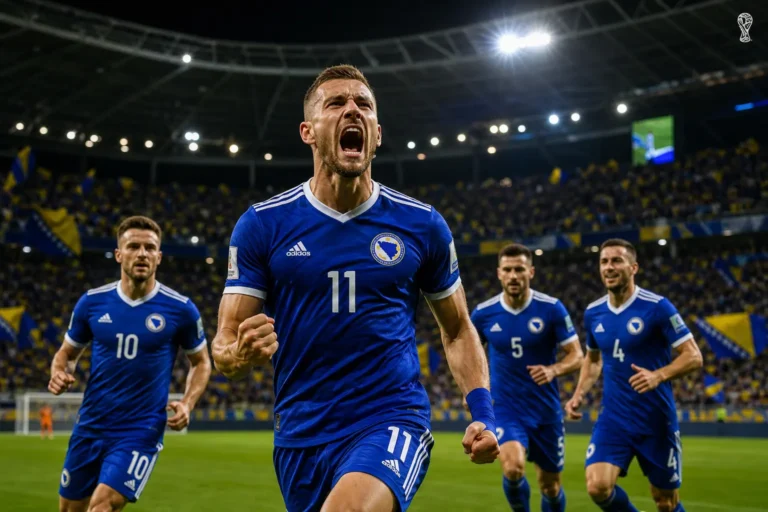
Switzerland are the group favourites — technically refined, tactically disciplined, and with the tournament experience of six consecutive World Cup appearances. They have beaten France, Spain, and Italy in recent knockout rounds and should not be underestimated. Bosnia and Herzegovina knocked out Italy in the play-off final to qualify, and at 40 years old Edin Dzeko leads their attack in what is almost certainly his last major tournament. Qatar arrive having qualified as AFC runners-up but will face intense scrutiny against three opponents who are all better on paper. Canada’s realistic target is second place — finishing above Bosnia and Herzegovina and Qatar while taking at least a point from Switzerland.
Canada as Host Nation — Path to the 2026 World Cup
Canada qualified for the 2026 World Cup automatically as one of three co-host nations alongside the United States and Mexico — a status confirmed when FIFA awarded the hosting rights in 2018. This means Canada played no competitive qualifying matches for 2026. That said, their last qualifying campaign — the 2022 CONCACAF Octagonal — stands as one of the most dominant performances by any CONCACAF nation in history. Canada finished first with 28 points from 14 matches, eight wins, four draws, and two defeats — ending a 36-year absence from the World Cup and confirming this generation as the best Canada have ever produced. That 2022 performance is the foundation everything in 2026 is built upon.
Host Nation — Qualified Automatically · Last Competitive Campaign: CONCACAF 2022 Octagonal (1st, 28 pts)
| Team | Pld | W | D | L | GF | GA | Pts |
|---|---|---|---|---|---|---|---|
| 🇨🇦 Canada | 14 | 8 | 4 | 2 | 23 | 7 | 28 |
| 🇺🇸 USA | 14 | 7 | 4 | 3 | 21 | 10 | 25 |
| 🇲🇽 Mexico | 14 | 7 | 3 | 4 | 17 | 22 | 24 |
| 🇵🇦 Panama | 14 | 5 | 5 | 4 | 17 | 20 | 20 |
| 🇨🇷 Costa Rica | 14 | 6 | 2 | 6 | 17 | 27 | 20 |
| 🇯🇲 Jamaica | 14 | 4 | 3 | 7 | 14 | 22 | 15 |
Canada 2026 World Cup Kits
Canada’s 2026 World Cup kits are manufactured by Nike and reflect the iconic red and white of the national flag — the maple leaf worn with the pride of a nation hosting the tournament for the first time. The home kit is a bold, deep red with white trim and the Canada Soccer crest prominently displayed. The away kit reverses the palette to white as the primary colour with red accents. Both kits are designed to reflect the identity of a country that has spent decades building toward this moment — and now, finally, gets to play it out in front of their own supporters on home soil.
Canada at the World Cup — Full Tournament History
Canada have appeared at the FIFA World Cup three times — 1986, 2022, and 2026. Their history is short but its trajectory is remarkable. The 1986 campaign in Mexico was their debut, and it ended without a point, a goal, or any indication of what was to come. The 2022 qualification was genuinely historic: Canada ended a 36-year absence by topping the CONCACAF Octagonal, but then lost all three group-stage matches in Qatar. The 2026 tournament — hosted on Canadian soil — represents the definitive answer to the question of whether this generation can deliver when the stage is largest.
| Year | Stage | Notable Result |
|---|---|---|
| 1986 | Group stage | Debut: lost to France 1-0, Hungary 2-0, Soviet Union 2-0 — 0 pts, 0 goals |
| 2022 | Group stage | Lost to Belgium 1-0, Croatia 4-1, Morocco 2-1 — Davies scored vs Croatia |
| 2026 | TBD | Group B hosts: Bosnia & Herzegovina, Qatar, Switzerland |
The 40-year gap between 1986 and 2022 tells the story of a nation that struggled for decades to convert the raw athletic talent in its population into organised, technically developed footballers. The investment in academies, MLS infrastructure, and the emergence of a generation who grew up watching Premier League football and dreaming of it changed that. Davies, David, Eustáquio, Buchanan — this is not a group that happened by accident. It was built deliberately, and now it plays the tournament that matters most in front of the people who built it. Canada’s best-ever World Cup result is one round of 16 appearance — and this squad believes they can exceed that.
Frequently Asked Questions
More World Cup 2026 Team Guides
Explore more 2026 FIFA World Cup team guides — from host-nation stories to Africa’s strongest contenders.