Uruguay: World Cup 2026 Squad, Fixtures, Standings & Kits

Uruguay — FIFA World Cup 2026
Group H · Coach: Marcelo Bielsa · Two-Time World Champions
Uruguay arrive at the 2026 FIFA World Cup as two-time champions, 15-time Copa América winners, and one of the most technically gifted squads La Celeste have assembled since the 2010 semi-final generation — a team that includes a Champions League winner, two Premier League regulars, a Real Madrid vice-captain, and the most expensive midfield trio of any South American nation at the tournament. Marcelo Bielsa, who took charge in 2023, announced his final 26-man squad on May 31, 2026, notably excluding Luis Suárez — the all-time top scorer with 69 goals in 143 caps — for the first time since South Africa 2010, ending the greatest goalscoring chapter in Uruguayan football history and passing the torch to Darwin Núñez, Federico Valverde, and a generation that owes nothing to the legends it follows.
Drawn into Group H alongside 2024 European champions Spain, Saudi Arabia, and Cape Verde, Uruguay face a group where second place is the realistic and achievable target. The June 26 final group match against Spain at Estadio Akron in Guadalajara will be the defining fixture of La Celeste’s tournament ambitions — a match between two nations whose World Cup records and squad quality demand a knockout-round meeting. José María Giménez captains Uruguay into his fourth World Cup at 30, while goalkeeper Fernando Muslera, who came out of international retirement, becomes the first Uruguayan to appear at five FIFA World Cup tournaments — a record that belongs to the longest-serving servant in La Celeste’s history.
Contents
What should fans know about Uruguay at World Cup 2026?
Uruguay are competing at the 2026 FIFA World Cup in the United States, Mexico, and Canada. They are placed in Group I and are managed by Marcelo Bielsa. The tournament runs from June 11 to July 19, 2026.
Uruguay World Cup 2026 Squad — La Celeste Official Roster
Marcelo Bielsa announced Uruguay’s final 26-man squad on May 31, 2026. The group is one of CONMEBOL’s most Europe-heavy squads — clubs represented include Real Madrid, Barcelona, Atlético Madrid, Manchester United, Tottenham, Napoli, Flamengo, Fluminense, Palmeiras, Sporting CP, and more. Bielsa notably excluded Luis Suárez (69 goals, 143 caps), ending the greatest individual scoring chapter in Uruguayan football history. Fernando Muslera, 38, returned from international retirement to join the squad as backup goalkeeper — and will become the first Uruguayan player to appear at five World Cups.
Goalkeepers

Defenders
Midfielders
Forwards
Uruguay’s most complete player and arguably the finest box-to-box midfielder in world football — a 73-cap international who serves as vice-captain of Real Madrid after the departures of Modríć and Vascão. Valverde brings Champions League-tested composure, 9 international goals, and the physical intensity that drives Bielsa’s system from its midfield core. His ability to press hard, drive from deep, and arrive late in the penalty box makes him the single most dangerous player in Uruguay’s squad — a midfielder who combines defensive discipline with attacking output that no other Uruguayan in this squad can replicate at elite level.
Uruguay’s top scorer in CONMEBOL qualifying with five goals — and the striker who has been building toward a World Cup performance since his £85 million transfer to Liverpool in 2022. Núñez moved to Al-Hilal in 2025 and reached an agreement to leave the Saudi club, with a European return expected after the tournament. His pace, physicality, and finishing in the box give La Celeste a genuine cutting edge that no back four in Group H can ignore — a player whose combination with Valverde’s late runs creates the most dangerous attacking partnership Uruguay have fielded at a World Cup since Forlan and Suárez in 2010.
Uruguay’s captain and the defensive cornerstone of Bielsa’s system — an Atlético Madrid centre-back entering his fourth World Cup at 30, with approaching 100 international caps. Giménez has been one of La Liga’s most reliable central defenders across a decade at the Metropolitano. His reading of the game, aerial dominance, and leadership under pressure are precisely what a Bielsa team that presses aggressively requires as its defensive anchor. Alongside Ronald Araújo, he forms arguably the best centre-back partnership of any South American nation at this tournament.
The Manchester United defensive midfielder who provides the destructive midfield base around which Valverde and Bentancur are free to operate — a player PSG paid €60 million for in 2023 before his move to Old Trafford. Ugarte’s combination of pressing intensity, ball recovery, and positional intelligence makes him the midfield engine that transforms Uruguay from a technically gifted side into a genuinely difficult team to break down. His duels won per 90 minutes rank among the highest of any defensive midfielder in the Premier League — a quality that translates directly into the high-press system Bielsa demands.
The Barcelona centre-back who brings La Liga’s most physically commanding defensive presence to Uruguay’s back line — combining exceptional pace, aerial ability, and 1v1 defending with the technical confidence to play out under pressure that Barcelona demands. Araújo’s partnership with Giménez gives Uruguay a central defensive pairing with Champions League experience, elite club pedigree, and leadership quality that makes the difference in knockout football. At 25, this is his first World Cup as an undisputed first-choice starter rather than a squad player.
The Fluminense playmaker who is Uruguay’s most creative passer and the link between Bielsa’s midfield and attacking line — a technically gifted number ten whose vision, through-ball delivery, and ability to find space in tight areas give La Celeste a dimension that pure energy-and-pressing midfielders cannot provide. De Arrascaeta has been one of South American club football’s most consistent creators over the past three seasons and his chemistry with Núñez and Valverde in the national team setup is one of Bielsa’s most trusted and tested attacking combinations.
Uruguay Tactics Under Bielsa — Press, Valverde and the Núñez Question
Marcelo Bielsa’s Uruguay deploy a high-energy 4-4-2 / 4-3-3 built around the positional superiority of their midfield and an aggressive press that aims to recover the ball within five seconds of losing possession. Valverde operates as the right-sided box-to-box midfielder — free to drive forward, press hard, and arrive late in the box — while Ugarte anchors the base of the midfield as the single pivot that protects the back four. Bentancur provides the left-sided midfield intelligence and technical quality that completes Bielsa’s midfield triangle. Núñez leads the press from the front, using his pace to unsettle centre-backs into errors under pressure — a role that suits his direct running style more than the positional striker role many European clubs have tried to force on him.
The June 26 final group match against Spain at Estadio Akron in Guadalajara is the tactical test that will define Uruguay’s tournament. Spain’s possession-based system, built around Pedri and Gavi’s control of the tempo and Yamal’s width, directly challenges Bielsa’s press — which works when Uruguay can force turnovers high but becomes vulnerable when a technically superior side plays through it. Bielsa has enough creative depth — de Arrascaeta, de la Cruz, Pellistri — to adjust tactically between fixtures. But the biggest question mark is not tactical: it is whether Núñez, fresh from a difficult Saudi spell, can rediscover the finishing efficiency that made him worth £85 million at Liverpool in 2022.
| Formation | Style | Key Shape | Primary Strength |
|---|---|---|---|
| 4-3-3 | High press + width | Valverde box-to-box; Ugarte pivot; Núñez + wide runners | Midfield dominance & pressure |
| 4-4-2 | Press + dual striker | Valverde + Bentancur wide; two strikers Núñez + Aguirre | Direct play and second ball wins |
| 3-5-2 | Possession + wide runners | Three-man back; five-man mid; fullbacks as wingbacks | Flexibility vs. strong possession teams |
Group H Fixtures — Uruguay at WC 2026
Matchday viewing routes are covered in the where to watch Uruguay football guide before kickoff.
Uruguay’s Group H schedule is front-loaded in the most favourable way: two manageable fixtures before the defining Spain encounter in the final game. The June 15 opener against Saudi Arabia in Miami at Hard Rock Stadium is the fixture Bielsa’s squad are expected to win — Saudi Arabia arrive in transition after a coaching change and without the shock-factor of 2022. The June 21 second game against Cape Verde at Hard Rock Stadium is equally winnable — the island nation making a strong continental debut but facing an opponent with significantly greater resources. Uruguay vs Spain on June 26 is the group’s prestige fixture — a clash of two nations whose combined 17 Copa América and World Cup titles represent one of football’s defining rivalries of different eras.
Local viewers can use the Uruguay FIFA World Cup 2026 TV schedule for DSPORTS, DGO, Canal 5, Antel TV, SECAN, kickoff times, and streaming information.
| Date | Match | Venue | City |
|---|---|---|---|
| Jun 15, 2026 | Saudi Arabia vs Uruguay | Hard Rock Stadium | Miami Gardens, FL |
| Jun 21, 2026 | Uruguay vs Cape Verde | Hard Rock Stadium | Miami Gardens, FL |
| Jun 26, 2026 | Uruguay vs Spain | Estadio Akron | Guadalajara, Mexico |
Group H — FIFA World Cup 2026
| Team | Pld | W | D | L | GF | GA | Pts |
|---|---|---|---|---|---|---|---|
| 🇪🇸 Spain | 0 | 0 | 0 | 0 | 0 | 0 | 0 |
| 🇺🇾 Uruguay | 0 | 0 | 0 | 0 | 0 | 0 | 0 |
| 🇸🇦 Saudi Arabia | 0 | 0 | 0 | 0 | 0 | 0 | 0 |
| 🇨🇻 Cape Verde | 0 | 0 | 0 | 0 | 0 | 0 | 0 |
Spain enter Group H as one of the tournament’s three or four outright favourites — the 2024 European champions with a squad that includes Lamine Yamal (18), Pedri, Gavi, and Morata in a generation that represents the peak of La Roja’s latest golden era. Saudi Arabia arrive as one of Asia’s stronger qualifiers, boosted by the domestic league’s continued investment in elite players, but without the element of surprise that defined their 2022 win over Argentina. Cape Verde qualify for only their second World Cup and represent the African continent’s most improved competitive force. Uruguay’s target is second place and a knockout-round berth — La Celeste have the squad quality to finish above Saudi Arabia and Cape Verde and to take at least a point from Spain in Guadalajara.
CONMEBOL Qualifying — Uruguay’s Defining Wins
Uruguay qualified fourth from CONMEBOL’s South American section with 28 points from 18 matches — seven wins, seven draws, and four defeats. The campaign’s defining moments came back-to-back in October and November 2023: a 2-0 win over Brazil at the Estadio Centenario in Montevideo, followed 29 days later by a 2-0 win over Argentina in Buenos Aires — consecutive victories over the continent’s two most powerful nations that confirmed Uruguay’s status as a genuine World Cup contender and not simply a qualifier. Uruguay conceded just 12 goals across 18 CONMEBOL matches — the second-tightest defensive record of any South American qualifier. Darwin Núñez finished as Uruguay’s top qualifier scorer with five goals.
CONMEBOL South America — 4th Place · 7W 7D 4L · 22 GF · 12 GA · 28 Points
| Team | Pld | W | D | L | GF | GA | Pts |
|---|---|---|---|---|---|---|---|
| 🇦🇷 Argentina | 18 | 12 | 2 | 4 | 33 | 12 | 38 |
| 🇪🇨 Ecuador | 18 | 8 | 8 | 2 | 14 | 5 | 29 |
| 🇨🇴 Colombia | 18 | 8 | 5 | 5 | 22 | 17 | 29 |
| 🇺🇾 Uruguay | 18 | 7 | 7 | 4 | 22 | 12 | 28 |
| 🇧🇷 Brazil | 18 | 7 | 5 | 6 | 21 | 19 | 26 |
Uruguay 2026 World Cup Kits
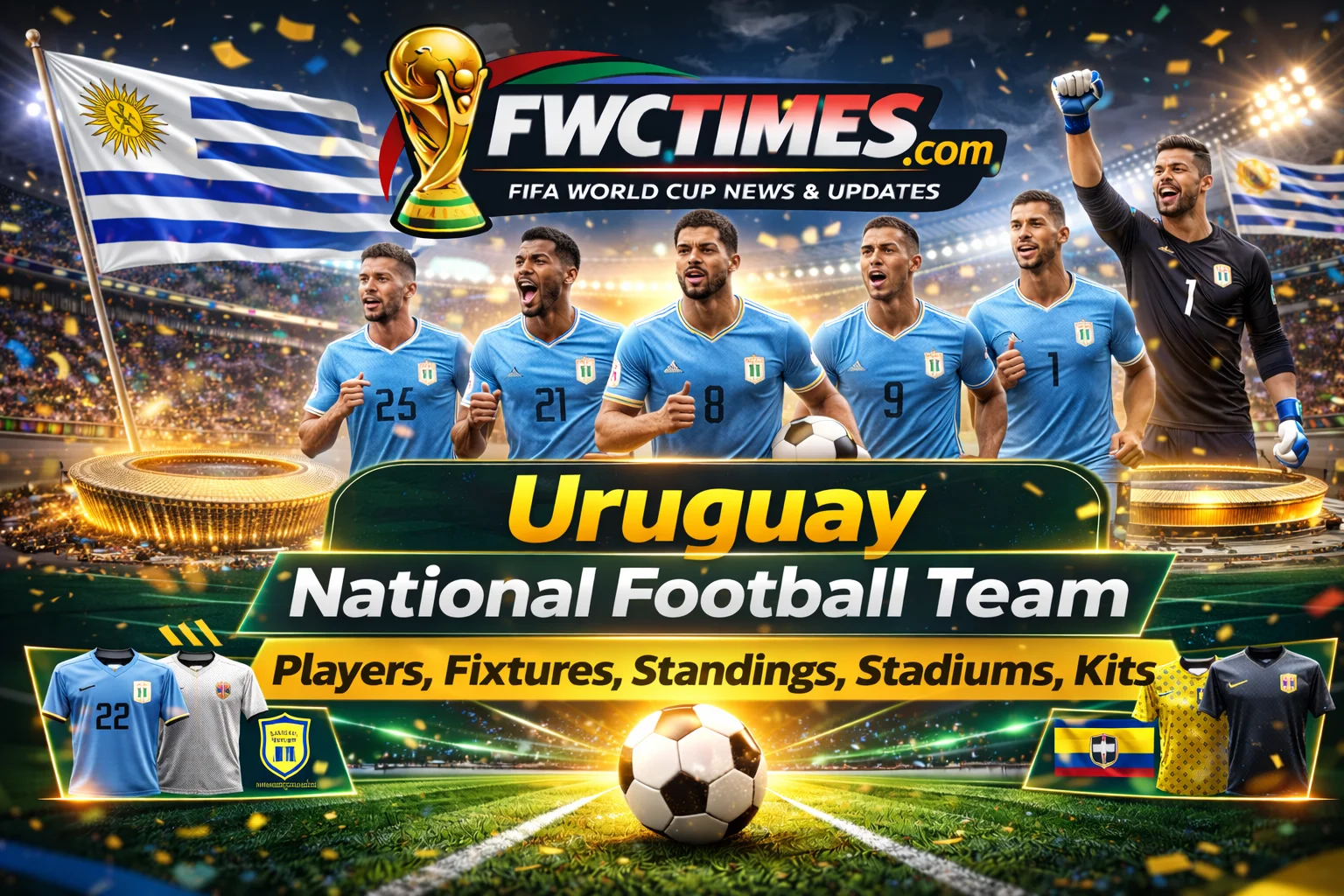
Uruguay’s iconic celeste — the light blue that has become one of football’s most recognisable national colours — returns as the home kit for the 2026 World Cup. The celeste carries the four stars above the AUF crest, representing Uruguay’s two Olympic gold medals (1924, 1928) and two World Cup titles (1930, 1950) — a badge load matched by no other nation in the tournament. The away kit uses white as the primary colour with celeste trim. Kit supplier PUMA continues their partnership with the AUF for 2026. The celeste was first worn at the 1930 World Cup — the same tournament Uruguay won on home soil. No other shade of blue in football carries quite the weight of that history.
Uruguay at the World Cup — Full Tournament History
Uruguay are one of only eight nations to have won the FIFA World Cup — and the only nation to have won it twice before 1960. Their 1930 triumph on home soil in Montevideo — beating Argentina 4-2 in the final at the Estadio Centenario — was the birth of World Cup football. Their 1950 Maracanãzo — the 2-1 victory over hosts Brazil in the deciding match at the Maracanã in front of an estimated 173,850 people — remains the largest upset in World Cup history by consensus. Uruguay reached the 2010 semi-finals under Óscar Tabarez, with Diego Forlan winning the Golden Ball and Luis Suárez’s handball on the line against Ghana becoming the most controversial moment in the tournament’s modern era. In the round of 16, they eliminated the Netherlands… actually, they lost to the Netherlands 2-3 in the 2010 semi-final before losing the third-place match 3-2 to Germany. At 2018 in Russia they reached the quarter-finals. At 2022 in Qatar, Uruguay were eliminated in the group stage despite losing only one match — they went out on goal difference in the most agonising group-stage exit in their history, finishing behind South Korea on goals scored.
| Year | Stage | Notable Result |
|---|---|---|
| 1930 | Winners | Won inaugural World Cup — beat Argentina 4-2 in Montevideo final |
| 1950 | Winners | Maracanãzo — beat Brazil 2-1 in front of 173,850 at Maracanã |
| 1954 | Semi-finals | Lost to Hungary 2-4 in semi-final |
| 1970 | 4th place | Lost to Brazil 1-3 in semi-final; lost 3rd place vs West Germany |
| 2010 | 4th place | Forlan Golden Ball; Suárez handball vs Ghana; lost SF to Netherlands 2-3 |
| 2014 | Round of 16 | Suárez bite ban; lost to Colombia 0-2 in R16 |
| 2018 | Quarter-finals | Beaten by France 0-2 in QF; Cavani brace ruled out by VAR |
| 2022 | Group stage | Eliminated on goal difference — drew Portugal 2-0 but went out behind South Korea |
| 2026 | TBD | Group H: Spain, Saudi Arabia, Cape Verde — 4th in CONMEBOL qualifying |
The 2022 group-stage elimination stings hardest because Uruguay were not outplayed — they were undone by mathematics in the cruelest possible way. Bielsa’s appointment in 2023 was a statement of intent: the most demanding tactical mind in South American football, tasked with rebuilding a squad that had lost Cavani, was losing Suárez, but still had Valverde, Araújo, Giménez, and Ugarte available. The two consecutive wins over Brazil and Argentina in qualifying confirmed the rebuild was real. In 2026, Uruguay bring the deepest and most tactically coherent squad they have fielded since Tabarez’s 2010 semi-finalists — with the added weight of knowing that 2022’s group-stage exit cannot happen again.
Frequently Asked Questions
More World Cup 2026 Team Guides
Explore more FIFA World Cup 2026 team guides — Uruguay’s Group H rivals and fellow South American nations.