Jearl Margaritha: SK Beveren and Curaçao Profile 2026

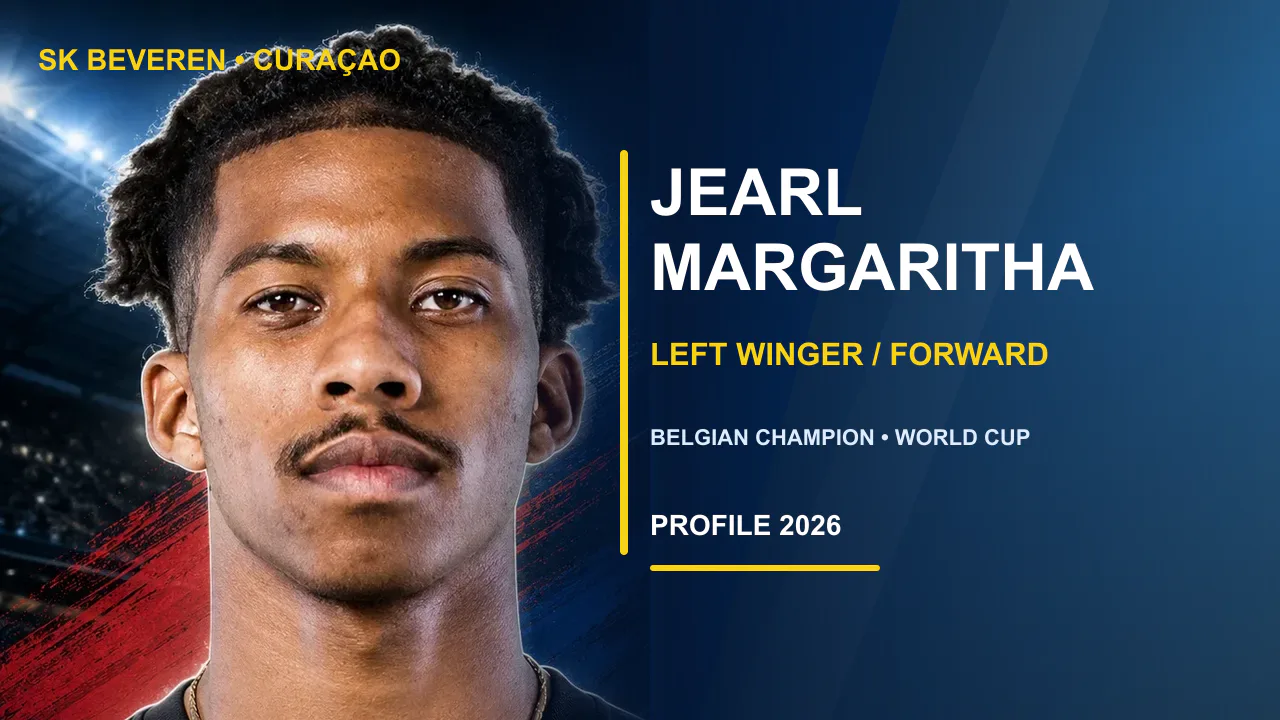
Jearl Margaritha is a Curaçao international winger who plays for SK Beveren. Born in Groningen on 10 April 2000, he rebuilt his career after early academy setbacks, became a productive professional in the Netherlands, played in Azerbaijan and the United States, then returned to Europe for a title-winning season in Belgium. His path also led to Curaçao’s historic 2026 FIFA World Cup campaign.
This profile separates verified career facts from interpretation. Club announcements, official competition reports, Concacaf match coverage and FIFA tournament documents support the dates, appearances and match events below. The focus is on how Margaritha reached his current level, what he does on the pitch and where he fits for club and country.
Jearl Margaritha profile at a glance
- Full name: Jearl Erwin Margaritha
- Date of birth: 10 April 2000
- Birthplace: Groningen, Netherlands
- Height: 1.81 metres, according to FIFA’s 2026 squad list
- Primary position: Left winger
- Other roles: Right winger and centre-forward
- Club: SK Beveren
- SK Beveren number: 17
- National team: Curaçao
- 2026 World Cup number: 16
Where does Jearl Margaritha play in 2026?
Margaritha is an SK Beveren player. The Belgian club signed him from Phoenix Rising in August 2025 on a three-year agreement running through 2028. The move returned him to European football after his season in the United States and placed him in a squad built to challenge for promotion.
That challenge ended successfully. SK Beveren won the 2025/26 Challenger Pro League and earned promotion to Belgium’s top division. Margaritha was part of the attacking group throughout the campaign, creating chances from wide areas and adding goals in important league matches. His current status therefore rests on more than a transfer announcement: he contributed during a complete championship season.
Why SK Beveren signed him
SK Beveren’s introduction described Margaritha as a fast left-sided attacker who can operate in small spaces, attack depth and threaten goal. Those qualities matched his earlier record. He had already shown that he could score from a wide starting position at TOP Oss and produce both goals and assists for Phoenix Rising.
The contract also gave both player and club a longer development window. A deal through 2028 meant Beveren was recruiting a player for the promotion push and the seasons beyond it. Margaritha arrived at age 25, old enough to bring experience from several countries but still at a stage where tactical detail and consistency can improve.
His role in the SK Beveren attack
Margaritha is most naturally used from the left. From that side he can receive close to the touchline, carry the ball toward a defender and either continue outside or move onto his right foot. The second route lets him combine with a forward, shoot or release an overlapping teammate.
He is not fixed to one narrow corridor. His senior career includes minutes on both wings and through the middle. That flexibility helps a coach change the shape of the front line without making an immediate substitution. It also gives Margaritha different ways to attack a full-back who has adjusted to his first movement.
Width, diagonal runs and rotations
When Beveren build against a compact defence, Margaritha can hold the width and stretch the last line. When the ball is on the opposite side, he can move diagonally into the area and behave more like a second striker. These off-ball movements matter because his contribution is not limited to dribbling in isolation.
He can also rotate with an advancing full-back. If the full-back overlaps, Margaritha may move inside and receive between the opposition’s midfield and defence. If the full-back stays deeper, the winger can remain outside and become the direct outlet. The best version of his game comes when those decisions are made early.
Early football years in Groningen
Margaritha grew up in Groningen and spent time in the youth structures of FC Groningen, GVAV and FC Emmen. His route was not a straight academy-to-first-team promotion. He encountered rejection and had to find senior football below the professional divisions before climbing again.
That background is central to his career. Many professional profiles begin after a player signs a first contract, but Margaritha’s progress is easier to understand when the years before TOP Oss are included. He needed competitive matches, responsibility and visible end product to reopen the professional door.
Why the academy setbacks matter
An academy release does not offer a reliable prediction of a player’s final level. Development speed, physical maturity, positional opportunity and the needs of one age-group squad can all affect the decision. Margaritha responded by seeking minutes rather than waiting for the same route to reopen.
That choice exposed him to senior defenders and matches in which results mattered. It also required him to create his own momentum. The next step, VV Hoogeveen, became the practical bridge between youth football and his later professional career.
VV Hoogeveen breakthrough
Margaritha joined VV Hoogeveen in the summer of 2019. Phoenix Rising’s later career summary credited him with 11 goals in 13 appearances there. The sample was short, but the output was strong enough to attract professional attention.
Scoring at that rate showed two useful traits. First, he could turn athletic and technical ability into decisive actions in senior matches. Second, he could adapt after leaving academy football. Those goals helped him move to Almere City in early 2020.
A productive reset
Hoogeveen was not an endpoint. It was the stage on which Margaritha made himself relevant to professional clubs again. The period illustrates a recurring theme in his career: when the route changed, he found competitive minutes and used output to earn the next move.
Almere City and the professional transition
Almere City brought Margaritha back into the Dutch professional system. This phase was important even though his most productive Dutch season would come later. Training and competing in a professional environment demanded quicker decisions, more disciplined positioning and repeated defensive work.
A winger moving up from semi-professional football cannot rely only on beating a defender. He must understand pressing triggers, recovery runs, rest defence and how to preserve the team’s spacing. Almere provided part of that education before Margaritha moved to TOP Oss.
Learning the full winger role
The professional version of a wide attacker has responsibilities before and after possession. Margaritha had to decide when to press the opposing full-back, when to block an inside passing lane and when to drop with a runner. These details are less visible than a goal, but they influence whether a coach can trust a winger to start regularly.
TOP Oss development
TOP Oss became the club where Margaritha established a clear professional record. SK Beveren’s signing announcement later summarized his TOP Oss spell as 63 appearances, 18 goals and 14 assists. That total shows sustained involvement rather than one isolated run of form.
He gained experience against organised professional defences and learned how opponents reacted to his speed. Full-backs could give him extra distance, show him toward the line or send a second defender. His task was to recognise the solution: combine quickly, attack the open lane or move into a different zone.
The 2022/23 season
TOP Oss reported that Margaritha finished 2022/23 as the team’s leading scorer with 12 goals and six assists. Those figures represented his strongest single Dutch professional season and created interest outside the Netherlands.
The balance between goals and assists is important. A winger who can only finish becomes easier to scheme against, while a winger who only creates may not punish defenders who protect the pass. Margaritha’s production showed both outcomes and helped secure a move to Sabah FC.
Transfer to Sabah FC
Margaritha joined Sabah FC in Azerbaijan in June 2023. TOP Oss announced the transfer, while later club records described a four-year agreement. Moving abroad was a new test: different opponents, travel demands, coaching ideas and expectations away from the Dutch system.
Phoenix Rising’s official introduction credited him with 19 top-flight appearances and one assist for Sabah. It was a quieter statistical spell than his final TOP Oss season, but it added international club experience and placed him in another tactical environment.
What the Azerbaijan spell added
Short overseas spells can still change a player. Margaritha had to compete for selection without the familiarity of Dutch football and adapt to a league where transition moments and match rhythm differed. The experience also preceded his senior international breakthrough with Curaçao.
Phoenix Rising move
Phoenix Rising signed Margaritha in August 2024 on a multi-year deal. Head coach Diego Gómez highlighted his quick feet, speed and willingness to attack opponents one against one. The club viewed him as an attacker who could add directness to the front line.
The move to the USL Championship offered regular minutes and a style suited to his strengths. Phoenix could use him in open-field transitions, but he also had to solve set defensive blocks and contribute without the ball.
Goals and assists in Arizona
When Phoenix transferred Margaritha to SK Beveren in August 2025, the club credited him with 26 appearances, 19 starts, six goals and five assists across all competitions. That is the cleanest official summary of his time in Arizona.
One match showed his direct threat clearly. Against Loudoun United, he made a late attacking run, moved inside and scored the goal in a 1-0 victory. Phoenix’s report also recorded a 2025 goal away to Colorado Springs. These moments helped maintain his profile before the return to Europe.
Why the Phoenix spell worked
Margaritha combined individual threat with useful team production. Six goals and five assists meant he influenced attacks in more than one way. Regular starts also gave him a run of competitive football after the smaller role at Sabah.
Return to Europe with SK Beveren
SK Beveren completed the transfer on 4 August 2025. Phoenix announced the outgoing move on the same date, providing a clear link between the two stages of his career. Margaritha joined a club pursuing promotion and immediately faced competition for attacking places.
His early months supplied evidence that his skills transferred back to Europe. In a 3-0 win against Jong Gent, Beveren reported his first goal for the club as well as an assist. The performance gave him a concrete contribution soon after arrival.
Brace against KV Kortrijk
Margaritha scored twice in a 3-1 league win over KV Kortrijk in October 2025. A brace against another promotion contender carried more weight than a routine appearance. It showed that he could affect a match with finishing as well as wide creation.
The 2025/26 championship season
SK Beveren controlled the Challenger Pro League race. The Pro League reported that the club secured promotion with a 19-point advantage over third place, describing it as the fastest promotion achieved in the competition’s history. Beveren then completed the season with 28 victories and a Belgian record.
Margaritha’s contribution fits within that team achievement. He was part of a wide attacking rotation that created chances, pressed opponents and supported a powerful scoring record. His season cannot be reduced to one match, but one late campaign moment stands out.
Assist in the title-clinching comeback
Against RWDM, Beveren came from behind to win 3-1 and confirm the championship. The club’s report recorded Margaritha supplying the assist for Hannes Van Hecke during the comeback. It was an appropriate contribution from a winger whose chance creation had been valuable during the campaign.
The result secured the trophy as well as promotion. For Margaritha, it delivered his first Belgian league title in the same season as his return from the United States.
What promotion changes
Promotion raises the weekly level of opposition. Space closes faster, full-backs recover more quickly and turnovers are punished more severely. Margaritha’s contract gives him the opportunity to compete for a role in that environment.
His experience across several leagues should help with adaptation, but selection will still depend on detail: the quality of his first touch under pressure, his defensive positioning and how consistently he converts promising attacks into shots or chances.
Jearl Margaritha playing style
Margaritha is a direct winger. He is comfortable receiving wide and confronting a defender, especially when he has room to accelerate. His quick feet allow him to adjust the ball before the defender fully commits, while his speed makes an early mistake difficult to recover from.
He also makes runs behind the defence. That matters against teams that protect central spaces and challenge wingers to attack the back line. A well-timed run can receive a pass directly or pull a full-back away from another attacker.
One-against-one ability
Phoenix explicitly identified one-against-one play as a strength when he signed. The goal is not dribbling for its own sake. Beating the first opponent must lead to a better team situation: a cutback, a shot, a cross or a pass that forces the defence to rotate.
Margaritha is most dangerous when he receives with his body prepared to move forward. If he takes the ball flat-footed and close to the line, the defender can contain him. If he receives on the move, he can threaten both directions.
Chance creation
His assist records at TOP Oss, Phoenix and Beveren reflect a player who can create from wide zones. He can deliver after going outside, but his inside movement is equally useful because it opens a pass into the striker or attacking midfielder.
The next level is repeatability. Better opponents may allow only one or two clean crossing positions. The weight, timing and target of the final pass then become as important as the run that created the opening.
Finishing from wide positions
The 12-goal season at TOP Oss and the Kortrijk brace show that Margaritha can finish. His diagonal movement lets him arrive in scoring areas without beginning as the central striker. He can also shoot after carrying inside from the left.
Shot selection remains a useful measure of his performance. A rushed attempt from a narrow angle may end an attack, while one extra pass can create a clearer chance. The best wide scorers preserve their aggression while choosing the right moment.
Work without the ball
Modern wing play includes pressing and recovery. Margaritha may be asked to close a centre-back, force play toward the touchline or follow an opposing full-back. The exact job changes with the team’s defensive shape.
His speed is helpful, but positioning comes first. Starting from the correct distance reduces the ground he must cover and prevents an opponent from passing around the press. At a higher league level, these details can determine whether he starts, enters as an impact substitute or misses the rotation.
Transition defence
When possession is lost, a winger has to judge whether to counter-press or recover. Chasing without support can open a passing lane, while retreating too early can release pressure. Margaritha’s multi-country experience has exposed him to different versions of this decision.
Curaçao senior debut
Margaritha made his Curaçao senior debut on 7 September 2023 against Trinidad and Tobago in the Concacaf Nations League. Concacaf’s match report noted that he reached a late one-against-one situation, but the goalkeeper saved his attempt in Curaçao’s 1-0 defeat.
The debut connected his club development with an international team that was expanding its player pool. Curaçao could use his speed on the left or deploy him across the front line, depending on the available forwards and the opponent.
Competition for attacking places
Curaçao’s squad includes attackers with experience in several European leagues. Margaritha therefore has to offer a distinct function. His direct running, ability to cover multiple front-line positions and willingness to enter matches at pace make him useful as both a starter and substitute.
For related profiles, see Leandro Bacuna, Jeremy Antonisse and Gervane Kastaneer.
Four-goal international match
Margaritha delivered his most productive Curaçao performance against Saint Martin in November 2024. Concacaf recorded four goals in a 5-0 Nations League victory, with two in each half.
The goals came through different actions. Concacaf described footwork followed by a powerful finish for the first, a backheel for the second and a loose-ball finish after a sprint for the third. Variety matters here: the performance was not four copies of the same chance.
What the four goals showed
The match demonstrated confidence, movement and composure. International opponents vary in level, so one result should not define a player, but four goals in a competitive senior fixture remain a significant achievement.
It also strengthened Margaritha’s case for future squads. Coaches need evidence that an attacker can turn favourable positions into goals. That night supplied it decisively.
2026 World Cup qualifying contribution
Margaritha contributed during Curaçao’s qualifying campaign. Concacaf reported his individual play creating Juninho Bacuna’s goal against Aruba, an example of chance creation rather than finishing. He later scored in the 69th minute of a 5-1 win against Haiti.
Those actions supported Curaçao’s progress through the qualification process. They also showed that his international value extended beyond the four-goal Nations League match.
Role in a historic campaign
Curaçao’s qualification carried historic significance for the country. Margaritha was one part of a broader squad effort led by experienced players and a structured coaching staff. His wide threat gave the team another route when central areas were crowded.
Our Curaçao 2026 World Cup squad guide provides the wider tournament context. Other squad profiles include Livano Comenencia, Kevin Felida, Godfried Roemeratoe and Eloy Room.
Selection for the 2026 FIFA World Cup
FIFA’s final squad list included Margaritha as Curaçao’s number 16. The document listed his full name, 10 April 2000 birth date, SK Beveren as his club, a height of 181 centimetres and a pre-tournament international record of 24 caps and five goals.
Selection confirmed that his club title season and qualifying involvement had earned a place at the highest international tournament. He was not guaranteed a starting position, but his pace offered a change-of-game option from the bench.
Appearance against Germany
Margaritha entered Curaçao’s opening group match against Germany in the 65th minute, replacing Jürgen Locadia. FIFA’s post-match report credited him with 31 minutes including added time, 3,212.1 metres covered and a top speed of 30.7 kilometres per hour.
He also registered a right-footed attempt in the 75th minute that went off target. Germany won 7-1, so the wider match situation was difficult, but the appearance made Margaritha a World Cup player and supplied an official record of his contribution.
Appearance against Ecuador
He came on again against Ecuador, replacing Tahith Chong in the 75th minute. Curaçao earned a 0-0 draw, a markedly different contest from the opener. FIFA’s records credited Margaritha with 20 minutes including added time.
Entering late in a level match requires control as well as speed. A substitute must offer an outlet without abandoning the team’s defensive plan. The draw gave Curaçao a tournament point and Margaritha his second appearance.
Côte d’Ivoire match
Margaritha was an unused substitute in the group match against Côte d’Ivoire. He therefore finished the tournament with two substitute appearances and no goals. That exact record is more useful than implying he played in all three fixtures.
Club and country fit
SK Beveren and Curaçao can ask Margaritha to perform different versions of the winger role. Beveren may control more possession in some domestic matches, requiring patient movement against a set defence. Curaçao often face opponents who leave more transition space but can also pin the team deeper.
His ability to play on either wing or centrally helps both coaches. For Beveren it supports rotation across a long season. For Curaçao it lets the staff change the front line during a match without using multiple substitutions.
Starter or impact substitute?
There is no single answer across every opponent. Margaritha can start when a team needs width and direct running from the first minute. He can also be effective against tiring defenders, as his two 2026 World Cup appearances showed.
The role will depend on form, team shape and the profiles around him. A mobile striker can create lanes for his diagonal runs, while an overlapping full-back can free him to move inside.
Areas that can still improve
Margaritha has already rebuilt his career and produced at professional and international level. Improvement now concerns consistency at a higher weekly standard. The promoted Belgian division will test his speed of thought as much as his running speed.
Final-ball quality, shot choice and defensive spacing are the clearest areas to monitor. These are normal development points for an attacking winger. Progress would make his direct qualities more reliable against stronger defenders.
Decision-making near the box
A winger often has several reasonable options within a second: shoot, cross, cut back, combine or retain possession. The strongest decision depends on teammate positions and the defender’s balance. Margaritha’s production rises when his first action creates time for a composed second one.
Consistency across match states
Open matches naturally suit his acceleration. The next challenge is influencing slow games in which the opponent defends deep and denies space behind. Short combinations, movement away from the ball and patient recycling become more important in those conditions.
Career timeline
- 2019: Joined VV Hoogeveen and produced a senior scoring breakthrough.
- 2020: Returned to professional football with Almere City.
- 2021 to 2023: Established himself at TOP Oss.
- 2022/23: Led TOP Oss with 12 goals and added six assists.
- June 2023: Transferred to Sabah FC in Azerbaijan.
- September 2023: Made his Curaçao senior debut.
- August 2024: Signed for Phoenix Rising.
- November 2024: Scored four times for Curaçao against Saint Martin.
- August 2025: Joined SK Beveren on a contract through 2028.
- 2025/26: Helped SK Beveren win the Challenger Pro League and promotion.
- 2026: Made two substitute appearances at the FIFA World Cup.
Frequently asked questions
What club does Jearl Margaritha play for?
He plays for SK Beveren. He joined the Belgian club from Phoenix Rising in August 2025 on an agreement through 2028.
What position does he play?
His primary position is left winger. He can also play from the right or as a central forward.
Which national team does he represent?
He represents Curaçao at senior international level. He was born in Groningen in the Netherlands and is eligible through his Curaçao heritage.
Did Jearl Margaritha play at the 2026 World Cup?
Yes. He appeared as a substitute against Germany and Ecuador. He was an unused substitute against Côte d’Ivoire.
How many goals did he score against Saint Martin?
He scored four goals in Curaçao’s 5-0 Concacaf Nations League victory in November 2024.
Did he win a title with SK Beveren?
Yes. SK Beveren won the 2025/26 Challenger Pro League and earned promotion. Margaritha assisted a goal in the 3-1 comeback against RWDM that confirmed the championship.
Primary sources used for this profile
- SK Beveren: Jearl Margaritha signing announcement
- SK Beveren: championship match report against RWDM
- SK Beveren: final 2025/26 league report
- Pro League: SK Beveren promotion report
- Phoenix Rising: transfer and club record
- Concacaf: four-goal Curaçao performance
- FIFA: 2026 World Cup squad list
- FIFA: Germany vs Curaçao post-match report
Profile reviewed and updated on 27 July 2026. Match records and squad details are based on the official sources listed above.