Leandro Bacuna: Iğdır FK and Curaçao Career Profile 2026

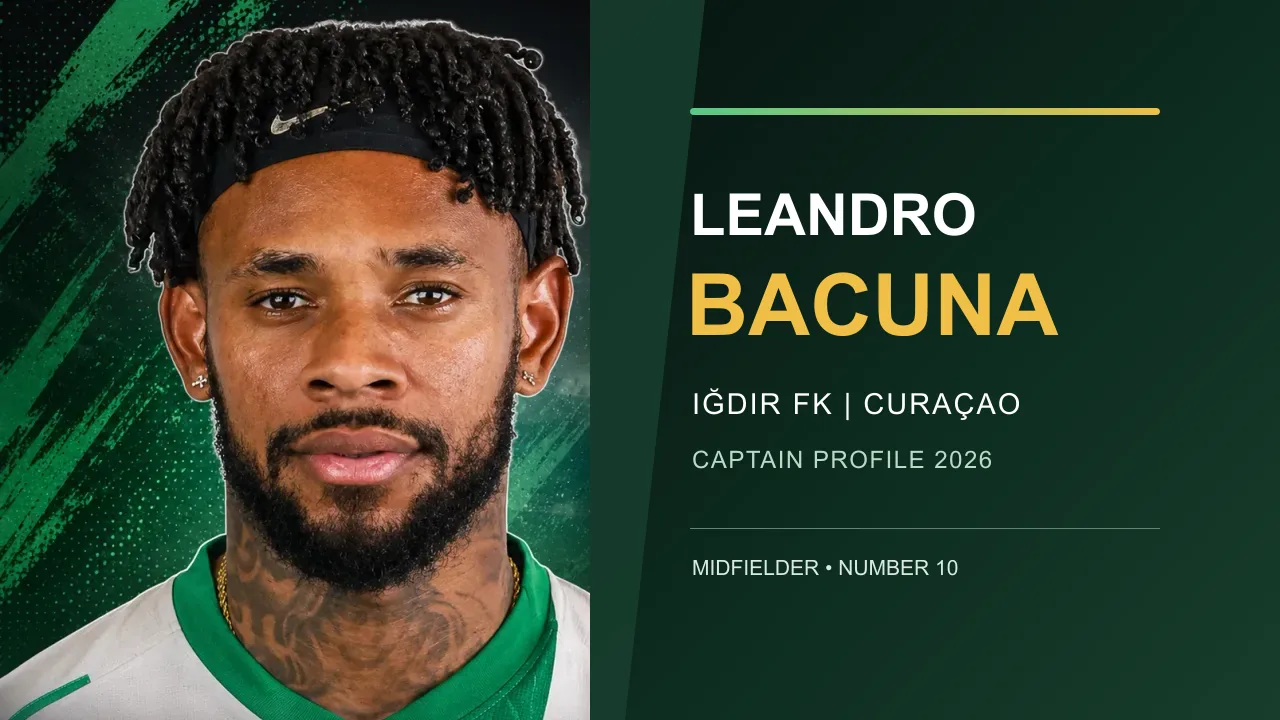
Leandro Bacuna plays for Iğdır FK and captains the Curaçao national team. The Turkish Football Federation lists his Iğdır contract from 7 January 2026 to 30 June 2027. FIFA’s final 2026 World Cup squad document records him as Curaçao’s number 10, a 1.80 m midfielder with 75 caps and 16 goals at the pre-tournament snapshot.
Bacuna’s career joins three distinct football settings. He started with hometown club FC Groningen, spent a decade in England with Aston Villa, Reading, Cardiff City and Watford, then returned to Groningen before moving into Turkey’s second tier. His Curaçao record carries even greater weight: Caribbean Cup champion, scorer of the country’s first Gold Cup goal, qualification captain and starter at the island’s first World Cup.
This profile uses dated club registrations, official tournament documents and match reports. It avoids private estimates and separates the June 2026 tournament snapshot from figures that can change with each match.
Leandro Bacuna profile at a glance
Verified details reviewed on 27 July 2026
| Full name | Leandro Jones Johan Bacuna |
|---|---|
| Date of birth | 21 August 1991 |
| Birthplace | Groningen, Netherlands |
| Current club | Iğdır FK |
| Contract end | 30 June 2027 |
| Primary role | Central midfielder |
| Other roles | Right-back and right midfield |
| Height | 1.80 m |
| National team | Curaçao |
| World Cup number | 10 |
| International role | Captain |
FIFA listed 75 caps and 16 goals when it published the final squad document. Bacuna then played during all three group matches, so readers should treat 75 as a tournament-entry figure rather than a permanent live total.
Current club status
Iğdır FK remains the latest official registration
The Turkish Football Federation identifies Bacuna’s club as Iğdır Futbol Kulübü A.Ş. Its player record gives 7 January 2026 as the contract start and 30 June 2027 as the end date. FIFA also listed Iğdır FK beside his name in the World Cup squad published in June.
These two records provide current evidence from the domestic federation and tournament organiser. No later official transfer announcement reviewed by FWCTimes moves him elsewhere. The correct club answer on 27 July 2026 is Iğdır FK.
The Iğdır FK contract
An eighteen-month move in January 2026
Iğdır announced Bacuna on 6 January 2026 after he left Bandırmaspor. The club described a one-and-a-half-year agreement, while the TFF registration supplies the exact end date in June 2027. He moved within Turkey’s second tier rather than arriving from another country.
The timing placed Bacuna in a new club environment five months before the World Cup. Iğdır gained an experienced central player, and Curaçao’s captain kept playing competitive league football before the tournament.
The Bandırmaspor half-season
Six goals in nineteen matches before the January switch
Bacuna joined Bandırmaspor in July 2025 after leaving FC Groningen. The TFF movement record shows his Bandırmaspor registration beginning on 4 July and ending by mutual termination on 6 January 2026. Voetbal International reported six goals in nineteen matches during that spell.
Those numbers came from a deeper midfield role rather than a fixed forward position. They also show that his Turkish move began before Iğdır. Profiles that jump from Groningen straight to his current club miss a short but productive first half of the season.
The return to FC Groningen
A hometown captain helping the club regain Eredivisie status
Bacuna returned to FC Groningen in August 2023 after ten years in English football. Groningen’s club magazine recorded that he negotiated the move with his brother Johnsen and club director Wouter Gudde, without using an agent. He wanted to help the relegated club return to the Eredivisie.
The staff gave him the captain’s armband, and Bacuna had to earn back his place after a difficult team start. Groningen secured promotion in May 2024. The homecoming added a leadership chapter to a career that had begun in the same academy and first team.
Early years in Groningen
A local academy player who reached the first team at eighteen
Bacuna grew up in Groningen and entered the club’s youth system. He made his senior debut against PSV on 30 October 2009. The move from academy football to the Eredivisie placed him against experienced professionals before his nineteenth birthday.
His first Groningen spell lasted until 2013. He learned more than one role, operating in midfield and on the right side. That flexibility became a defining feature of his later English career.
Development in the Eredivisie
Energy, set pieces and positional range
Groningen used Bacuna as a central midfielder, wide player and right-sided defender. He carried the ball with purpose and offered set-piece delivery. Coaches could change the shape without substituting him because he understood both midfield and full-back duties.
The Eredivisie years also gave him attacking responsibility. He made forward runs from midfield and struck the ball cleanly from distance. Aston Villa saw enough in that profile to bring him to the Premier League in 2013.
The Aston Villa transfer
A move to England in summer 2013
Bacuna left Groningen for Aston Villa in 2013. Reading’s 2026 retrospective says he spent four years at Villa Park, made more than 100 appearances and played in the 2015 FA Cup final. The move placed a 21-year-old Dutch league player into one of Europe’s most demanding domestic competitions.
Villa used his versatility from the start. He appeared at right-back, in midfield and on the right wing. That range helped him earn minutes, though changing roles also made it harder to build a single positional identity.
A memorable first Villa goal
The free-kick against Manchester City
Bacuna scored his first Aston Villa goal during a 3-2 home win over Manchester City on 28 September 2013. Villa’s official archive describes a free-kick that beat Joe Hart before Andreas Weimann scored the winner.
The goal displayed Bacuna’s clean contact and confidence from dead balls. It remains one of the clearest images from his first Premier League season because it arrived against the future champions in a comeback win.
The 2015 FA Cup final
Villa’s run to Wembley
Aston Villa reached the 2015 FA Cup final after beating Liverpool in the semi-final. Bacuna featured during the cup run and was part of the final squad at Wembley, where Arsenal won 4-0.
A final defeat does not erase the scale of the route. Bacuna had moved from Groningen less than two years earlier and was already involved on English football’s largest domestic cup stage.
Premier League experience
Ninety-six appearances and six goals in the top division
Competition records credit Bacuna with 96 Premier League appearances and six goals across Aston Villa and Cardiff City. Most came during his Villa years. He faced the league’s strongest wide players while also taking midfield assignments.
The total helps explain his value to Curaçao. He arrived in the national setup with experience of high-speed transitions, hostile away grounds and tactical changes inside matches. Few players from the island had worked through that volume of Premier League football.
The move to Reading
Sixty-six appearances across eighteen months
Bacuna joined Reading in August 2017 after leaving Aston Villa. Reading’s 2026 review records 66 appearances during his two seasons as a Royal. The Championship required repeated midweek fixtures and a different physical rhythm from the Premier League.
Reading used him in midfield and at full-back. He also wore the captain’s armband during parts of his spell, evidence that coaches trusted his voice and experience before he became Curaçao’s long-term leader.
International goals during the Reading period
Set-piece responsibility for club and country
Reading’s archive records Bacuna scoring a penalty in Curaçao’s 5-0 win over the US Virgin Islands in October 2018. It also notes goals in a 10-0 win over Grenada during Concacaf Nations League qualification.
Those matches expanded his role beyond ball progression. Bacuna took responsibility from the spot and became one of the team’s dependable attacking contributors from midfield.
The Cardiff City chapter
A January 2019 move back to the Premier League
Cardiff signed Bacuna from Reading on 31 January 2019. The club announced an agreement through summer 2022 and highlighted his ability to play right-back or midfield. He joined during Cardiff’s Premier League season and remained after relegation.
His first Cardiff goal came in a 1-0 Championship win over Stoke City in November 2019. The club report says he finished from a tight angle after Gary Madine’s backheel. Bacuna later became a regular central option in a side built around work rate and direct play.
Watford and the return to match football
A short-term opportunity after leaving Cardiff
Bacuna left Cardiff at the end of his 2022 agreement and spent several months without a club. In Groningen’s later interview, he explained that a false impression of a long injury had complicated his search. Watford brought him into its Championship squad in December 2022.
The half-season restored competitive minutes. He then chose the emotional and sporting challenge of returning to Groningen, where he could lead a young team and pursue promotion.
A decade of English football
Four clubs and several tactical roles
Bacuna’s English route ran through Aston Villa, Reading, Cardiff City and Watford. He played in the Premier League, Championship and FA Cup final, sometimes as a specialist midfielder and sometimes as the right-sided solution to a squad problem.
That versatility kept him useful across coaching changes. It also demanded constant adjustment. A central midfielder scans in every direction and manages space between the lines; a right-back receives pressure near the touchline and defends fast wingers. Bacuna learned both sets of cues.
Netherlands youth international years
Under-19 and under-21 experience before Curaçao
Concacaf’s 2017 tournament notes record Bacuna representing the Netherlands at under-19 and under-21 level. He was born and developed in the Netherlands, so that pathway matched his early football environment.
Youth appearances did not prevent a later senior choice for Curaçao under eligibility rules. Bacuna joined the island’s project in 2016 and built a senior international career that surpassed the scale of his youth record.
The Curaçao debut
A March 2016 start against Barbados
FIFA’s 2026 interview dates Bacuna’s Curaçao debut to March 2016, a 1-0 defeat against Barbados. The result gave no hint of the milestones that followed. Curaçao was still trying to establish itself in Concacaf after the constitutional changes that created the current national association.
Bacuna stayed with the project through early defeats, coaching changes and qualifying campaigns. His arrival added Premier League experience to a group that Patrick Kluivert and later coaches built from players based on the island and across Europe.
The 2017 Caribbean Cup title
Four Bacuna goals during the championship campaign
Concacaf records Bacuna scoring four times in the 2016/17 Caribbean Cup campaign. Two came during the extra-time win over Puerto Rico that secured a semi-final place. Curaçao then beat Martinique before defeating Jamaica 2-1 in the final on 25 June 2017.
The trophy was Curaçao’s first Caribbean Cup title and qualified the team for its first Gold Cup under the current national identity. Bacuna’s goals during the route made him one of the tournament’s important contributors even though Elson Hooi scored both in the final.
The first Gold Cup campaign
Three narrow defeats in 2017
Curaçao lost all three group games at the 2017 Gold Cup, but Concacaf noted that each defeat came by a two-goal margin. The tournament gave Bacuna and his teammates a first sustained test against the region’s established national teams.
The results supplied a benchmark. Two years later, Curaçao returned with greater control, a settled core and a midfielder ready to deliver the country’s first goal at the competition.
The historic Honduras goal
Curaçao’s first Gold Cup goal and win
Bacuna scored in the 40th minute against Honduras on 21 June 2019. Concacaf’s match report says he met Gevaro Nepomuceno’s pass near the penalty spot. Eloy Room made thirteen saves as Curaçao protected the 1-0 lead.
The strike was the nation’s first Gold Cup goal and secured its first victory in the competition. Curaçao later drew 1-1 with Jamaica and reached the quarter-finals for the first time.
The 2019 quarter-final run
A midfield leader in Curaçao’s best Gold Cup finish
Four group points took Curaçao into a quarter-final against the United States. The Americans won 1-0, but the campaign changed outside expectations of the Blue Wave. The team had beaten Honduras, rescued a late point against Jamaica and competed with the eventual runners-up.
Bacuna connected midfield work to decisive moments. His Honduras goal provided the result that made advancement possible. The experience also strengthened his status inside the national group.
The road to the 2026 World Cup
Ten unbeaten qualifiers and a captain at the centre
Curaçao went unbeaten through ten matches in the second and third Concacaf qualifying phases. FIFA’s qualification review records a perfect second-round group and first place ahead of Jamaica, Trinidad and Tobago and Bermuda in the final round.
Bacuna captained the team and supplied midfield control. He scored from the penalty spot during the 7-0 win away to Bermuda in November 2025. A 0-0 draw in Jamaica then secured Curaçao’s first World Cup place.
The meaning of qualification
The smallest country ever to reach the men’s finals
Curaçao qualified with a population of about 156,000, becoming the smallest country to reach a men’s World Cup. In his May 2026 FIFA interview, Bacuna described how qualification united people across the island.
His connection stretched beyond tournament selection. Bacuna had joined in 2016, won a regional title, scored the first Gold Cup goal and stayed through ten years of development. He entered the World Cup as the captain of a project he had helped build.
FIFA’s pre-tournament record
Number 10, 75 caps and 16 goals
FIFA’s final squad list gives Bacuna’s full name, date of birth, Iğdır FK registration and 180 cm height. It records 75 senior caps and 16 goals before the tournament began. Among Curaçao’s outfield players, that cap total made him the most experienced.
The document also confirms his midfield classification and number 10 shirt. These figures answer a dated question. They should not replace a later association record after more international appearances.
The World Cup opener against Germany
A difficult 7-1 introduction in Houston
Bacuna started and captained Curaçao against Germany on 14 June 2026. Germany won 7-1, exposing the gap between a first-time qualifier and a four-time champion. Livano Comenencia scored Curaçao’s first World Cup goal.
The captain’s job extended beyond his own touches after the result. Curaçao had six days to restore structure and confidence before facing Ecuador, a team that had lost only once under Sebastián Beccacece before the finals.
The historic point against Ecuador
A 0-0 draw built around Eloy Room’s saves
Bacuna started the second group match and led Curaçao to its first World Cup point. Eloy Room made fifteen saves in Kansas City. FIFA quoted Bacuna praising the goalkeeper after several difficult warm-up and opening results.
Curaçao defended for long periods and protected the central area. Bacuna worked in front of the defensive line, competed for second balls and helped the team slow the game when possession returned. The draw kept qualification hopes alive for the final match.
The final match against Côte d’Ivoire
Captain Bacuna created one of Curaçao’s few openings
Bacuna started again in Philadelphia on 25 June. FIFA’s report says he beat two defenders near the edge of the penalty area before shooting wide of the near post. Côte d’Ivoire won 2-0 through two Nicolas Pépé goals.
Curaçao finished fourth with one point. The captain had started all three matches and remained an attacking outlet even when opponents controlled possession. Concacaf’s tournament review placed him among the team’s leading shooters.
Bacuna’s primary position
A central midfielder with right-sided experience
FIFA and Iğdır list Bacuna as a midfielder. He now works most often in central areas, where his tasks include receiving from defenders, moving play across the pitch and supporting the press. His long career at right-back still shapes how he covers wide space.
Supporters should avoid reducing him to one label. He has played as a number eight, deeper midfielder, right midfielder and full-back. The team shape determines which part of that experience a coach needs.
How Bacuna moves the ball
Forward carries and passes through the inside-right channel
Bacuna likes to receive on the half-turn and advance into space. His first touch can take him away from pressure, while his right foot gives him access to diagonal passes toward the left wing or direct balls into a forward.
At Curaçao, he often starts deeper than the attacking players and then joins the next phase. Against Côte d’Ivoire, his dribble past two defenders showed that he can still create a shooting lane when a compact defence leaves little room.
Set-piece and shooting threat
Free-kicks, penalties and strikes from midfield
The Manchester City free-kick, international penalties and 2019 Gold Cup goal show three types of finishing. Bacuna can bend a stationary ball, accept responsibility from the spot and arrive inside the box from midfield.
Shot selection remains important. A long attempt can end an attack if teammates occupy better positions. His best moments come when the ball sits cleanly or a carry opens a clear lane near the edge of the area.
Defensive responsibilities
Reading transitions with full-back experience
A central midfielder must decide whether to press the ball or protect the space behind him. Bacuna’s years at right-back help him recognize overlapping runs and cover the channel when a teammate advances.
Age changes the physical calculation. Positioning and early scanning can reduce the distance he needs to sprint. Curaçao uses his voice to organize players around him, while younger midfielders provide extra running power.
Captaincy and communication
A leader shaped by club football in three countries
Bacuna has worn the armband for Reading, Groningen and Curaçao. He has worked under different managers and played beside young academy graduates, Championship veterans and international teammates spread across many leagues.
FIFA’s post-Ecuador coverage showed the captain directing praise toward Eloy Room. That response kept attention on the player who delivered the historic point. Leadership in a national team includes managing the message as well as the midfield.
The Bacuna football family
Leandro and Juninho together at the World Cup
Leandro’s younger brother Juninho also plays for Curaçao. Both appeared in the 2026 World Cup midfield, giving the family a place in the country’s first finals squad. FIFA highlighted the brothers when announcing the team.
Their roles differ. Leandro provides senior control and captaincy, while Juninho carries the ball and attacks space with greater frequency. The shared upbringing gives Curaçao two midfielders with an established understanding.
Reading Bacuna’s statistics
Attach each number to its competition and date
Premier League records list 96 appearances and six goals. Reading records 66 club appearances. The final FIFA squad list shows 75 Curaçao caps and 16 goals before the World Cup, while TFF documents the current contract rather than a complete career total.
Each number answers a different question. Combining them into one total would mix club and international football. A useful profile keeps the labels visible and updates the changing figures from their original source.
Leandro Bacuna career timeline
From Groningen academy to Curaçao’s World Cup
- 30 October 2009: Made his FC Groningen first-team debut against PSV.
- 2013: Joined Aston Villa and began a decade in English football.
- 28 September 2013: Scored his first Villa goal with a free-kick against Manchester City.
- 2015: Featured in Aston Villa’s run to the FA Cup final.
- March 2016: Made his senior Curaçao debut against Barbados.
- 25 June 2017: Won the Caribbean Cup after Curaçao beat Jamaica in the final.
- August 2017: Moved from Aston Villa to Reading.
- 31 January 2019: Joined Cardiff City on a contract through 2022.
- 21 June 2019: Scored Curaçao’s first Gold Cup goal in the 1-0 win over Honduras.
- December 2022: Joined Watford for the second half of the Championship season.
- August 2023: Returned to FC Groningen and became captain.
- May 2024: Helped Groningen regain Eredivisie status.
- July 2025: Signed for Bandırmaspor in Turkey.
- 18 November 2025: Captained Curaçao as a draw in Jamaica secured World Cup qualification.
- 7 January 2026: Registered with Iğdır FK through 30 June 2027.
- June 2026: Started all three matches during Curaçao’s first World Cup.
Official sources behind this profile
Federation, club and tournament records
Current club and contract details come from the Turkish Football Federation player record. FIFA’s final World Cup squad list supplies his shirt number, height, club and pre-tournament international totals.
International history comes from FIFA’s Curaçao squad announcement, the Ecuador reaction report and Concacaf’s 2019 Gold Cup review. Reading and Cardiff’s archives confirm the main English club milestones.
The featured visual reuses the exact-player source already held in the FWCTimes media library. FWCTimes removed the old template labels, rebuilt the layout at 1280 by 720 and added current Iğdır FK and Curaçao context.
Related Curaçao profiles and coverage
Continue through the captain’s national-team network
Read the Curaçao team guide and World Cup squad report for the broader tournament story. The repaired profiles for Eloy Room, Juriën Gaari, Armando Obispo and Shurandy Sambo explain the teammates around him.
Leandro Bacuna FAQ
Which club does Leandro Bacuna play for?
Iğdır FK is his current verified club on 27 July 2026. The TFF records his contract through 30 June 2027.
What position does Bacuna play?
He plays most often as a central midfielder. His club career also includes substantial work at right-back and right midfield.
How tall is Leandro Bacuna?
FIFA’s final 2026 World Cup squad list records him at 1.80 metres.
Does Leandro Bacuna captain Curaçao?
Yes. Bacuna captained Curaçao through World Cup qualification and during the country’s first finals appearance.
Did Bacuna play at the 2026 World Cup?
Yes. He started all three group matches against Germany, Ecuador and Côte d’Ivoire.
How many Curaçao goals had he scored before the tournament?
FIFA listed 16 goals from 75 caps in its final pre-tournament squad document. The cap figure increased when he played at the finals.
Is Juninho Bacuna his brother?
Yes. Juninho is Leandro’s younger brother, and both played in Curaçao’s 2026 World Cup midfield.
Last reviewed: 27 July 2026. FWCTimes dates club registrations, contracts, appearance totals and international records so readers can distinguish an official snapshot from a live count.