Jeremy Antonisse: Kifisia and Curaçao Profile 2026

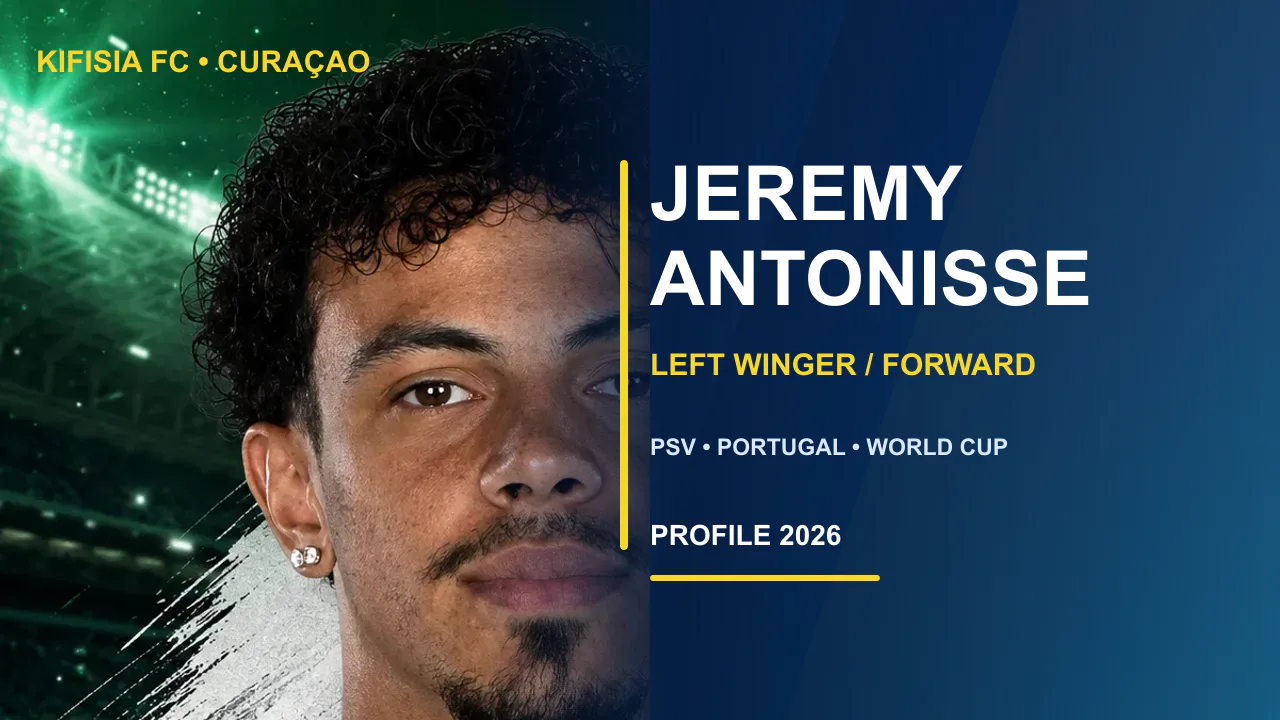
Jeremy Antonisse is a Curaçao international forward who plays for Kifisia FC in Greece. Born in Rosmalen in the Netherlands, he spent his formative years at PSV, learned senior football with Jong PSV and FC Emmen, moved to Portugal with Moreirense, and then joined Kifisia in 2025. His route is useful because it shows how a technically trained winger can build a career through several different football cultures rather than following one straight line.
This profile focuses on what can be established from club, league, FIFA and Concacaf records. It covers Antonisse’s current role, his development at PSV, his moves to Emmen and Moreirense, his international progress with Curaçao, and his appearances at the 2026 FIFA World Cup. It also explains the qualities visible in his game and the areas that can determine his next step.
Jeremy Antonisse profile at a glance
- Full name: Jeremy Cornelis Jacobus Antonisse
- Date of birth: 29 March 2002
- Birthplace: Rosmalen, Netherlands
- Height: 164 cm, according to FIFA’s 2026 squad list
- Primary role: Left winger and forward
- Current club: Kifisia FC
- International team: Curaçao
- Kifisia squad number: 7 in the official Greek league listing
These details are a snapshot rather than a substitute for match-by-match records. Positions can change within a game, and appearance totals continue to move as competitions progress. The stable part of Antonisse’s profile is that he is a compact, mobile attacker whose career has been built mainly from wide areas.
Where Jeremy Antonisse plays in 2026
Antonisse is listed with Kifisia FC in the Greek Super League. The league’s official player and team pages identify him as part of the senior squad and show him wearing number 7. That is the clearest current-club reference because it comes from the competition in which Kifisia play.
His place in the Kifisia squad
The official league snapshot showed regular first-team involvement, including a goal, during Kifisia’s campaign. The exact appearance number can differ between a player card and a table that updates at a different time, so it is better to read the listing as evidence of a sustained role rather than freeze a supposedly final total. Antonisse was not merely registered on the edge of the group. He received meaningful top-flight minutes.
Why the Greek move matters
Greece presented a new tactical and cultural test after the Netherlands and Portugal. A winger has to interpret unfamiliar defensive spacing, new pressing cues and different expectations in transition. For Antonisse, joining Kifisia also created an opportunity to turn academy promise and shorter senior chapters into a more continuous role. Regular decisions under pressure are often more valuable for a young attacker than occasional minutes at a larger club.
Position and role
Antonisse is most naturally described as a left winger or wide forward. He has enough mobility to operate from either flank, and his low centre of gravity helps him receive, turn and accelerate in limited space. Calling him only a midfielder can hide the attacking purpose of his game. Calling him a pure striker would also be misleading because much of his work begins outside the central channel.
Starting wide, attacking forward
His useful actions often start with width. By receiving near the touchline, he can isolate a full-back, carry the ball into the half-space or release it before continuing his run. When the opposite winger has possession, Antonisse can become a far-side runner rather than remain a stationary wide player. That movement makes him part winger and part secondary forward.
Playing on either side
On the left, he can attack the outside lane or move inside toward goal. From the right, the geometry changes: he may receive on his back foot, drive diagonally or combine before attacking the box. The important point is not that every role produces the same output. His two-sided experience gives a coach more options when changing a front line during a match.
Early life in Rosmalen
Antonisse was born in Rosmalen, a town in the southern Netherlands, on 29 March 2002. His Dutch upbringing placed him inside a football system that gives young players repeated technical contact with the ball and expects them to understand several phases of play. His later choice to represent Curaçao added a second national identity to that development.
There is no need to inflate an early-life story with unsupported anecdotes. The reliable career marker is that PSV brought him into its academy structure at a young age. From there, his progress can be followed through official club announcements and match records.
Growing up in the PSV academy
PSV’s own material records Antonisse as an academy player from the 2010-11 period. Spending so many years in one development system means more than learning a set of tricks. Academy wingers are asked to scan before receiving, create passing angles, react after losing possession and understand when width helps the team.
Technical education at PSV
The PSV pathway exposed Antonisse to possession football, transition attacks and structured positional work. His speed was an asset, but progression required him to connect that speed to the next action. A run matters when it creates separation. A dribble matters when it opens a shot, pass or cutback. Those habits became the foundation for his later senior roles.
First professional contract
PSV announced Antonisse’s first professional contract on 5 August 2019. The agreement ran to 2022, according to the club announcement. A first contract is not proof that a prospect will reach the senior side, but it is an important development checkpoint. It showed that PSV saw a pathway worth continuing after years in the academy.
Jong PSV and the step into professional football
Jong PSV gave Antonisse the bridge between youth football and senior competition. Reserve teams in the Dutch professional pyramid face experienced opponents, varied game states and physical pressure that academy matches cannot fully reproduce. This environment forced him to make his actions faster and accept that possession would not always be comfortable.
Professional debut against Cambuur
Antonisse made his professional debut for Jong PSV against SC Cambuur on 30 November 2020. PSV’s match report records the occasion in a difficult result. For the player, the lasting importance was the transition from prospect to professional participant. He had entered a competition where points, contracts and first-team opportunities were attached to performance.
Learning through volume
By the time PSV sent him on loan to FC Emmen, the club said he had made 60 appearances for Jong PSV. That volume gave him repeated exposure to full-backs with different strengths. Some could be beaten with acceleration, others required combination play, and some matches demanded patient work without the ball. Those lessons are easy to miss if a career is judged only by first-team starts.
PSV first-team debut at FC Emmen
Antonisse made his Eredivisie debut for PSV away to FC Emmen on 26 January 2021. PSV won 2-0. The appearance connected his long academy journey to the senior first team, even though it did not immediately establish him as a regular starter.
For a young wide player, a debut often involves a simple challenge: enter at match speed, protect the team’s structure and use the first clear attacking opportunity. Antonisse had now experienced the level he was trying to reach. The next task was to find enough senior minutes to make that experience normal rather than exceptional.
European debut against Sturm Graz
PSV’s report from the Europa League match against Sturm Graz on 25 November 2021 records another milestone for Antonisse. PSV won and he received European minutes. The setting brought a different tempo and greater tactical consequence than reserve football.
What a European appearance added
European competition tests a player’s preparation because opponents are less familiar and game plans can change sharply. Even a short appearance can demand instant recognition of pressing triggers, defensive cover and the score situation. Antonisse’s involvement showed that he had reached the edge of PSV’s senior European rotation.
PSV contract extension in 2021
PSV extended Antonisse’s contract on 23 August 2021, with the club saying the new agreement ran through the summer of 2024. The decision came after his progress through Jong PSV and his first senior exposure. It gave both parties more time to assess whether he could convert development into a stable first-team role.
The extension should be understood in its moment. It was a vote of confidence, not a promise about selection. Competition for attacking places at PSV is intense, and young players can need a loan or permanent move to find the minutes that their development requires.
FC Emmen loan in 2023
FC Emmen signed Antonisse on loan on 31 January 2023 for the remainder of the season. PSV confirmed the temporary move, while Emmen introduced him as an attacker who could add depth and directness. The loan returned him to the Eredivisie in a setting where the competitive priorities differed from PSV’s.
Why Emmen wanted him
Emmen highlighted qualities such as depth, the ability to beat an opponent and a useful shot. That description fits the practical value of Antonisse’s game. A team under pressure needs a winger who can carry the ball away from its own half, stretch a defensive line and turn a recovery into an attack without requiring a long sequence of passes.
The value of a relegation-pressure environment
Minutes in a demanding team context teach a different kind of discipline. A winger may have fewer touches and must therefore protect the ball more carefully. He also has to track runners, defend the far post and choose the right moment to leave his defensive position. The loan broadened Antonisse’s experience even if it did not settle his long-term future at PSV.
Permanent move to Moreirense
PSV sold Antonisse to Moreirense on 1 September 2023. Moreirense’s official announcement presented him as an addition to the attack. The transfer ended his long formal connection with PSV and started a new phase in Portuguese football.
Leaving the PSV pathway
A permanent move can be more demanding than a loan because the player no longer returns automatically to a familiar environment. Antonisse had to earn his place within a new club’s plans, learn new terminology and adjust to different expectations around the ball. It was also a chance to be evaluated for what he could contribute now rather than only for his academy history.
Two seasons in Portugal
Antonisse spent two seasons in Portugal before moving to Kifisia. Portuguese top-flight football values technical security but also contains intense duels and tactically careful defensive blocks. For a winger, the league can punish loose touches and predictable dribbles. His time there added another layer to a career already shaped by Dutch positional education.
Joining Kifisia in 2025
Kifisia’s move for Antonisse was reported as an official transfer in July 2025 after his Moreirense period. The Greek club offered a fresh league and an opportunity for sustained first-team involvement. Official Super League records now provide the most direct evidence of his current playing status.
A role with more continuity
Continuity matters for a 24-year-old attacker. Training at a good level develops technique, but competitive minutes reveal whether decisions survive pressure. A run of matches lets a winger learn the timing of teammates, understand the full-back behind him and recognize how opponents respond to his preferred movements.
Kifisia’s number 7
The number 7 carries a traditional association with wide attackers, although shirt numbers do not define tactics. In Antonisse’s case, it fits the way Kifisia use him as a forward option. More important than the number is the responsibility to produce useful final actions after advancing the team up the pitch.
Jeremy Antonisse playing style
Antonisse’s game is built around mobility, acceleration and direct intent. At 164 cm, he does not rely on aerial dominance. His advantages appear closer to the ground: balance through changes of direction, quick steps when separating from a defender and the ability to move between wider and narrower lanes.
Acceleration and direct running
His first burst can turn a neutral reception into forward momentum. That quality is especially useful after a turnover, when a defender is moving toward the wrong goal or has not yet received cover. Antonisse does not need to run the full length of the pitch for the action to help. Ten sharp metres can force the defensive line to retreat and open a passing lane for a teammate.
One-against-one threat
A defender facing Antonisse has to respect both the outside run and the diagonal carry. His small turning radius helps him shift the ball quickly, but successful one-against-one play still depends on context. He is most dangerous when he receives with space to accelerate. Against a settled double team, combination play may be the better choice.
Off-ball movement
Wide attackers are sometimes judged only when they possess the ball. Antonisse can also affect the defence by running behind a full-back or moving into the gap between full-back and centre-back. A well-timed run can pin the back line even when the pass goes elsewhere. It creates room for an attacking midfielder or advancing teammate.
Work without the ball
Modern wingers must contribute to the defensive shape. Antonisse’s role can require him to close the opposing full-back, angle his pressure toward a predictable pass and recover alongside his own midfield. The exact instruction changes by coach and opponent, but the principle is constant: attacking selection depends partly on whether the player can be trusted when possession is lost.
Pressing from the wing
Effective pressing is not simply running at the ball. The winger must approach on an angle that blocks an easy return pass and must know whether teammates are close enough to support the action. Antonisse’s speed gives him the physical tool to close space. Improving the timing and coordination of that press makes the speed more useful.
Final-ball responsibility
The next level for most direct wingers is determined in the final third. Beating a defender is valuable, but the action must lead to a shot, a chance or controlled possession in a better area. Antonisse can sharpen his impact through earlier scanning and a clearer selection between shooting, crossing and cutting the ball back.
Crossing and cutbacks
When he reaches the outside lane, a low cutback can be more productive than a hopeful high cross. When he moves inside, the far-post pass or a reverse ball may become available. The best decision depends on teammate movement, so chemistry with the centre-forward and opposite winger matters.
Finishing development
Antonisse has shown that he can finish an important chance, most notably with Curaçao against Canada. Consistent scoring requires repeated arrival in good zones, composure after high-speed runs and clean contact under pressure. A winger does not need striker-level volume to help, but adding dependable goals would raise his value to Kifisia and Curaçao.
Curaçao senior debut in 2021
Antonisse made his senior Curaçao debut on 25 March 2021 in a 5-0 win over Saint Vincent and the Grenadines. The appearance began an international career that eventually led to the 2026 World Cup. Representing Curaçao also connected him with several players developed in the Netherlands who brought varied club experiences to the national side.
International football compresses preparation. Players arrive from different clubs, train for a short period and must quickly understand a shared plan. A mobile winger can help by offering a clear outlet and attacking space when the team recovers possession.
Becoming part of Curaçao’s attack
Antonisse’s international involvement developed from substitute opportunities into a place within the wider attacking group. The FIFA squad list published for the World Cup recorded 28 caps and four goals at the time of its 17 June version. Those figures are best tied to that document date because international totals change.
Competition for wide positions
Curaçao can select attackers with experience in several European leagues. That raises the standard for each camp. Antonisse’s flexibility across the front line helps, but selection also depends on club rhythm, defensive work and the specific opponent. His route into the team has therefore required more than one outstanding moment.
World Cup qualifying role
During Curaçao’s 2025 qualifying campaign, Antonisse was part of a team trying to make national history. Concacaf’s report from the scoreless match against Trinidad and Tobago noted one of his long-range attempts. The detail reflects a broader role: offer a forward outlet and test a compact defence when central routes are restricted.
Qualifying matches are often tense because a single transition can change a group. Wide players must balance ambition with ball security. Antonisse’s pace gave Curaçao a way to threaten space, while the collective defensive structure kept the campaign alive.
Gold Cup equaliser against Canada
One of Antonisse’s clearest international highlights came in the 2025 Concacaf Gold Cup against Canada. In stoppage time, Joshua Zimmerman played him through and Antonisse finished toward the far post to make the score 1-1. Concacaf’s report confirms the late equaliser.
Why the goal suited his strengths
The move matched Antonisse’s profile. He attacked space beyond the defence, controlled the moment at speed and selected a composed finish rather than striking wildly. It was not only a dramatic goal. It showed how his direct running can become decisive when a teammate recognizes the route early.
Importance for Curaçao
A late goal against a strong regional opponent gives a squad proof that it can stay in difficult matches. For Antonisse, it also created a reference point for future selection. The challenge after any major moment is to repeat the underlying actions: make the run, arrive balanced and make the final decision calmly.
Selected for the 2026 FIFA World Cup
FIFA’s official squad material lists Antonisse as number 11 for Curaçao at the 2026 World Cup. The document gives his full name, birth date, Kifisia as his club and a height of 164 cm. Selection placed him in the group that represented Curaçao on football’s largest international stage.
The tournament was a major step for the country and for players whose careers had developed across different leagues. Antonisse entered it as a wide attacking option rather than an automatic starter. His task was to be ready when the match state required speed and directness.
World Cup appearance against Germany
Antonisse came on at half-time in Curaçao’s 7-1 loss to Germany. FIFA’s post-match report records him as the replacement for Sontje Hansen. The score made the assignment difficult, but the second half still offered a meaningful test against an elite opponent.
Physical output in the Germany match
FIFA’s physical report credited Antonisse with 6,143.9 metres covered, 30 sprints and a top speed of 31.3 km/h. These figures describe that appearance, not his ability in every match. They do, however, support the visible picture of an active wide player prepared to run repeatedly after entering at the interval.
Lessons from an elite opponent
Germany reduced the time available for every decision. A winger receiving under that pressure must secure the first touch, recognize support and avoid carrying into a trap. The result was painful for Curaçao, yet this type of opposition provides information that domestic matches cannot fully reproduce.
Ecuador match from the bench
Antonisse was an unused substitute in Curaçao’s 0-0 draw with Ecuador. Being named among the substitutes is different from an appearance, so it should not be added to his tournament minutes. The distinction matters when building an accurate player record.
The clean-sheet draw also showed that Curaçao could adjust after the Germany match. From Antonisse’s perspective, the role was preparation: study the opponent, remain physically ready and understand that the coaching staff may preserve a working structure when the game remains balanced.
Appearance against Côte d’Ivoire
Antonisse returned to the pitch in Curaçao’s 2-0 loss to Côte d’Ivoire, entering in the 62nd minute. That gave him a second World Cup appearance and another chance to confront high-level pace and physical pressure.
What the substitute role required
Entering after an hour asks a winger to change the energy of the attack without losing the team’s defensive spacing. Antonisse could offer runs against defenders who had already played most of the match. At the same time, he had to adapt immediately to the speed and score state rather than ease into the contest.
Antonisse’s 2026 World Cup record
Antonisse appeared in two group matches, against Germany and Côte d’Ivoire, and remained on the bench against Ecuador. He did not score at the tournament. This concise record is more useful than suggesting he started or played in all three games.
For a player from Kifisia, the experience joined domestic first-team football with the highest international level in the same season. The long-term benefit depends on how he applies the lessons after returning to club competition.
How Antonisse fits Curaçao
Curaçao benefit from attackers who can turn defensive recoveries into forward movement. Antonisse offers a natural transition outlet because he can begin wide and attack the space behind a full-back. His presence can also create room for experienced central players by forcing the opposing back line to defend the width.
Links with other Curaçao players
His international context includes teammates and squad competitors profiled by FWC Times, such as Livano Comenencia, Kevin Felida, Tyrese Noslin, Godfried Roemeratoe and Eloy Room. Different profiles make the team functional: ball winners, distributors, runners and goalkeepers each support the attacking phase in a different way.
Areas for further development
Antonisse’s speed and mobility give him a useful base, but his next career step is likely to depend on efficiency. More consistent final-third output would make his minutes harder to replace. That includes goals, assists, chance creation and the quieter decisions that keep an attack alive.
Decision-making after the first action
The first action may beat a defender; the second often decides the possession. Antonisse can improve by scanning the penalty area before reaching it, identifying the cutback early and varying the speed of his final pass. A defender who expects maximum pace on every action becomes easier to surprise when the winger can pause or combine.
Consistency across full matches
Impact as a substitute and influence as a starter are different challenges. A starter must choose moments over 90 minutes, conserve useful energy and remain connected to the defensive block. Continued first-team football at Kifisia can help Antonisse show that his direct qualities remain effective throughout changing match states.
Turning carries into measurable chances
Progressive carries attract attention, but coaches need the move to end productively. The next pass, shot or foul won in a dangerous area determines the value of the run. Improving this conversion does not require Antonisse to abandon direct play. It requires him to connect direct play to teammates more reliably.
Career timeline
- 2010-11 period: Part of PSV’s academy pathway.
- 5 August 2019: PSV announce his first professional contract.
- 30 November 2020: Professional debut for Jong PSV against SC Cambuur.
- 26 January 2021: PSV first-team debut away to FC Emmen.
- 25 March 2021: Senior Curaçao debut against Saint Vincent and the Grenadines.
- 23 August 2021: PSV announce a contract extension.
- 25 November 2021: European debut against Sturm Graz.
- 31 January 2023: Joins FC Emmen on loan.
- 1 September 2023: Completes a permanent move to Moreirense.
- 2025: Scores a late Gold Cup equaliser against Canada.
- July 2025: Moves from Moreirense to Kifisia.
- 2026: Represents Curaçao at the FIFA World Cup.
What his career says about player development
Antonisse’s path is not a simple rise from academy to permanent first-team place. He reached PSV’s senior side, went on loan, moved permanently to Portugal and then found a broader role in Greece. That pattern is common in professional football. Development can continue after a player leaves the club most associated with his youth.
His international career also changed the scale of the story. Curaçao gave him competitive matches, a memorable Gold Cup goal and a World Cup stage. Club and country have therefore contributed different forms of growth: weekly tactical repetition at club level and compressed high-pressure assignments internationally.
Frequently asked questions
Who does Jeremy Antonisse play for?
He plays for Kifisia FC. The official Greek Super League player and team listings include him in Kifisia’s senior squad.
Which national team does Jeremy Antonisse represent?
Antonisse represents Curaçao at senior international level. He made his debut in March 2021 and was selected for the country’s 2026 World Cup squad.
What position does Jeremy Antonisse play?
He is primarily a left winger or wide forward. He can also operate from the opposite side and move into narrower attacking areas.
Did Jeremy Antonisse play for PSV?
Yes. He developed in PSV’s academy, played for Jong PSV and made senior appearances, including an Eredivisie debut in January 2021 and a Europa League appearance in November 2021.
Did he play at the 2026 World Cup?
Yes. Antonisse appeared as a substitute against Germany and Côte d’Ivoire. He was an unused substitute in the draw with Ecuador.
What is Jeremy Antonisse’s height?
FIFA’s 2026 squad list records him at 164 cm.
Related Curaçao coverage
For the wider team context, see the Curaçao team profile and the Curaçao 2026 World Cup squad report. These pages explain the national-team setting around Antonisse rather than repeating his individual career.
Sources and update note
This profile was checked against official material from PSV, FC Emmen, Moreirense, the Greek Super League, FIFA and Concacaf. Match and squad totals are date-sensitive, so the article distinguishes fixed career events from live statistical snapshots. The page was reviewed on 27 July 2026.