Tyrese Noslin: Barnsley FC and Curaçao Profile 2026

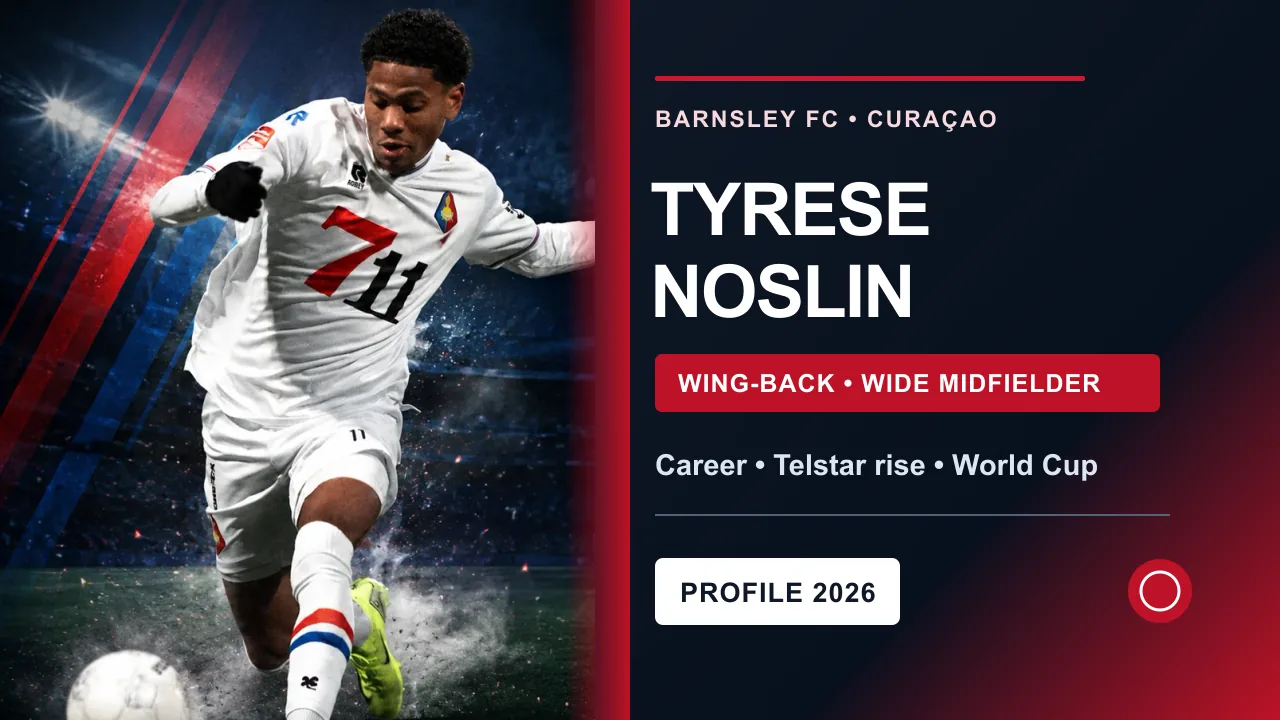
Tyrese Noslin is a Curaçao international footballer who joined Barnsley FC from SC Telstar in July 2026. The Amsterdam-born wide player built his senior reputation during Telstar’s rise from the Dutch second tier to the Eredivisie, then carried that progress onto the international stage with Curaçao. His story is less about a single fixed position than about learning how to influence matches from several roles on the right side.
This profile follows the part of Noslin’s career that can be checked through club and FIFA records. It explains the Barnsley move, his development at Almere City and Telstar, the matches that marked his Dutch breakthrough, his role for Curaçao, and what his combination of running power and positional flexibility may offer in English football. It does not estimate private financial information or turn uncertain database totals into facts.
Tyrese Noslin profile at a glance
- Full name: Tyrese Noslin
- Date of birth: 11 September 2002
- Birthplace: Amsterdam, Netherlands
- Height: approximately 1.82 metres
- Preferred foot: right
- Current club: Barnsley FC
- International team: Curaçao
- Usual roles: wing-back, wide midfielder and full-back
The labels only tell part of the story. Telstar used Noslin as a wing-back and also pushed him into more advanced positions. FIFA listed him among Curaçao’s midfield options for the 2026 World Cup squad. That difference is useful rather than contradictory: he is a right-sided footballer whose job changes with the shape of the team.
Where does Tyrese Noslin play now?
Noslin is a Barnsley FC player. Telstar announced on 14 July 2026 that the clubs had agreed a transfer and that he would move immediately to South Yorkshire. Barnsley’s own announcement said the agreement was for three years with a further one-year club option, subject at that point to the normal EFL and international clearance process.
The move from Telstar to Barnsley
The transfer followed two seasons in which Noslin moved quickly from a chance at Telstar to regular senior football and then Eredivisie exposure. Barnsley are competing in League One, the third tier of English football, so the move presents a different test rather than a simple step down from the Dutch top flight. The schedule, contact level and second-ball battles in League One will ask different questions of him.
Why Barnsley may value his flexibility
A club can use Noslin in a back four, as a wing-back in a back five, or higher on the flank when a match needs direct running. That range gives a head coach options within a game without immediately making a substitution. His Telstar experience also shows that he can accept a role that asks him to defend deep in one phase and arrive near the opposition penalty area in the next.
What position does Tyrese Noslin play?
Wing-back is the clearest summary, especially when describing his Telstar development, but it should not be treated as a strict limit. He has operated at right-back, on the right side of midfield and in advanced wide areas. Telstar match reports sometimes placed him in an attacking line, while FIFA’s Curaçao squad announcement grouped him with midfielders.
Wing-back responsibilities
As a wing-back, Noslin has to provide width when his team has possession and recover quickly when the ball is lost. The role depends on timing. Running forward too early can remove a safe passing option; running too late can leave an attacker isolated. His improvement at Telstar came as he became more comfortable making those repeated decisions over a full match.
Advanced wide assignments
When selected higher up, Noslin can press an opposing full-back, attack space outside a centre-back and arrive at the far post. His goal against Jong Ajax in February 2025 came from exactly the kind of far-post presence that a wide player can provide. The finish mattered, but the movement before it explains why a coach might release him from deeper duties.
Early football development in Almere
Noslin was born in Amsterdam but developed for much of his youth career in Almere. Telstar’s own preview material said he had been part of Almere City’s youth structure since 2013. That long period gave him a technical base and an understanding of several right-sided jobs before his route into senior football opened elsewhere.
Learning inside Almere City’s academy
Academy development is not only a list of age groups. For a player like Noslin, it is where details such as receiving on the touchline, checking the space behind him and deciding when to overlap become habits. The path did not produce an immediate first-team breakthrough, but it prepared him to take advantage when Telstar offered a new environment.
A patient route into the professional game
Noslin was not presented as a teenage superstar. His progress required patience through the years when many prospects disappear from public view. That context makes his later rise meaningful. He entered senior football with the physical maturity to handle repeated running and with enough tactical range to fill several needs for a smaller professional squad.
How Telstar gave Noslin his senior opportunity
Telstar signed Noslin in 2024 after he had trained with the squad. The club announced a deal for the season with an option for an additional year. It was an opportunity with a clear performance test attached, not a guarantee built on reputation. He responded well enough for Telstar to exercise the option and extend his stay to 30 June 2026.
Earning a contract after training with the squad
Training before signing allowed both sides to assess the fit. Telstar could see whether his intensity and positional habits matched their football, while Noslin could judge whether the club would give him a credible route to minutes. The arrangement worked because he became useful in more than one role instead of waiting for a single position to become available.
From squad option to trusted player
The later contract decision showed that the first season had changed his standing. Telstar specifically described his development as a wing-back. That is important evidence because it comes from the club that coached him each day, and it explains why later match reports could show him both defending the flank and appearing in dangerous attacking positions.
The 2024/25 breakthrough season
Noslin’s first Telstar season placed him inside a team building momentum in the Eerste Divisie. He contributed goals from wide areas and became part of the squad that earned promotion in 2025. The season gave him regular senior problems to solve: physical opponents, compact defences, quick transitions and the pressure of meaningful matches late in the campaign.
Goal against Jong Ajax
Telstar’s report of the 3-0 win over Jong Ajax recorded Noslin scoring at the far post in the 49th minute. It was a useful picture of his attacking value. Rather than staying outside the penalty area, he continued the move and occupied a scoring zone. For a wing-back or wide midfielder, those runs can turn territorial pressure into an actual chance.
Scoring in the win over FC Dordrecht
He also scored as Telstar beat FC Dordrecht 5-0. The result was a team statement, but Noslin’s involvement reinforced that his contribution was not restricted to safe circulation or defensive cover. A wide player who can arrive in the box gives opponents another runner to track and creates room for central forwards.
Promotion and the step into the Eredivisie
Promotion changed the level of every weekly test. Eredivisie opponents circulate the ball faster, punish poor distances more consistently and often isolate defenders in wider spaces. Noslin had to learn whether the qualities that worked in the second tier could survive against stronger technical players. Telstar’s willingness to keep using him suggested that the coaching staff trusted his adaptability.
What promotion demanded from him
The step required more than increased effort. Defensive decisions had to become cleaner because one late press could open a passing lane behind him. In possession, the first touch needed to move the ball away from pressure. His role could also change according to the opponent, with some games demanding deeper protection and others inviting direct runs into space.
Why top-flight minutes mattered
Eredivisie experience gave Noslin a stronger reference point before the Barnsley move. He had faced teams capable of dominating possession and had learned to remain involved when his side spent long periods without the ball. That background can help in England, where Barnsley will encounter both promotion contenders and opponents happy to defend in a low block.
Historic victory away to PSV
Telstar’s 2-0 away win against PSV in August 2025 was one of the defining results of the club’s return to the top division. The club report listed Noslin in an advanced role. Beating the reigning level of opposition in Eindhoven demanded collective discipline, brave counterattacking and concentration without the ball.
Noslin’s place in the attacking structure
Starting high did not remove his defensive responsibility. A wide attacker against PSV still has to track the opponent’s full-back, close passing angles and become an outlet when possession is recovered. The match showed why the simple word defender can be misleading for Noslin. His usefulness comes from connecting the defensive and attacking phases.
First top-flight home win since 1978
Telstar later beat Go Ahead Eagles 4-2 for their first Eredivisie home victory since 1978. The club report described Noslin’s header leading to the rebound from which the opening goal was scored. He did not receive the goal, but his action created the immediate danger. That distinction matters in an accurate profile: influence is broader than the final statistic.
Attacking the far-post zone
The sequence echoed his goal against Jong Ajax. Noslin can be valuable when he arrives beyond the central striker rather than remaining fixed near the touchline. A far-post run forces the weak-side defender to choose between protecting the goal and closing the crosser’s target, which can create rebounds even when the first header is saved.
Eredivisie goal against AZ
Telstar’s report of the 2-1 defeat at AZ credited Noslin with a goal in the 63rd minute. Scoring away to an established top-flight club was another sign that his forward runs could translate to the higher level. The result remained a defeat, so the goal should not be inflated into a complete performance verdict, but it belongs among the clearest markers of his season.
What the AZ moment showed
For Barnsley, the value of that evidence is not that Noslin should be judged as a regular scorer. It is that he has shown the timing and composure to contribute in advanced zones against strong opposition. If used as a wing-back, occasional goals from the opposite side of the box can make the whole attacking shape less predictable.
Tyrese Noslin’s playing style
Noslin’s game is built around mobility, repeated running and the ability to cover the full right channel. He is most useful when the match gives him space to carry the ball or accelerate beyond a teammate. His right foot supports conventional width, while his experience higher up the pitch helps him recognise when to continue into the penalty area.
Direct running with and without the ball
Direct does not have to mean careless. Noslin can advance the team by carrying into open grass, but his off-ball runs may be just as important. An overlap can pull a defender away from a winger, while an underlap can attack the gap between full-back and centre-back. The best version of his game chooses the run that improves the next pass.
Crossing and final-third choices
Wide players are often judged by cross totals, yet the quality of the decision matters more than volume. Noslin must recognise when an early delivery suits the striker, when to reach the byline and when to recycle possession. His Eredivisie experience exposed him to opponents who quickly punish low-percentage deliveries with counterattacks.
Recovery work and pressing
His pace also has defensive value. After possession is lost, a quick recovery can delay the counterattack and allow the back line to reset. When he starts higher, he can press outside-in to steer play toward a prepared trap. Barnsley’s coaching staff will judge him on the reliability of that work as much as on eye-catching forward runs.
Areas that can still improve
At 23, Noslin is entering an important stage rather than arriving as a finished player. Positional flexibility can earn minutes, but he still needs clarity in each assignment. The distances required from a League One full-back are different from those of an Eredivisie winger, and switching roles only helps if the defensive details remain dependable.
Consistency across different roles
The main development question is whether he can reproduce his best decisions from week to week. That includes the timing of pressure, body position when defending one against one, and selection of the final pass. A powerful run can solve one moment; consistent spacing helps the team across ninety minutes.
Adapting to English match rhythm
League One contains direct attacks, set-piece pressure and fast transitions, often within the same match. Noslin will need to read second balls and protect the area behind him when Barnsley commit numbers forward. His experience in a promoted Telstar side offers a useful foundation, but adaptation will still require training time and competitive minutes.
Why Curaçao selected Tyrese Noslin
Noslin’s Dutch development made him eligible and attractive to Curaçao, whose squad draws heavily from players trained in the Netherlands. His ability to cover several positions gives an international coach practical value because tournament squads have limited places. Dick Advocaat included him among the midfielders in FIFA’s official 2026 World Cup squad announcement.
A useful profile for tournament football
International teams have less training time than clubs. A player who understands wing-back, full-back and wide midfield responsibilities can help the coach change shape without rebuilding every relationship. Noslin could provide energy from the start or from the bench, depending on the opponent and the state of the match.
Role in Curaçao’s qualifying campaign
FIFA’s report of Curaçao’s goalless qualifier against Trinidad and Tobago noted that Noslin came close late on with a powerful right-footed effort. The attempt narrowly missed, but it showed his willingness to take responsibility in a tight match. Qualifying games often offer few clean chances, making a wide player’s ability to create a shot especially useful.
Competing for minutes in a flexible squad
Curaçao have experienced options across defence and midfield. Noslin therefore had to earn his place through tactical usefulness rather than assume it from club form. He joined a group that includes figures such as Leandro Bacuna, while fellow profiles Livano Comenencia and Kevin Felida illustrate the squad’s Dutch-developed core.
The 2026 FIFA World Cup experience
Noslin was selected for Curaçao’s historic first men’s World Cup squad. FIFA’s team announcement confirmed his place, and tournament material associated him with shirt number 13. Selection itself represented a major career milestone because Curaçao had never previously reached the men’s finals.
Sharing Curaçao’s first World Cup point
Curaçao lost their opening game to Germany, then drew 0-0 with Ecuador for the country’s first World Cup point before a defeat against Côte d’Ivoire. FIFA coverage after the Ecuador match showed Noslin embracing goalkeeper Eloy Room. The image captured the collective meaning of the result without requiring claims about unverified individual minutes.
What the tournament adds to his career
A World Cup squad exposes a player to elite preparation, global attention and opponents with different tactical habits. It does not automatically settle his club level, but it expands his experience. Noslin returned from the tournament with a clearer understanding of the standards required when every mistake is examined on the biggest stage.
How he fits Barnsley’s possible systems
Barnsley can use Noslin as the wide outlet in a three-at-the-back system or ask him to compete for a conventional full-back role. In a wing-back setup, his task would be to stretch the opponent in possession and recover alongside the back line. In a back four, he would start deeper and choose forward runs more selectively.
Option in a back three
A back three can give him more permission to attack because an outside centre-back protects part of the space behind him. Even then, he must coordinate with the nearest midfielder. If both advance at once, Barnsley can be exposed; if neither advances, the team may lack width. Communication will determine whether his athletic qualities become structural value.
Option in a back four
At full-back, defensive positioning becomes more visible. Noslin would need to protect the far post, manage runners outside and inside him, and build a stable relationship with the right centre-back. His experience as an attacker may help him anticipate an opponent’s movement, but the role demands concentration even when he has not touched the ball for several minutes.
What Barnsley supporters should expect
Supporters should expect an energetic right-sided player, not a promise that every appearance will look the same. Noslin’s early minutes may come in different positions while the staff assess his strongest fit. His Telstar record suggests he can grow when a coach gives him responsibility, but a new country and league always bring an adjustment period.
Short-term expectations
The first goal is tactical trust. He needs to learn Barnsley’s pressing cues, set-piece assignments and the preferred timing of overlaps. If he becomes reliable without the ball, his direct running can give the team an extra way to progress. A substitute role in one match and a start in another would not necessarily indicate a settled hierarchy during that process.
Longer-term opportunity
A three-year agreement, plus the reported club option, gives Barnsley room to develop rather than judge him on a handful of weeks. Noslin can establish himself by turning versatility into consistent performance. The strongest outcome would be a clear primary role with enough secondary knowledge to help when injuries or tactical changes demand it.
Tyrese Noslin career timeline
- 2013 onward: develops in Almere City’s youth system, according to Telstar’s club material.
- 2024: trains with Telstar and earns a contract for the season with an option.
- 2024/25: contributes from the right side, scores against Jong Ajax and FC Dordrecht, and is part of Telstar’s promotion season.
- 2025: Telstar exercises the contract option after his development as a wing-back.
- 2025/26: plays in the Eredivisie, including the historic away win at PSV and a goal at AZ.
- 2025/26: becomes part of Curaçao’s qualifying and World Cup plans.
- June 2026: selected in Curaçao’s first men’s World Cup squad.
- 14 July 2026: Telstar announces his transfer to Barnsley FC.
This sequence is more informative than an inflated list of unsourced totals. It shows the central pattern: a long academy education, a senior opportunity at Telstar, rapid exposure to higher levels, international selection and a move into English football.
Frequently asked questions
How old is Tyrese Noslin?
Noslin was born on 11 September 2002. He is 23 years old as of 27 July 2026. The date matters more than a permanently written age because the latter becomes outdated each birthday.
Is Tyrese Noslin related to Tijjani Noslin?
Publicly available club and FIFA material used for this profile does not establish a family relationship. Similar surnames are not sufficient evidence, so this page does not present them as relatives.
Which country does Tyrese Noslin represent?
He represents Curaçao at senior international level. He was born in the Netherlands and developed in Dutch football, which is why both places are relevant to his football identity.
What number does Tyrese Noslin wear?
FIFA tournament material associated him with number 13 for Curaçao at the 2026 World Cup. Club squad numbers can change by season, so this profile does not assign an unconfirmed Barnsley number.
When did Tyrese Noslin join Barnsley?
Telstar announced the agreed transfer on 14 July 2026. Barnsley’s announcement described a three-year contract with a further one-year club option, subject at the time to standard clearance.
Did Tyrese Noslin play in the Eredivisie?
Yes. He played for Telstar after their promotion and featured in club reports from matches against PSV, Go Ahead Eagles, AZ and FC Volendam during the 2025/26 top-flight season.
Related Curaçao coverage
Read the Curaçao team guide for the broader tournament picture and the Curaçao World Cup squad report for the selection context. The player profiles linked above explain how different club paths came together in the national team.
Sources and editorial method
This profile prioritises first-party records. The current-club information comes from Telstar’s transfer announcement and Barnsley’s official announcement. Career moments are drawn from Telstar’s signing, contract and match reports. International selection and qualifying context come from FIFA’s tournament coverage.
Facts that could not be verified through those records were left out or clearly qualified. Appearance totals can differ across databases depending on competition coverage, and private contract finances are not treated as public facts. The page was last fact-checked on 27 July 2026 and should be updated when Barnsley confirms a squad number or publishes new competitive records.