Extra Time World Cup 2026 Group Stage Regulations

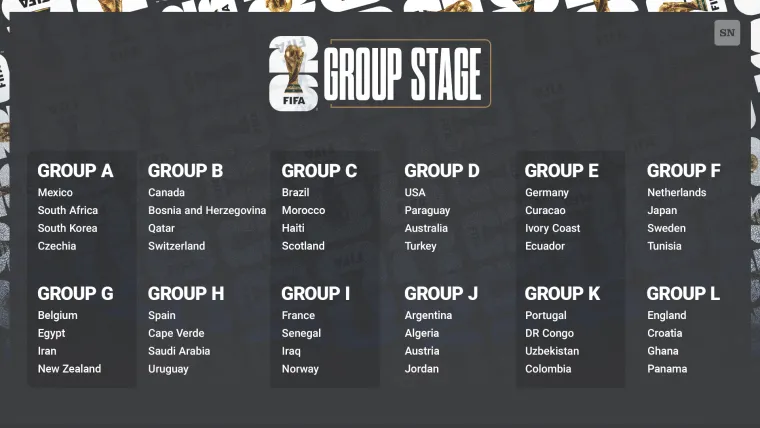
Understanding the extra time World Cup 2026 group stage rules helps fans follow the tournament without confusion during tense. Contested matches. Group games do not go to extra periods if the score is level after 90 minutes of play. This Is a critical difference from the knockout rounds and instead.
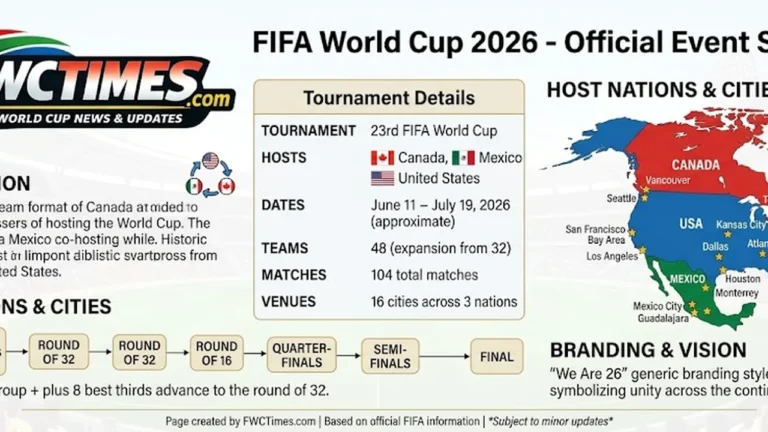
The 2026 tournament marks the most significant expansion in World Cup history. With 48 teams competing across 12 groups of four. The top two teams from each group progress automatically to the Round of 32. While the eight best third-placed teams across all groups also qualify for the knockout stage.
Extra Time World Cup 2026 Group Stage: Points and Format Rules
The group stage uses a standard league points system where a win earns three points. A draw earns one point per team and and A loss earns zero. Each of the 48 teams plays three group-stage matches. This means Every nation has nine possible points available from the group phase.
Since group draws end after 90 minutes without any additional play. Tactical approaches in the group stage differ significantly from knockout matches. Teams must decide whether to push for a late winner or accept one point. Particularly in fixtures where a draw might still secure progression to the Round of 32.
Rules by Tournament Stage
| Stage | Extra Time Used? | If Level After 90 Minutes |
|---|---|---|
| Group stage | No | Match ends as a draw, one point each |
| Round of 32 | Yes | 30 minutes extra time, then penalties |
| Round of 16 | Yes | 30 minutes extra time, then penalties |
| Quarter-final | Yes | 30 minutes extra time, then penalties |
| Semi-final | Yes | 30 minutes extra time, then penalties |
| Third-place match | Yes | 30 minutes extra time, then penalties |
| Final | Yes | 30 minutes extra time, then penalties |
From the Round of 32 onward. Every match must produce a definitive winner since no draws are permitted in the elimination format. If a knockout match remains level after 90 minutes of regulation play. An additional 30 minutes of extra time is played across two 15-minute halves.
Both halves of extra time must be played in full regardless of any goals scored. Since the 2026 World Cup does not use a sudden-death or Golden Goal rule. This means a team that scores in the first 15-minute period of extra time cannot. End the match immediately and must defend for the remaining time of the second half.
Why the Group Stage Excludes Extra Time
Tactical Role of Extra Time World Cup 2026 Group Stage
Excluding extra periods from the group stage is a deliberate design. Decision that protects players from accumulated physical fatigue early in the tournament. Adding 30 minutes to group matches would compress recovery windows between fixtures and increase. Injury risk for squads that must play three games before reaching the knockout rounds.
Broadcaster scheduling also benefits from the predictable 90-minute group match format. Since television networks can plan their programming around fixed time slots without uncertainty about whether a match will extend. Traveling supporters can plan their stadium visits and local transport around known match lengths during the group stage. A drawn result in the group phase still carries significant meaning.
Tiebreaker Rules When Teams Finish Level on Points
When two or more teams finish the group stage with identical points totals. A series of tiebreaker criteria separates them in the standings. Goal difference is the first tiebreaker, calculated by subtracting goals conceded from goals scored across all three group matches. If goal difference remains equal, total goals scored during the group phase serves as the second separator.
Head-to-head results between the tied teams become relevant if goal difference and total goals scored remain identical. Fair play points and based on the number and severity of yellow and red cards received during group play. Can also act as a final separator in extreme tiebreaker scenarios. Read our guides on World Cup 2026 groups and the World Cup 2026 schedule PDF.
Frequently Asked Questions
Is there extra time in the World Cup 2026 group stage?
No, extra time is not used during the World Cup 2026 group stage. If a match ends level after 90 minutes plus stoppage time. Both teams receive one point and the match is over. There is no additional period of play and no penalty shootout in any group-stage fixture.
Do group stage games have penalty shootouts at World Cup 2026?
No, penalty shootouts are not used in the group stage under the 2026 World Cup format. Drawn matches end after 90 minutes, with both nations sharing one point each. Only knockout matches from the Round of 32 onward use penalty. Shootouts to decide a winner when extra time also ends level.
When does extra time begin in the World Cup 2026 tournament?
Extra time begins in the Round of 32, which is the first knockout stage of the 2026 World Cup. Every subsequent elimination round, including the Round of 16, quarter-finals, semi-finals. And The final, also uses extra time when matches are level after regulation. The Round of 32 is a new feature introduced specifically for the expanded 48-team format.
How long is extra time in World Cup 2026 knockout matches?
Extra time in the 2026 World Cup knockout rounds lasts 30 minutes in total. Split into two halves of 15 minutes each. Both halves must be played in full regardless of any goals scored. Since the tournament does not use the Golden Goal or sudden-death rule.
How many points does a draw award in the World Cup 2026 group stage?
A draw awards one point to each team in the World Cup 2026 group stage. Wins award three points while losses award zero. Following the same standard points system used across professional football leagues worldwide. These points accumulate across three group-stage matches to determine the final group standings.