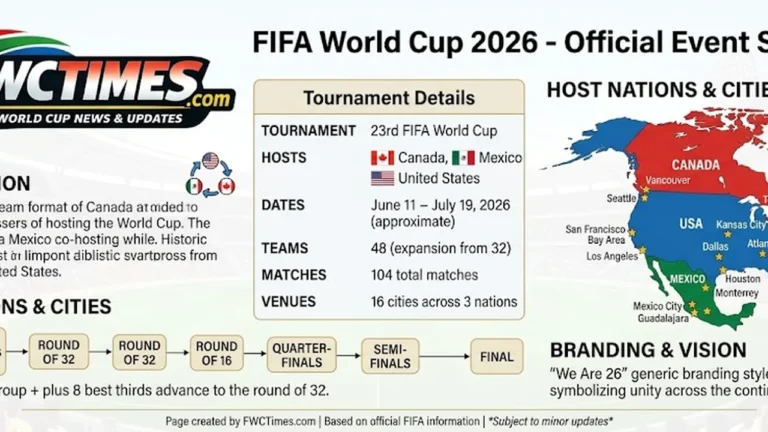
FIFA World Cup 2026 Economic Impact on Host Cities


The World Cup 2026 economic impact is projected to be. One of the largest ever generated by a single sporting event. Driven by the tournament’s expanded 48-team format across 16 host cities in three countries. A joint FIFA and World Trade Organization study published in March 2025 estimated total tournament-related expenditure at approximately.
Economists note that the economic boost from major sporting events. Tends to be more localized and shorter-lived than initial projections suggest. Host cities receive the clearest direct benefits through hotel bookings, restaurant spending, and retail activity during the tournament weeks. Individual host cities can expect incremental economic activity ranging from $160 million to $620 million depending on their size.
World Cup 2026 Economic Impact by Host Country
| Host Country | Projected Economic Benefit | Key Driver |
|---|---|---|
| United States | GDP increase of approx. 0.05 percentage points | Visitor spending and hotel demand |
| Mexico | $3 billion total, GDP uplift of 0.1%–0.2% | Tourism, retail, and hospitality |
| Canada | Tourism gains of $1 billion to $5 billion | Quarterly GDP lift of approx. 0.1 percentage points |
| All 16 host cities combined | $160 million to $620 million per city | Match-week visitor activity |
| Total tournament expenditure | Approx. $13.9 billion (FIFA-WTO estimate) | All tournament-related spending |
Mexico stands to gain one of the most noticeable proportional lifts of the three host nations. With economists forecasting a total economic benefit of around $3. Billion and a GDP uplift between 0.1 and 0.2 percentage points. This is a meaningful boost for an economy where international tourism already plays a significant role.
Hotel markets across the 16 host cities anticipated record occupancy rates as planning began. Yet some cities have seen booking paces run below initial expectations in the months leading up to the tournament. Tourism Economics projected hotel room revenue increases of between 7. And 25 percent in June 2026 across the host cities and a range that reflects significant variation between cities.
Tourism and Hospitality: Where the Money Goes
Visitor spending is the single largest component of the World Cup 2026 economic impact. Projected at approximately $6.2 billion across accommodation, food and beverage, local transport, entertainment, shopping and and Match tickets. The average total cost for a fan attending a match. Including a resale ticket, two-night hotel stay, travel costs, food.
FIFA’s use of dynamic pricing for tickets and where prices rise with demand. Has attracted some criticism from economists who argue that high ticket costs may reduce total attendance. A fan who cannot afford a ticket may not visit the city at all. Removing their broader spending from hotels, restaurants and and Local businesses and in fact.
Long-Term Legacy Beyond Match Weeks
Host cities view the 2026 World Cup as more than a short-term tourism event. Since the global media attention creates an opportunity to raise their international profile for future visitors and business investment. Stadium upgrades, transport infrastructure improvements and and Public space developments completed in preparation for the tournament leave physical. Legacies that local residents and future visitors can benefit from for years.
The United States benefits not only from direct tournament spending but also from the sustained. Global media presence it receives as the primary host nation from June 11 to July 19 and 2026. This visibility supports the country’s bid to position several of its cities as world-class football. Destinations ahead of an era where Major League Soccer is growing its international profile.
Costs and Risks for Host Cities
Tactical Role of World Cup 2026 Economic Impact
Not every host city will see the same return on investment. And Some will face situations where operating costs outpace the direct revenue flowing into the local economy. Security, transport management, fan zone operations, venue preparation and and Staffing costs all represent significant public expenditure that. Recovered through visitor spending and tax revenue generated by the event and cities that are already major tourism hubs.
Economists also caution that the pattern of major sporting event. Economic projections has historically trended toward overestimating benefits and underestimating costs and actual post-event economic analyses of previous. Including Brazil 2014 and Russia 2018, consistently showed that headline projections overstated the realized economic gains for host communities. That said.
Frequently Asked Questions
What is the projected economic impact of World Cup 2026?
A joint FIFA and World Trade Organization study published in March 2025 estimated total World Cup 2026 economic. And Mexico and visitor spending accounts for roughly $6.2 billion of that total, covering accommodation, food, transport, entertainment. Individual host cities are projected to see incremental economic activity ranging from $160 million. To $620 million depending on their size and the number of matches they host.
Which sectors benefit most from the World Cup 2026?
Hotels, restaurants, transport providers, retail businesses, and local tourism services are the primary beneficiaries of tournament-related visitor spending. The hospitality sector benefits first since fans need accommodation and. Food from the moment they arrive in a host city and local transport providers, including ride services, public transit. And Taxis, see sharply higher demand during match days and the surrounding days of fan activity.
How much does Mexico benefit from hosting World Cup 2026?
Economists forecast a total economic benefit of approximately $3 billion for Mexico. With a GDP uplift projected between 0.1 and 0.2 percentage points during the tournament period. This represents one of the more noticeable proportional economic lifts of the three host nations. Given Mexico’s economy is smaller than the United States but already relies significantly on international tourism revenue.
Do host cities face costs as well as benefits from the World Cup?
Yes, host cities bear significant costs including security operations, transport management, fan zone setup, venue preparation. And Staffing expenses that must be funded before any visitor spending arrives. These costs can outpace direct local economic returns. Particularly for cities that see World Cup visitors replacing rather than adding to their normal tourism demand.
When will the full economic impact of World Cup 2026 be known?
The clearest picture of the actual economic impact will emerge in the months following the tournament’s conclusion. 2026, when government agencies and economists can review visitor spending data, hotel occupancy records and and Tax revenue figures. Pre-tournament projections provide useful estimates but cannot account for variables like weather disruptions, geopolitical factors, actual attendance levels. And Hotel occupancy rates that only become clear during and after the event and full multi-year assessments.