FIFA World Cup 2026 Round of 32 Schedule & Bracket

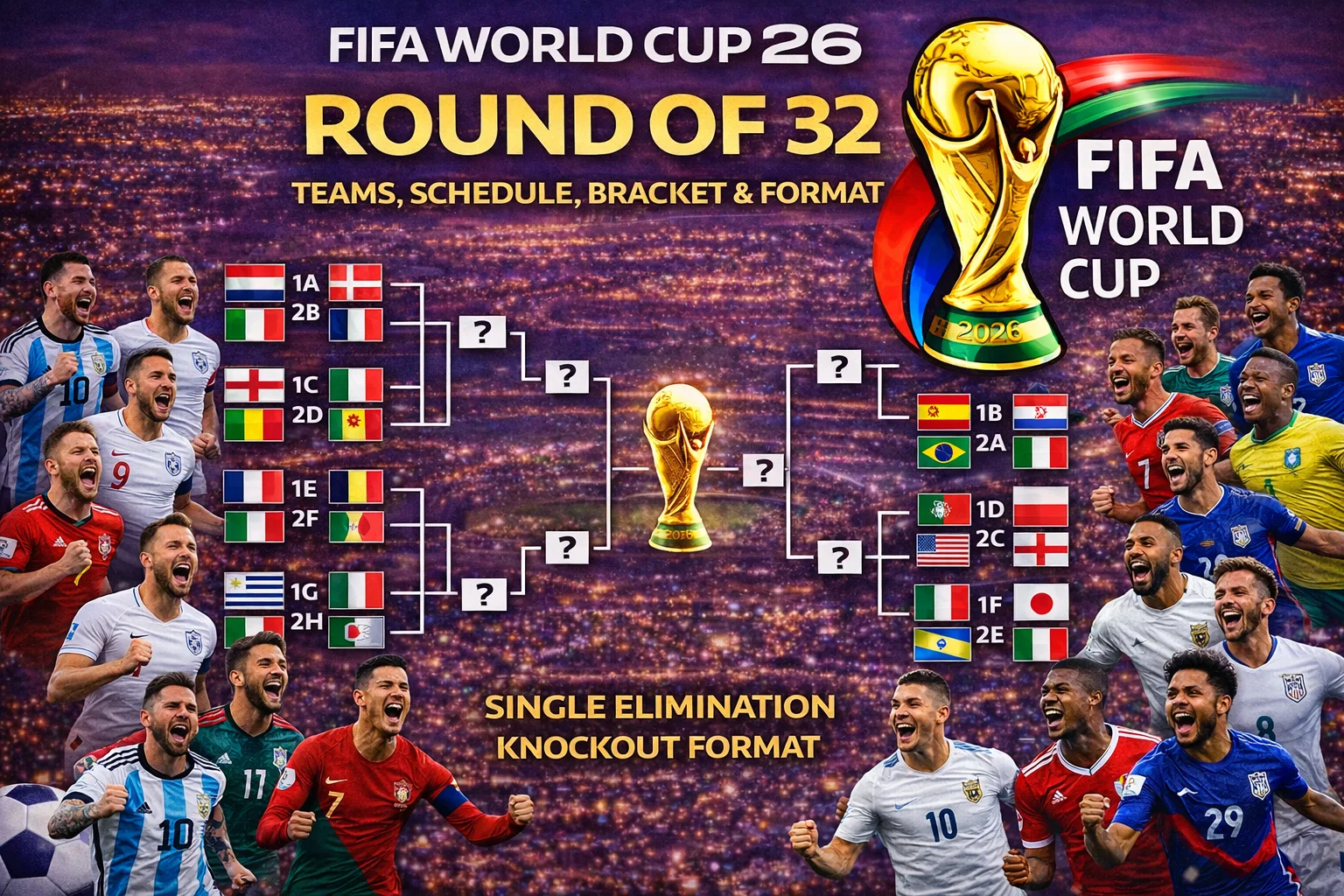
The FIFA World Cup 2026 Round of 32 has moved again, with more knockout ties confirmed before the final group-stage matches on June 27. Twenty-five teams now have places in the first elimination round. Seven slots still depend on the last results from Groups G, K, and L plus the final third-place ranking.
The round starts on Sunday, 28 June and runs through Friday, 3 July by local match dates. Sixteen one-off matches will decide the last-16 lineup. Fans can track the full tournament path through the FIFA World Cup 2026 matches hub as the bracket keeps filling.
The biggest update is that Germany, France, Ivory Coast, Norway, Paraguay, Sweden, Argentina, and Cabo Verde now know their knockout opponents. Mexico, Spain, Switzerland, Australia, England, Portugal, Colombia, Egypt, and Ghana are also through, but several of them still await final bracket placement.
FIFA World Cup 2026 Round of 32 Schedule
The latest schedule now includes eight confirmed ties and eight bracket slots still pending. Local dates are listed first, with GMT conversions shown beside each kickoff.
| Local Date | Match | Kickoff | Venue | Status |
|---|---|---|---|---|
| 28 June 2026 | South Africa vs Canada | 12:00 local / 19:00 GMT | Los Angeles Stadium | Confirmed |
| 29 June 2026 | Brazil vs Japan | 12:00 local / 17:00 GMT | Houston Stadium | Confirmed |
| 29 June 2026 | Germany vs Paraguay | 16:30 local / 20:30 GMT | Boston Stadium | Confirmed |
| 29 June 2026 | Netherlands vs Morocco | 19:00 local / 01:00 GMT+1 | Estadio Monterrey | Confirmed |
| 30 June 2026 | Ivory Coast vs Norway | 12:00 local / 17:00 GMT | Dallas Stadium | Confirmed |
| 30 June 2026 | France vs Sweden | 17:00 local / 21:00 GMT | New York New Jersey Stadium | Confirmed |
| 30 June 2026 | Mexico vs third-place qualifier from C/E/F/H/I | 19:00 local / 02:00 GMT+1 | Mexico City Stadium | Opponent pending |
| 1 July 2026 | Group L winner vs third-place qualifier from E/H/I/J/K | 12:00 local / 16:00 GMT | Atlanta Stadium | Opponent pending |
| 1 July 2026 | Group G winner vs third-place qualifier from A/E/H/I/J | 13:00 local / 20:00 GMT | Seattle Stadium | Opponent pending |
| 1 July 2026 | United States vs Bosnia and Herzegovina | 17:00 local / 00:00 GMT+1 | San Francisco Bay Area Stadium | Confirmed |
| 2 July 2026 | Spain vs Group J runner-up | 12:00 local / 19:00 GMT | Los Angeles Stadium | Opponent pending |
| 2 July 2026 | Group K runner-up vs Group L runner-up | 19:00 local / 23:00 GMT | Toronto Stadium | Opponent pending |
| 2 July 2026 | Switzerland vs third-place qualifier from E/F/G/I/J | 20:00 local / 03:00 GMT+1 | BC Place Vancouver | Opponent pending |
| 3 July 2026 | Australia vs Group G runner-up | 13:00 local / 18:00 GMT | Dallas Stadium | Opponent pending |
| 3 July 2026 | Argentina vs Cabo Verde | 18:00 local / 22:00 GMT | Miami Stadium | Confirmed |
| 3 July 2026 | Group K winner vs third-place qualifier from D/E/I/J/L | 20:30 local / 01:30 GMT+1 | Kansas City Stadium | Opponent pending |
Confirmed Teams in the FIFA World Cup 2026 Round of 32
The confirmed team pool has grown from nineteen to twenty-five since the last update. Brazil, Japan, Germany, Paraguay, France, Sweden, Ivory Coast, Norway, Argentina, and Cabo Verde now have named opponents and dates.
United States will face Bosnia and Herzegovina in the Bay Area, while Canada open the knockout phase against South Africa. Netherlands vs Morocco gives the Monterrey slot one of the strongest tactical matchups in the round.
| Status | Teams | Notes |
|---|---|---|
| Confirmed matchup | South Africa, Canada, Brazil, Japan, Germany, Paraguay, Netherlands, Morocco, Ivory Coast, Norway, France, Sweden, United States, Bosnia and Herzegovina, Argentina, Cabo Verde | Opponent, date, and venue are known |
| Qualified, opponent pending | Mexico, Spain, Switzerland, Australia | Date and venue known, opponent still open |
| Qualified, bracket placement still pending | England, Portugal, Colombia, Egypt, Ghana | Final group positions and third-place grid still affect placement |
| Remaining slots | yet to be confirmed | Seven places depend on the last group matches and third-place table |
New Confirmed Matchups Added on June 27
Germany vs Paraguay is now set for Boston on 29 June. Germany survived an uneven Group E, while Paraguay came through Group D after a tense draw with Australia. The matchup gives Germany a direct test against a compact South American side.
Ivory Coast vs Norway will be played in Dallas on 30 June. Norway reached the knockouts from Group I after wins over Iraq and Senegal, then rested key players against France. Ivory Coast advanced from Group E and now get a chance to win a first World Cup knockout match.
France vs Sweden is also locked for 30 June at New York New Jersey Stadium. France topped Group I with three wins and enter the tie with major attacking rhythm. Sweden arrive from Group F after doing enough to qualify through the expanded bracket.
Argentina vs Cabo Verde gives Miami a major July 3 fixture. Argentina won Group J early, while Cabo Verde made history by reaching the knockouts in their first World Cup. That matchup now becomes one of the clearest storylines of the round.
FIFA World Cup 2026 Round of 32 Bracket Watch
The remaining uncertainty sits around Group G, Group K, Group L, and the final third-place allocation. Mexico, Switzerland, Spain, and Australia already know their match windows, but their opponents still depend on those moving pieces.
England, Portugal, Colombia, Egypt, and Ghana are through, yet their final placement can still shift the late side of the bracket. Once the last June 27 matches finish, the Round of 32 should move from partial bracket to full fixture list.
How Teams Qualify for the Round of 32
The top two teams from each of the twelve groups qualify automatically. That creates twenty-four places before the third-place ranking is applied. The best eight third-placed teams then complete the thirty-two-team knockout field.
Group ranking starts with points, then head-to-head records between tied teams. If teams remain level, goal difference, goals scored, disciplinary score, and FIFA ranking can separate them. The third-place table uses points, goal difference, goals scored, discipline, and ranking.
That rule set is why some teams qualify before they know their opponent. A team can secure enough points to advance while still waiting for the bracket grid. Fans should also check the FIFA World Cup group stage matches before judging any pending third-place route.
Extra Time and Penalty Rules
Round of 32 matches cannot end level. If a tie is drawn after ninety minutes, teams play thirty minutes of extra time. If the score still stays level, a penalty shootout decides the winner.
The format rewards teams that protect their fitness across the group stage. Knockout nights can stretch beyond two hours of playing time. Coaches must balance attacking changes with enough structure to survive extra time.
Discipline also matters because suspensions can damage a squad’s next-round plan. Players carrying bookings need controlled decisions in tackles, set-piece defending, and late-game transitions. One mistimed challenge can change the path to the last 16.
Frequently Asked Questions
When does the FIFA World Cup 2026 Round of 32 start?
The Round of 32 starts on Sunday, 28 June 2026, with South Africa vs Canada at Los Angeles Stadium.
How many Round of 32 fixtures are confirmed now?
Eight fixtures are confirmed as of June 27, 2026, while eight still include at least one pending opponent.
Which new Round of 32 matchups were added?
Germany vs Paraguay, Ivory Coast vs Norway, France vs Sweden, and Argentina vs Cabo Verde are the newest confirmed matchups.
Do Round of 32 matches go straight to penalties?
No. A tied knockout match goes to extra time first. Penalties follow only if the score remains level after extra time.
When will the full Round of 32 bracket be complete?
The full bracket should be complete after the final group-stage matches and third-place ranking are settled on June 27, 2026.
Conclusion
The FIFA World Cup 2026 Round of 32 is now much clearer than it was a day ago. Eight ties are confirmed, twenty-five teams have qualified, and the final seven places remain tied to the last group-stage results. The next update should complete the bracket once Groups G, K, and L finish.
Read Also: FIFA World Cup round of 16