UEFA Teams in FIFA World Cup 2026: News

The participation of UEFA Teams in FIFA World Cup matches shapes the tournament story. European nations are preparing to challenge for the global trophy in North America. The expanded format alters the path to qualification for many teams.
European soccer features immense tactical depth and world-class squad organizations. The qualifying rounds produced intense competition across all the groups. Fans are preparing to support their teams in large numbers.
Which UEFA teams are in FIFA World Cup 2026?
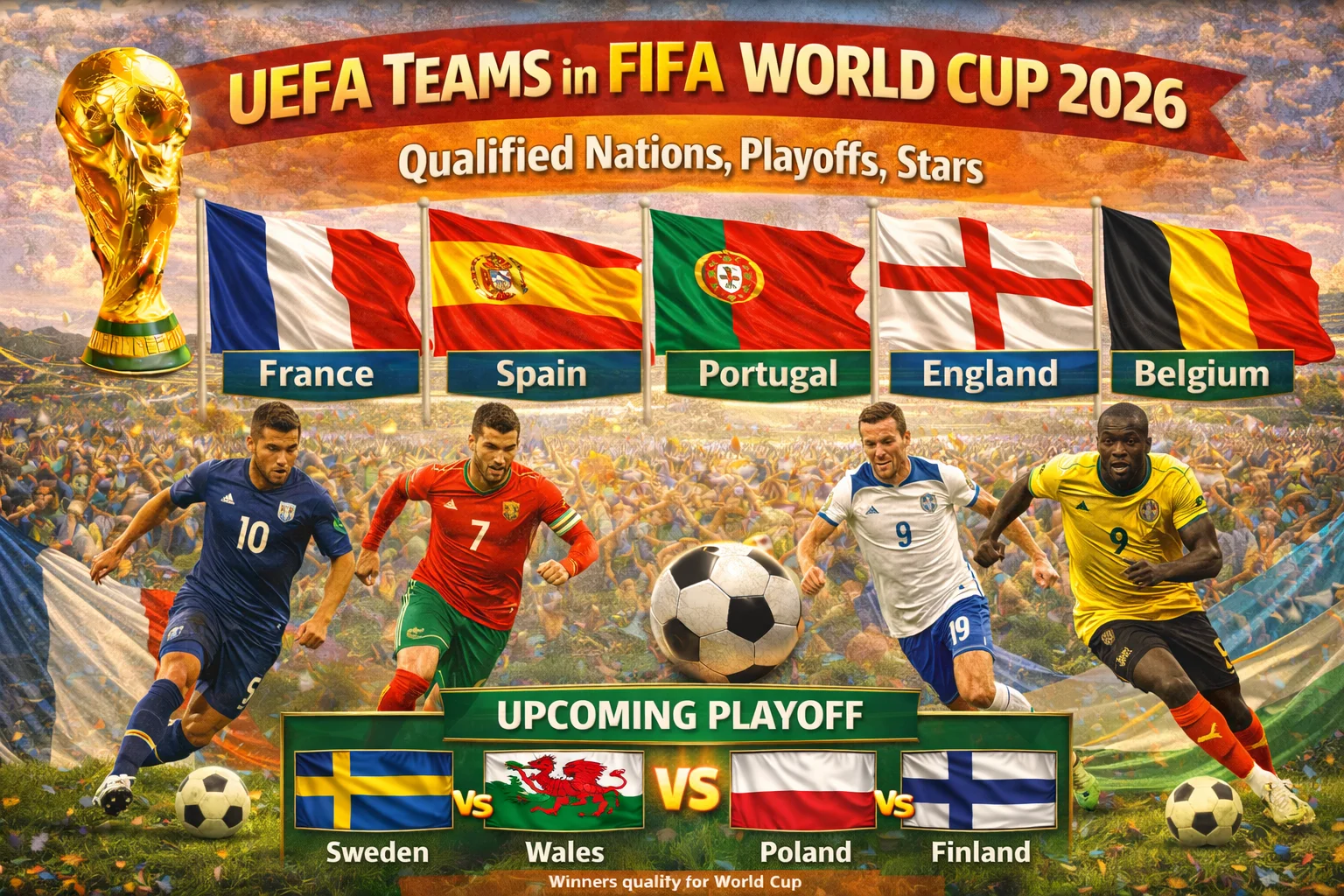
A total of sixteen UEFA Teams in FIFA World Cup 2026 can qualify. Confirmed group winners include Austria, Belgium, Croatia, England, France, Germany, Netherlands, Norway, Portugal, Scotland, Spain, and Switzerland. The remaining four spots are decided in the play-offs in March 2026.

How UEFA qualification works for the 2026 World Cup?
The qualification structure was modified to fit the expanded tournament format. UEFA receives sixteen qualification slots for the final tournament draw. The teams were divided into twelve groups of four or five teams each.
UEFA Teams in FIFA World Cup qualifiers
The qualifying group stage featured high-stakes matches and dramatic finishes. Supporters can check the Why FIFA World Cup 2026 has 48 teams article.
The play-offs
The play-off phase features sixteen teams competing in single-leg knockout matches. The four path winners secure the final tournament tickets.
UEFA Teams in FIFA World Cup Already Qualified
Twelve European nations secured direct qualification as group winners. Spain and England confirmed their tickets after dominant campaigns. France and Germany also qualified with consistent defensive records.
UEFA Teams in FIFA World Cup group winners
The direct qualifiers showed great tactical organization during the group stage. Details are in the Spain FIFA World Cup 2026 schedule guide.
UEFA World Cup 2026 play-offs: dates, format, and why they matter
The play-off matches are scheduled for March 2026 to select the final qualifiers. The single-leg format creates intense pressure for all participating teams. A single error can end the dream of qualifying.
Key play-off dates to know
The play-off matches are played during the March international window. The schedule is demanding for the players.
Semi-finals
The play-off semi-finals feature eight matches played across Europe. Details are in the England FIFA World Cup 2026 schedule guide.
Finals
The four path finals decide the last European representatives for the tournament. The winners celebrate historic qualification.
UEFA World Cup play-off paths and fixtures
The sixteen play-off teams are organized into four knockout brackets. The brackets ensure competitive matches between teams of similar strength. The matches will be played on March 26 and March 31, 2026.
Play-off semi-finals (March 26, 2026)
Eight semi-final fixtures will trim the play-off field on this day. The players are ready for the challenge.
Play-off finals (March 31, 2026)
The four final matches will confirm the final European lineup. The drama will be unforgettable.
Stars to watch from qualified UEFA teams
European stars are expected to headline the tournament matches in North America. These players perform at the highest levels in club football. Their individual quality will decide the success of their national teams.
Goals and headline moments
Lethal strikers provide the goals needed to win tournament matches. Supporters expect them to deliver.
Kylian Mbappé (France)
Kylian Mbappé is prepared to lead the French attack in North America. Fans expect another performance.
Harry Kane (England)
Harry Kane provides the clinical finishing and leadership for England. The team relies on his goalscoring form.
Erling Haaland (Norway)
Erling Haaland led Norway to direct qualification with his scoring record. The defenders must plan carefully.
Cristiano Ronaldo’s legacy effect (Portugal)
Cristiano Ronaldo remains an influential figure in the Portugal squad. His goalscoring instincts are still sharp.
Control, balance, and structure
Midfield generals control the tempo of matches with accurate passing. Their work rate is essential for the team.
Luka Modrić and Croatia’s midfield culture
Luka Modrić continues to dictate play for Croatia with his technical skill. The team relies on his tactical guidance.
Kevin De Bruyne and Belgium’s creativity
Kevin De Bruyne provides the creative passes for Belgium’s attackers. The squad expectations are high.
Spain’s new wave
Spain features technically gifted young midfielders who dominate match possession. The team aims to control every match.
Netherlands’ defensive leaders
The Netherlands relies on world-class central defenders to secure their backline. The team is difficult to beat.
Tactical trends shaping UEFA teams for 2026
European coaches are focusing on tactical flexibility and quick transition play. Teams adapt their formations based on match scenarios and opponent strengths. Defensive compacting is combined with rapid counter-attacking patterns.
Compact defending with fast counters
Expect to see compact defensive lines that deny space to opponent midfielders. The tactical execution must be precise.
Set pieces as a superpower
Coaches spend significant training time preparing set-piece routines. Defending teams must stay alert.
Squad depth and rotation
A demanding schedule requires coaches to rotate players during the group stage. The rotation strategies will be key.
Smart risk management
Teams avoid taking unnecessary risks in possession during close matches. The game management must be mature.
Underrated storylines fans should track
Norway and Scotland are rising forces challenging traditional giants. Austria and Switzerland have developed solid tournament habits over recent years. Belgium is transitioning to a new generation of talent.
Norway and Scotland
Norway qualified directly after a brilliant qualifying group campaign. They expect to challenge group opponents.
Austria and Switzerland
Austria uses an intense pressing style under their modern coaching staff. They have the quality to advance.
Belgium’s transition timing
Belgium is integrating young talents with experienced squad veterans. The fans expect another campaign.
Germany’s rebound narrative
Germany is aiming to rebuild their reputation after recent tournament disappointments. The preparations are progressing well.
What the UEFA field means for the World Cup 2026 title race
The presence of UEFA Teams in FIFA World Cup matches guarantees high standards. European nations have won several recent global titles. The depth of the field makes them strong contenders for the trophy. The battle for the cup will be historic.
Table: UEFA teams and qualification paths
| Qualified UEFA nation | Route to qualification | What it signals for 2026 |
|---|---|---|
| Austria | Group winner | A disciplined structure with experienced leaders and direct attacking moments |
| Belgium | Group winner | One more run for a golden generation blend, plus exciting wide attackers |
| Croatia | Group winner | Midfield control and tournament craft, even as the squad transitions |
| England | Group winner | Depth, pace, and finishing options, with huge expectations in every match |
| France | Group winner | Elite athleticism and goals from multiple lines, built for knockout football |
| Germany | Group winner | A refreshed core and high tempo phases, aiming to peak at the right time |
| Netherlands | Group winner | Defensive authority and sharp wing play, with clinical transition attacks |
| Norway | Group winner | A true star-led rise, with goals and direct play that travel well |
| Portugal | Group winner | Technical control and match winners, with strong tournament experience |
| Scotland | Group winner | A resilient unit with set-piece threat and belief from recent momentum |
| Spain | Group winner | Possession control plus new speed in wide areas and final-third movement |
| Switzerland | Group winner | Compact defending, smart game management, and consistent tournament habits |
How many UEFA Teams in FIFA World Cup qualify directly?
Twelve European teams qualify directly as winners of the qualifying groups. Confirmed group winners include Spain, England, France, and Germany.
How many slots are allocated to Europe in 2026?
Europe receives sixteen slots in the expanded tournament format. This is an increase from the previous allocation of thirteen slots.
When are the UEFA play-off matches played?
The play-off matches are played in March 2026. The semi-finals are on March 26, and the path finals are on March 31, 2026.
How many teams compete in the UEFA play-offs?
Sixteen teams compete in the play-offs for the final four slots. The play-offs feature four knockout paths with semi-finals and finals.
Conclusion
The campaign for UEFA Teams in FIFA World Cup 2026 will be spectacular. With sixteen spots, Europe sends a powerful contingent to North America. The mix of elite favorites and hungry debutants promises amazing drama.
The tournament represents a major test of European soccer dominance. The tactical depth and world-class talent of the teams are ready for the global stage. Success in the finals will write new chapters in soccer history. The excitement is building globally.
Read Also: afc-teams-in-fifa-world-cup