Fastest Goals in FIFA World Cup Top 10 List

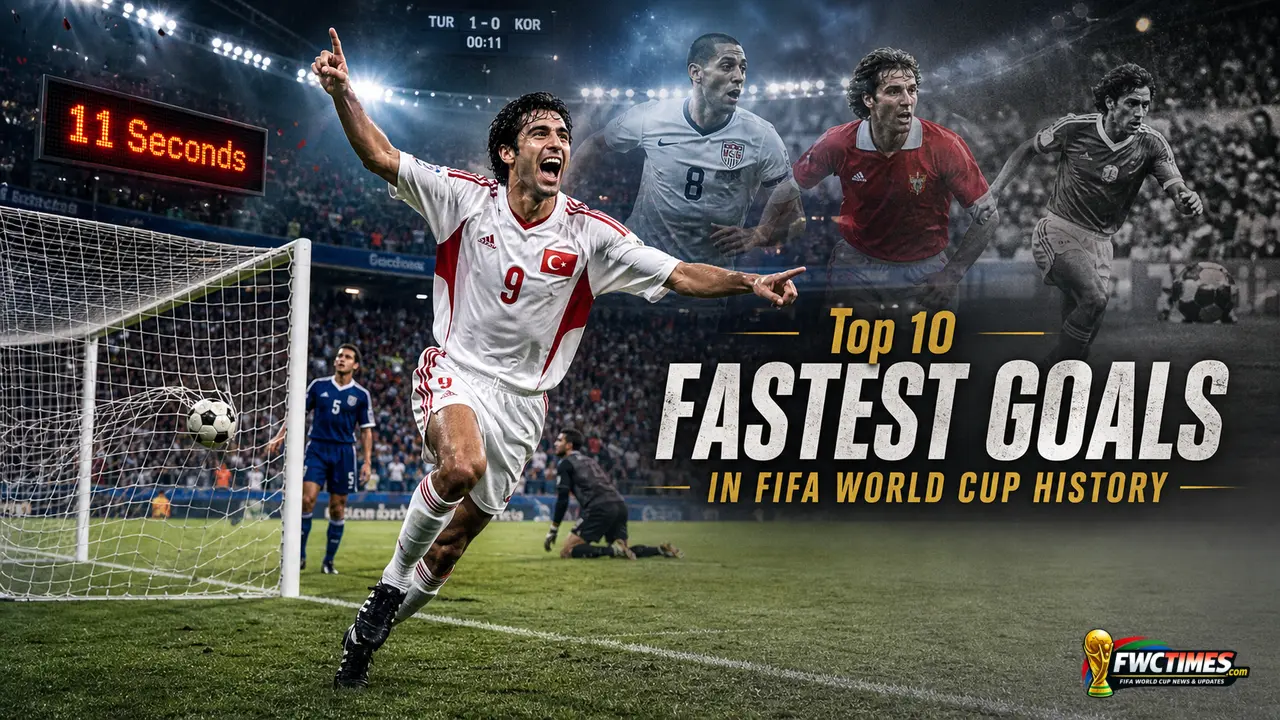
Tracking the fastest goals in FIFA World Cup history reveals matches that flipped in the opening seconds of play. These lightning strikes shock defensive setups and remove all tactical preparation in an instant. Scoring early changes the entire psychological dynamic between two opposing teams. Only a select group of forwards has managed to score within the first minute of play. The record for the fastest goal belongs to Turkish striker Hakan Şükür. He scored after just eleven seconds against South Korea in the third-place match in 2002. This historic strike broke a record that had stood for forty years. So this milestone remains one of the most famous moments in tournament history.
Fastest Goals in FIFA World Cup: Top 10 List
Comparing the times of these rapid goals shows how quickly a World Cup match can start. Most of these strikes caught defensive lines completely disorganized before they could settle. The complete ranking of the fastest goals recorded in tournament history is detailed below.
| Rank | Time | Player | Team | Opponent | Year |
|---|---|---|---|---|---|
| 1 | 11 seconds | Hakan Şükür | Turkey | South Korea | 2002 |
| 2 | 15 seconds | Václav Mašek | Czechoslovakia | Mexico | 1962 |
| 3 | 25 seconds | Ernst Lehner | Germany | Austria | 1934 |
| 4 | 28 seconds | Bryan Robson | England | France | 1982 |
| 5 | 30 seconds | Clint Dempsey | United States | Ghana | 2014 |
| 6 | 31 seconds | Bernard Lacombe | France | Italy | 1978 |
| 7 | 35 seconds | Arne Nyberg | Sweden | Hungary | 1938 |
| 7 | 35 seconds | Émile Veinante | France | Belgium | 1938 |
| 9 | 50 seconds | Adalbert Deşu | Romania | Peru | 1930 |
| 9 | 50 seconds | Flórián Albert | Hungary | Bulgaria | 1962 |
| 9 | 50 seconds | Pak Seung-zin | North Korea | Portugal | 1966 |
The statistics show that early goals have occurred across almost every era of the tournament. The inaugural edition in 1930 featured a fifty-second goal by Romanian forward Adalbert Deşu. The 1938 tournament in France saw two separate goals scored within thirty-five seconds of kickoff. These rapid goals highlight the unpredictable nature of tournament football.
Hakan Şükür and the Eleven-Second Record
June 29, 2002 stands as a historic day for Turkish football in Daegu. Turkey faced co-hosts South Korea in the third-place play-off match. South Korea kicked off the match but lost possession almost immediately near their penalty box. Ilhan Mansiz pressed the defender to recover the ball quickly. He passed to Şükür who finished cleanly past the goalkeeper with his left foot. The stadium clock showed exactly ten point eight seconds had elapsed from the opening whistle. This strike stunned the home crowd and set the tone for Turkey's three-two victory. Şükür's record has survived multiple tournament editions since that afternoon. His career achievement is celebrated as a moment of tactical pressing at its best. The Turkish forward capitalized on a defensive error before South Korea could organize. This goal remains the fastest recorded in the history of the competition. So it stands as a legendary moment for Turkish football.
Václav Mašek and Clint Dempsey Early Strikes
Václav Mašek held the record for forty years before Şükür's strike in 2002. The Czechoslovakian forward scored after fifteen seconds against Mexico during the 1962 tournament in Chile. His direct run and quick shot caught the Mexican defense completely off guard. Despite his early goal, Mexico recovered to win the match three-one. American midfielder Clint Dempsey scored a famous early goal against Ghana in Brazil in 2014. He cut inside the penalty box and scored with a low shot after twenty-nine seconds. The strike gave the United States an early lead in a crucial group stage match. The United States eventually won the match two-one in Natal. Dempsey's goal stands as the fastest scored by an American player in the tournament. His sharp movement showed how direct attacking play can exploit early defensive nerves. To see how other records compare, visit the
FIFA World Cup records still standing after 50 yearspage. Early goals remain a thrilling feature of tournament play.
Tactical Influence of Early Goals
Scoring early forced opposing teams to adjust their tactical plans immediately. Teams that prefer to defend in a low block are forced to push forward. This adjustment creates space behind their defensive line for counter-attacks. As a result, matches often become more open and high-scoring. The physical preparation of defenders in the opening minutes is crucial. They must maintain focus from the first whistle to avoid costly mistakes. Because of modern training, defenders are usually more alert in the early phases. Still, the pressure of a World Cup match can lead to early errors. To understand how other scoring records compare, check the
most goals in a single FIFA World Cup tournamentpage. The disciplinary aspect of early pressure is detailed on the
FIFA World Cup own goal recordspage. The 2026 edition in North America will surely feature early drama.
Frequently Asked Questions
What is the fastest goal in World Cup history?
Hakan Şükür of Turkey holds the record for the fastest goal in World Cup history. He scored after exactly eleven seconds against South Korea in the third-place match in 2002.
Who holds the second-fastest goal record?
Václav Mašek of Czechoslovakia holds the second-fastest record. He scored after just fifteen seconds against Mexico during the group stage of the 1962 tournament in Chile.
What is the fastest goal scored by an American player?
Clint Dempsey scored the fastest goal by an American player in the tournament. He found the net after twenty-nine seconds against Ghana in the group stage of the 2014 edition in Brazil.
Did any player score early in the 1930 tournament?
Adalbert Deşu of Romania scored after fifty seconds against Peru in the inaugural 1930 tournament. This goal stands as the first sub-one-minute goal in the history of the competition.
Conclusion
The list of the fastest goals in FIFA World Cup history highlights moments of pure speed and concentration. From Hakan Şükür's eleven-second strike to modern goals like Clint Dempsey's, these moments define match histories. The upcoming 2026 tournament in North America will surely deliver early match drama for fans worldwide. Stay tuned to FWCTimes.com for the latest FIFA World Cup 2026 updates. Read Also:
Youngest Players to Score at FIFA World Cup