Most Goals in a Single FIFA World Cup Tournament Records

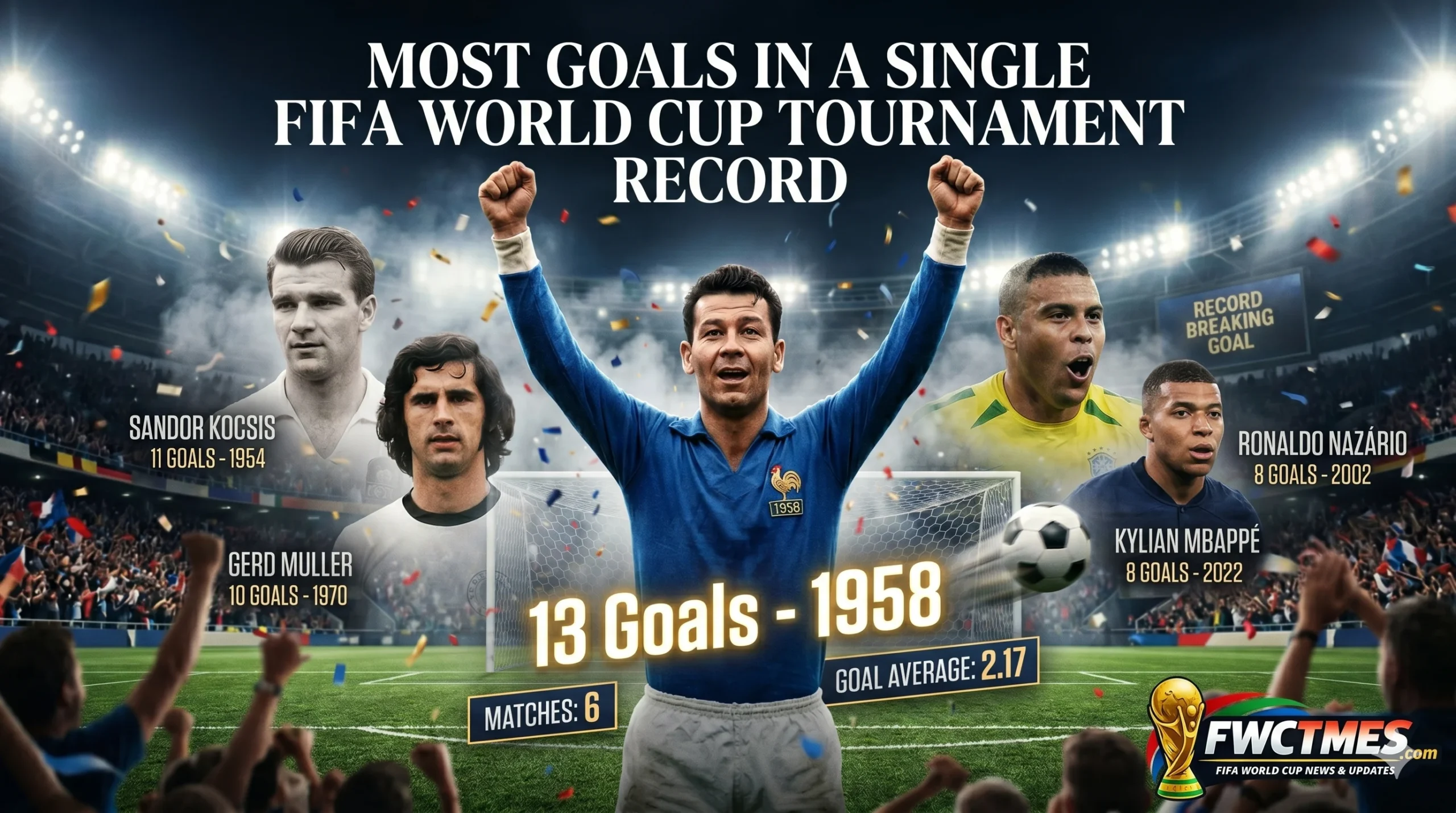
Just Fontaine of France holds the record for the most goals in a single FIFA World Cup tournament. He scored thirteen goals in six matches during the 1958 edition in Sweden. That tally has stood untouched for over sixty-five years. No player since has come within three goals of it in a single edition.The French striker found the net in every match France played. He scored a hat-trick against Paraguay and four goals against West Germany in the third-place play-off. His goals came from a combination of clinical finishing, intelligent movement, and creative support from Raymond Kopa. France finished third in that tournament, but Fontaine's scoring left an unforgettable mark.
Most Goals in a Single FIFA World Cup Tournament: The Top List
Comparing single-tournament goalscoring totals reveals how dramatically the game has changed. Early editions featured open tactical formations that created more scoring opportunities. Modern defensive organization has made high single-tournament tallies increasingly rare. The greatest single-edition performances in World Cup history are presented below.
| Rank | Goals | Player | Country | Year |
|---|---|---|---|---|
| 1 | 13 | Just Fontaine | France | 1958 |
| 2 | 11 | Sándor Kocsis | Hungary | 1954 |
| 3 | 10 | Gerd Müller | West Germany | 1970 |
| 4 | 9 | Eusébio | Portugal | 1966 |
| 4 | 9 | Ademir | Brazil | 1950 |
| 6 | 8 | Kylian Mbappé | France | 2022 |
| 6 | 8 | Ronaldo (R9) | Brazil | 2002 |
| 6 | 8 | Guillermo Stábile | Argentina | 1930 |
The list shows that most of the highest single-tournament tallies belong to an earlier era of football. Defensive structures in the 1950s and 1960s were far less organized than today. Strikers could find space repeatedly in the same match against the same opponents. Modern coaching has closed those tactical gaps considerably.Kylian Mbappé is the only player from the last twenty years to crack the top six. His eight goals in Qatar 2022 included a hat-trick in the final against Argentina. He stands as the strongest modern representative of the single-tournament goalscoring tradition. His presence alone makes the 2026 edition one of the most anticipated in scoring history.The table also shows that Brazil's tradition of tournament scoring runs deep. Ronaldo R9 scored eight in 2002 on his way to the title. Ademir scored nine in 1950 as Brazil reached the Maracanã final. Their national squad has always produced elite attackers who perform in major tournaments.
Just Fontaine and the 1958 Standard
Fontaine's thirteen goals in six matches represent an average of two point one seven goals per game. That rate is extraordinary even by the standards of open 1950s football. He scored in every single match France played during the tournament. His consistency under pressure across six consecutive matches is what sets the record apart.He scored a hat-trick against Paraguay in the group stage. He followed it with two goals against Yugoslavia and two against Scotland. His four-goal performance against West Germany in the third-place match sealed the record. Those goals came even in a match that carried no final significance.His record has survived the most prolific attackers of every generation. Pelé, Ronaldo, Müller, and Messi have all played multiple tournaments without reaching thirteen in a single edition. The closest challenger in the modern era is Kocsis with eleven in 1954. No player since 1970 has reached double figures in a single edition.The achievement reflects the attacking freedom of that era. Teams played with two central strikers and multiple attacking midfielders. Defenses were designed to attack rather than absorb pressure. Fontaine's supporting cast was also exceptional, with Kopa providing creativity from midfield. The
page places this record in its full historical setup.
Sándor Kocsis and the Golden Head of 1954
Sándor Kocsis of Hungary scored eleven goals in the 1954 tournament in Switzerland. He earned the nickname "The Man With the Golden Head" for his exceptional aerial ability. Hungary scored a tournament record twenty-seven goals across their six matches. That team is still considered one of the greatest national squads ever assembled.Kocsis scored two hat-tricks during the 1954 tournament, including one against West Germany and one against South Korea. His goals helped Hungary reach the final, where they lost to West Germany in the Miracle of Bern. Despite the defeat, his personal output remains remarkable. He scored more goals in 1954 than any player in any edition except Fontaine four years later.His scoring reflected the tactical freedom granted to Hungarian forwards at that time. The Mighty Magyars played a revolutionary 4-2-4 system that overloaded opposing defenses. Kocsis was the finishing end of a fluid, attacking machine. His eleven goals stand as the second-highest tally in a single edition.
Can Fontaine’s Record Fall in 2026?
Breaking thirteen goals in a single tournament is theoretically possible but extremely unlikely. The expanded format gives a champion eight matches to play, compared to seven previously. A player would need to score thirteen goals in eight matches, averaging one point six three per game. No one in the last fifty years has come close to that rate across a full tournament.Mbappé is the most realistic candidate. His eight goals in Qatar in 2022 showed he can sustain elite output across multiple rounds. If he replicates that performance in 2026, he adds eight to his career total of twelve. That would take him to twenty career goals and smash Klose's all-time record of sixteen. He would still fall five short of Fontaine's single-edition mark.The
FIFA World Cup Golden Boot winnerslist shows how rarely players score more than six in modern editions. Winning the Golden Boot with six or seven goals has been common across recent tournaments. Double figures remain an almost mythical achievement under modern conditions. The
most FIFA World Cup appearancespage shows how rarely any single player dominates across multiple editions. Fontaine's record is likely to stand for many more decades.Still, the expanded format and the presence of elite attackers make 2026 the most open era in decades. The
FIFA World Cup 2026will test whether modern football's best can approach levels last seen in a different era. Every match in North America is a chance to write new history.
Frequently Asked Questions
Who holds the record for most goals in a single World Cup tournament?
Just Fontaine of France holds the record with thirteen goals in the 1958 tournament in Sweden. He scored in every match France played, including a hat-trick against Paraguay. He also scored four goals against West Germany in the third-place match.
Who is second on the list of most goals in a single tournament?
Sándor Kocsis of Hungary is second with eleven goals in the 1954 tournament in Switzerland. He scored two hat-tricks and helped Hungary reach the final. They lost to West Germany, despite scoring twenty-seven goals as a team throughout the edition.
Could Mbappé break Fontaine’s record in 2026?
Mbappé would need fourteen goals in eight matches to break Fontaine’s record. That requires roughly 1.75 goals per game across a full tournament. His 2022 output of eight goals was exceptional. Still, fourteen in a single edition is extremely unlikely under modern defensive conditions.
Who is the highest scorer in a single tournament in the modern era?
Mbappé scored eight goals at Qatar 2022, the highest single-edition tally since Gerd Müller scored ten in 1970. Visit the most assists in FIFA World Cup history page for details on elite multi-stat performers.
Conclusion
Just Fontaine's thirteen goals in 1958 remain one of the most extraordinary individual records in all of sport. This ranking of the most goals in a single FIFA World Cup tournament shows how the game has changed. The 2026 tournament in North America offers the closest realistic chance of approaching that record since the mark was set.Stay tuned to FWCTimes.com for the latest FIFA World Cup 2026 updates.Read Also:
Lionel Messi World Cup Stats and Records 2006-2026