Mexico: World Cup 2026 Squad, Fixtures, Standings & Kits

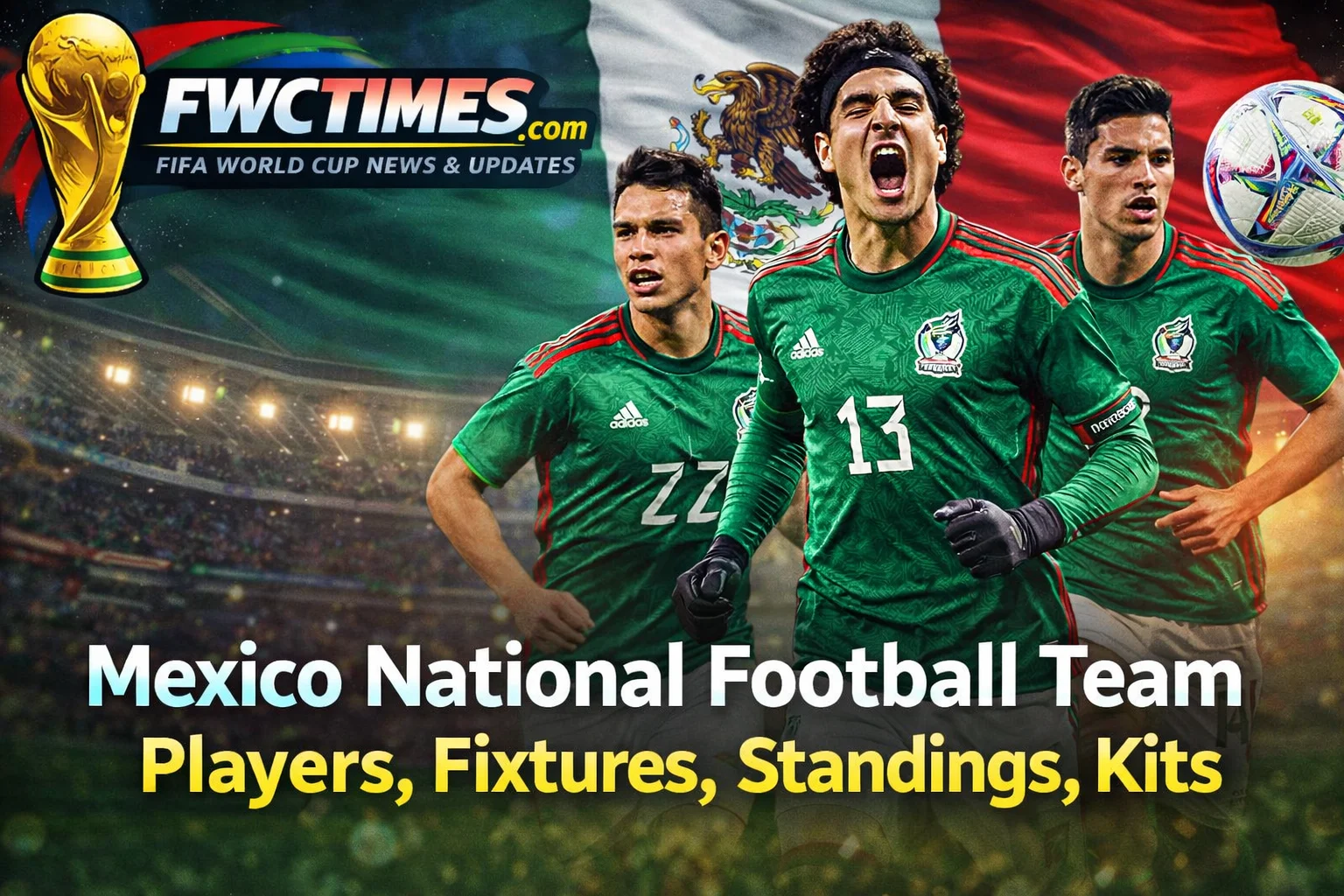
Mexico — FIFA World Cup 2026
Group A · Coach: Javier Aguirre · El Quinto Partido Begins at Home
Mexico return to the FIFA World Cup as one of the tournament’s three co-hosts, playing on home soil for the first time since 1986 — the last occasion on which El Tri reached a World Cup quarter-final. Coach Javier Aguirre, in his third stint managing Mexico, announced his final 26-man squad on June 1, 2026, naming Edson Álvarez of Fenerbahçe as captain and including 17-year-old Gilberto Mora of Club Tijuana — who becomes the youngest player in Mexican World Cup history, breaking a record set at the inaugural 1930 tournament. Veteran goalkeeper Guillermo Ochoa appears in an unprecedented sixth World Cup — a Mexican record that may never be matched. The squad arrives having won back-to-back CONCACAF titles: the Nations League 2024-25 and the Gold Cup 2025, beating the United States 2-1 in the Gold Cup final at NRG Stadium in Houston.
Mexico are placed in Group A alongside South Africa, South Korea, and Czechia — and open the entire 2026 FIFA World Cup against South Africa on June 11 at Estadio Ciudad de México, the Azteca reimagined for the tournament. It is the most significant match in Mexican football since 1986 — a home opening match at the stadium where Diego Maradona scored the Hand of God and the Goal of the Century 40 years before. Santiago Giménez of AC Milan is El Tri’s most dangerous striker and the player opponents fear most in the penalty box. The question that defines Mexico’s 2026 tournament — and perhaps the next decade of Mexican football — is whether they can finally break the curse of “el quinto partido”: a quarter-final appearance Mexico has not reached since hosting the tournament in 1986.
Contents
What should fans know about Mexico at World Cup 2026?
Mexico are competing at the 2026 FIFA World Cup in the United States, Mexico, and Canada. They are placed in Group A and are managed by Javier Aguirre. The tournament runs from June 11 to July 19, 2026.
Mexico World Cup 2026 Squad — El Tri Official Roster
Javier Aguirre announced Mexico’s final 26-man World Cup squad on June 1, 2026. The group combines European quality with Liga MX reliability — clubs include AC Milan, Fulham, Fenerbahçe, Real Betis, Atlético Madrid, Anderlecht, Genoa, AZ Alkmaar, PAOK, AEK Athens, and Guadalajara (four players, the most from any single club). Hirving Lozano — El Tri’s most famous attacker of the past decade — was excluded due to a lack of consistent playing time at San Diego FC. Guillermo Ochoa, 41, was included for his sixth World Cup as the third goalkeeper and squad mentor. 17-year-old Gilberto Mora of Club Tijuana completes a squad with a 24-year age gap between its oldest and youngest member.
Goalkeepers

Defenders
Midfielders
Forwards
The AC Milan striker who is Mexico’s most complete forward and the player Aguirre’s entire attacking system is designed to serve. Giménez moved to Milan from Feyenoord after an extraordinary goal scoring run in the Eredivisie and has established himself as one of Serie A’s most reliable penalty-box finishers — technically composed, strong in the air, and quick enough to create space in tight defences. At 24 and playing for one of Italy’s most iconic clubs, this World Cup on home soil is his opportunity to become the defining striker of Mexican football’s next era — and to end El Tri’s 40-year wait for a quarter-final appearance.
Mexico’s captain and the defensive midfield engine around whom Aguirre’s system is organised — a physically imposing, technically accomplished ball-winner who moved to Fenerbahçe in 2024 after impressing at Ajax and West Ham. Álvarez provides the midfield shield that protects Mexico’s back three or four and the transition quality that launches El Tri’s most dangerous counter-attacking moments. His leadership, experience of European football at the highest level, and ability to dominate physical midfield duels make him indispensable across all three Group A matches and beyond.
The AEL Limassol goalkeeper making his sixth FIFA World Cup appearance — a Mexican national record that may stand for generations. Ochoa’s previous five World Cups (2006, 2010, 2014, 2018, 2022) included iconic performances: his 0-0 save against Brazil in 2014 — the match-defining stop that defined him as one of the tournament’s great goalkeepers — and consistent reliability across five tournaments without a single poor performance at major finals level. At 41 and playing in Cyprus, his selection reflects Aguirre’s trust in experienced mentors as much as starting-eleven quality.
The Atlético Madrid midfielder who is Mexico’s most exciting young midfield talent — a technically gifted, press-resistant central player whose development under Diego Simeone’s demanding system at the Metropolitano has accelerated dramatically. Vargas provides the creative link between Álvarez’s defensive base and the attacking line, and his Atlético education in pressing, positional discipline, and composure gives Mexico a midfielder whose ceiling is significantly higher than his current cap count suggests. His World Cup debut on home soil could define his international career trajectory entirely.
The Fulham striker who returned from a devastating skull fracture suffered at Arsenal in November 2020 to become one of the Premier League’s most reliable centre-forwards — a story of resilience that defines his national team legacy as much as his goal record. Jiménez’s hold-up play, movement off the ball, and ability to link midfield to attack give Aguirre a different attacking profile from Giménez’s box presence — a combination striker who creates space as often as he finishes chances. His experience of World Cup football gives El Tri a forward with the temperament to perform in high-pressure knockout environments.
The 17-year-old Club Tijuana midfielder who becomes the youngest player in Mexico’s World Cup history — breaking the record set by Manuel Rosas at the inaugural 1930 tournament in Uruguay. Mora’s selection reflects Aguirre’s confidence that the teenager’s technical ability, pace, and fearlessness in tight spaces can contribute at the highest level from the start of the group stage. Playing in front of home crowds at the Azteca and Estadio Akron, his debut World Cup at 17 will be watched by every major European club — and his performances in Group A could accelerate a transfer timeline that makes him Mexico’s most valuable asset in 2026 and beyond.
Mexico Tactics Under Aguirre — Verde Verde, Always Organised
Javier Aguirre has built Mexico around a pragmatic 3-4-3 or 4-4-2 that prioritises defensive organisation, quick vertical transitions, and Santiago Giménez’s finishing in the penalty box. Álvarez anchors the midfield as the primary defensive shield, with Fidalgo or Obed Vargas providing the creative link between defence and attack. On the left wing, Roberto Alvarado or César Huerta provides the directness that creates the space behind opposing full-backs for Giménez’s runs. The system is designed to minimise mistakes at the back — Aguirre’s Mexico have been defensively solid across the back-to-back CONCACAF title wins — while offering enough attacking variety through Giménez, Jiménez, and the wide forwards to threaten Group A opponents with different profiles.
The Group A opener against South Africa at Estadio Ciudad de México on June 11 — which is also the opening match of the entire 2026 World Cup — sets the tactical tone for Mexico’s tournament. Aguirre is expected to deploy a compact 4-4-2 against South Africa’s physical approach, with Giménez and Jiménez as the two forwards pressing from the front. The June 18 encounter against South Korea at Estadio Akron in Guadalajara will test Mexico’s ability to break down an organised defensive block — South Korea’s disciplined low-block is exactly the system that has historically frustrated El Tri in World Cup knockout rounds. The Czechia finale on June 24 gives Mexico a chance to seal qualification with style on home soil.
| Formation | Style | Key Shape | Primary Strength |
|---|---|---|---|
| 4-4-2 | Compact + counter | Alvarez pivot; Fidalgo/Vargas creative; Gimenez + Jimenez up front | Defensive solidity and pace on break |
| 3-4-3 | Wing attack + pressing | Three-man back; Alvarez + Lira mid; Mora + Alvarado wide | Width, youth energy and home support |
| 4-2-3-1 | Controlled possession | Double pivot; Vargas as ten; Gimenez lone striker | Ball control in high-pressure matches |
Group A Fixtures — Mexico at WC 2026
Local broadcast times are listed in the Mexico FIFA World Cup 2026 TV schedule.
For matchday viewing routes, use the where to watch Mexico football guide before kickoff.
Mexico’s Group A fixtures carry the unique honour of hosting the opening match of the 2026 FIFA World Cup. The June 11 opener against South Africa at Estadio Ciudad de México — 100,000 capacity, the Azteca reimagined — is the most emotionally charged fixture in Mexican football since the 1986 tournament. South Africa are Africa’s representatives in the group and the side Aguirre expects to beat for three vital early points. The June 18 match against South Korea at Estadio Akron in Guadalajara brings the pressure of needing points after the opener to maintain momentum toward the knockout rounds. Czechia on June 24 back at Estadio Ciudad de México gives Mexico a home farewell to the group stage — and possibly the platform from which “el quinto partido” finally becomes reality.
| Date | Match | Venue | City |
|---|---|---|---|
| Jun 11, 2026 | Mexico vs South Africa | Estadio Ciudad de México | Mexico City, Mexico |
| Jun 18, 2026 | Mexico vs South Korea | Estadio Akron | Guadalajara, Mexico |
| Jun 24, 2026 | Czechia vs Mexico | Estadio Ciudad de México | Mexico City, Mexico |
Group A — FIFA World Cup 2026
| Team | Pld | W | D | L | GF | GA | Pts |
|---|---|---|---|---|---|---|---|
| 🇲🇽 Mexico | 0 | 0 | 0 | 0 | 0 | 0 | 0 |
| 🇿🇦 South Africa | 0 | 0 | 0 | 0 | 0 | 0 | 0 |
| 🇰🇷 South Korea | 0 | 0 | 0 | 0 | 0 | 0 | 0 |
| 🇨🇿 Czechia | 0 | 0 | 0 | 0 | 0 | 0 | 0 |
Mexico enter Group A as the clear favourites — a co-host nation with back-to-back CONCACAF titles, home advantage across all three group matches, and Santiago Giménez at the peak of his powers at AC Milan. South Africa arrive as CAF’s representatives with a physically competitive squad and the motivation of facing Mexico in what will be the World Cup’s most-watched opening match. South Korea qualify from the AFC with a technically organised side and the experience of their remarkable 2022 round-of-16 run. Czechia are the group’s fourth seed — a Central European qualifier whose structured, physical approach can create problems for technically superior opponents across 90 minutes. Mexico’s realistic minimum target is first place in Group A — the home crowd, the familiar stadiums, and the squad quality make anything less a significant disappointment for a tournament that Mexicans have waited 40 years to host again.
CONCACAF & Tournament Preparation — Co-Host & Double Champions
Mexico earned automatic qualification for the 2026 FIFA World Cup as one of the tournament’s three co-hosts alongside the United States and Canada. Rather than compete in CONCACAF qualifying, El Tri used the 2024-25 cycle to win both major CONCACAF competitions under Javier Aguirre. They won the CONCACAF Nations League 2024-25 with a convincing campaign that demonstrated improved defensive organisation and attacking efficiency. They then won the Gold Cup 2025, beating the United States 2-1 in the final at NRG Stadium in Houston — back-to-back CONCACAF titles that confirmed Aguirre’s squad is the strongest and most cohesive Mexico team since the 2006 generation. The competitive preparation across these two tournaments has given the squad match rhythm, tactical clarity, and the winning mentality that seven consecutive R16 exits had begun to erode.
CONCACAF — Co-Host (Automatic Qualification) · Nations League 2024–25 Winners · Gold Cup 2025 Champions
| Nation | Pld | W | D | L | GF | GA | Status |
|---|---|---|---|---|---|---|---|
| 🇲🇽 Mexico | — | — | — | — | — | — | Co-Host |
| 🇺🇸 USA | — | — | — | — | — | — | Co-Host |
| 🇨🇦 Canada | — | — | — | — | — | — | Co-Host |
| 🇵🇦 Panama | 18 | 5 | 5 | 8 | 16 | 23 | 20 |
| 🇨🇼 Curaçao | 18 | 4 | 4 | 10 | 18 | 28 | 16 |
| 🇭🇹 Haiti | 18 | 4 | 3 | 11 | 14 | 28 | 15 |
Mexico 2026 World Cup Kits
Mexico’s iconic verde (green) home kit returns for the 2026 World Cup as the symbol of a nation that has worn the same distinctive dark green across every World Cup since 1930. The 2026 home kit features the traditional dark green base with white and red detailing from the Mexican tricolor flag, manufactured by Adidas under their ongoing FMF partnership. The away kit uses white as the primary colour with green and red accents. Mexico play Group A home matches at the Azteca — renamed Estadio Ciudad de México for the tournament — and at Estadio Akron in Guadalajara. The verde shirt has been worn in every memorable Mexico World Cup moment, from Hugo Sánchez in 1986 to Ochoa’s Brazil save in 2014, and it returns in 2026 carrying the weight of 40 years of broken dreams.
Mexico at the World Cup — Full Tournament History
Mexico have appeared at the FIFA World Cup 18 times — one of the most experienced nations in the tournament’s history — and their record is defined by extraordinary consistency and a single defining barrier. From 1994 to 2018, Mexico reached the round of 16 in seven consecutive World Cups — every tournament they attended — and lost every single time. Italy (1994), Germany (1998), USA (2002), Argentina (2006 AET), Argentina again (2010), Argentina a third time (2014 AET), and Brazil (2018) all ended Mexico’s tournament at the same stage. This run of seven consecutive R16 exits defined Mexican football’s 21st-century identity — always competitive, never advancing. In 2022, the streak ended in the worst possible way: eliminated in the group stage in Qatar, failing to qualify from a group containing Argentina, Poland, and Saudi Arabia despite beating Saudi Arabia 2-0. The 2026 World Cup on home soil is the reset Mexico needs — a chance to rewrite a narrative that has calcified into national sporting trauma.
| Year | Stage | Notable Result |
|---|---|---|
| 1970 | Quarter-finals | Best early result — host nation, beat Belgium; lost to Italy 1-4 in QF |
| 1986 | Quarter-finals | Best modern result — host nation; beat West Germany; lost to W. Germany (pens) |
| 1994 | Round of 16 | Lost to Bulgaria on penalties (R16 curse begins) |
| 2002 | Round of 16 | Lost to USA 0-2 in R16 — first loss to USA at a WC |
| 2014 | Round of 16 | Ochoa Brazil save iconic; lost to Argentina 1-2 AET for third time |
| 2018 | Round of 16 | Beat Germany 1-0 in groups; lost to Brazil 0-2 in R16 |
| 2022 | Group stage | R16 streak ended; eliminated on GD behind Poland despite beating Saudi Arabia 2-0 |
| 2026 | TBD | Group A co-host: South Africa, South Korea, Czechia — home quarter-final target |
Mexico’s best World Cup results both came when they hosted the tournament — quarter-finals in 1970 and quarter-finals in 1986. The pattern is not coincidental: home advantage at the Azteca, with 100,000 Mexican fans, created an atmosphere that lifted El Tri beyond their usual ceiling. In 2026, the same conditions are present for the first time in 40 years. Giménez at Milan, Álvarez at Fenerbahçe, Vargas at Atlético, Mora at 17 — this Mexico squad has more European quality than any generation that played in 1970 or 1986. The tournament is co-hosted with Canada and the United States, but Mexico’s group stage is entirely on Mexican soil. If “el quinto partido” is ever going to happen, it will happen in 2026.
Frequently Asked Questions
More World Cup 2026 Team Guides
Explore more FIFA World Cup 2026 team guides — Mexico’s Group A rivals and fellow CONCACAF nations.