Kenji Gorré: Maccabi Haifa and Curaçao Profile 2026

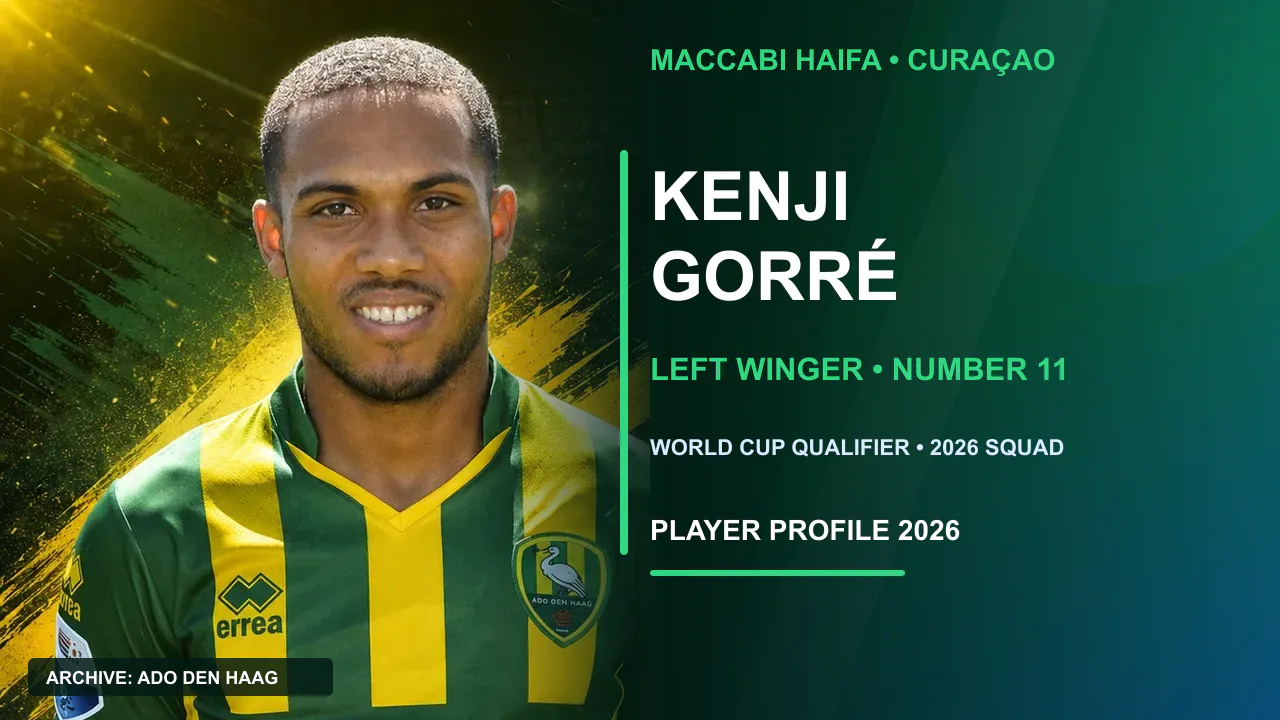
Kenji Gorré is a Curaçao international winger who plays for Maccabi Haifa. The Spijkenisse-born attacker wears number 11 for the Israeli club and number 14 for his national team. His career has passed through elite English academies, senior football in four European countries, Qatar, World Cup qualifying and the 2026 FIFA World Cup.
This profile uses club records, official match reports, Concacaf coverage and FIFA tournament documents. It explains where Gorré plays, how his role has developed and why his contribution to Curaçao’s first World Cup qualification was significant. It avoids estimates and focuses on facts that can be checked.
Kenji Gorré profile at a glance
- Full name: Kenji Joel Gorré
- Date of birth: 29 September 1994
- Birthplace: Spijkenisse, Netherlands
- Height: 1.74 metres, according to Maccabi Haifa
- Primary position: Left winger
- Other roles: Right winger and wide midfielder
- Current club: Maccabi Haifa
- Club number: 11
- National team: Curaçao
- National-team number: 14 at the 2026 World Cup
Where does Kenji Gorré play in 2026?
Gorré is a Maccabi Haifa winger. The club’s official squad page lists him among the forwards with number 11. UEFA also registered him as a Maccabi Haifa attacker during the 2025/26 Conference League campaign.
He arrived after two seasons with Umm Salal in Qatar and returned to club football closer to the European competitive structure in which he had spent much of his career. Maccabi used him primarily from the left, where he could carry the ball inside on his right foot or deliver after creating space near the touchline.
His current Maccabi Haifa status
Maccabi Haifa’s player record credits Gorré with 24 league appearances and four league goals in 2025/26. It also lists three State Cup appearances with one goal and one Toto Cup appearance. These are club-published totals and give a clearer picture than combining figures from unrelated databases.
The season contained spells as both a starter and substitute. Gorré’s value came from his ability to play either wing, attack a full-back directly and join scoring positions after beginning outside the penalty area.
Role in Maccabi Haifa’s attack
Gorré most often starts from the left. He is right-footed, so the position allows him to move diagonally toward goal. The same starting point also gives him the option to continue outside and cross, which prevents defenders from showing him one predictable route.
Maccabi’s official reports show this range. Some of his best actions came from crossing positions, while others came after he cut into the box. He can support a central forward, combine with an overlapping full-back and become a second scoring threat at the far post.
Left-side combinations
A left winger needs a working relationship with the full-back and central midfielder on his side. When the full-back overlaps, Gorré can move into the inside channel. When the defender stays behind the ball, Gorré can hold the width and receive directly against his opponent.
His strongest sequences usually involve an early forward action. He can play a short combination, accelerate into the return lane or isolate the defender. The decision depends on the defensive cover behind the first opponent.
Key Maccabi Haifa performances
Three official match reports show how Gorré contributed in different ways during 2025/26. He produced a goal and an assist away to FC Ashdod, created a goal in the Haifa derby and scored the winner against Ironi Tiberias.
Those matches offer better evidence of his role than a general description alone. They show wide creation, inside finishing and involvement in combination play.
Goal and assist against FC Ashdod
Maccabi won 4-0 away to FC Ashdod at the end of 2025. Gorré’s tight-angle shot created the rebound for the opening goal. He then laid the ball back to Peter Agba for the second, an action recorded as an assist.
In the 58th minute, Gorré received on the left, beat his defender, cut into the area and finished toward the far post. The sequence captured his preferred attacking pattern: direct control, a change of direction and a right-footed finish after moving inside.
Assist in the Haifa derby
Against Hapoel Haifa in January 2026, Gorré received on the left and crossed for Guy Melamed to score. The official report credited him with the assist in a 2-0 derby win.
Later in the match, he beat two defenders, entered the area and pulled the ball back for another chance. That second action did not become a goal, but it showed how he could repeatedly create danger from the same flank through different deliveries.
Winner against Ironi Tiberias
Maccabi’s February match against Ironi Tiberias was level at 2-2 when Gorré scored in the 82nd minute. He met a Jelle Bataille cross near the edge of the area and drove a low shot into the net for a 3-2 victory.
The goal came after several earlier crosses and combinations from Gorré. It showed that his match influence was not confined to serving teammates. He remained ready to finish when the delivery arrived from the opposite side.
Kenji Gorré playing style
Gorré is a quick, direct winger with close control and a preference for attacking from the left. He can receive to feet, turn toward a defender and create separation with a change of pace. His low centre of gravity helps him adjust direction without taking several preparation touches.
He is also comfortable moving across the front line. That flexibility matters when a coach wants the wide players to exchange sides or when the game requires a second forward rather than a fixed touchline winger.
Dribbling and first movement
The first movement often determines whether Gorré can use his speed. If he receives while stationary and the defender has cover, the space can disappear. When he receives on the move or after a quick rotation, he can attack the defender’s outside shoulder or shift inside.
His purpose is to create a useful next action. The dribble should open a shot, cross, cutback or combination. His best official Maccabi examples end with one of those outcomes.
Crossing from the left
Gorré can cross after reaching the outside lane, but he also delivers after moving inside. An inswinging ball from his right foot can target the striker’s run or the far-post winger. A cutback is more useful when the defence has retreated toward its own goal.
The derby assist demonstrated his ability to create from the left. His chance creation also became important for Curaçao during World Cup qualifying, where Concacaf recorded three assists across the campaign.
Finishing
His Maccabi goals against Ashdod and Tiberias came from different situations. Against Ashdod he created the shot by beating a defender and cutting in. Against Tiberias he arrived to finish a cross from the opposite side.
That variety is useful for a winger. If he only shoots after carrying inside, defenders can prepare for the movement. Far-post arrivals and quick finishes after combinations create other problems.
Early life and football family
Gorré was born in Spijkenisse in the Netherlands. His father, Dean Gorré, played professional football and later worked in coaching and football development. Kenji moved to England as a child and entered the academy system at an unusually young age.
Maccabi Haifa describes his father as Surinamese and his mother as Curaçaoan. That family background later made Curaçao a natural senior international choice.
Manchester City and Manchester United academies
Gorré began in Manchester City’s youth system before moving to Manchester United in 2002. He spent roughly a decade at United, training in an environment shaped by a successful first team and a strong academy culture.
Academy status did not guarantee a senior place. The useful part of that experience was the technical and tactical foundation: receiving under pressure, combination play, positional discipline and the expectation to compete every day.
Move to Swansea City
Gorré joined Swansea City from Manchester United in 2013. He initially played for the development side and became a leading attacker at that level. Swansea later reported a season in which he scored 18 goals and supplied 10 assists for the under-21 team.
He also scored twice in the 2015 play-off final against Huddersfield as Swansea’s under-21s won the Development League Two title. That production earned him first-team attention.
Premier League debut
Gorré made his Swansea first-team debut as a late substitute against Crystal Palace on the final day of the 2014/15 Premier League season. It remained his only senior league appearance for Swansea, but it was an important milestone after years in English academy football.
Swansea gave him a new three-year contract in July 2015. The club saw value in his under-21 output, while Gorré still needed senior matches to bridge the gap between development football and regular first-team selection.
ADO Den Haag loan
Swansea sent Gorré to ADO Den Haag for senior experience. He made five appearances during the loan. One memorable contribution came against PSV, when his delivery led to goalkeeper Martin Hansen’s famous late equaliser.
Gorré later told Swansea that the spell improved him even though his minutes were limited. Training with a senior squad and playing in the Eredivisie added practical experience that under-21 football could not reproduce.
What the loan taught him
A senior winger must perform tactical jobs even when he is not receiving the ball. He has to protect the full-back, recognise the press and make recovery runs. ADO exposed Gorré to those demands in the Dutch top division.
The archive portrait used on this page comes from that ADO period. It is labelled clearly because it is an older image, while Maccabi Haifa is his current club.
Northampton Town experience
Gorré later joined Northampton Town on loan. The League One spell gave him a different type of senior football, with more direct duels and a demanding weekly schedule.
He remembered scoring the deciding penalty against West Bromwich Albion in the League Cup as one of the important moments of his early career. The win set up a tie with his former academy club Manchester United.
Why regular senior minutes mattered
Loans are most useful when they force a player to solve real match problems. At Northampton, Gorré faced physical defenders, changing game states and the pressure attached to first-team results. Those lessons helped prepare him for the permanent move that followed.
Permanent move to Nacional
Gorré left Swansea when his contract expired in 2018 and signed for Nacional in Portugal. The move gave him a stable senior platform after years split between development football, a single Premier League appearance and loans.
Portugal became a major part of his career. He learned to play against compact defensive blocks, combine in patient possession and manage matches with different rhythms from English football.
Estoril loan
During his Nacional period, Gorré spent part of 2018/19 on loan at Estoril. The move kept him playing and added another Portuguese club environment to his experience.
Returning to Nacional, he became a regular contributor. Boavista’s 2021 signing announcement noted that he had played 32 matches and scored five goals in his final Nacional season.
Boavista years
Boavista signed Gorré in July 2021 on a two-year contract. The Porto club described him as a winger and highlighted his years at Manchester United, Premier League debut and Portuguese experience.
The move kept him in the Primeira Liga and gave him repeated top-flight minutes. He operated from wide positions, sometimes carrying transitions and sometimes working against deeper defensive shapes.
Technical growth in Portugal
His Portuguese career encouraged a more measured use of the ball. A fast winger still needs to know when to slow an attack, protect possession and wait for support. The league’s tactical organisation made those decisions important.
By the end of the Boavista spell, Gorré had built a substantial body of senior football. That record gave him the foundation for a move outside Europe.
Umm Salal and his scoring peak
Gorré joined Umm Salal in Qatar in 2023. Maccabi Haifa’s official profile says he scored 12 goals there, describing it as the highest single-season total of his career.
The Qatar spell showed that he could convert wide play into consistent scoring. Different league conditions also demanded adaptation to climate, travel and tactical styles.
How Qatar changed his profile
A double-figure scoring season strengthens an attacker’s case in the transfer market and at international level. Gorré had already created and scored across several clubs, but the Umm Salal run gave him his clearest senior scoring peak.
He returned to a European-linked competition with Maccabi Haifa in 2025, carrying more experience and a stronger record in front of goal.
Curaçao international career
Gorré represents Curaçao at senior level. His ability to play on either side gives the national team options around the central striker, while his club experience helps him adjust to opponents from different confederations and tactical traditions.
He wears number 14 and was an important part of the group that qualified for Curaçao’s first FIFA World Cup. Related player profiles include Leandro Bacuna, Gervane Kastaneer and Jearl Margaritha.
Wide role for the national team
Curaçao can use Gorré as a starter who holds width or as an attacker who moves inside around a striker. His directness is valuable in transition, while his crossing helps when the team has longer possession.
International matches also require defensive discipline. A winger may spend long periods protecting his full-back before receiving one chance to break forward. Gorré’s senior experience makes him capable of handling both parts of the role.
2026 World Cup qualifying impact
Concacaf recorded Gorré as one of only four players in the region to produce at least three goals and three assists during qualification for the 2026 World Cup. He was the only Curaçao player to reach both marks.
FIFA also highlighted Gorré and Gervane Kastaneer as combining for eight qualifying goals. Those figures place Gorré’s contribution at the centre of Curaçao’s successful campaign rather than at its margins.
Assist against Saint Lucia
In June 2025, Curaçao beat Saint Lucia 4-0 to secure progress toward the final qualifying round. Gorré provided the service for Kastaneer’s second goal in the 52nd minute.
The action showed the creative side of his output. He did not need to score to change the match; a correctly weighted delivery placed a teammate in position to finish.
Goal against Haiti
Four days later, Gorré scored in the 15th minute of a 5-1 win over Haiti. The victory confirmed Curaçao at the top of its second-round group and carried momentum into the final stage.
Scoring early helped establish control. It also added a goal to the assist from the previous qualifier, demonstrating consecutive-match production.
Goal against Jamaica
Gorré scored Curaçao’s second goal in a 2-0 home win over Jamaica in October 2025. Concacaf described a finish into the top-right corner from the left side of the box after an assist from Jürgen Locadia.
The result moved Curaçao to the top of the group at that stage. It was one of the most important wins of the campaign because Jamaica was a direct rival for the automatic qualification place.
Goal against Trinidad and Tobago
In the next qualifier, Gorré opened the scoring against Trinidad and Tobago with a right-footed finish into the upper-right corner. The match ended 1-1, extending Curaçao’s unbeaten run.
Goals in consecutive final-round matches demonstrated consistency under pressure. Curaçao later completed qualification with a draw in Jamaica, becoming the smallest nation by population and area to reach a World Cup.
Selection for the 2026 World Cup
FIFA included Gorré in Curaçao’s 26-player World Cup squad. He was listed as a Maccabi Haifa forward and wore number 14. His qualification record made the selection expected, but tournament minutes still depended on the opponent and match plan.
Our Curaçao World Cup squad guide covers the complete group. Other profiles include Livano Comenencia, Kevin Felida, Godfried Roemeratoe and Eloy Room.
Germany opener
Gorré was an unused substitute in Curaçao’s opening match against Germany. FIFA’s official match report lists him among the available substitutes without an entry minute.
The match ended in a heavy defeat, and the coaching staff used other attacking options from the bench. Listing Gorré as unused is important because squad selection alone does not count as an appearance.
Ecuador appearance
Gorré made his World Cup debut against Ecuador. He entered in the 75th minute as Curaçao protected a 0-0 score. FIFA’s report records him among the substitutes used in the match.
Curaçao held the draw and earned a point. Gorré’s task was to provide an outlet on the break while keeping the team’s defensive shape. The appearance made him a World Cup player after his decisive qualifying contribution.
Côte d’Ivoire match
He was an unused substitute against Côte d’Ivoire in the final group fixture. He therefore completed the tournament with one substitute appearance and no goals.
That record does not reduce his importance to qualification. Tournament selection and qualifying contribution are separate measures, and Gorré’s three goals and three assists helped Curaçao reach the finals in the first place.
Club and country comparison
Maccabi Haifa often ask Gorré to work against domestic opponents who defend in organised lines. Curaçao can face longer periods without the ball and use him in transitions. The technical skills overlap, but the rhythm and defensive responsibilities change.
For his club, repeated combinations and final-ball quality may define his match. For Curaçao, one break or one set of consecutive runs can be the main attacking opportunity. His experience supports both versions.
Starter and substitute value
Gorré can start as a direct left winger, but he also suits an impact role. A fresh attacker who can threaten both sides of a defender is useful late in a match. His Ecuador appearance followed that pattern.
The choice depends on the opponent, available teammates and team shape. His ability to play multiple wide roles keeps him relevant even when he is not the first attacking name selected.
Strengths
- Direct running: He attacks defenders and can gain ground quickly.
- Two-way left-wing threat: He can continue outside or cut onto his right foot.
- Crossing: Official club and qualifying reports show productive deliveries.
- Finishing: He can score after carries, combinations and far-side arrivals.
- Experience: He has played senior football in England, the Netherlands, Portugal, Qatar and Israel.
- Positional flexibility: He can operate on either wing or as a wide midfielder.
Areas to monitor
At age 31 during the second half of 2026, Gorré’s game increasingly depends on timing and decision quality alongside speed. His first movement, choice of final pass and defensive positioning help preserve his effectiveness against younger defenders.
Consistency in the final third remains the key measure. His best matches contain both chance creation and scoring threat. Maintaining that balance will determine his club role and future national-team minutes.
Efficiency against compact teams
Deep defences leave less room for long carries. Gorré then needs sharp combinations, well-timed off-ball runs and accurate crosses. The Haifa derby and Tiberias reports show that he can contribute in these situations.
Defensive detail
A winger’s pressing angle can decide whether the opponent plays outside or through midfield. Recovery positioning also protects the full-back. These actions become especially important in international matches where Curaçao may defend for longer periods.
Career timeline
- 2002: Moved from Manchester City’s academy to Manchester United.
- 2013: Joined Swansea City.
- 2015: Won the under-21 league play-off and made his Premier League debut.
- 2015/16: Spent time on loan at ADO Den Haag.
- 2016/17: Gained League One experience with Northampton Town.
- 2018: Left Swansea and signed for Nacional.
- 2019: Spent part of the year on loan at Estoril.
- 2021: Joined Boavista.
- 2023: Moved to Umm Salal in Qatar.
- 2025: Joined Maccabi Haifa and helped Curaçao qualify for the World Cup.
- 2026: Made his World Cup debut against Ecuador.
Frequently asked questions
What club does Kenji Gorré play for?
He plays for Maccabi Haifa and wears number 11.
What position does he play?
Gorré is primarily a left winger. He can also play from the right or as a wide midfielder.
Which national team does he represent?
He represents Curaçao and wears number 14. His mother is from Curaçao, while he was born in the Netherlands.
Did Kenji Gorré play in the Premier League?
Yes. He made one Premier League appearance for Swansea City as a late substitute against Crystal Palace in May 2015.
How did he perform in 2026 World Cup qualifying?
Concacaf credited him with three goals and three assists. He was one of only four players across the confederation to reach at least three in both categories.
Did he play at the 2026 World Cup?
Yes. He entered as a substitute against Ecuador. He was unused against Germany and Côte d’Ivoire.
Primary sources used
- Maccabi Haifa: official Kenji Gorré player profile
- Maccabi Haifa: FC Ashdod match report
- Maccabi Haifa: Haifa derby report
- Maccabi Haifa: Ironi Tiberias match report
- Swansea City: former-player record
- Boavista: 2021 signing announcement
- Concacaf: 2026 qualifying production
- Concacaf: Curaçao vs Jamaica report
- FIFA: 2026 World Cup squad list
- FIFA: Ecuador vs Curaçao report
Profile reviewed and updated on 27 July 2026. Current club totals and match events are based on the official sources listed above.