Uruguay playing style World Cup 2026: Team Tactics

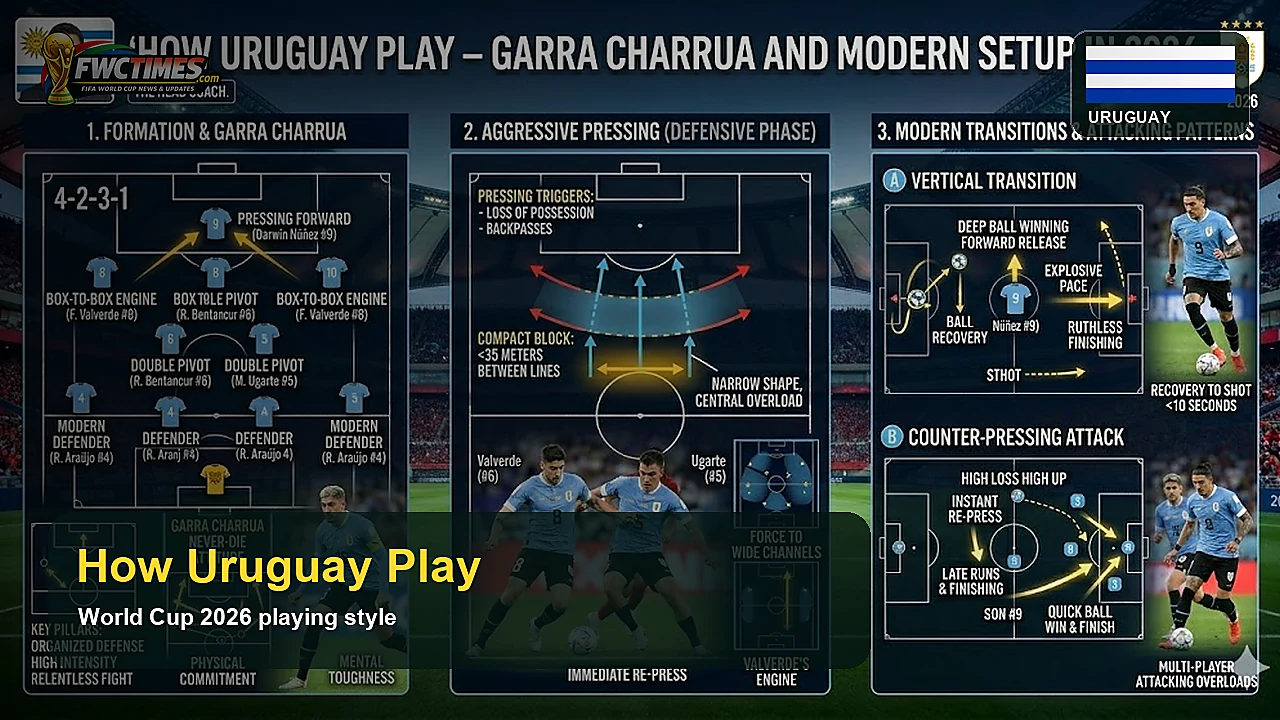
The Uruguay playing style World Cup 2026 approach runs on a high-intensity, vertical pressing system created by head coach Marcelo Bielsa. Bielsa has overhauled the squad’s identity, replacing traditional deep defensive blocks with an aggressive, front-foot pressing model. In fact, Uruguay secured their place in the tournament by finishing fourth in the CONMEBOL standings, recording notable wins over Brazil and Argentina. This tactical setup combines relentless physical workload with direct attacking transitions.
The physical load of the expanded 48-team schedule presents a major challenge to Bielsa’s demanding system. With travel across multiple host nations and varying climates, the players must maintain elite fitness levels to avoid late-game fatigue. As a result, Uruguay relies on a younger, highly athletic core to sustain their intense pressing triggers. This physical capacity is essential for surviving the long tournament path.
The history of the tournament shows that Uruguay plays with a legendary fighting spirit known as Garra Charrua. Bielsa has modernized this traditional grit by channeling it into organized, collective pressing structures. The coaching staff has selected fast defenders to cover the space behind their high defensive line. The Celeste enters the group stage hoping to challenge the world’s best.
The High-Intensity 4-3-3 Press
Marcelo Bielsa has structured Uruguay’s system around a flexible 4-3-3 formation that morphs based on the opponent’s build-up. The defensive phase relies on a man-oriented pressing scheme, where players mark direct opponents across the pitch. This pressure forces errors and enables Uruguay to win the ball back deep in the opponent’s half. The high press World Cup guide explores the mechanics of this coordinated pressure.
In possession, Uruguay avoids slow horizontal build-up, prioritizing direct vertical passes to exploit space immediately. The fullbacks push narrow to create central passing angles while the wingers stretch the opponent’s defensive line. The midfielders make diagonal runs to overload the final third, creating constant passing options. The 4-3-3 formation World Cup guide shows how this shape compares to other systems.
Valverde as the Box-to-Box Engine
Federico Valverde serves as the primary tactical engine and leader of Uruguay’s midfield. Operating as a box-to-box midfielder, Valverde covers massive ground to support both defensive pressing and attacking transitions. His physical stamina allows Uruguay to sustain their high-intensity press across 90 minutes. Valverde also threat from distance, scoring two goals during qualifying.
Manuel Ugarte provides defensive balance by sitting deeper in the midfield to screen the back four. Ugarte intercepts passes and challenges opponents in central duels, freeing Valverde to push higher up the pitch. This double-midfielder structure provides security behind Uruguay’s vertical attacks. The possession football World Cup guide explains how defensive midfielders maintain team balance.
Núñez Leading the Vertical Attack
Darwin Núñez functions as the focal point and primary goalscorer in Uruguay’s direct attacking system. His physical power and vertical speed allow him to challenge centre-backs in 1v1 duels and run into space behind lines. Núñez led Uruguay’s qualifying campaign with five goals, proving his importance to the attack. His constant runs drag defenders out of position, opening space for wide forwards.
The wide forwards cut inside to support Núñez, creating a narrow front three that presses the opponent’s backline. This coordinated movement forces the opponent to play long clearances, which Ugarte and the defenders can easily recover. The Spain playing style World Cup guide shows how wide attackers link up in transition-heavy systems.
CONMEBOL Qualifying Standings and Statistics
Uruguay secured direct qualification by finishing fourth in the highly competitive South American standings. The squad recorded seven wins and seven draws across their 18 qualifying matches. They scored 22 goals while conceding 12, reflecting their balanced tactical setup. Uruguay enters Group H alongside Cape Verde, Saudi Arabia, and Spain.
| Statistic | Value | | :— | :— | | Group Position | 4th (CONMEBOL) | | Matches Played | 18 | | Wins | 7 | | Goals Scored | 22 | | Goals Conceded | 12 | | Top Scorer | Darwin Núñez (5 Goals) |
This record shows that Bielsa’s vertical model has delivered consistent results against elite opponents. The squad enters the tournament with a clear understanding of their high-pressing duties. This tactical clarity makes them one of the most dangerous teams in Group H.
Key Vulnerabilities of the Uruguayan System
The biggest tactical risk is the space behind Uruguay’s high defensive line. Because Bielsa demands a high press, the defenders must push up to keep the team compact. If the opponent breaks the press, they can exploit the space behind the central defenders. This vulnerability requires excellent anticipation from Ronald Araújo and José María Giménez.
The system also faces a fatigue issue due to Bielsa’s intense physical requirements. If the squad suffers from injuries or fatigue during the group stage, the pressing intensity declines. The backup players must match the physical outputs of the starting eleven to prevent defensive breakdowns. This physical demand makes roster rotation a critical factor for tournament success.
Expert Verdict
Uruguay enters the 2026 World Cup with a clear identity built on physical intensity and vertical speed. Bielsa has created a team that can outrun and overwhelm any opponent on their day. The vertical 4-3-3 shape and Valverde’s midfield engine give Uruguay a very high ceiling. The key to their tournament will be managing physical fatigue across the long matches.
If they can maintain their pressing intensity, Uruguay will challenge Spain in Group H. The match against the Spaniards will be a significant test of their defensive transition speed. Bielsa’s structured physical preparation should keep the squad ready for the knockout stages. Uruguay has the tools to make a deep run, but they must defend the space behind their line.