How Long Is a Football Match?

How long is a football match? A standard senior match lasts 90 minutes, split into two equal 45-minute halves. The referee then adds time lost during each half.
The real viewing window often runs beyond two hours because players also take a half-time interval. Knockout matches can extend through extra time and penalties, so fans should plan around the competition format.
How Long Is a Football Match?
A standard football match has two 45-minute halves and a half-time interval of up to 15 minutes. Stoppage time can extend both halves beyond the displayed 45 and 90-minute marks.
A tied knockout match may add two 15-minute extra-time periods. If the score remains level, a penalty shootout can determine the winner.
How Long Is a Football Match Under IFAB Law 7?
IFAB Law 7 sets the standard duration at two equal halves of 45 minutes. Teams change ends after the first half, and the referee manages the official match clock. Competition rules can approve shorter periods in permitted formats.
The clock normally keeps running when play stops. Referees track time lost through injuries, substitutions, disciplinary sanctions, goal celebrations, medical breaks, and VAR reviews. They add that lost time near the end of the relevant half.
The fourth official displays the minimum added time. The referee can increase that amount when more delays happen during stoppage time. The referee cannot reduce the displayed minimum.
A half can also continue for a penalty kick that must be taken or retaken. This exception means the referee may allow the kick after the displayed time expires. The half ends once that penalty sequence finishes.
Normal Time, Half-Time, and Stoppage Time
Normal time means the scheduled 90 minutes before any extra time. It includes the first half, the second half, and stoppage time added within those halves. Football does not use a stopped public game clock like basketball.
Players receive a half-time interval that cannot exceed 15 minutes under Law 7. Competition rules state the interval length, and only the referee can approve an alteration. Teams use this break for recovery and tactical changes.
Stoppage time is part of normal time rather than a separate match phase. A goal scored at 90+6 counts like any goal scored earlier. The match clock notation simply records that the goal came during added time.
Long VAR checks or medical treatments can make a match run well beyond 90 minutes. FWCTimes explains tournament review delays in its World Cup 2026 VAR officiating guide. Those checks can extend the viewing window without creating extra time.
Extra Time and Penalty Shootout Length
Extra time appears when competition rules require a winner and normal time ends level. It usually contains two equal 15-minute periods. Referees can add stoppage time to each extra-time period.
Teams play the full extra-time periods even when one side scores. Modern major tournaments do not use the golden-goal system. A team can still respond before the 120-minute phase finishes.
If extra time ends level, kicks from the penalty mark may decide the winner. The shootout has no fixed duration because it can continue into sudden death. Each team first takes up to five alternating kicks.
FWCTimes covers the knockout sequence in its World Cup stats and records. Fans should allow a longer schedule window when watching elimination matches.
Football Match Timing Comparison
| Match Phase | Standard Length | Can It Run Longer? |
|---|---|---|
| First half | 45 minutes | Yes, through stoppage time |
| Half-time | Up to 15 minutes | Only with referee approval |
| Second half | 45 minutes | Yes, through stoppage time |
| Extra time | Two 15-minute periods | Yes, each period can have stoppage time |
| Penalty shootout | No fixed duration | Yes, sudden death continues until separated |
Why Broadcasts Last Longer Than 90 Minutes
A broadcast includes much more than active match time. Coverage starts with line-ups, analysis, anthems, and team entrances. It then includes half-time discussion and post-match reaction.
A normal group match often needs a viewing window near two hours. A knockout match that reaches penalties can require far longer. Weather delays, medical incidents, and VAR reviews can extend the schedule again.
Cooling breaks also affect the running time in hot conditions. FIFA has announced mandatory cooling-break planning for World Cup 2026 matches. FWCTimes tracks that rule through its World Cup cooling-break update.
Match Length Exceptions and Practical Planning
Youth, veterans, disability, and grassroots competitions can use shorter match periods when the approved rules allow them. Those formats do not change the standard senior rule. Players and spectators should check the competition regulations before assuming a 90-minute schedule.
An abandoned match has no universal replacement length or outcome. Competition organisers decide whether to replay it, resume it, or apply another result. Weather, crowd safety, and field conditions can all interrupt the expected timing.
A referee does not shorten the second half to correct a first-half timekeeping error. Law 7 protects equal scheduled periods and assigns the referee responsibility for time. This detail prevents informal clock adjustments after teams have already changed their plans.
Fans arranging transport should allow a buffer after the scheduled final whistle. Stadium exits, added time, and post-match crowd controls can delay departure. A knockout match requires an even larger buffer because extra time and penalties remain possible.
Connection to FIFA World Cup 2026
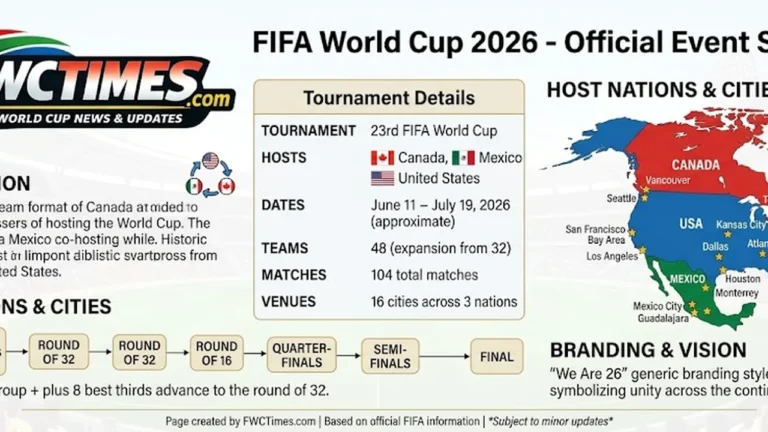
The FIFA World Cup 2026 group stage allows drawn matches, so those games finish after normal time. Knockout matches from the Round of 32 must produce a winner.
A level knockout match moves from 90 minutes to extra time and then penalties if needed. Teams such as the United States must manage recovery across the expanded tournament’s longer knockout route.
Fans attending matches should also allow time for security, transport, and post-match exits. A possible penalty shootout can change travel plans by more than half an hour.
Frequently Asked Questions
How long is a football match?
A standard senior football match lasts 90 minutes, divided into two 45-minute halves. Stoppage time can extend both halves beyond those scheduled periods.
Why does a football match go beyond 90 minutes?
The referee adds time lost through injuries, substitutions, goal celebrations, VAR reviews, and other delays. The displayed added time is a minimum and can increase.
Has a football match always lasted 90 minutes?
The 90-minute standard developed during football’s early codification and became the accepted senior format. Modern IFAB Law 7 keeps two equal 45-minute halves as the standard.
What is the difference between stoppage time and extra time?
Stoppage time replaces time lost within normal or extra-time periods. Extra time is a separate 30-minute phase used when competition rules require a winner.
How long can a World Cup 2026 match last?
A World Cup 2026 knockout match can include 90 minutes, stoppage time, two 15-minute extra-time periods, and penalties. The shootout has no fixed maximum duration.
Conclusion
A standard match contains 90 scheduled minutes, yet the referee’s added time determines the final whistle. Half-time, reviews, and medical delays make the full viewing window longer.
World Cup knockout matches can extend through extra time and penalties, so fans should plan for every phase. Stay tuned to FWCTimes.com for the latest FIFA World Cup 2026 updates.
Read Also: FIFA World Cup Live Score and Fixtures