Juan Musso: Atlético Madrid and Argentina Profile 2026

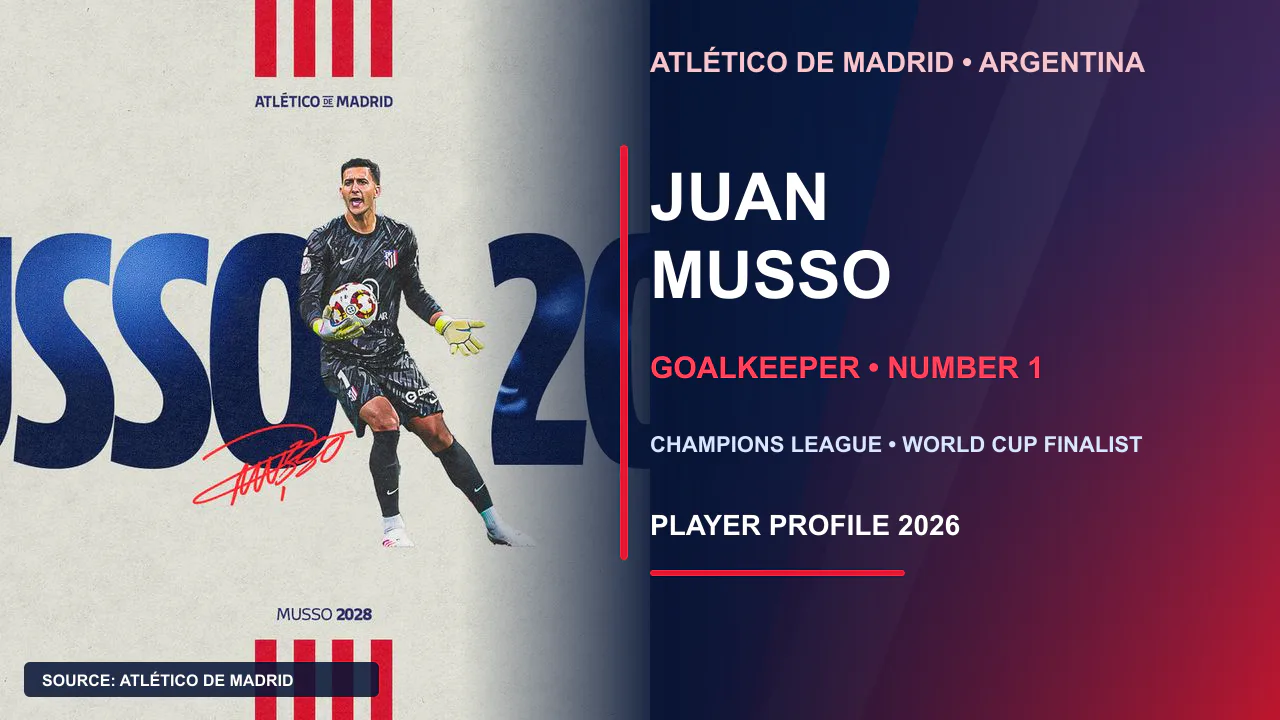
Juan Musso is an Argentine goalkeeper for Atlético de Madrid. The 1.91-metre goalkeeper joined Atlético permanently after an initial loan from Atalanta and is under contract through 2028. He has won major trophies with Atalanta and Argentina, played in the Champions League and was part of the Argentina squad that reached the 2026 FIFA World Cup final.
This profile distinguishes team honours from appearances. Musso was an official member of Argentina’s 2026 World Cup squad and received a runner-up medal, but he did not play in the tournament. His current club role, career development and goalkeeping style are supported by Atlético, UEFA and FIFA records.
Juan Musso profile at a glance
- Full name: Juan Agustín Musso
- Date of birth: 6 May 1994
- Birthplace: San Nicolás de los Arroyos, Argentina
- Height: 1.91 metres
- Position: Goalkeeper
- Current club: Atlético de Madrid
- Club number: 1
- Contract: Through 2028
- National team: Argentina
- Major honours: Europa League, Copa América and Finalissima
Where does Juan Musso play in 2026?
Musso plays for Atlético de Madrid. The Spanish club completed his permanent transfer from Atalanta after he spent 2024/25 in Madrid on loan. Atlético’s announcement states that he signed through 2028.
He competes with Jan Oblak for the goalkeeper position. Oblak remains a major figure at the club, but Musso has proved that Atlético can use him in domestic and European matches. That depth became especially important when injury opened a longer run of games during 2025/26.
Permanent Atlético transfer
Musso initially joined Atlético on loan for the 2024/25 season. The club later reported nine appearances during that first year, seven in the Copa del Rey and two in LaLiga. He kept six clean sheets across those matches.
Atlético then agreed a permanent transfer with Atalanta. The 2028 contract changed his status from short-term cover to a goalkeeper tied to the club for several seasons.
Atlético Madrid role
Musso’s role requires readiness. A second goalkeeper may go several matches without starting and then enter a demanding run with little preparation time. Atlético need him to understand their defensive spacing, set-play assignments and build-up patterns even when Oblak starts.
His 2025/26 appearances showed that he could step into high-pressure matches. UEFA lists four Champions League appearances for Musso during the season. Those minutes included knockout football against elite opponents.
Competition with Jan Oblak
Competition does not mean both goalkeepers have identical roles. Oblak’s history gives him senior status, while Musso offers experienced cover and genuine selection pressure. The arrangement gives the coach a proven alternative rather than an untested reserve.
Musso’s task is to maintain match sharpness through training, cup games and any run created by rotation or injury. His Argentina selection in 2026 reflected how well he handled that responsibility.
2025/26 Champions League run
Atlético reached the Champions League semi-finals in 2025/26. Musso played four matches in the competition and conceded six goals according to UEFA’s squad statistics. A goalkeeper’s record needs match context, so the appearances matter alongside the raw total.
He started a league-phase match against Inter and later played in the knockout rounds. Atlético eliminated Tottenham and Barcelona before Arsenal ended the run in the semi-finals.
Inter match
UEFA’s official report lists Musso as Atlético’s starting goalkeeper against Inter in November 2025. Playing against a team with experienced international attackers tested his positioning, communication and reaction speed.
European matches also place emphasis on distribution. Opponents press goal kicks and back-passes with coordinated movements, so the goalkeeper must select the safe outlet without making the team passive.
Barcelona quarter-final
Musso started the second leg of Atlético’s Champions League quarter-final against Barcelona in April 2026. Atlético lost the match 2-1 but advanced 3-2 on aggregate. UEFA noted that Barcelona created early pressure before Ademola Lookman’s goal secured the decisive aggregate advantage.
The match demanded recovery after two early goals. Musso and the defence had to remain organised while Atlético found the goal that protected the tie.
What the European run established
Starting in a Champions League quarter-final carries a different level of scrutiny from a routine rotation match. Musso showed that Atlético could trust him in a knockout tie where one error could end the campaign.
FIFA later described his club season as strong, highlighting the period in which he occupied the goal during Oblak’s injury. That form supported his return to Argentina’s World Cup squad.
Goalkeeping style
Musso is a tall, athletic goalkeeper whose game is built around reach, aerial command and shot-stopping. Atlético highlighted his control of the air when announcing his loan. At 1.91 metres, he has the frame to challenge crosses without relying only on defenders.
Height alone does not decide aerial success. The goalkeeper has to read the flight, choose a route through bodies and decide whether to catch, punch or remain on the line. Musso’s Serie A background gave him extensive practice in crowded penalty areas.
Shot-stopping
Musso can cover the goal with strong lateral movement and reach. His best saves combine early set position with a powerful push toward the ball. Against close-range attempts, balance is more useful than moving too soon.
Atlético’s match updates recorded important saves against Barcelona, Real Madrid and Osasuna during 2026. These reports do not provide a complete season model, but they show his contribution in high-level league matches.
Aerial command
Crosses require communication before the ball arrives. Musso must tell centre-backs whether he is claiming the delivery and make the call early enough for them to respond. A decisive claim can end pressure and start a counterattack.
If a catch is unsafe, a strong punch toward the side is preferable to a weak contact into the centre. His reach helps, but judgement determines whether leaving the line is the correct choice.
One-against-one situations
In a one-against-one, Musso can use his frame to reduce the visible target. The challenge is timing: advancing too early allows the attacker to finish around him, while staying deep leaves more goal to aim at.
Experienced goalkeepers delay the attacker and react to the touch. Musso’s years in Serie A exposed him to forwards who disguise their finish and use small changes of pace.
Distribution and build-up
Atlético can build short from the goalkeeper or play over pressure. Musso needs both options. A short pass can attract the opponent and open space farther forward, while a longer delivery can move the team out of danger immediately.
His decision depends on the press, teammate positions and match state. Protecting a late lead may require a different risk level from chasing a goal.
Short passing
Short distribution requires a clear body position. Musso must receive back-passes in a way that keeps both sides available and lets him play with limited touches. The nearest defender also needs enough distance to avoid bringing pressure directly onto goal.
A goalkeeper does not need to force an ambitious pass to prove technical quality. Choosing the correct simple option is often the best way to keep possession.
Long distribution
Long kicks can target a striker, wide player or space behind an advanced full-back. Accuracy matters because an uncontrolled clearance returns possession to the opponent.
Musso can also release the ball quickly after a catch. Atlético’s transition attackers benefit when the goalkeeper recognises an open lane before the opposing defence resets.
Clean sheets and goalkeeper evaluation
A clean sheet belongs to the complete defensive unit, but the goalkeeper still has a distinct role in producing it. Musso’s six clean sheets in nine Atlético appearances during 2024/25 reflected his saves, communication and the work of the defenders and midfielders in front of him.
Clean-sheet totals need context. A goalkeeper may perform well while conceding after a deflection or a clear one-against-one, and he may record a clean sheet without facing a difficult shot. Musso is better evaluated through the quality of his decisions across several matches.
Starting position before the shot
The save often begins before the attacker strikes the ball. Musso adjusts his distance from the goal line according to the ball’s location, the position of defenders and the possibility of a pass behind them. Moving a step too far toward one post can open the opposite side.
When the ball travels wide, he must protect the near post without losing the ability to react to a cross. When it moves centrally, he needs a balanced stance that permits a push in either direction. These small adjustments explain why some difficult saves look controlled.
Communication with the back line
Goalkeepers see the full defensive shape. Musso can warn a centre-back about a runner, organise the wall at a free kick and tell the line when to step out. Clear, early information reduces emergency defending.
Communication is especially important when line-ups change. Musso has played behind different Atlético defenders in league, cup and Champions League matches. Shared language on crosses and set pieces helps the unit function even when the usual goalkeeper or centre-back is absent.
Preparation between appearances
A goalkeeper outside the starting eleven still prepares for the exact opponent. Musso studies penalty takers, preferred finishing angles, corner routines and how forwards behave in one-against-one situations. That work must be current even if he ultimately remains on the bench.
Training also has to reproduce match intensity without exposing the goalkeeper to unnecessary fatigue. Repeated handling, footwork and reaction exercises build sharpness, while tactical sessions connect him to the defenders likely to start.
Mental readiness
The reserve goalkeeper cannot predict when an injury, illness or tactical decision will create an opportunity. Musso’s 2025/26 run showed the value of staying prepared. He moved from a supporting role into Champions League knockout and major league matches.
Confidence in this role comes from routine. The goalkeeper has to trust his preparation rather than chase a spectacular action early in the match. Safe handling and accurate first passes can establish rhythm before the first difficult save arrives.
Early football in Argentina
Musso developed at Club de Regatas San Nicolás before joining Racing Club in 2012. Moving to Racing placed him in one of Argentina’s major football institutions and a competitive goalkeeper pathway.
Young goalkeepers often develop more slowly than outfield players because there is only one starting position. Training quality, reserve matches and patience all mattered before Musso became a senior regular.
Racing Club development
Musso learned the demands of playing for a club with large support and title expectations. Racing won the Argentine championship in 2014, and Atlético includes that honour in its official career summary.
His later senior performances earned interest from Europe. The move to Italy required adjustment to a new language, defensive culture and level of tactical detail.
Udinese move
Udinese brought Musso to Serie A. The club gave him the platform to become a regular top-flight goalkeeper against some of Europe’s strongest attackers.
Serie A demanded careful positioning and concentration. Matches could contain long quiet periods followed by a decisive chance, so remaining mentally active was essential.
Becoming a Serie A starter
Regular starts allowed Musso to refine his box management. He faced varied attacking styles, from teams that crossed frequently to teams that created through central combinations.
Udinese also required him to handle pressure in matches where the opponent controlled possession. Shot volume, defensive organisation and set pieces tested different parts of his game.
Transfer to Atalanta
Musso joined Atalanta after establishing himself at Udinese. The move placed him in a side competing in Europe and using an aggressive tactical system.
Atalanta’s defenders often held higher positions, leaving space behind them. The goalkeeper therefore had to judge through balls and be prepared to act outside the six-yard box.
Three seasons in Bergamo
Atlético’s official profile states that Musso spent three seasons with Atalanta. Across his time in Italy, it credits him with 203 appearances. That is a substantial top-level record and explains why Atlético viewed him as experienced cover.
The period also brought the biggest club honour of his career: the 2023/24 UEFA Europa League.
Europa League winner
Atalanta won the 2023/24 Europa League, the club’s first continental title. Musso was part of the winning team and played an important role during the European campaign.
The honour added knockout experience and a major trophy to his record before the move to Madrid. Atlético repeatedly referenced the Europa League title when introducing him.
Why the trophy matters
A European title reflects a full campaign rather than one match. Goalkeepers contribute through preparation, rotation, clean sheets and the ability to handle unfamiliar opponents.
The experience also helped Musso adapt to Atlético’s expectations. Both clubs require defensive discipline and comfort in high-pressure elimination games.
First Atlético season on loan
Musso arrived in Madrid for 2024/25 as a loan signing. Atlético used him heavily in the Copa del Rey and twice in LaLiga. Six clean sheets in nine matches gave the club evidence that he could perform within Diego Simeone’s structure.
The permanent transfer followed after the season. A contract through 2028 indicated that Atlético wanted to preserve experienced goalkeeper depth.
Copa del Rey role
Cup competitions can be difficult for a rotation goalkeeper because each match may be separated by weeks. Musso had to maintain rhythm without regular league starts.
Seven Copa del Rey appearances provided most of his first-season minutes. The clean-sheet total showed that the defensive unit functioned with him in goal.
Argentina senior career
Musso made his senior Argentina debut in 2019. He joined a goalkeeper group that has included Emiliano Martínez and Gerónimo Rulli, making selection competitive.
He has been part of successful national-team squads even when another goalkeeper started. That role still requires high training standards and readiness for an unexpected change.
Copa América 2021
Argentina won the 2021 Copa América, ending a long senior trophy wait. Musso was part of the champion squad. Emiliano Martínez was the starting goalkeeper, so the honour should be described as a squad achievement rather than a claim that Musso led the tournament run.
The title established Argentina’s winning cycle under Lionel Scaloni and preceded further international success.
Finalissima 2022
Musso was also part of Argentina’s Finalissima-winning group in 2022. Argentina beat Italy at Wembley to add another trophy before the Qatar World Cup.
He was not selected for Argentina’s final 2022 World Cup squad, so the Qatar title is not one of his honours. Keeping that distinction clear prevents an inaccurate World Cup winner claim.
2026 World Cup selection
Scaloni selected Musso alongside Emiliano Martínez and Gerónimo Rulli for the 2026 World Cup. FIFA’s final squad documentation confirms his place as an Atlético de Madrid goalkeeper.
FIFA identified Musso as one of the new members compared with the 2022 champion squad. His Atlético form, including the period covering for Oblak, supported the decision.
Goalkeeper hierarchy
Martínez remained Argentina’s first choice. FIFA later noted that Rulli and Musso were the only two members of the squad who did not receive tournament minutes. That statement gives a precise answer to Musso’s 2026 appearance record.
Musso still trained throughout the run and provided experienced support. A reserve goalkeeper must prepare as if he may start with little notice.
Argentina’s run to the final
Argentina progressed from Group J and reached a second consecutive World Cup final. Musso remained an unused substitute throughout the tournament.
The squad defeated opponents across the knockout rounds before meeting Spain in New York New Jersey on 19 July 2026. Our 2026 World Cup hub covers the wider tournament.
Final against Spain
Spain beat Argentina 1-0 after extra time. Ferran Torres scored in the 106th minute. Martínez played in goal, while Musso was part of the matchday squad.
Musso therefore finished the tournament as a World Cup runner-up and finalist without making an appearance. The Spain vs Argentina final statistics page provides match-level context.
Relationship with Argentina teammates
Several Atlético players were part of Argentina’s 2026 squad, including Nahuel Molina, Julián Álvarez, Thiago Almada and Giuliano Simeone. Familiar club relationships can help communication during a short international tournament.
Read related profiles for Lionel Messi, Julián Álvarez, Nahuel Molina and Thiago Almada.
Goalkeeper group
Musso’s closest positional competition came from Martínez and Rulli. The three goalkeepers share preparation work but compete for the same place. Professional cooperation is essential because the starter relies on useful training pressure and clear support.
See the Emiliano Martínez profile for the first-choice goalkeeper’s role. Midfield context is available in the Rodrigo De Paul profile.
Strengths
- Aerial reach: His 1.91-metre frame supports work on crosses and set pieces.
- Top-level experience: He has more than 200 appearances from his years in Italy.
- Shot-stopping: He has the reach and reactions to cover close and distant attempts.
- Knockout experience: He has played in domestic cups and European elimination matches.
- Readiness: He has handled rotation and stepped in when Atlético needed a longer run.
- Communication: Years in Argentina, Italy and Spain support work with varied defensive systems.
Areas to monitor
Musso’s main challenge is consistent playing time. Goalkeepers benefit from repeated match decisions, and a reserve role can interrupt rhythm. Training quality and cup opportunities therefore remain important.
Distribution under an aggressive press is another key measure. Atlético’s European opponents can close short options quickly, forcing accurate decisions with limited time.
Maintaining sharpness
A goalkeeper cannot recreate every match situation in training. Deflections, crowd pressure and unexpected breaks behave differently in competition. Musso must use each appearance to restore timing quickly.
Selection path
Oblak’s status means Musso may alternate between starting runs and the bench. His contract provides continuity, but selection will depend on form, fitness and the competition plan.
Career timeline
- 2012: Joined Racing Club from Club de Regatas San Nicolás.
- 2014: Won the Argentine league with Racing.
- 2018: Moved to Udinese and began his Serie A career.
- 2021: Joined Atalanta and won the Copa América with Argentina.
- 2022: Added the Finalissima with Argentina.
- 2024: Won the Europa League with Atalanta and joined Atlético on loan.
- 2025: Completed a permanent Atlético transfer through 2028.
- 2026: Played in Atlético’s Champions League run and reached the World Cup final with Argentina.
Frequently asked questions
What club does Juan Musso play for?
He plays for Atlético de Madrid. The club signed him permanently from Atalanta on a contract through 2028.
What number does he wear?
Musso wears number 1 for Atlético de Madrid.
How tall is Juan Musso?
Atlético lists him at 1.91 metres.
Did Musso win the Europa League?
Yes. He was part of the Atalanta team that won the 2023/24 UEFA Europa League.
Did he play at the 2026 World Cup?
No. Musso was in Argentina’s final squad but did not appear. FIFA noted that he and Gerónimo Rulli were the only squad members without tournament minutes.
Is Juan Musso a World Cup winner?
No. He was not in Argentina’s final 2022 World Cup squad. He was a runner-up squad member in 2026 when Spain beat Argentina in the final.
Primary sources used
- Atlético Madrid: permanent transfer and contract
- Atlético Madrid: loan signing and career background
- UEFA: Atlético 2025/26 squad statistics
- UEFA: Atlético vs Barcelona quarter-final report
- FIFA: Argentina 2026 World Cup squad
- FIFA: Argentina tournament minutes review
- FIFA: 2026 World Cup final report
Profile reviewed and updated on 27 July 2026. Appearance claims, honours and contract details are based on the official sources listed above.