Chris Brady: Chicago Fire and United States Profile 2026

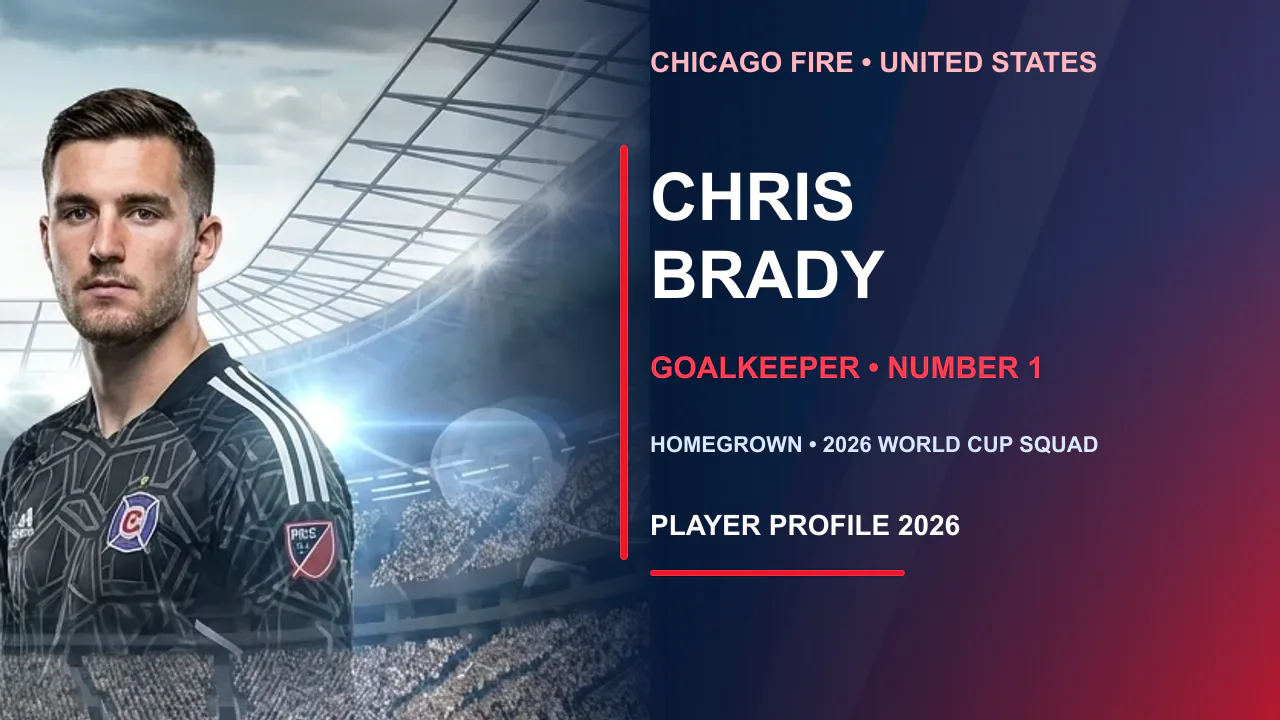
Chris Brady is an American goalkeeper for Chicago Fire FC and the United States men’s national team. Born in Naperville, Illinois, on 3 March 2004, he developed in the Fire academy, signed as a Homegrown Player in 2020 and became the club’s first-choice goalkeeper in his early twenties. He stands 1.91 metres tall and wears number 1 for Chicago.
Brady’s route is especially relevant to American soccer because it connects a local youth club, an MLS academy, a lower-division loan, MLS NEXT Pro and the senior national team. The United States selected him for its 2026 FIFA World Cup squad before he had won a senior cap. He made his international debut in the pre-tournament win over Senegal, received number 25 for the World Cup, and remained an unused squad goalkeeper during the tournament itself.
Chris Brady profile
| Full name | Christopher Brady |
|---|---|
| Known as | Chris Brady |
| Date of birth | 3 March 2004 |
| Birthplace | Naperville, Illinois, United States |
| Height | 1.91 m (6 ft 3 in) |
| Position | Goalkeeper |
| Club | Chicago Fire FC |
| Chicago shirt | Number 1 |
| National team | United States |
| 2026 World Cup shirt | Number 25 |
| Chicago contract | Through 2029, with a club option for 2030 |
This table reflects the verified position in July 2026. Club appearances and clean-sheet totals change during a season, so the dated milestones below are more useful than an undated total. Chicago’s September 2025 contract announcement recorded 87 regular-season appearances, 7,716 minutes and 18 clean sheets at that point.
Current role with Chicago Fire
First-choice responsibility
Brady entered 2026 as an established senior goalkeeper rather than a prospect waiting for occasional minutes. He had already completed three seasons with a substantial MLS workload and had twice been voted Chicago Fire Defensive Player of the Year. Chicago also committed to him with a long contract, a strong sign that the club viewed his development and first-team role as part of the same plan.
Goalkeeper performance cannot be reduced to saves alone. A starter must organize the penalty area, choose when to leave the line, help the team circulate possession and recover after mistakes. Brady’s experience at a young age matters because those decisions improve through repeated exposure to different game states. Readers following the Fire can use the matches hub for broader fixture context.
Contract through 2029
Chicago Fire announced a new deal on 16 September 2025. It runs through the 2029 MLS season and includes a club option for 2030. That date and structure are important: this is not an estimate based on a transfer database. It comes from the club’s own announcement and gives Brady a defined platform for the next phase of his career.
At the time of the extension, Chicago said Brady had made 87 MLS regular-season appearances and had become the leading Homegrown goalkeeper in club history by appearances. The contract followed years of first-team evidence rather than a short run of form.
From Naperville to the Fire academy
Roadrunners Soccer Club beginnings
Brady grew up in Naperville in the Chicago metropolitan area. Before joining the professional academy system, he played for Roadrunners Soccer Club. That local start helps explain why his story is described as Homegrown in more than a registration sense: his development took place inside the region represented by the club.
Chicago Fire lists 2017 as the year he entered its academy. He progressed through youth football while also appearing for United States age-group teams. For a goalkeeper, academy years are not only about stopping shots. Coaches assess footwork, handling technique, communication, positioning and the ability to make decisions under pressure.
Signing as a Homegrown Player
Chicago signed Brady to a Homegrown Player contract on 24 March 2020. He was sixteen. A Homegrown deal links an academy player to the senior roster without the normal college or draft route, but it does not guarantee immediate first-team football. Brady still needed competitive minutes and a bridge between youth matches and MLS.
His development illustrates why the players directory should distinguish between signing a professional agreement and establishing a senior role. The first is a milestone; the second requires performance across training, reserve football, loans and first-team opportunities.
Forward Madison loan and professional education
Learning in senior competition
Brady spent time on loan with Forward Madison in USL League One. That move exposed him to senior attackers, set pieces, physical challenges and the responsibility that comes with results. Reserve and academy matches can develop technique, but a loan asks a young goalkeeper to apply that technique in a team whose points matter every week.
The loan was part of a deliberate pathway rather than a move away from Chicago. It gave Brady match experience while the Fire retained his longer-term development. His progress later earned league recognition at the lower-division level, including the 2020 USL League One Young Player of the Year award.
Chicago Fire II as another bridge
Brady also played for Chicago Fire II. The reserve side offered tactical continuity with the first team and regular work against developing professionals. By moving through academy football, a USL loan and the Fire’s second team, he faced different types of pressure before becoming the MLS starter.
This layered route is one reason his career should not be summarized as an overnight breakthrough. The public first noticed the MLS performances, but the foundation had been built over several seasons.
MLS debut and the 2022 opportunity
First senior appearances for Chicago
Brady made his MLS debut in 2022. Chicago’s player biography notes that he became the second-youngest goalkeeper in club history to record a win and the second-youngest goalkeeper in MLS history to keep a clean sheet. Those markers showed that he could handle senior responsibility, though they did not yet make him the permanent starter.
Goalkeeper succession can be difficult because only one player starts. Brady’s opportunity came as the Fire prepared for a change in the position. His early appearances provided evidence that the academy pathway could supply a serious first-team option.
Taking over as Chicago’s starter in 2023
Thirty starts and eight shutouts
The 2023 season was the decisive step. Brady started 30 regular-season matches, played 2,640 minutes and recorded eight shutouts. Chicago named him its Defensive Player of the Year. The club award reflected a complete season in which he carried the weekly demands of the position rather than a small sample of eye-catching saves.
MLS also named him to its 22 Under 22 list, and he was the only goalkeeper included. That recognition placed him among the league’s most highly regarded young players. It also highlighted how unusual it is for a goalkeeper of that age to accumulate a starter’s workload.
What changed after the breakthrough
Once Brady became the regular starter, opponents had more video and more chances to test him. The challenge moved from proving he belonged to maintaining standards. He had to prepare for repeated crosses, different pressing systems and long stretches in which concentration mattered as much as reaction speed.
The 2023 award did not mean development was complete. It established a baseline from which distribution, command and decision-making could keep improving.
Second straight club award in 2024
Thirty-three starts and 107 saves
Chicago named Brady its Defensive Player of the Year again in 2024. He started 33 regular-season matches and made 107 saves. According to the club, he was the first Fire goalkeeper to pass 100 saves in a season since 2012. The repeat award is valuable context because it shows recognition across two different campaigns.
Save totals partly reflect how often a team allows shots, so they should not be read in isolation. Even so, handling that volume tests a goalkeeper’s durability, recovery and focus. Brady remained available and took responsibility through a demanding season.
Chicago’s 2025 return to the playoffs
Experience before a long-term extension
By 2025, Brady was no longer being judged only against other young goalkeepers. He was a senior starter expected to help Chicago compete. MLS credited him as part of the team that returned to the playoffs that season. The September contract extension then turned the accumulated evidence into a long-term commitment.
Chicago’s announcement recorded 18 regular-season clean sheets across his first 87 appearances. That figure belongs to the date of the announcement and should not be mistaken for a permanent career total. It is useful because it captures the scale of his experience before he turned 22.
Form before the 2026 World Cup
Six clean sheets by mid-May
Chicago reported that Brady had six clean sheets by 16 May 2026. That club form provided timely evidence before the United States finalized its World Cup squad. Selection was still a major step because the senior national-team goalkeeping group included players with previous international experience.
The World Cup was staged in the United States, Canada and Mexico, making Brady’s inclusion particularly meaningful for a goalkeeper developed in the host country’s domestic system. See the site’s 2026 groups guide and teams and squads hub for tournament structure.
Chris Brady’s goalkeeping style
Shot stopping and reaction work
Brady’s height gives him useful reach, but his best saves also depend on set position and reaction speed. He tries to stay balanced before the shot, which helps him move in either direction. In close-range situations, a goalkeeper often has little time to choose a perfect technique, so strong hands, body shape and the willingness to hold position matter.
Highlight saves are the visible part of the role. The less visible part is reducing the difficulty of the shot through positioning. A keeper who reads the angle early can make a difficult action look routine.
One-on-one decisions
In one-on-one situations, Brady must judge whether to close the attacker, hold his ground or protect against a pass. His size can narrow the target when he advances, but timing is essential. Moving too early gives the attacker space to finish around him; waiting too long leaves more goal exposed.
These situations also test emotional control. A goalkeeper may concede despite making the correct percentage decision. The next phase still requires clear communication and concentration.
Crosses and penalty-area command
At 1.91 metres, Brady has the frame to compete for high balls. Command involves more than height. He must read the delivery, judge traffic, communicate with defenders and decide whether to catch, punch or remain on the line. Consistent decisions help a back line defend second balls.
Set pieces are a useful measure of partnership between goalkeeper and defenders. Brady’s calls must match the team’s marking plan. That relationship develops through repeated club minutes, one reason continuity is valuable.
Distribution and build-up play
Modern teams ask goalkeepers to participate in possession. Brady can start attacks with short passes or move the ball longer when pressure removes the short option. The important quality is not simply passing accuracy; it is recognizing which choice fits the pressure and the position of teammates.
Distribution remains an area where young goalkeepers can keep expanding. Faster decisions, passes that lead a teammate away from pressure and more consistent long delivery can change where the next duel takes place.
Areas for continued development
Consistency across every phase
Brady already has unusual senior experience for his age, but goalkeeper evaluation is demanding because a single decision can shape a match. The next level is consistency across crosses, build-up, sweeping and shot prevention. That does not mean eliminating all errors. It means improving the quality and repeatability of decisions.
International football adds another test. A backup may go several matches without playing and then be asked to enter against elite opposition. Training sharpness and mental preparation become part of the role even when the appearance record stays unchanged.
United States youth-national pathway
From under-15 to under-23 levels
Brady represented the United States at under-15, under-16, under-17, under-20 and under-23 levels. That long age-group pathway allowed national-team coaches to evaluate him over time rather than through one camp. It also exposed him to tournament football, where recovery between matches and knockout pressure differ from a league season.
His youth record made the later senior call-up understandable, but youth appearances do not automatically count as senior caps. This profile keeps those records separate.
2022 Concacaf Under-20 Golden Glove
At the 2022 Concacaf Under-20 Championship, Brady won the Golden Glove as the tournament’s leading goalkeeper. U.S. Soccer credited him with four consecutive clean sheets in the knockout rounds. The team’s run secured qualification for the 2024 Olympic men’s football tournament.
The award showed that he could handle a short international competition with little room for recovery after a mistake. It also arrived before his full MLS breakthrough, making it an important bridge between youth promise and senior responsibility.
Senior USMNT call-ups before the World Cup
Learning inside the goalkeeper group
Brady entered senior United States camps before winning his first cap and was part of the 2025 Concacaf Gold Cup squad. A goalkeeper can gain useful experience in camp without appearing: training speed rises, coaches test build-up decisions, and the player learns the national team’s defensive language.
Those call-ups placed him in competition with more experienced senior keepers. They also allowed the staff to assess whether his club form translated to the international environment.
Historic selection for the 2026 World Cup
Chosen before his senior debut
United States head coach Mauricio Pochettino named Brady in the 26-player World Cup squad while he was still uncapped. U.S. Soccer reported that he was the first uncapped player selected for a USMNT World Cup roster since goalkeeper Juergen Sommer in 1994. The federation also described Brady as the third-youngest goalkeeper ever named to a U.S. men’s World Cup squad, behind Kasey Keller and Tony Meola in 1990.
Those distinctions describe selection, not tournament playing time. They should not be turned into a claim that Brady appeared at the World Cup.
Senior debut against Senegal
First cap on 31 May 2026
Brady made his senior international debut on 31 May 2026 in a pre-World Cup friendly against Senegal. He replaced Matt Turner at halftime, and the United States won 3-2. U.S. Soccer now records that match as his first senior cap and first win.
The debut removed the “uncapped” label before the tournament began, but it remained historically accurate that he had been uncapped when the roster was announced. Dates matter when both statements appear in a profile.
Number 25 at the World Cup
Role in the United States goalkeeper group
The United States assigned Brady number 25 for the 2026 World Cup. He joined Matt Freese and Matt Turner in the goalkeeper group. Selection required him to prepare for every match even though only one goalkeeper could start.
Brady’s age, club form and domestic development made the tournament an important learning experience. However, training participation and squad selection are not official appearances, so his World Cup playing record must be stated precisely.
Did Chris Brady play at the 2026 World Cup?
Zero tournament appearances
No. Chris Brady did not play in a match at the 2026 FIFA World Cup. He was an unused substitute throughout the United States campaign. Before the round-of-16 match against Belgium, U.S. Soccer listed Brady among the three squad members who had not appeared. The official Belgium match record also lists him among the substitutes who did not enter.
This distinction protects the accuracy of his profile. Brady was a World Cup squad member and gained the experience of a home tournament, but his senior debut came in the friendly against Senegal, not in the World Cup itself.
United States tournament run
From the group stage to the round of 16
The United States advanced from its group and then beat Bosnia and Herzegovina in the round of 32. Belgium ended the American campaign with a 4-1 win in the round of 16 on 6 July 2026. Brady remained an unused squad goalkeeper in that final match.
For schedule and knockout-round context, readers can use the round-of-32 guide, the stadiums guide and the main United States team page.
How Brady compares within the USMNT pathway
A young senior goalkeeper with real club minutes
Brady’s case is built on a combination that national teams value: age-group tournament experience and a substantial first-team workload. He had already handled multiple MLS seasons before receiving his first senior cap. That gives coaches more evidence than a youth reputation alone.
The player profiles for defenders Antonee Robinson and Joe Scally show different routes from American development into senior national-team football. Brady’s route is more domestic and position-specific, but the common thread is competitive club experience before a major tournament.
Career timeline
- 2017: Joined the Chicago Fire academy after playing for Roadrunners Soccer Club.
- 24 March 2020: Signed a Chicago Fire Homegrown Player contract.
- 2020: Gained senior experience with Forward Madison and won USL League One Young Player of the Year.
- 2022: Won the Concacaf Under-20 Golden Glove and helped the United States qualify for the 2024 Olympics.
- 2022: Made his MLS debut for Chicago Fire.
- 2023: Became Chicago’s regular starter, made 30 league starts, kept eight shutouts and won club Defensive Player of the Year.
- 2024: Started 33 league matches, made 107 saves and won the club defensive award again.
- 2025: Helped Chicago return to the playoffs and signed a deal through 2029 with an option for 2030.
- May 2026: Selected for the United States World Cup squad while uncapped.
- 31 May 2026: Made his senior USMNT debut in a 3-2 win over Senegal.
- June-July 2026: Served as number 25 in the U.S. World Cup squad without making a tournament appearance.
Key verified records
The most reliable way to understand Brady’s progress is to anchor each number to its source and date. Chicago recorded 30 starts, 2,640 minutes and eight shutouts in 2023. The club recorded 33 starts and 107 saves in 2024. Its September 2025 contract release listed 87 regular-season appearances, 7,716 minutes and 18 clean sheets. A May 2026 club report said he had six clean sheets by that point of the season.
These are not all meant to be added together because some are season figures and others are career totals at a particular date. Keeping the date attached prevents double counting and makes later updates easier.
Frequently asked questions
How old is Chris Brady?
Chris Brady was born on 3 March 2004. He was 22 during the 2026 FIFA World Cup.
Where is Chris Brady from?
He is from Naperville, Illinois, in the Chicago metropolitan area. He played for Roadrunners Soccer Club before joining the Chicago Fire academy.
How tall is Chris Brady?
Chicago Fire and U.S. Soccer list him at 6 feet 3 inches, equivalent to approximately 1.91 metres.
What position does Chris Brady play?
He is a goalkeeper. He has been Chicago Fire’s regular first-team goalkeeper and is part of the United States senior national-team pool.
What number does Chris Brady wear?
He wears number 1 for Chicago Fire. The United States assigned him number 25 for the 2026 FIFA World Cup.
When does Chris Brady’s Chicago contract end?
His contract runs through the 2029 MLS season. Chicago Fire holds an option for the 2030 season.
When did Chris Brady make his USMNT debut?
He made his senior United States debut on 31 May 2026, entering at halftime in a 3-2 friendly win against Senegal.
Did Chris Brady appear at the 2026 World Cup?
No. He was selected for the squad and wore number 25, but he did not enter a tournament match. His World Cup appearance total is zero.
Sources and update policy
This profile prioritizes first-party records. Core facts were checked against the Chicago Fire player biography, the club’s September 2025 contract announcement, its 2023 awards release and 2024 awards release.
Senior international details were checked against U.S. Soccer’s World Cup roster announcement, Senegal match report, World Cup number list and Belgium match report. The page is dated July 2026 and should be updated when his club status or senior record materially changes.