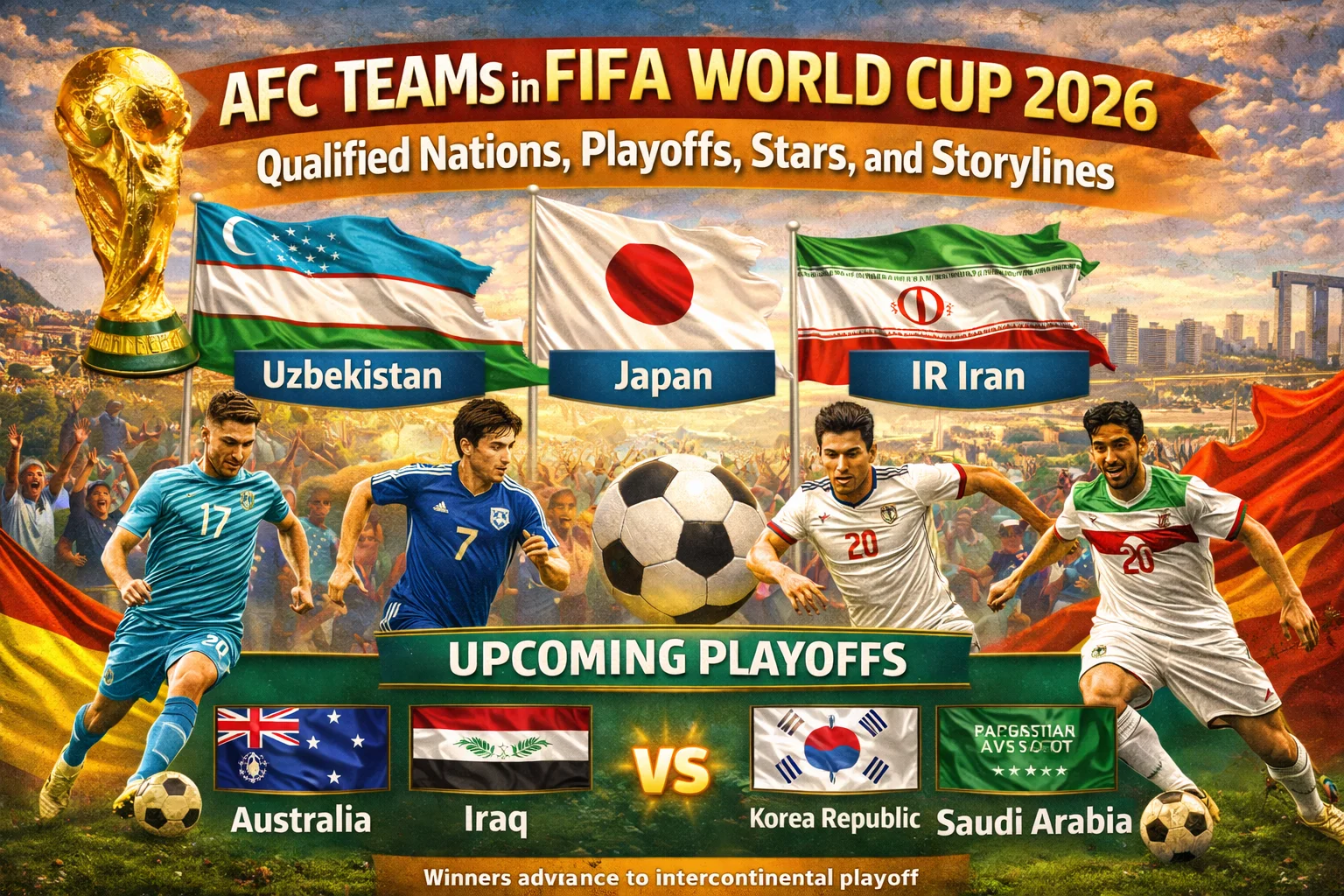
AFC Teams in FIFA World Cup 2026, Qualified Nations, Playoffs, Stars, and Storylines
Asia is sending its biggest-ever presence to the FIFA World Cup 2026, and the feeling is different this time. The expansion to 48 teams has opened doors for new names while still rewarding the continent’s most consistent programs. The result is not only a bigger list of flags, but a snapshot of how Asian football has grown through better coaching, stronger domestic leagues, and clearer player pathways.
The tournament being hosted in Canada, Mexico, and the United States also adds its own angles. Travel distance, climate shifts, and scheduling patterns will shape preparation. For Asian teams, planning for the North American setting becomes part of the story, not a footnote.
How many AFC teams can qualify for the 2026 World Cup?
Asia can qualify eight teams directly, plus one more via the inter-confederation play-offs. That means the realistic ceiling is nine AFC representatives at the finals in North America.
That extra playoff chance changes the pressure inside qualifying. Finishing “almost good enough” still leaves a route alive, which keeps more teams motivated deeper into the cycle.
AFC slots in one quick list
- Direct tickets: 8 teams qualify straight to the finals
- Playoff ticket: 1 Asian team can still qualify through the FIFA Play-Off Tournament in March 2026
Asia’s qualification format in plain English
AFC qualification runs through multiple stages, and each stage shifts the stakes.
First round
The qualification process began in October 2023. The first round featured 20 lower-ranked teams playing two-legged home-and-away ties. Winners advanced to the next phase.
Second round
Those winners joined higher-seeded nations in second-round groups. The group stage built rhythm, punished inconsistency, and created rivalries that carried into later rounds.
Third round
In the third round, 18 teams were split into three groups of six and played home-and-away matches. The top two teams from each group qualified directly for the World Cup. Third and fourth place did not go home, but moved forward.
This is where the qualification picture got clearer: the elite teams aimed to finish early, while the middle tier fought for survival.
Fourth round
Next, six teams (the third and fourth place finishers) played in two groups of three at centralized hosts. The winner of each mini-group qualified directly for the World Cup. This stage created a short, high-pressure tournament feel where one mistake could end a cycle.
Fifth round
Then, the two fourth-round runners-up met over two legs. The winner became Asia’s representative in the inter-confederation play-offs.
Latest confirmed AFC teams for FIFA World Cup 2026
Eight Asian nations have secured direct qualification to FIFA World Cup 2026. The mix includes familiar contenders and historic first-time qualifiers, which makes Asia’s final lineup feel fresh and unpredictable.
AFC direct qualifiers and how they qualified
| AFC Team | Qualification route | What it signals |
|---|---|---|
| Japan | Third round: top-two finish | Elite structure, depth, and tournament experience |
| Iran | Third round: top-two finish | Consistency across cycles and strong qualifying mentality |
| Korea Republic | Third round: top-two finish | Balanced squad-building and long-term World Cup reliability |
| Australia | Third round: top-two finish | Pragmatic qualifying approach and physical game management |
| Uzbekistan | Third round: top-two finish | Breakthrough moment and a milestone qualification |
| Jordan | Third round: top-two finish | Historic achievement and smart tactical identity |
| Qatar | Fourth round: group winner | Composure in central-venue pressure games |
| Saudi Arabia | Fourth round: group winner | Competitive edge and results under tight margins |
The AFC playoff storyline
Even with eight direct qualifiers confirmed, Asia still has one more possible spot. That final chance runs through the FIFA Play-Off Tournament in March 2026, where teams from multiple confederations compete.
Iraq as Asia’s inter-confederation playoff representative
From the AFC fifth round, Iraq emerged as the winner and advanced to the inter-confederation play-offs. Iraq is the AFC team still fighting for Asia’s potential ninth ticket.
What makes this AFC lineup different from past World Cups?
Asia’s 2026 contingent reflects two shifts that fans can feel, even without digging into spreadsheets.
More variety, not just the usual names
Japan, Korea Republic, Iran, and Australia are familiar World Cup participants. They bring experience, calm, and clear expectations. Uzbekistan and Jordan represent a different side of the continent: patient rebuilding paying off, plus a new sense of belief.
That blend changes the tone. Traditional powers still set the standard, but new qualifiers arrive with momentum and curiosity around how far they can go.
Tactical maturity across regions
Across West Asia, Central Asia, and East Asia, teams look more comfortable in structured defending, more organized in mid-blocks, and more dangerous on set pieces. There is also a stronger baseline of players developing in tougher environments, which raises the level of qualifying campaigns and the confidence that follows.
Team-by-team guide
If you are building previews, writing match guides, or simply trying to understand Asia’s representatives, these quick angles help you cover each team with clarity.
Japan
Japan’s identity is built around tempo control, pressing triggers, and wide rotations that create overloads. They handle tournament pressure well, which often decides group-stage matches. Their qualification story fits a familiar pattern: structured football, depth across positions, and confidence that travels.
Iran
Iran blends physical forward play with a disciplined shape. They rarely panic in qualifiers, and they keep matches under control through structure. Their North America storyline will include travel and logistics, but their on-field identity remains about shape, toughness, and managing key moments.
Korea Republic
Korea Republic brings intensity, fast combinations, and strong fitness across the squad. They can raise the pace late in matches, which becomes a real weapon in tight group games. Their long record of qualifying adds calm, but their style still leans energetic and direct.
Australia
Australia can be direct when needed and compact without the ball. They know how to “win ugly,” and that skill often decides group-stage survival. Their approach is practical: manage space, stay physical, and take advantage of set pieces and momentum swings.
Uzbekistan
Uzbekistan’s qualification signals a mature football system and growing confidence in big games. For fans, they fit the label of a watchable underdog with genuine upset potential. Their presence also highlights Central Asia’s rise and the idea that new programs can break through with the right structure.
Jordan
Jordan reaching the finals is a major moment for their football culture. Their style often includes clear defensive commitment, which can frustrate stronger opponents and keep games close. Their story also brings emotion: a first-time appearance that carries national pride and a sense of discovery for global audiences.
Qatar
Qatar’s story includes learning to qualify through competitive routes rather than hosting. They showed composure in central-venue pressure games, which matters when a tournament becomes a sprint. Their experience of big-stage attention remains part of their identity, even as the path to 2026 had its own demands.
Saudi Arabia
Saudi Arabia has shown it can navigate tight groups where one draw changes everything. Their ability to protect leads and manage match rhythm can translate well to World Cup group matches. They also carry recent global attention, with a reputation for stepping up in high-profile moments.
Player Spotlights
Asian teams often rely on core stability, so star players matter even more when schedules tighten and margins shrink.
Standout names to watch
- Son Heung-min: a headline figure for Korea Republic, known for goals and match-turning moments
- Takehiro Tomiyasu: a major defensive presence for Japan
- Mathew Ryan: an experienced goalkeeper for Australia
- Salem Al-Dawsari: a key figure for Saudi Arabia in decisive moments
Table: quick star snapshot
| Star Player | Team | Strengths |
|---|---|---|
| Kaoru Mitoma | Japan | Dribbling and attacking threat |
| Son Heung-min | Korea Republic | Finishing and leadership |
| Mousa Al-Tamari | Jordan | Pace and direct attacking runs |
| Aziz Behich | Australia | Versatility and balance |
Tournament format impact
The move to a 48-team World Cup changes what success can look like for AFC teams. Asia’s slot increase is the headline, but the match format also shapes how teams manage risk, rotation, and planning.
A new group structure is part of the discussion, and it raises the value of fast starts and disciplined game management. With more matches and more teams, the tournament becomes less forgiving for slow beginnings, while still giving teams a clearer belief that knockout football is reachable.
Group stage dynamics to keep in mind
- Short group phases raise the value of each match
- Advancing routes keep teams fighting until the final whistle
- Host venues across Canada, Mexico, and the United States reward adaptability
Preparation and challenges ahead for AFC teams
Qualification is only the first half of the work. After booking a ticket, the focus shifts to preparation: friendlies, squad development, and building chemistry under real match pressure.
Travel, climate, and scheduling
North America brings long travel legs and different climate patterns. Some venues add altitude considerations and logistical challenges. These details affect training plans, recovery routines, and how coaches manage minutes.
Squad depth and fitness
Injuries and club form can shape an entire World Cup. This is why depth matters for AFC teams, especially those that rely on a stable core. Smart rotation and flexible tactical plans help teams survive the tournament rhythm.
Tactical readiness
Coaches emphasize fitness, versatility, and scouting. Opponent study begins early, and the biggest teams treat preparation as a long project. For emerging qualifiers, preparation can be the difference between a proud debut and a real upset.
Practical viewing guide for AFC fans worldwide
With matches played in North America, many kickoffs will land in late-night or early-morning windows across Asia. Fans following multiple AFC teams will benefit from a plan.
Tips to follow AFC teams without burnout
- Build a must-watch list: openers, likely group deciders, and rivalry matches
- Use extended highlights for secondary matches, then full replays for classics
- Track injuries and squad announcements, since stability matters for many AFC sides
FAQs
The confirmed direct qualifiers are Japan, Iran, Korea Republic, Australia, Uzbekistan, Jordan, Qatar, and Saudi Arabia.
Asia has eight direct slots, plus one extra chance through the inter-confederation play-offs in March 2026.
Iraq advanced through the AFC fifth round and represents Asia in the inter-confederation play-offs pathway.
The fourth round used centralized mini-groups, and the group winners qualified directly. The setup created high-pressure, short-run tournaments.
Uzbekistan and Jordan are highlighted as nations that sealed World Cup qualification for the first time.
Final Takeaway
The AFC teams in FIFA World Cup 2026 represent a deeper Asia than many fans are used to seeing. The traditional powers still lead the way, but new qualifiers have earned their place through structure and belief. With one more Asian side still chasing qualification through the global play-offs, the AFC story is not finished yet.