Argentina: World Cup 2026 Squad, Fixtures, Standings & Kits

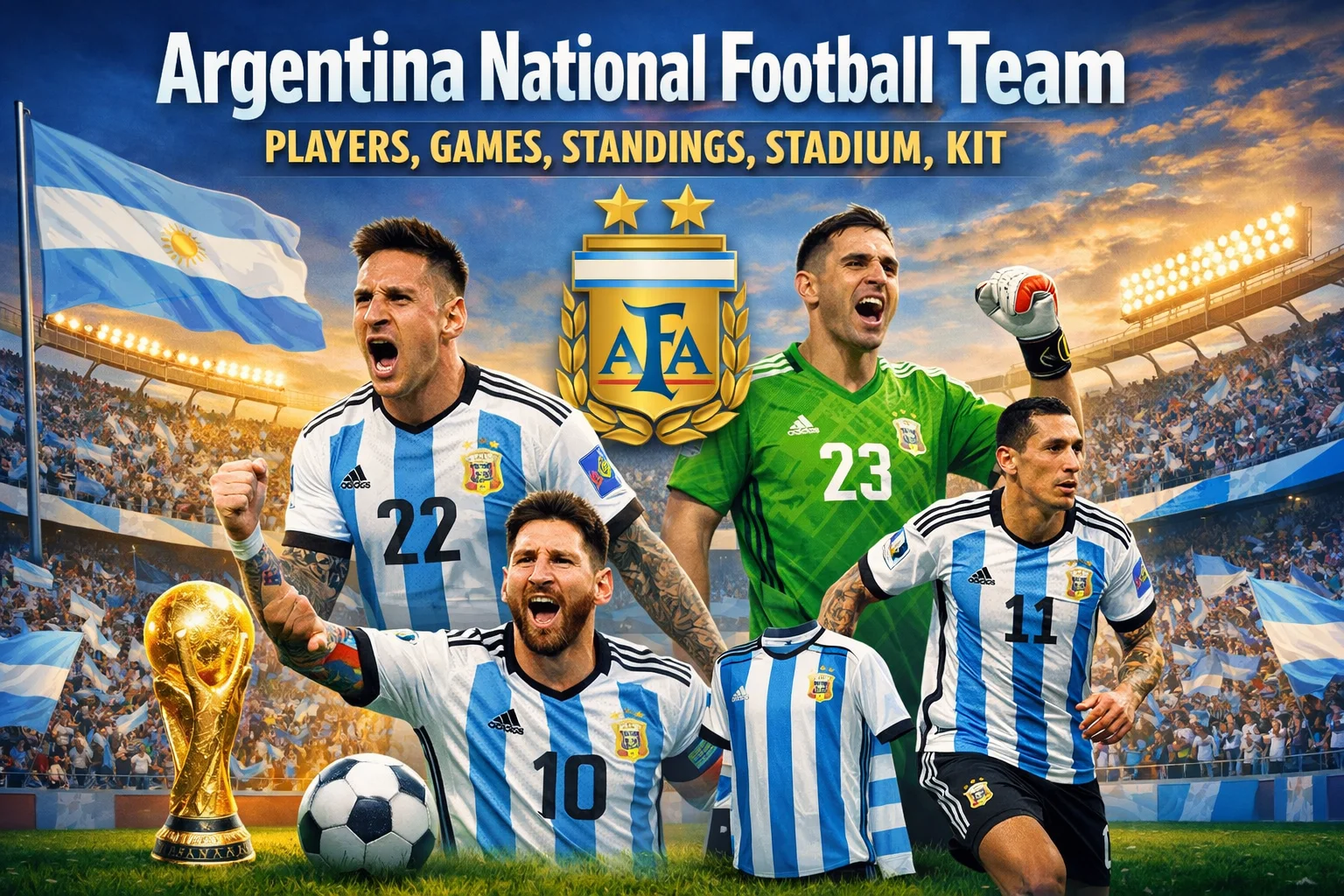
Argentina arrive at the 2026 FIFA World Cup as defending champions, looking to become only the third nation in history to win back-to-back World Cup titles. Lionel Scaloni’s side dominated CONMEBOL qualifying, finishing first with 38 points — eight clear of second-placed Ecuador. The official 26-man squad was announced on 28 May 2026.
Placed in Group J alongside Algeria, Austria, and Jordan, Argentina are clear favourites to advance. The biggest story of the tournament is Lionel Messi making history at his sixth and almost certainly final FIFA World Cup at 38 years old. The squad retains the core that won in Qatar, with Mac Allister, Enzo Fernández, Lautaro Martínez, and Julián Álvarez all returning.
What should fans know about Argentina at World Cup 2026?
Argentina are competing at the 2026 FIFA World Cup in the United States, Mexico, and Canada. They are placed in Group B and are managed by Lionel Scaloni. The tournament runs from June 11 to July 19, 2026.
Argentina — FIFA World Cup 2026
Group J · Coach: Lionel Scaloni · La Albiceleste
Contents
Argentina World Cup 2026 Squad
Lionel Scaloni named his final 26-man squad on 28 May 2026. The core of the 2022 World Cup winning side returns, with Messi captaining the team at his sixth tournament. Notable absentees include Marcos Acuña and Franco Mastantuono, while Nico Paz of Como earns his first major tournament call-up following a sensational Serie A season.
Goalkeepers



Defenders




Midfielders



Forwards


Key Players to Watch at World Cup 2026
Argentina have world-class quality across every position. These six players will be the difference-makers as Scaloni’s side hunt a historic third title.
The greatest footballer of all time makes his sixth and almost certainly final World Cup appearance at 38. Messi is the defending champion’s captain, heartbeat, and match-winner. When he is on form, Argentina are nearly impossible to stop.
The best goalkeeper in the world according to many. Martínez was the hero of the 2022 World Cup penalty shootouts and his shot-stopping, distribution, and psychological impact on opponents make him irreplaceable in this squad.
Top scorer at Copa América 2024 and one of the most complete centre-forwards in world football. Lautaro’s movement, finishing, and link-up play with Messi give Argentina a devastating attacking combination that defenders cannot handle.
The engine of Argentina’s midfield. Mac Allister’s energy, technical quality, and ability to press and create from deep have made him one of the best midfielders in the world at Liverpool. He is arguably Scaloni’s most important non-Messi player.
Four goals in Qatar 2022 and a Copa América winner. Álvarez’s work rate, movement off the ball, and clinical finishing from any position make him the perfect foil for Messi and Lautaro in a front three.
The 2022 World Cup’s best young player award winner. Fernández’s composure on the ball, range of passing, and ability to control the tempo in tight spaces are central to how Argentina build and break down opposition defences.
Tactics and Formation Under Lionel Scaloni
Scaloni typically deploys Argentina in a 4-3-3 or a fluid 4-2-3-1 that shifts between shapes depending on the opponent. Mac Allister and Enzo Fernández provide the technical base in midfield, with De Paul adding energy and driving runs from box to box. Messi operates in a free role, drifting inside from the right to find pockets and create from deep or in behind.
Against Group J’s three opponents — Algeria, Austria, and Jordan — Argentina will likely play with high possession and press aggressively off the ball. The front three of Messi, Lautaro, and J. Álvarez is one of the most dangerous in the tournament. Scaloni’s key challenge will be keeping Messi fit and sharp through the group stage ahead of the knockout rounds.
| Formation | Style | Key Shape | Primary Strength |
|---|---|---|---|
| 4-3-3 | High press + possession | Messi free right; Lautaro 9; Mac Allister pivot | Most dangerous attacking combination |
| 4-2-3-1 | Controlled build-up | Double pivot Enzo+Mac Allister; Messi as 10 | Balance of creativity and defensive shape |
| 4-4-2 | Counter-press | Lautaro + J.Álvarez up front; Messi drops to mid | Hard to press; deadly on the counter |
Group J Fixtures — Argentina at WC 2026
Local broadcast times are listed in the Argentina FIFA World Cup 2026 TV schedule.
Fans can also use the where to watch Argentina football guide for the next synced match card, kickoff conversion and official TV channel routes.
Argentina open against Algeria in Kansas City before back-to-back matches at AT&T Stadium in Arlington, Texas against Austria and Jordan. All three opponents are beatable on paper, and Scaloni will want maximum points from the group stage to set up a favourable knockout bracket.
| Date | Match | Venue | City |
|---|---|---|---|
| 17 June 2026 | Argentina vs Algeria | GEHA Field at Arrowhead | Kansas City, MO |
| 22 June 2026 | Argentina vs Austria | AT&T Stadium | Arlington, TX |
| 28 June 2026 | Argentina vs Jordan | AT&T Stadium | Arlington, TX |
Group J — FIFA World Cup 2026
| Team | Pld | W | D | L | GF | GA | Pts |
|---|---|---|---|---|---|---|---|
| 🇦🇷 Argentina | 0 | 0 | 0 | 0 | 0 | 0 | 0 |
| 🇦🇹 Austria | 0 | 0 | 0 | 0 | 0 | 0 | 0 |
| 🇩🇿 Algeria | 0 | 0 | 0 | 0 | 0 | 0 | 0 |
| 🇯🇴 Jordan | 0 | 0 | 0 | 0 | 0 | 0 | 0 |
Argentina are overwhelming favourites to top Group J. Jordan are making their World Cup debut and pose limited threat. Algeria and Austria are stronger but neither has the squad depth to match the defending champions. Scaloni will target nine points from the group before focusing on the knockout rounds.
CONMEBOL World Cup Qualifying
Argentina were the dominant force in CONMEBOL qualifying. Finishing first with 38 points — eight ahead of second-placed Ecuador — Scaloni’s side showed the class and depth of champions throughout the 18-game campaign. Their attacking quality, led by Messi, Lautaro, and J. Álvarez, produced 31 goals across qualifying.
| Team | Pld | W | D | L | GF | GA | Pts |
|---|---|---|---|---|---|---|---|
| 🇦🇷 Argentina | 18 | 12 | 2 | 4 | 31 | 10 | 38 |
| 🇪🇨 Ecuador | 18 | 8 | 8 | 2 | — | — | 29 |
| 🇨🇴 Colombia | 18 | 7 | 7 | 4 | 28 | 18 | 28 |
| 🇺🇾 Uruguay | 18 | 7 | 7 | 4 | 22 | 12 | 28 |
| 🇧🇷 Brazil | 18 | 8 | 4 | 6 | 24 | 17 | 28 |
| 🇵🇾 Paraguay | 18 | 7 | 7 | 4 | 14 | 10 | 28 |
Argentina 2026 World Cup Kits
Argentina’s iconic sky blue and white striped home shirt is one of the most recognisable kits in world football. Their 2026 World Cup kits are manufactured by Adidas. Official kit images will be updated when released by the AFA and Adidas.
Argentina at the World Cup
Argentina are one of the most decorated nations in World Cup history. They have won the tournament three times — in 1978, 1986, and 2022 — and have reached the final on five occasions. Their 2022 triumph in Qatar, which ended a 36-year wait for a third title, was one of the greatest tournaments ever played.
| Year | Stage | Notable Result |
|---|---|---|
| 1930 | Runners-up | Lost to Uruguay 4–2 in the first-ever World Cup final |
| 1978 | Winners | Beat Netherlands 3–1 in final on home soil |
| 1982 | Second round | Eliminated in second group stage despite Maradona |
| 1986 | Winners | Maradona’s tournament — beat West Germany 3–2 |
| 1990 | Runners-up | Lost to West Germany 1–0 in the final |
| 1994 | Round of 16 | Eliminated after Maradona’s failed drugs test |
| 1998 | Quarter-final | Lost to Netherlands on penalties |
| 2002 | Group Stage | Shock exit — eliminated in the group stage |
| 2006 | Quarter-final | Lost to Germany on penalties |
| 2010 | Quarter-final | Lost to Germany 4–0 |
| 2014 | Runners-up | Lost to Germany 1–0 after extra time in the final |
| 2018 | Round of 16 | Lost to France 4–3 |
| 2022 | Winners | Beat France 4–2 on penalties — Messi lifts the trophy |
| 2026 | TBD | Group J: Algeria, Austria, Jordan — defending champions |
In 2026, Argentina return as defending champions with a squad that is arguably stronger than the one that won in Qatar. If Messi stays fit and Lautaro and Álvarez maintain their club form, there is every reason to believe Argentina can become the first team since Brazil in 1962 to win back-to-back World Cup titles.
Frequently Asked Questions
More World Cup 2026 Team Guides
Follow every nation at the 2026 FIFA World Cup on FWC Times.