OFC Teams in FIFA World Cup 2026, New Zealand Qualified, Playoffs and Rising Stars
OFC teams in FIFA World Cup 2026 arrive with something Oceania has never had before in this competition cycle a clear route that feels real. For the first time, the region has one guaranteed direct place at the FIFA World Cup, plus a second pathway through the inter-confederation play-offs. That single change shifts everything. It turns qualification from a long-shot dream into a target that can be planned, trained for, and earned on the pitch.
Oceania football still lives in its own world. Travel is heavy, squads are often small, and many players balance football with semi-pro realities. That is why a breakthrough from the Pacific is never just qualifying. It reflects years of scouting, development, coaching, facilities, and belief finally lining up at the right time.
This guide brings the full OFC World Cup 2026 story into one place: the qualification format, the teams involved, who has qualified, who is still fighting, how the play-offs work, and the players who can decide matches when pressure is at its highest.
Why World Cup 2026 is different for Oceania
The FIFA World Cup 2026 expands to 48 teams, and that expansion changes what is possible for regions like OFC. In past cycles, Oceania often had to survive a difficult path that ended in a high-risk intercontinental challenge. Now, the winner of Oceania qualifies directly, and the runner-up still has a defined second chance.
A direct slot changes the mindset
A direct slot changes how teams prepare. When the pathway is realistic, preparation replaces hope. Planning replaces guesswork. Camps get organized earlier. Player availability becomes a priority. Fitness and recovery get more attention. Even small improvements add up when the margin for error is thin.
A second pathway keeps more nations alive
The runner-up route matters almost as much as the direct slot. It keeps more teams invested deeper into the cycle. It also makes the final phase feel less like a single “all-or-nothing” moment and more like a structured competition with two clear outcomes: direct qualification or a play-off route.
OFC qualification format
Oceania qualifying for this cycle ran from September 6, 2024 to March 24, 2025 and moved through three rounds. The structure rewarded discipline and punished slow starts. Group games mattered. Knockout matches offered no space for mistakes.
The three rounds at a glance
First, lower-ranked teams battled through an early knockout stage. Next came the main group stage, where contenders were filtered into a final knockout window. Finally, a short March bracket decided the two biggest outcomes: the direct qualifier and the play-off entrant.
| Stage | Teams | Format | What teams earned |
|---|---|---|---|
| First round | 4 | Knockout mini-round | One team advanced |
| Second round | 8 | Two groups of four | Top two in each group advanced |
| Third round | 4 | Knockout bracket | Winner qualified; runner-up reached inter-confederation play-offs |
The teams involved across Oceania
All eleven OFC members took part. New Zealand entered as the region’s powerhouse, while nations like Fiji, Solomon Islands, Tahiti, New Caledonia, Papua New Guinea, and Vanuatu pushed to close the gap. Smaller teams such as Samoa, Tonga, Cook Islands, and American Samoa began in the earlier stage, bringing urgency and pride to every match.
The OFC qualification journey
Oceania’s route combined early knockout tension with group-stage momentum and a final knockout window that decided everything.
Early knockout and group stages built the contenders
Lower-ranked teams began in a knockout round hosted in Samoa, where Samoa advanced after edging Tonga. From there, the competition moved into group stages hosted across Fiji, Vanuatu, New Zealand, and Papua New Guinea.
Group A finished tight at the top. New Caledonia led the group with seven points from three matches, edging Fiji on goal difference. Their campaign included results against Solomon Islands and Papua New Guinea, and it set up a serious push toward the final bracket.
Group B was dominated by New Zealand, who scored nineteen goals in three games. They beat Samoa 8-0, Vanuatu 8-1, and Tahiti 3-0. That scoring output made a statement. It also showed how dangerous New Zealand can be when their tempo stays high and their service into the box is consistent.
The final knockout window turned everything into pressure football
The semifinals and final were the heart of the campaign. Four teams entered the March bracket knowing exactly what was on the line. Win the tournament and qualify directly. Lose the final and you still live, but only through the inter-confederation play-offs.
Qualified nations from OFC for FIFA World Cup 2026
OFC has one confirmed World Cup participant from this cycle, and one team still fighting for a second slot.
New Zealand qualified directly
New Zealand won the OFC third round and qualified for FIFA World Cup 2026 on March 24, 2025. They defeated New Caledonia 3-0 in the OFC final. This will be their third World Cup appearance, after 1982 and 2010, and their first since 2010.
New Zealand’s qualification fits the broader pattern in Oceania. When the route is clear, the region’s top program tends to rise quickly. Their match management, set-piece threat, and experience showed up when games tightened. Their overall scoring run in the cycle reflected control, not luck.
New Caledonia reached the inter-confederation play-offs
New Caledonia finished as the OFC runner-up and earned a place in the inter-confederation play-offs. They are not qualified yet, but they are still alive, and their pathway is now defined rather than mysterious. That matters for planning, confidence, and preparation.
Key results
The third round delivered clear scorelines and decisive moments. These matches shaped the entire World Cup picture for the confederation.
| Match | Date | Score | Venue | Scorers |
|---|---|---|---|---|
| New Caledonia vs Tahiti | March 21, 2025 | 3-0 | Sky Stadium, Wellington | Gope-Fenepej (2), Waya |
| New Zealand vs Fiji | March 21, 2025 | 7-0 | Sky Stadium, Wellington | Wood (3), Singh, Bindon, Payne, Barbarouses |
| New Zealand vs New Caledonia (Final) | March 24, 2025 | 3-0 | Mount Smart Stadium, Auckland | Boxall, Barbarouses, Just |
These results tell a simple truth. New Zealand arrived in the final window with the strongest depth and the most reliable end product. New Caledonia earned their play-off opportunity through consistency and composure, then faced a final that demanded perfection.
OFC play-offs explained
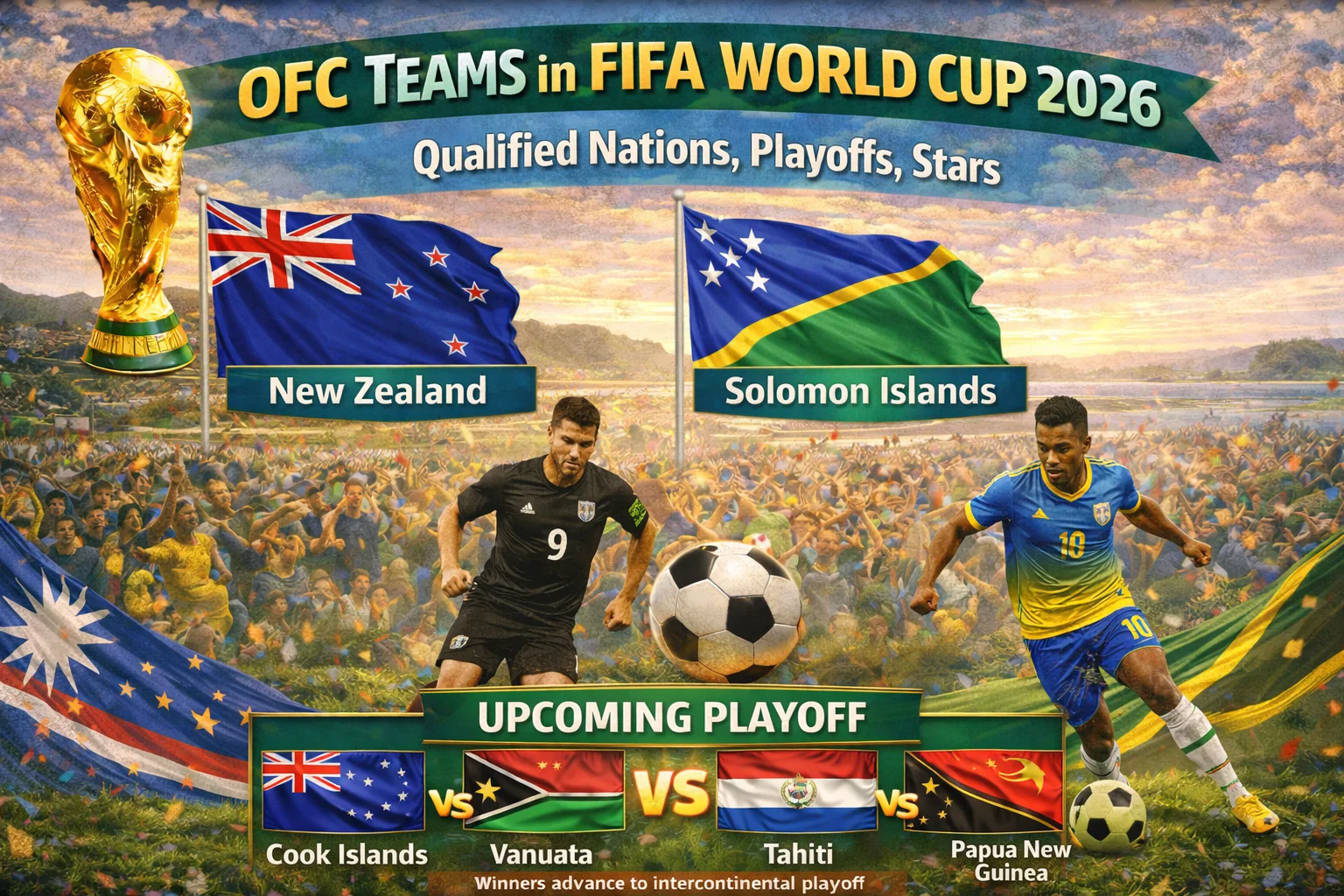
The inter-confederation play-offs include six teams and award the final World Cup spots. The tournament is scheduled for March 2026. Two teams will qualify through this mini-bracket.
Which confederations are involved
The play-offs include six teams: two from Concacaf and one each from AFC, CAF, CONMEBOL, and OFC. New Caledonia represent Oceania as the OFC runner-up.
How the seeded bracket works
The format is built around FIFA’s men’s world ranking, with seeding details connected to the ranking window used for that purpose.
- The four lowest-ranked teams play first.
- The two winners then face the two highest-ranked teams.
- The two final winners qualify for the World Cup.
For New Caledonia, the big idea is simple. This is not one impossible tie against a single giant. It is a route where one upset can change a nation’s history, and two wins can send them to the biggest tournament in football.
The six-team play-off field (as presented in this cycle)
In this cycle’s play-off lineup, New Caledonia are joined by Bolivia, DR Congo, Iraq, Jamaica, and Suriname. The structure turns it into compact tournament football, where game states swing fast and emotions run high.
The stars who define OFC’s 2026 story
Oceania teams often win through structure, set pieces, and moments. That makes star power look different. It is less about having eleven famous names and more about having two or three players who can decide a close match with one action.
New Zealand key players to watch
New Zealand’s squad blends European-based experience with homegrown intensity. Their qualification run also highlighted the importance of roles: a striker who finishes chances, midfielders who control rhythm, and wide players who feed the box.
Chris Wood
Chris Wood is New Zealand’s captain and a central figure in how they play. He scored heavily in the campaign, including the hat-trick against Fiji in the semifinal. New Zealand’s attack often revolves around his timing, aerial threat, and finishing.
Why he matters in 2026:
- He creates constant danger in the air.
- He turns half-chances into goals.
- He makes set pieces feel like penalties, because one delivery can decide a match.
Sarpreet Singh
New Zealand’s creativity often depends on who can receive under pressure and deliver the final pass. Singh’s name comes up often in that role. When he is sharp, New Zealand’s attack becomes harder to read, because the ball moves into dangerous spaces faster.
Marko Stamenic and Joe Bell
Tournament football punishes teams that cannot control rhythm. Stamenic and Bell give New Zealand steadiness through shielding, circulation, and positioning. Their value is sometimes quiet, but it shows when the match tightens and the opponent pushes.
Liberato Cacace
Cacace is presented in this cycle as a key presence from left-back, combining defensive work with attacking contributions. For New Zealand, the wide areas matter because Wood needs service and second balls. When wide players push up with control, New Zealand look like a team built for tournament football.
Elijah Just
Just is part of the new wave and delivered in key moments, including a goal in the final. He represents the type of player who can grow into the tournament as confidence rises.
Ryan Thomas
Ryan Thomas was highlighted by coach Darren Bazeley as an important addition after returning from a long injury-affected period. If he is healthy, he adds composure and experience in midfield areas, especially in matches where decision-making becomes the difference.
New Caledonia players who can swing a play-off
New Caledonia’s strengths lean toward collective energy, quick combinations, and fearless attacking moments. In a one-off play-off match, personality matters. Belief matters. Calm leadership matters even more.
César Zeoula
Zeoula is widely recognized as New Caledonia’s most capped player and a long-term leader around the national team setup. In tight matches, experience helps a squad stay organized when emotions rise.
Georges Gope-Fenepej
Gope-Fenepej stands out as a direct, game-changing attacker. His brace against Tahiti in the knockout window shows what he can do when space opens. In a play-off setting, one run, one finish, or one set-piece moment can flip the whole story.
The supporting cast
Play-off tournaments are compact. Legs matter. Options matter. New Caledonia’s pool mixes local-league contributors with France-based experience, creating a blend that can help them handle travel stress and match intensity.
OFC teams that impressed even without qualifying
The most important long-term shift in Oceania is that qualification now feels meaningful across the region. That raises the standard. It also pushes teams to invest in structure, player pathways, and preparation.
Fiji and Solomon Islands
These teams are presented here as organized and fearless, especially in midfield. They are no longer treated as simple group-stage opponents. Their progress raises the overall level of OFC, which helps the region’s top teams arrive sharper when they face global opponents.
Tahiti and Papua New Guinea
Tahiti and Papua New Guinea continue to produce athletic and technical profiles that can cause problems in single matches. When defensive structure improves, these nations can surprise stronger teams and make qualifying campaigns harder for everyone.
What OFC teams need to succeed at World Cup 2026
A World Cup is not only about talent. It is about habits that hold under pressure, across travel, fatigue, and unfamiliar opponents.
Managing the first 20 minutes
Against elite opponents, the opening phase is often the most dangerous. OFC teams need to survive without panicking. Conceding early can force game states that are hard to chase, especially for teams built around structure and moments.
Set-piece excellence on both ends
Set pieces remain Oceania’s most reliable equalizer. New Zealand, in particular, can punish opponents when deliveries are clean and second balls are attacked. At the same time, defending set pieces becomes non-negotiable at World Cup level.
Squad availability and travel planning
Many OFC players travel long distances and play across different leagues. Managing fatigue, recovery, and camp timing becomes a competitive advantage, not a background detail. In a tournament setting, small planning edges can protect performance.
OFC 2026 status and pathways
| Category | What it means for 2026 | Current OFC situation |
|---|---|---|
| Direct qualification | One team qualifies automatically | New Zealand qualified (March 24, 2025) |
| Second chance | One team enters inter-confederation play-offs | New Caledonia in play-offs (March 2026) |
| Play-off structure | Seeded mini-bracket | Six teams, two spots available |
| Defining scorer | Shows attacking efficiency in big moments | Chris Wood delivered major goals in the run |
Storylines to follow heading into the tournament
Oceania’s 2026 chapter carries pressure and opportunity at the same time. The new structure gives OFC teams a path, but it also raises expectations.
Can New Zealand win their first World Cup match?
New Zealand’s 2010 campaign is remembered for going unbeaten in the group stage, but not advancing. The 2026 squad carries a clear target: earn a first World Cup win and push toward a real knockout-round run. The expanded format adds opportunity, but the team still has to take it.
Will New Caledonia turn the play-off into history?
A two-match play-off route is difficult, but it is realistic. If New Caledonia land the right matchup and stay disciplined, they can push Oceania toward a two-team World Cup presence. For a nation like New Caledonia, that would be a defining moment.
Is this the start of a stronger Oceania pipeline?
The biggest long-term impact is belief. When qualification is possible, young players believe in international careers. Federations invest earlier. Camps become more serious. Over time, that can lift the entire region’s standard and widen the gap between participating and competing.
FAQs
New Zealand qualified directly by winning the OFC third round on March 24, 2025.
Yes. OFC has one direct slot and one inter-confederation play-off slot, so two OFC teams are possible.
New Caledonia reached the inter-confederation play-offs as the OFC runner-up.
They are scheduled for March 2026 and will decide the final World Cup places.
For New Zealand, Chris Wood leads the story up front, with Sarpreet Singh and other key names shaping chances. For New Caledonia, César Zeoula and Georges Gope-Fenepej stand out as major influences.
Final Takeaway
OFC teams in FIFA World Cup 2026 are not framed by miracles anymore. New Zealand arrive as deserved qualifiers after a decisive campaign that peaked in a 3-0 final win on March 24, 2025. New Caledonia still have a defined route through the March 2026 inter-confederation play-offs, where two wins can deliver history.
Most importantly, the new qualification reality changes what comes next. When a pathway is real, preparation becomes sharper, belief becomes louder, and Oceania stops asking if it belongs on the global stage.