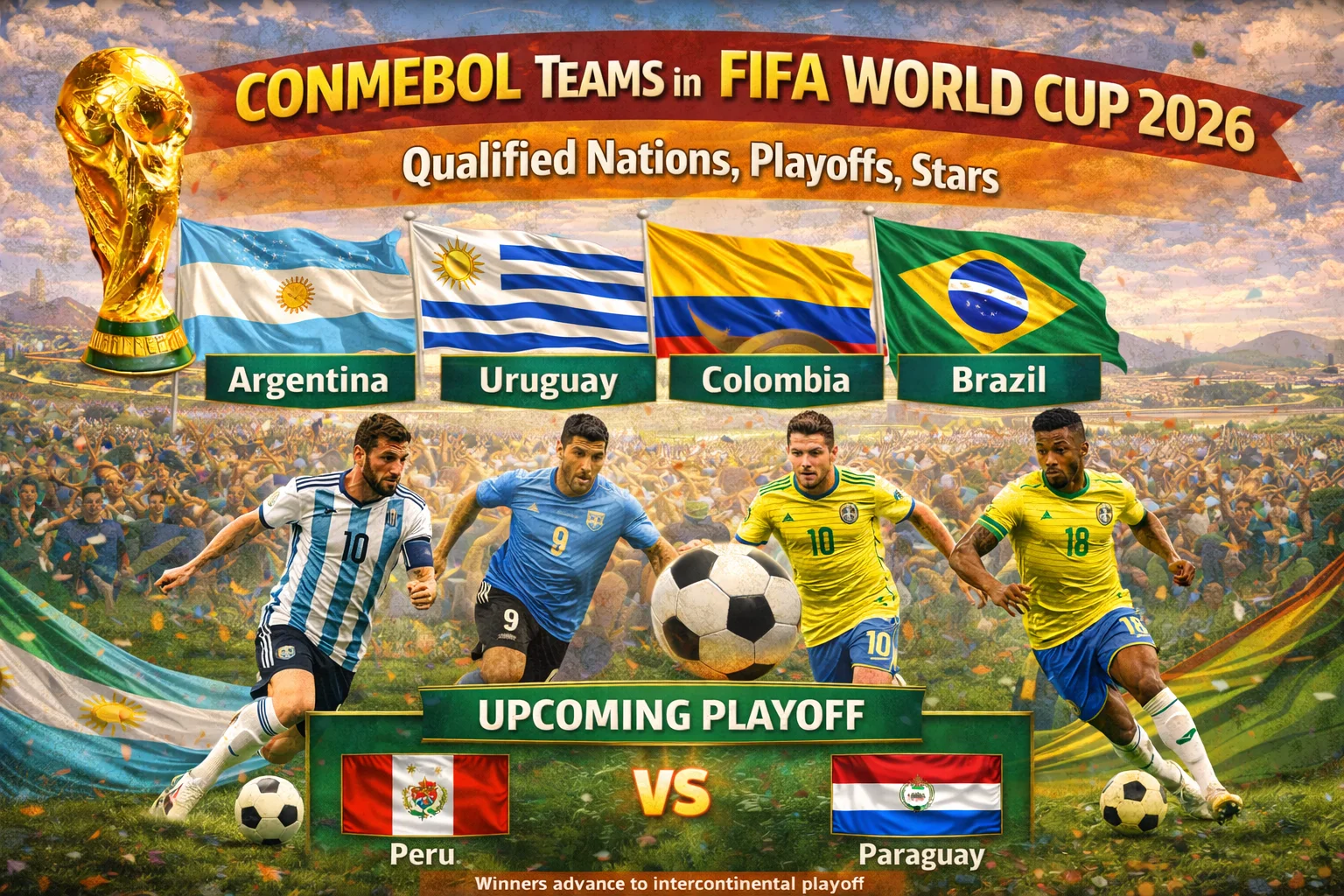
CONMEBOL Teams in FIFA World Cup 2026, Qualified Nations, Playoffs, Stars, Updates
CONMEBOL teams are often the heartbeat of the World Cup. In 2026, that feeling is even stronger because the tournament expanded to 48 nations and will be hosted across Canada, Mexico, and the United States. South American football arrives with history, pressure, and elite talent, so expectations never stay quiet for long.
Even with more places available, qualifying in South America remains brutal. Every away trip can feel like a test of identity. Teams fight opponents, travel demands, difficult environments, and stadium intensity. Over 18 matchdays, that pressure does not stop. The teams that survive usually arrive sharper and more prepared for tournament moments.
This guide brings everything into one place: how many CONMEBOL spots exist, who qualified directly, why Bolivia landed in the play-off path, which stars can decide games, and what trends from qualifying may carry into the World Cup.
How many CONMEBOL spots are available for the 2026 World Cup?
CONMEBOL received six direct qualification places for the 2026 finals, plus one additional place through an inter-confederation play-off route. That means up to seven South American teams can still reach the tournament.
The extra place did not make the race easy. The round-robin format still punishes inconsistency. With 18 matchdays, a slow start can haunt a team, while a late surge can still rescue a campaign. The long schedule tested depth, planning, and emotional control as much as it tested talent.
Quick breakdown of the CONMEBOL qualification outcome
Here is how the final table translated into World Cup tickets and the play-off path:
| Finish | Team | Status for World Cup 2026 |
|---|---|---|
| 1 | Argentina | Qualified (direct) |
| 2 | Ecuador | Qualified (direct) |
| 3 | Colombia | Qualified (direct) |
| 4 | Uruguay | Qualified (direct) |
| 5 | Brazil | Qualified (direct) |
| 6 | Paraguay | Qualified (direct) |
| 7 | Bolivia | Inter-confederation play-offs |
| 8 | Venezuela | Eliminated |
| 9 | Peru | Eliminated |
| 10 | Chile | Eliminated |
Overview of the CONMEBOL qualification process and timeline
The qualification journey began in September 2023 and concluded by September 2025, using a round-robin format among ten nations. Each team played 18 matches, home and away, across a demanding calendar. The structure was simple, but the challenge was constant: earn points, avoid collapses away from home, and stay stable during the moments when confidence wobbles.
A two-year campaign also meant squads changed as the schedule moved forward. Form shifted, injuries mattered, and small margins decided table positions. Certain venues added their own pressure, including altitude and intense atmospheres. In CONMEBOL, those factors can shape not only results, but also how teams learn to manage games.
Qualified CONMEBOL nations: what each team brings to 2026
The six qualified nations are not just big names. They arrive with clear identities, and each one matches up differently against global styles. Some lean into control and tempo. Others thrive on transitions, wide threats, or compact defending. That variety is why South America can look unpredictable and dangerous when the World Cup begins.
Argentina
Argentina finished first and enter 2026 with the biggest target on their backs. Their advantage is not only talent, but also control of tempo. They can win ugly, which often separates good teams from title-level teams in knockout football.
The key question is timing: when to slow a match down, and when to press for a second goal. If Argentina read those moments well, tight matches can become manageable. Their leadership core also matters in tournaments, because calm decision-making often decides one-goal games.
Ecuador
Ecuador finished second and looked like a modern international side built around speed and structure. They defended with discipline and conceded very little during qualifying. Their approach avoided chaotic swings that can ruin campaigns.
In 2026, Ecuador’s edge can be how quickly they turn recoveries into direct attacks. When they play cleanly through the middle third, they force opponents to retreat fast. That opens space for late runs and second balls near the box, which can decide World Cup group matches.
Colombia
Colombia qualified directly and scored heavily compared to most rivals. They can look unstoppable when their wingers and attacking midfielders connect early and create quick combinations near the area.
For 2026, the mission is consistency across different game scripts. If Colombia stay composed after conceding first, they can become a true deep-run threat. Squad depth also matters more in a bigger tournament, and Colombia’s profile fits that reality well.
Uruguay
Uruguay qualified directly and bring a style that can shine in knockout settings. They are comfortable turning matches into physical contests while still having enough midfield quality to compete for possession.
Their identity is clear: raise the pace, sustain intensity, and make opponents feel every duel. In a World Cup, that approach can be valuable because it travels well across venues and climates. Uruguay’s ability to stay strong in tight games keeps them dangerous when groups get tense.
Brazil
Brazil qualified directly after early inconsistencies, then recovered with a stronger finish. Their depth allowed rotation over the long schedule, helping them maintain performance levels across the campaign.
Brazil’s success in 2026 will depend on clarity and balance. When the midfield protects transitions, attackers can take risks without breaking team shape. If that balance holds, Brazil’s ceiling stays as high as anyone’s.
Paraguay
Paraguay qualified directly and did it with compact defending, relentless competitiveness, and strong game management. They did not need to dominate possession to earn results. They stayed difficult to break down and focused on staying alive in matches.
In 2026, Paraguay could be the team nobody wants in their group. Group-stage survival can come down to avoiding one bad 15-minute spell. If Paraguay keep matches tight, one set-piece can swing everything.
Final standings and recent updates from the South American qualifiers
The qualifiers are presented as concluded with Argentina leading, followed by Ecuador, then a tight battle among Colombia, Uruguay, Brazil, and Paraguay. The table below reflects the full set of results and shows how fine the margins were in places.
| Position | Team | Played | Wins | Draws | Losses | Goals For | Goals Against | Goal Difference | Points |
|---|---|---|---|---|---|---|---|---|---|
| 1 | Argentina | 18 | 12 | 2 | 4 | 31 | 10 | +21 | 38 |
| 2 | Ecuador | 18 | 8 | 8 | 2 | 14 | 5 | +9 | 29 |
| 3 | Colombia | 18 | 7 | 7 | 4 | 28 | 18 | +10 | 28 |
| 4 | Uruguay | 18 | 7 | 7 | 4 | 22 | 12 | +10 | 28 |
| 5 | Brazil | 18 | 8 | 4 | 6 | 24 | 17 | +7 | 28 |
| 6 | Paraguay | 18 | 7 | 5 | 6 | 19 | 16 | +3 | 26 |
| 7 | Bolivia | 18 | 6 | 4 | 8 | 20 | 25 | -5 | 22 |
| 8 | Venezuela | 18 | 4 | 7 | 7 | 15 | 20 | -5 | 19 |
| 9 | Peru | 18 | 3 | 5 | 10 | 10 | 25 | -15 | 14 |
| 10 | Chile | 18 | 3 | 3 | 12 | 11 | 31 | -20 | 12 |
Bolivia’s path
Bolivia finished seventh, which earned a place in the inter-confederation play-offs rather than direct qualification. This play-off tournament is scheduled for March 2026 in Mexico and features six teams from different confederations competing for the final two World Cup places.
That makes Bolivia’s route simple to describe and hard to execute. It is not about building a long run of form. It is about surviving a short, intense window where small moments can decide everything.
What Bolivia must do to qualify
Win the moments, not just the match
Play-off football is often decided by transitions, set-pieces, and nerves. Bolivia must treat every dead-ball situation like a real scoring chance because open-play dominance is rarely guaranteed in one-off games.
Control the emotional swings
In play-offs, conceding first changes everything. Bolivia must stay calm, keep shape, and avoid desperate fouls around the box. A single mistake can turn a dream into regret.
Manage stamina and recovery demands
These tournaments compress recovery time. Smart rotation and disciplined pressing can matter as much as pure quality. Bolivia’s ability to stay organized late in games may decide their fate.
If Bolivia qualify, they become a wildcard because they are used to extreme home conditions. In a neutral-site play-off, they must show a more universal style and handle pressure in a different way.
CONMEBOL stars to watch in 2026
South America never arrives without famous names, and 2026 also highlights a generational overlap. That blend can create unpredictable chemistry, which is one reason CONMEBOL teams remain so difficult to read.
Headline icons who still tilt tournaments
Lionel Messi (Argentina)
Messi remains a leading figure in the qualification narrative. His presence changes how opponents defend. Even when quiet, he pulls defensive shape toward him and opens space for others.
Vinícius Júnior and Brazil’s attacking weapons
Brazil’s winger depth can overwhelm teams that defend narrow. If Brazil create isolation in wide areas, they can turn a 0–0 match into a 2–0 win quickly.
Federico Valverde and Uruguay’s engine room
Uruguay’s midfield intensity is often why they look tournament ready. They can raise the pace, then sustain it, which breaks opponents over time.
Emerging and prime-age difference makers across the region
Ecuador’s athletic core
Ecuador’s best weapon is how fast they recover and counter. Their runners can decide matches late, especially when defenses tire.
Colombia’s wide threats
Colombia’s attackers can produce quick combinations near the box. Against compact World Cup defenses, speed of thought matters as much as speed of feet.
Paraguay’s set-piece targets
Paraguay’s route to upsets often runs through corners and free kicks. In tight groups, that is not a small edge. It can be a full strategy for survival.
Top performers table from qualifying
| Player Name | Nation | Position | Key Strengths | Qualifier Goals |
|---|---|---|---|---|
| Lionel Messi | Argentina | Forward | Dribbling, Vision | 8 |
| Luis Diaz | Colombia | Winger | Speed, Finishing | 7 |
| Miguel Terceros | Bolivia | Midfielder | Creativity, Shooting | 7 |
| Salomon Rondon | Venezuela | Striker | Aerial Ability, Hold-up Play | 6 |
| Enner Valencia | Ecuador | Forward | Positioning, Leadership | 6 |
This snapshot shows the range of profiles CONMEBOL brings to 2026: creators, runners, finishers, and players who can decide a match with one moment.
Key tactical trends from CONMEBOL qualifying that carry into 2026
CONMEBOL qualifying is a long stress test. It exposes what teams trust when pressure builds, and those habits often reappear at the World Cup.
Compact defending is back because transitions decide games
Many teams protected central zones and invited crosses rather than allowing through balls. One clean pass through the middle can end a match at the highest level. That is why shape and spacing became so important across the campaign.
Away-game management separates contenders from chaos
The top teams consistently avoided disasters away from home. They did not always win, but they rarely collapsed. In a World Cup, that same maturity often wins groups and protects a team from early exits.
Depth matters more in a 48-team tournament
With more teams, the tournament environment still demands rotation, travel management, and the ability to keep intensity after substitutions. Teams with stronger second units can protect leads, chase games without losing shape, and survive the physical demands of a long month.
What happens next for CONMEBOL teams before the World Cup begins?
For the six qualified teams, the priority shifts from results to readiness. That means building chemistry across units, rehearsing tactical plans, and shaping the squad so it can handle different match scripts.
For Bolivia, everything centers on March 2026 and the play-off tournament in Mexico. One strong week can rewrite their entire cycle.
The wider South American storyline is familiar. Expectations rise. Criticism gets louder. Teams that stay stable usually benefit. World Cups rarely reward the noisiest team. They reward the one that handles pressure best.
FAQs
Argentina, Ecuador, Colombia, Uruguay, Brazil, and Paraguay qualified directly from CONMEBOL.
No. Bolivia finished seventh and earned a spot in the inter-confederation play-offs instead of direct qualification.
CONMEBOL has six direct places, plus one additional pathway through the inter-confederation play-offs, for a total route of seven teams.
They are scheduled for March 2026 in Mexico and will decide the final two World Cup places.
Because every team plays home and away across 18 matchdays, and travel plus demanding environments create constant pressure.