CONCACAF Teams in FIFA World Cup 2026, Qualified Nations, Playoffs, Key Stars & What’s Next
The FIFA World Cup 2026 is historic for CONCACAF because it is hosted in North America. That reality changes everything for the region. It boosts attention, raises expectations, and increases the number of realistic contenders.
In simple terms, CONCACAF can send more teams than ever. Not every spot is a guaranteed ticket. Some places are earned directly, while others depend on a high-pressure playoff route. That mix creates a new kind of tension for supporters, because qualification can be decided by long group campaigns or by one knockout match where a single mistake ends the dream.
This guide brings together the full picture how CONCACAF places work, which nations are already in, who is still fighting, and the players fans should know heading toward 2026.
How Many CONCACAF Spots Are Available for World Cup 2026?
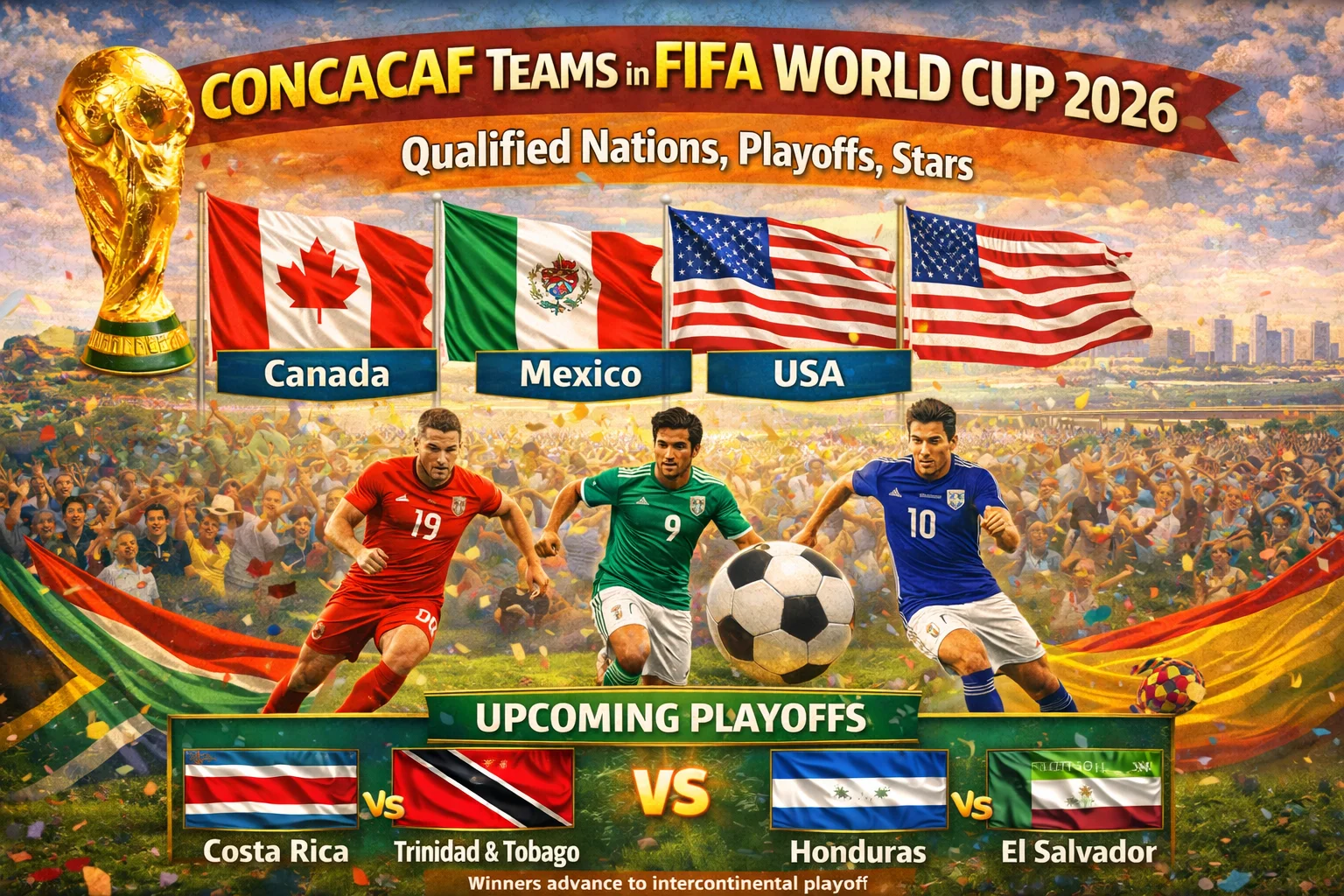
CONCACAF has a pathway that mixes automatic host berths with qualification results. The region can send up to eight teams to the tournament if playoff teams also qualify.
CONCACAF World Cup 2026 slots explained
| Category | Number of teams | What it means |
|---|---|---|
| Automatic host | 3 | Canada, Mexico, USA qualify automatically |
| Direct qualification Slots | 3 | Earned through CONCACAF qualifying |
| FIFA Play-Off Tournament Slots | 2 | Earned through CONCACAF qualifying, then played globally |
| Maximum possible CONCACAF teams | 8 | If both playoff teams qualify |
This structure matters because it rewards strong teams, but also gives emerging nations a real chance. The playoff route can be brutal, because it is a short tournament format. A strong qualifying campaign can still end with heartbreak if a team lands in a one-off situation against unfamiliar opposition.
Overview of the CONCACAF Qualification Process for 2026
The qualification journey has been intense, and the tournament’s 48-team expansion reshaped the region’s opportunity. The process unfolded in multiple rounds, starting with preliminary matches among lower-ranked sides, then moving into group formats that narrowed the field.
In the second round, teams competed in groups, and winners and runners-up progressed. The final round was played in a round-robin style where the top teams earned direct qualification. The best two third-placed finishers moved to playoffs.
This cycle felt different for three main reasons:
The hosts changed the balance
With Canada, Mexico, and the United States already qualified, the direct spots opened up. That created a genuine opportunity for nations that usually fight for fourth place.
More belief across the Caribbean and Central America
Teams like Curaçao and Haiti showed that tactical structure and player development can overcome ranking gaps. That belief spreads quickly across a confederation.
Better organization and clearer pathways
The format was easier to understand and follow. That transparency helped fans track progress, and it helped smaller federations plan properly.
Qualified CONCACAF Teams in FIFA World Cup
As of the latest confirmed updates in the information here, these CONCACAF nations have already booked their places. The qualified list blends co-hosts, familiar tournament nations, and new faces that turned qualifying into a defining moment.
Confirmed qualified teams from CONCACAF
| Team | How they qualified | Why it’s notable |
|---|---|---|
| Canada | Host | Automatic entry as co-host |
| Mexico | Host | Automatic entry as co-host |
| United States | Host | Automatic entry as co-host |
| Panama | Direct qualification | Back to the World Cup for a second appearance |
| Curaçao | Direct qualification | First-ever World Cup, and a historic small-nation qualifier |
| Haiti | Direct qualification | First World Cup since 1974, despite huge challenges |
Curaçao’s qualification stands out as one of the region’s biggest stories. Haiti’s return also carries weight, because the team endured major instability and still delivered results when it mattered most.
Co-Hosts Already In
Hosting changes preparation. These three teams do not need qualifiers, so the focus shifts toward building a tournament-ready group, testing systems, and managing expectations.
Canada as a co-host and rising force
Canada enters as a co-host and builds on recent achievements. Their squad blends youth and experience effectively. Playing at home can lift energy and confidence, especially when matches become tight and crowd momentum turns into an extra edge.
Mexico’s legacy and home advantage
Mexico, another co-host, carries a rich history in the World Cup and aims to use home advantage for a deep run. The pressure is real, because fans expect more when the tournament is on familiar soil. Mexico’s goal becomes turning that pressure into purpose.
United States leading the North American charge
The United States completes the hosting trio with a focus on youth development and squad depth. Home stadiums can create an intense atmosphere, and that environment often rewards teams that manage emotion well and stay disciplined in key moments.
Panama
Panama often looks comfortable in tense matches. They defend with discipline, compete hard in midfield, and rarely panic under pressure.
Key strengths Panama can bring to World Cup 2026
- Strong midfield control and physical balance
- Quick attacking phases that punish mistakes
- A team identity that travels well in tournaments
Panama may not be the flashiest team, but they can frustrate bigger nations. That makes them dangerous in a group stage, where one match can change the entire table.
Panama key stars to watch
- Adalberto “Coco” Carrasquilla: A modern midfield engine who links everything together
- Ismael Díaz: A direct attacker who can decide games with one moment
- A battle-tested core that understands CONCACAF intensity
When games tighten, Panama’s ability to stay compact and compete for second balls becomes valuable. Their profile fits the kind of team that can earn points without needing perfect conditions.
Curaçao
Curaçao’s rise is not accidental. The national team benefited from diaspora talent and stronger organization. They embraced a clear tactical plan, which helped them stay stable in pressure matches.
What makes Curaçao unique at World Cup 2026
- Their first appearance on the biggest stage
- A squad filled with players developed in strong European systems
- A fearless underdog identity that can surprise opponents
In a World Cup group, underdogs need belief and a defensive foundation. Curaçao have both, based on the way they managed qualifying pressure.
Curaçao players to know
- Leandro Bacuna: A leader and an experienced presence in the squad
- Eloy Room: A veteran goalkeeper profile, important in close games
- Several dual-national players who bring maturity and composure
Curaçao’s challenge will be handling the jump in spotlight. At the same time, a first appearance can free a team from fear. That can make them unpredictable.
Haiti
Haiti’s qualification is one of the most powerful stories of this cycle. The team overcame serious off-field barriers, including instability that affected normal preparations.
Yet, the squad stayed focused. They found goals. They defended leads. They handled pressure.
Haiti’s biggest advantages heading into 2026
- A hungry squad with a point to prove
- Strong spirit and unity in difficult conditions
- Attackers who can convert chances quickly
Haiti will likely be labeled an underdog. Underdogs with real goal threats are never comfortable opponents, because a single chance can flip a match.
Haiti key stars to watch
- Duckens Nazon: A proven scorer who has delivered in big moments
- Frantzdy Pierrot: A physical forward who can trouble defenders
- Supporting attackers who thrive in transitions
Haiti’s identity in big tournaments can lean on intensity and purpose. When a team has fought through instability just to arrive, the mindset can be hard to break.
The FIFA Play-Off Tournament CONCACAF Teams Still Fighting for a Ticket
Not every strong CONCACAF side qualified directly. Two teams earned a second chance through the FIFA Play-Off Tournament.
CONCACAF teams in the FIFA Play-Off Tournament
| Team | What they earned | What happens next |
|---|---|---|
| Jamaica | Play-Off Tournament place | Must win playoff games to qualify |
| Suriname | Play-Off Tournament place | Must win playoff games to qualify |
This playoff tournament includes six teams total, drawn from multiple confederations. Only two World Cup spots are available. One bad match can end the dream instantly.
Why the Play-Off Tournament is so dangerous
It is not a long group campaign. It is a short, knockout-style challenge. Momentum matters, injuries matter, and discipline matters even more.
That is why Jamaica and Suriname will lean on tight defending, fast transitions, and set pieces. Those moments often decide single-match outcomes, especially when teams meet opponents they do not face regularly.
Jamaica
Jamaica has enough quality to qualify. The issue is not talent. The issue is execution in must-win matches.
Jamaica: what could decide their playoff run
- Defensive concentration, especially late in matches
- Finishing chances, because playoffs rarely offer many
- Managing emotion, because pressure can create mistakes
Jamaica often produce athletic, powerful performances. If they stay organized, they can beat anyone in a one-off scenario. In playoffs, the team that stays calm tends to control the story.
Suriname
Suriname have become tougher and more structured. They can be dangerous in transition, especially when opponents push forward.
To qualify, Suriname will need disciplined defending and ruthless counter attacks. In a playoff format, that approach works. One strong defensive performance, one clean break, one set-piece finish, and the entire path changes.
Star Players Shining for CONCACAF Teams in World Cup 2026
A World Cup is also a stage for individuals. These names shape expectations, because one player can carry a match with a sprint, a pass, a save, or a finish.
Headline stars from the co-hosts
- Alphonso Davies (Canada): Speed, skill, and leadership on the left side
- Hirving Lozano (Mexico): Pace and finishing that can open games
- Christian Pulisic (United States): Creativity and decision-making in key areas
These players are central because home tournaments create moments where leaders must deliver under massive attention.
Key stars from the direct qualifiers and playoff teams
- Duckens Nazon (Haiti): Goal scoring presence and big-moment history
- Coco Carrasquilla (Panama): Midfield engine and balance
- Leon Bailey (Jamaica): Dribbling speedster with match-changing ability
- Juninho Bacuna (Curaçao): Dynamic midfielder in a new World Cup story
Different teams need different kinds of leaders. Some need a calm midfielder to control rhythm. Some need a forward who finishes half chances. Some need a winger who forces defenders to panic. That mix is what makes CONCACAF teams interesting heading into 2026.
Top Scorers and Trending Names in CONCACAF Qualifying
Goals change everything in qualification. A single strike can decide a group. It can also decide a nation’s history.
Notable scoring leaders and attackers to track
| Player | Nation | Why fans watched them |
|---|---|---|
| Duckens Nazon | Haiti | Delivered key goals on the road to qualification |
| Óscar Santis | Guatemala | One of the most productive scorers in the cycle |
Even when a player’s nation is not World Cup-bound in this snapshot, form can shape the qualifying narrative and raise a player’s profile.
What Fans Should Expect From CONCACAF Teams at World Cup 2026
CONCACAF teams usually bring intensity, speed, and a physical edge. In 2026, expect an even stronger showing for three reasons.
More experience in top leagues
More CONCACAF players are now regulars in Europe and competitive leagues across the Americas. That improves game management and tactical discipline.
More tactical flexibility
Teams are no longer locked into one style. They can press, sit deep, or switch shapes mid-match. That adaptability matters in World Cup groups.
More belief across the region
When teams like Curaçao and Haiti qualify, it changes the mindset. Smaller nations stop playing scared. That shift creates dangerous opponents, because they stop accepting the idea that “survival” is the goal. You can check also CAF Teams in FIFA World Cup 2026
Who’s In, Who’s Still Fighting
Here is the clean snapshot for fans who want clarity.
CONCACAF World Cup 2026 status table
| Status | Teams |
|---|---|
| Qualified (hosts) | Canada, Mexico, United States |
| Qualified (direct) | Panama, Curaçao, Haiti |
| In FIFA Play-Off Tournament | Jamaica, Suriname |
FAQs
Canada, Mexico, and the United States qualified as hosts. Panama, Curaçao, and Haiti qualified directly through CONCACAF qualifying.
CONCACAF can send up to eight teams. That includes three hosts, three direct qualifiers, and up to two playoff winners.
It is a multi-confederation playoff involving six teams, competing for two World Cup spots. Jamaica and Suriname represent CONCACAF there.
Yes. Curaçao’s qualification marks their first World Cup appearance, which is a major milestone for the nation.
Look for leaders and creators like Coco Carrasquilla for Panama and Duckens Nazon for Haiti. Also watch Jamaica’s and Suriname’s playoff leaders.