Germany World Cup Stats, Goals, Titles and All-Time Records

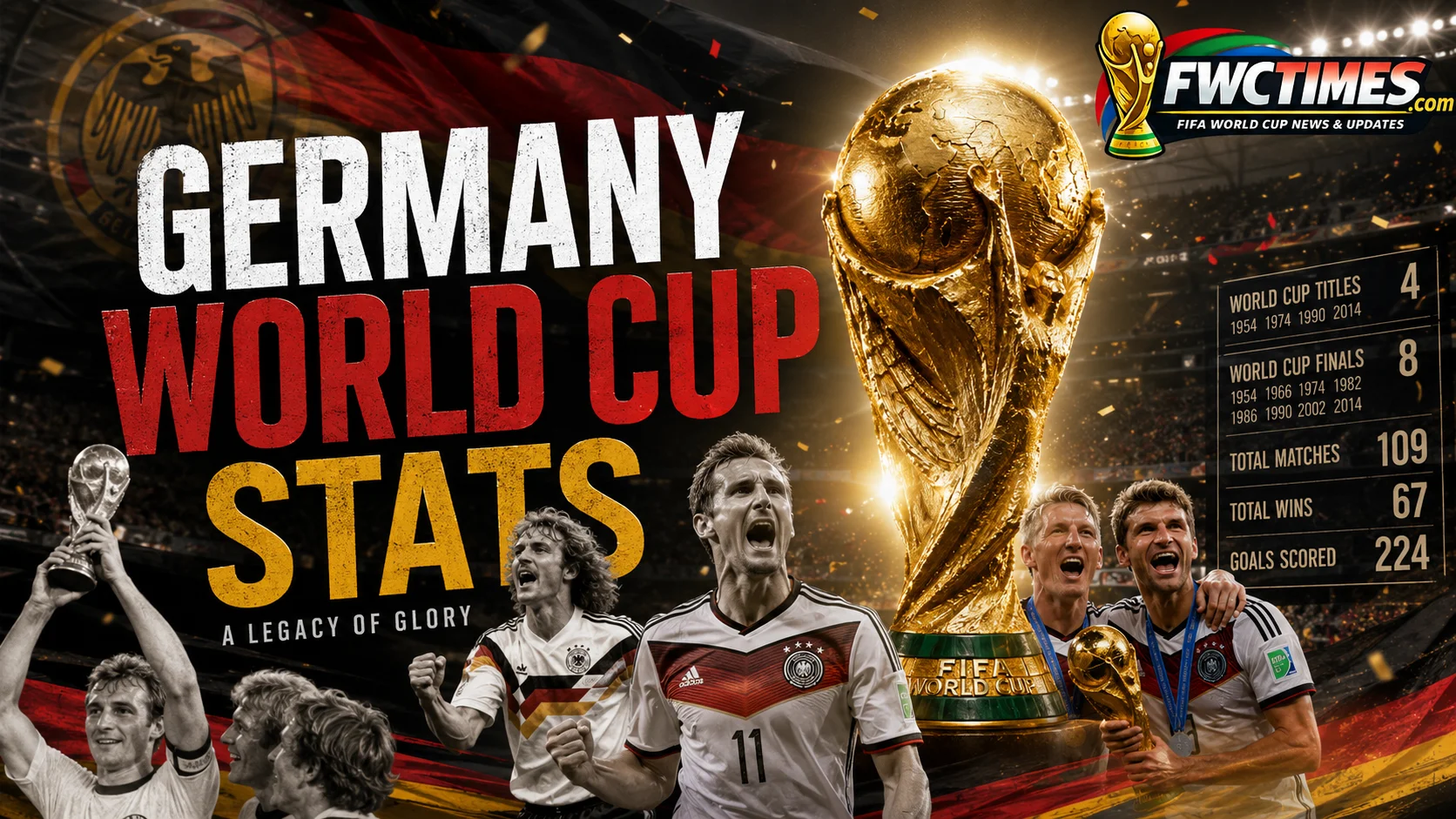
International football has seen many dominant nations over the last century. German football represents one of the most successful histories in the sport. This article covers the Germany World Cup stats to show their incredible achievements. They have reached the final match eight times in their history.Germany has won the tournament four times. They secured titles in 1954, 1974, 1990, and 2014. Only Brazil has won more championships in the history of the sport.
Germany World Cup Stats and Performance
Tracking German team statistics reveals a story of incredible consistency and tournament success. They hold the record for the most podium finishes in tournament history. The complete tournament record of the German national team is presented here.
| Tournament | Finish | Matches | Wins | Draws | Losses | Goals For | Goals Against |
|---|---|---|---|---|---|---|---|
| 2022 | Group Stage | 3 | 1 | 1 | 1 | 6 | 5 |
| 2018 | Group Stage | 3 | 1 | 0 | 2 | 2 | 4 |
| 2014 | Champions | 7 | 6 | 1 | 0 | 18 | 4 |
| 2010 | Third Place | 7 | 5 | 0 | 2 | 16 | 5 |
| 2006 | Third Place | 7 | 5 | 1 | 1 | 14 | 8 |
| 2002 | Runners-up | 7 | 5 | 1 | 1 | 14 | 3 |
| 1990 | Champions | 7 | 5 | 2 | 0 | 15 | 5 |
The table highlights the statistical dominance of Germany across different tournament eras. They have played more matches than any other European nation. Their goalscoring record is second only to Brazil. German teams have consistently qualified for the knockout stages.Their performance is built on tactical discipline and physical preparation. They have consistently reached the final four of the competition. German squads are known for raising their level in tournament environments. Their statistical history is a testament to this resilience.German players have also won numerous individual awards. Oliver Kahn won the Golden Ball for his performance in 2002. Thomas Müller won the Golden Boot in 2010. These achievements reflect the collective strength of the squad.
Historic Titles of German Football
Germany won their first title in Switzerland in 1954. That match is famous as the Miracle of Bern. They defeated a legendary Hungarian team in the final. This victory started a golden era for the nation.Their second title came on home soil in 1974. Led by Franz Beckenbauer, they defeated the Netherlands in the final. They added their third title in Italy in 1990, defeating Argentina in Rome. Their fourth title was secured in Brazil in 2014.That 2014 campaign included a historic seven-one victory over the hosts. Germany showed tactical brilliance throughout the tournament. They remain one of the most respected teams in history. They have built their success on teamwork.The 2014 team was noted for its incredible technical speed. Midfielders controlled the tempo of matches with precision. Joachim Löw organized the squad to play flexible possession football. Germany deservedly lifted their fourth world trophy.Their historic victories are celebrated by fans across the globe. Each title reflects a different tactical approach to the game. They have adapted their style to meet modern physical demands. German football remains a global benchmark.
Miroslav Klose Goalscoring Record
Miroslav Klose stands as the top scorer in World Cup history. The German striker scored sixteen goals across four tournaments. He broke the previous record held by Brazilian Ronaldo in 2014.His goals were scored through clinical finishing and aerial dominance. He scored five goals in 2002 and five goals in 2006. He added four goals in 2010 and two goals in 2014. He was famous for his acrobatic goal celebrations.He remains a model of professionalism and dedication for young forwards. His positioning in the penalty area was exceptional. He scored headers, tap-ins, and crucial knockout goals. Klose set a benchmark that will be difficult to break.He was highly respected for his fair play on the pitch. His longevity allowed him to compete at the top level for over a decade. He played with great discipline in every campaign. Klose remains a legendary figure.His performance under pressure was always outstanding. He scored in crucial matches when the team needed goals. His teammates trusted his ability to convert half-chances. Klose remains a hero for German fans.
Lothar Matthäus Longevity Record
Lothar Matthäus holds the record for the most matches played by a German player. He competed in twenty-five matches across five different editions. He captained the team to their 1990 victory.He played as a box-to-box midfielder and later as a sweeper. His tactical versatility allowed him to remain at the top level. He competed against the finest players of his era, including Diego Maradona. His leadership was a key asset.Matthäus represents the traditional qualities of German football. He was physically strong, tactically smart, and mentally resilient. His record of five tournaments shows his incredible longevity. He remains a legend of the sport.His battles in midfield were always highly intense. He was a complete leader who demanded excellence from teammates. Matthäus was honored with individual awards during his career. He is a historic German captain.His tactical understanding of the game was exceptional. He could control the tempo of matches from deep positions. His longevity is a model for modern professional players. Matthäus remains a central figure in football.
Biggest Wins and Defeats in History
Germany has recorded some of the largest victories in tournament history. Their biggest win was an eight-zero triumph over Saudi Arabia in 2002. Miroslav Klose scored a hat-trick in that match.They also defeated Brazil seven-one on home soil in 2014. That match shocked the football world. Still, they have also suffered heavy defeats in their history. Their largest defeat was a three-eight loss against Hungary in 1954.These matches show the dramatic history of the national team. They have experienced ultimate highs and disappointing lows. German fans have witnessed legendary campaigns over the decades. The records are a testament to their strength.The team has shown resilience to bounce back from defeats. They analyze mistakes and improve their tactical preparation. This approach has allowed Germany to remain competitive over decades. They have a proud tournament history.Their historic matches are studied by coaches to analyze tactical trends. Large victories build team confidence for later rounds. Heavy defeats force teams to review their defensive structures. Germany has experienced all aspects of tournament play.
Modern Challenges and Rebuilding
Germany has faced difficult campaigns in recent tournaments. They suffered group stage exits in 2018 and 2022. These results shocked the football world. The team is currently in a rebuilding phase.Young talents are emerging to lead the next generation. They must adapt to modern tactical demands. The pressure to succeed remains immense in Germany. Fans demand a return to the top level.The coaching staff is focused on developing tactical flexibility. They want to combine traditional German strength with modern technical skill. The road to recovery requires patience and hard work. The national team is determined to rise again.They have invested heavily in youth academies. Technical training has become a key priority. They are developing intelligent players who can control matches. Germany seeks to reclaim its place at the top.The rebuilding process involves testing new playing systems. Coaches are giving opportunities to younger players in friendly matches. They must build a cohesive squad for future tournaments. The focus remains on long-term success.
World Cup 2026 Outlook
The upcoming tournament in North America will offer a chance for redemption. Germany will look to establish themselves as title contenders. They have qualified for the tournament with impressive displays.Active coaches like
Ralf Rangnickwill watch the German progress. The expanded format will feature forty-eight teams, creating more matches. You can read more about their rivals like
Ecuadorto understand the competition. The journey to the
FIFA World Cup 2026starts now.The squad will combine experienced leaders with young energy. They must build a cohesive team to succeed. The fans will travel in large numbers to support them. Germany is ready for the challenge.The tournament will feature intense matches from the group stage. Tactical preparation will be crucial to progress. German players must show mental strength to meet expectations. The tournament promises to be spectacular.
Frequently Asked Questions
How many World Cups has Germany won?
Germany has won the FIFA World Cup four times. They secured their titles in 1954, 1974, 1990, and 2014. Only Brazil has won more championships in history.
Who is Germany’s all-time top scorer at the World Cup?
Miroslav Klose is Germany’s all-time top scorer at the World Cup with 16 goals. He also holds the record for the most goals in tournament history across all nations.
Who has played the most World Cup matches for Germany?
Lothar Matthäus has played the most World Cup matches for Germany, appearing in 25 games. He captained the team during their 1990 triumph in Italy.
Did Germany qualify for the 2026 World Cup?
Yes, Germany has successfully qualified for the 2026 tournament. They will compete in North America as one of the traditional powerhouses of European football.
Conclusion
Germany remains one of the most successful and consistent teams in football history. The ranking of Germany World Cup stats highlights a legacy built on teamwork, tactical intelligence, and physical strength. The upcoming tournament in North America will offer another opportunity to write historic chapters.Stay tuned to FWCTimes.com for the latest FIFA World Cup 2026 updates.Read Also:
Most FIFA World Cup Goals by a Midfielder in History