
FIFA Unveils High-Tech Referee Body Cameras for World Cup 2026 Officiating

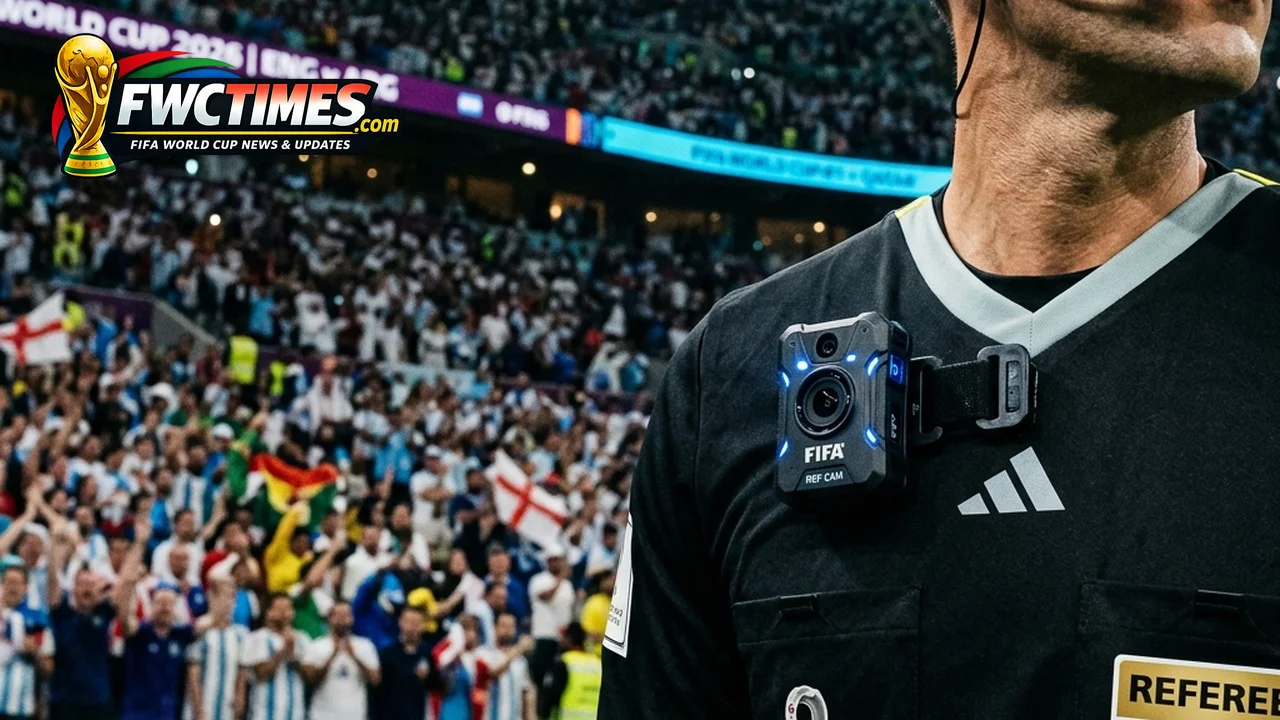
FIFA has officially confirmed that the FIFA World Cup 2026 will feature the debut of high-tech referee body cameras and “Football AI Pro” officiating assistants. This technological leap, announced in early May 2026, aims to provide fans with an unprecedented first-person perspective of match officiating while enhancing the speed and accuracy of VAR decisions. The body cameras, integrated into the officials’ communication headsets, utilize AI-powered stabilization to provide clear, motion-blur-free footage for global broadcasts. This move toward radical transparency in officiating comes as the tournament expands to a 48-team World Cup 2026 format, requiring elite-level consistency across 104 matches in three host nations.
The introduction of wearable technology for the 170 selected match officials marks the largest officiating upgrade since the implementation of VAR in 2018. FIFA’s refereeing department, led by Pierluigi Collina, has emphasized that the body cameras are not just for broadcast entertainment but serve as a critical tool for post-match analysis and training. By capturing exactly what a referee sees in high-pressure moments—such as penalty box incidents or red card confrontations—FIFA intends to demystify the decision-making process for billions of viewers. The technology has already undergone successful trials in youth tournaments and is now ready for the global stage in North America.
Football AI Pro — The Digital Assistant for VAR
In addition to the physical wearables, FIFA is deploying “Football AI Pro,” a sophisticated knowledge and analysis assistant designed to support Video Match Officials (VMOs). The AI Pro system processes thousands of data points per second, including player tracking and ball movement, to provide VAR rooms with instantaneous situational assessments. This technology works alongside existing semi-automated offside systems to reduce the “down-time” associated with video reviews. By automating the preliminary analysis of foul intensity and contact points, Football AI Pro allows human officials to focus on the final interpretation of the Laws of the Game, significantly speeding up the match rhythm.

Football AI Pro also includes 3D player avatars that can reconstruct a foul or offside position from any angle in near-real-time. These visualizations will be shared with broadcasters to explain complex decisions to the audience within seconds of the incident occurring. FIFA confirmed that the AI system has been trained on over 50,000 historical match incidents to ensure that its “advice” to human officials is based on consistent disciplinary standards. This integration of AI ensures that the New York New Jersey Stadium and other high-capacity venues maintain the flow of the game despite the added pressure of the 48-team structure.
Referee Selection and Training — 170 Officials Confirmed
The list of 170 match officials, comprising 52 referees, 88 assistant referees, and 30 video match officials, has completed the final tech-integration camp in Dallas. Six female referees have been selected to lead matches, continuing FIFA’s commitment to gender diversity in officiating. Each official has been trained specifically on the operational requirements of the body cameras, ensuring that the devices do not interfere with their physical movement or communication during the 90 minutes. The cameras are lightweight, shock-resistant, and feature an “instant-upload” capability that sends encrypted footage directly to the FIFA match operations center.
Training also focused on the “human-tech interface,” ensuring that referees remain the primary authority on the pitch while utilizing the AI Pro insights. Pierluigi Collina noted that “technology is a shield, not a sword,” emphasizing that the goal is to protect officials from clear and obvious errors rather than replacing their intuition. The final officiating roster includes veterans from previous tournaments and high-performing debutants who have mastered the new technological requirements during the final qualification phases in 2025 and 2026. This group will be responsible for maintaining the integrity of the 104 matches across the United States, Mexico, and Canada.
Impact on Fan Experience and Transparency
For fans watching at home or in the stadiums, the referee body cameras provide a revolutionary visual tool. During controversial moments, broadcasters can switch to the “Ref-Cam” view, allowing the audience to experience the speed of the game from pitch level. This immersion is expected to increase fan empathy for officials and provide a clearer understanding of why certain decisions are made. FIFA has also indicated that audio from the referees’ microphones may be utilized in specific post-match “transparency reports” to further explain the communication between the pitch and the VAR room.
As the tournament approaches, the focus remains on ensuring that these technological advancements improve the game without disrupting its natural flow. Follow the latest updates on match officiating, stadium tech, and team news in our FIFA World Cup news section. The 2026 World Cup is set to become the most technologically advanced sporting event in history, setting a new standard for how football is officiated and consumed globally.
Frequently Asked Questions
Frequently Asked Questions
The 2026 World Cup officiating tech marks a turning point in sports transparency, ensuring that the world’s largest tournament is managed with the highest degree of technological support available.
Stay tuned to FWCTimes.com for the latest FIFA World Cup 2026 updates.
Read Also: Belgium World Cup 2026 Squad Announced — Rudi Garcia Confirms Final 26-Man Roster