England: World Cup 2026 Squad, Fixtures, Standings & Kits

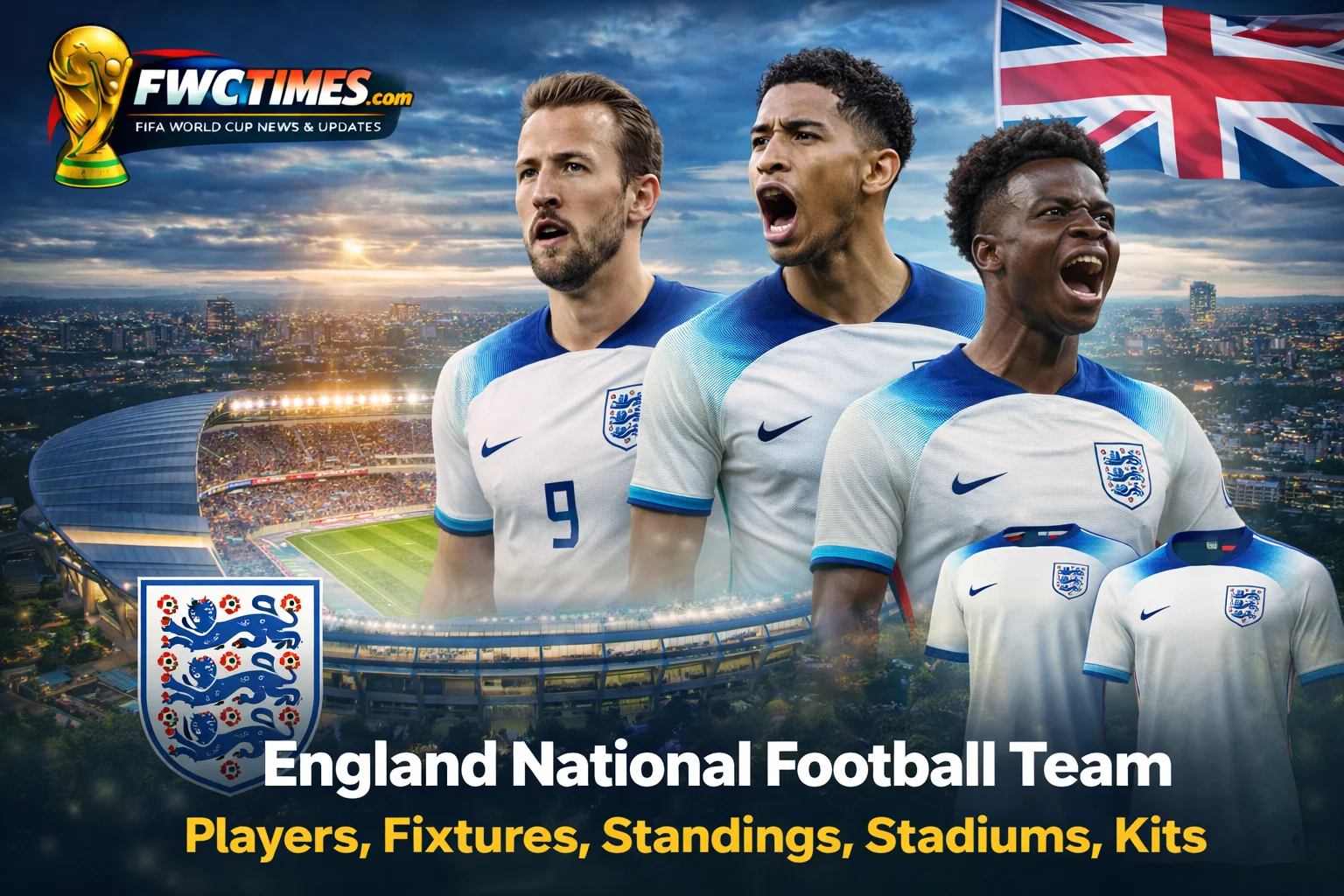
England arrive at the 2026 FIFA World Cup with one of the most dominant qualifying campaigns in UEFA history. Thomas Tuchel’s side won all eight Group K matches, scoring 22 goals and conceding none — a perfect record that sent a clear statement to the rest of the tournament. The Three Lions are seeded, confident, and carry genuine expectations of going all the way for the first time since 1966.
Drawn in Group L alongside Croatia, Ghana, and Panama, England have one of the more manageable group draws. The squad — named on May 22, 2026 — includes some notable omissions: Cole Palmer, Phil Foden, Trent Alexander-Arnold, and Harry Maguire have all been left out in a ruthless Tuchel selection. The core is built around Harry Kane, Jude Bellingham, Declan Rice, and Bukayo Saka — four of the most important players at the entire tournament. Jordan Henderson makes history, attending his record-equalling fourth World Cup alongside Sir Bobby Charlton.
What should fans know about England at World Cup 2026?
England are competing at the 2026 FIFA World Cup in the United States, Mexico, and Canada. They are placed in Group E and are managed by Thomas Tuchel. The tournament runs from June 11 to July 19, 2026.
England — FIFA World Cup 2026
Group L · Manager: Thomas Tuchel · Perfect qualifying record
Contents
England World Cup 2026 Squad
Thomas Tuchel named his 26-man England squad on May 22, 2026. The selection was ruthless — Cole Palmer, Phil Foden, Trent Alexander-Arnold, and Harry Maguire are the headline omissions. Nine players make their senior tournament debut, including James Trafford, Tino Livramento, Nico O’Reilly, Djed Spence, Dan Burn, Jarell Quansah, Elliot Anderson, Noni Madueke, and Morgan Rogers. Harry Kane wears the captain’s armband.
Goalkeepers



Defenders








Midfielders




Forwards






Key Players to Watch
England’s World Cup challenge is built around these six players. Their form, fitness, and ability to perform on the biggest stage will determine whether 60 years of hurt finally ends in North America.
England’s captain and all-time record scorer with 78 international goals. Kane arrives at his third World Cup with Bayern title momentum and proven major-tournament authority. The tournament’s decisive moments still flow through him because England’s system is built to feed their talismanic striker.
England’s most complete and dangerous player. Bellingham won La Liga and the Champions League with Real Madrid and is now established as one of the best midfielders in world football. His ability to arrive late in the box, his technical range, and his big-game temperament make him the player every opposition team plans around.
A relentless attacking threat on the right flank and one of the most consistent performers in the Premier League. Saka’s directness, work rate, and composure in the final third give England a constant outlet. He has grown into a senior leader in the dressing room despite still being in his mid-20s.
The defensive midfield anchor that allows Bellingham to roam freely. Rice is one of the best players in his position in Europe — disciplined, technically gifted, and capable of carrying the ball through pressure. His partnership with Bellingham gives England a midfield as good as any in the tournament.
England’s undisputed number one and one of the most experienced players in the squad. A consistently reliable presence at major tournaments, Pickford has saved England at crucial moments across multiple competitions and is the best last line of defence the Three Lions have had in decades.
Revitalised at Barcelona after leaving Manchester United, Rashford brings pace, directness, and a goal threat that England have lacked from the left. His move to Spain coincided with a return to peak form, and he arrives in the best shape of his career heading into this World Cup.
Tactics and Formation Under Thomas Tuchel
Tuchel has settled on a flexible 4-2-3-1 that can shift into a 4-3-3 depending on the opponent. Declan Rice and a partner sit in a double pivot, providing the defensive foundation that allows Bellingham to operate as a free number ten — breaking into the box from deep and linking with Kane. The wide forwards, typically Saka on the right and Rashford on the left, provide direct pace and width that stretches opposition defences.
Defensively, England sit in a compact mid-block and are disciplined in their shape. John Stones and a partner anchor the back four with Walker-like full-backs pushing high. Tuchel’s attention to detail and man-management of elite egos has transformed the squad’s spirit and collective output. This England side defends as a unit and attacks with more coherence than any previous generation under any other manager.
| Formation | Style | Key Shape | Primary Strength |
|---|---|---|---|
| 4-2-3-1 | Compact + vertical transitions | Rice double pivot · Bellingham free 10 | Elite midfield control |
| 4-3-3 | High press vs weaker teams | Saka · Bellingham · Rashford triangle | Overwhelming front three |
| 4-4-2 | Deep block in big games | Kane & Watkins dual threat | Physical presence, set pieces |
Group L Fixtures — England at WC 2026
Local broadcast times are listed in the United Kingdom FIFA World Cup 2026 TV schedule.
England open against Croatia — a repeat of their Euro 2020 group stage opener, which England won 1-0 thanks to Raheem Sterling. Ghana is the critical fixture for securing top spot. The Panama match completes the group stage and should be a straightforward victory. England are expected to top Group L and enter the knockout rounds as one of the favourites.
| Date | Match | Venue | City |
|---|---|---|---|
| Jun 17, 2026 | England vs Croatia | AT&T Stadium | Dallas (Arlington), TX |
| Jun 23, 2026 | England vs Ghana | Gillette Stadium | Boston (Foxborough), MA |
| Jun 27, 2026 | England vs Panama | MetLife Stadium | New York / New Jersey |
For matchday TV channels, kickoff times and official streaming routes, use the where to watch England football guide before each Group L game.
Group L — FIFA World Cup 2026
| Team | Pld | W | D | L | GF | GA | Pts |
|---|---|---|---|---|---|---|---|
| 🏴 England | 0 | 0 | 0 | 0 | 0 | 0 | 0 |
| 🇫🇷 Croatia | 0 | 0 | 0 | 0 | 0 | 0 | 0 |
| 🇬🇭 Ghana | 0 | 0 | 0 | 0 | 0 | 0 | 0 |
| 🇵🇦 Panama | 0 | 0 | 0 | 0 | 0 | 0 | 0 |
Group L is a favourable draw for England. Croatia, the 2018 World Cup finalists, are a fading force — ageing through their golden generation. Ghana are dangerous in flashes but inconsistent. Panama are the group’s weakest side. England should top the group comfortably, with the real test coming in the knockout rounds where the calibre of opposition rises sharply.
UEFA World Cup Qualifying
England delivered the most dominant UEFA qualifying campaign of any nation heading into the 2026 World Cup. They won all eight Group K matches without conceding a single goal — one of the most remarkable defensive records in the history of England qualifying. Thomas Tuchel’s tactical discipline and organisational quality transformed the Three Lions into an almost impenetrable defensive unit while remaining clinical at the other end.
| Team | Pld | W | D | L | GF | GA | Pts |
|---|---|---|---|---|---|---|---|
| 🏴 England | 8 | 8 | 0 | 0 | 22 | 0 | 24 |
| 🇦🇱 Albania | 8 | 4 | 1 | 3 | 12 | 11 | 13 |
| 🇷🇸 Serbia | 8 | 3 | 2 | 3 | 10 | 9 | 11 |
| 🇱🇻 Latvia | 8 | 2 | 1 | 5 | 8 | 14 | 7 |
| 🇦🇩 Andorra | 8 | 0 | 0 | 8 | 1 | 19 | 0 |
England 2026 World Cup Kits

England’s 2026 World Cup kits are produced by Nike and represent the Three Lions in the traditional white home and red away. The home kit carries the iconic St George’s cross crest and the clean white design England have worn in their most historic moments. The away kit brings the classic England red — the same colour worn in the 1966 World Cup final triumph at Wembley. Both kits will be worn across Group L and, if England progress, throughout the knockout stages of a tournament a nation of 56 million has been waiting 60 years to win.
England at the World Cup
England are the only home nation to have won the FIFA World Cup, lifting the trophy at Wembley in 1966 under Sir Alf Ramsey. Since then, their record has been one of near-misses, heartbreaking penalty exits, and a generation waiting for the next great triumph.
| Year | Stage | Notable Result |
|---|---|---|
| 1966 | Winners 🏆 | Beat West Germany 4-2 at Wembley — England’s only World Cup triumph |
| 1990 | Semi-finals | Lost to West Germany on penalties — Gazza’s tears, Waddle’s miss |
| 2018 | Semi-finals | Lost to Croatia 2-1 — best finish since 1990 |
| 2022 | Quarter-finals | Lost to France 2-1 — Kane missed penalty at 1-1 |
| 2026 | TBD | Group L: Croatia, Ghana, Panama |
England’s World Cup story has been defined by moments of agonising near-success. The 2018 semi-final was their best finish in 28 years. The 2022 quarter-final exit — losing to France when Kane missed a late penalty — still stings. This 2026 squad is arguably the most talented Three Lions generation since 1966. The combination of Kane, Bellingham, Saka, and Rice under the tactical intelligence of Thomas Tuchel gives England the best legitimate chance of ending 60 years of hurt.
Frequently Asked Questions
More World Cup 2026 Team Guides
England share the 2026 tournament with 47 other nations. Explore complete squad guides, fixtures, and player breakdowns from across the competition below.
For team-specific TV and streaming details, use England World Cup 2026 live match coverage.