Most Red Cards in World Cup History: All Sending-Off Records

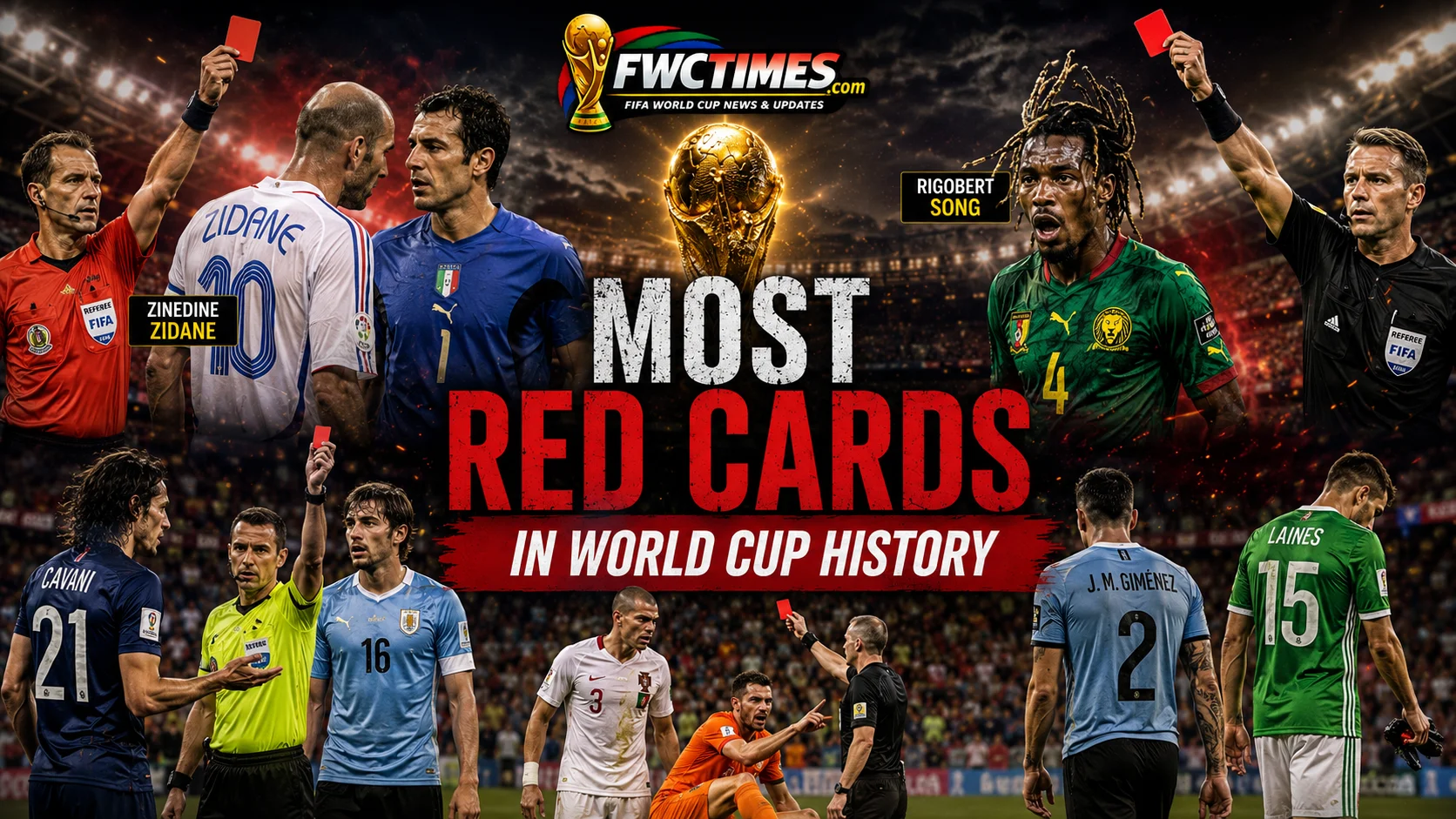
Football matches are often intense battles defined by physical contact. Referees use red cards to enforce rules and maintain player safety. This article covers the most red cards in World Cup history to showcase the disciplinary records. Sending-offs have decided some of the biggest matches.No player has received more than two red cards in tournament history. Rigobert Song of Cameroon and Zinedine Zidane of France share this record. Both players were sent off twice in their careers.
Players with the Most Red Cards in World Cup History
Tracking red cards reveals the physical nature of international football over the decades. Referees have become more strict in recent editions to protect players. The players with the most sending-offs in tournament history are presented.
| Rank | Player | Country | Red Cards | Appearances |
|---|---|---|---|---|
| 1 | Rigobert Song | Cameroon | 2 | 9 |
| 1 | Zinedine Zidane | France | 2 | 12 |
| 3 | José Batista | Uruguay | 1 | 3 |
| 3 | Laurent Blanc | France | 1 | 5 |
| 3 | Wayne Rooney | England | 1 | 11 |
| 3 | Luis Suárez | Uruguay | 1 | 13 |
| 3 | David Beckham | England | 1 | 13 |
The list shows that even the most talented superstars can lose control under pressure. Midfielders and defenders are more likely to receive cards. Their role involves physical battles and tactical fouls. Red cards often lead to immediate suspensions.A sending-off can change the outcome of a crucial knockout match. Teams must play with ten players for the remaining minutes. The tactical burden increases for the remaining players. The records show the cost of these cards.Referees now analyze video replays to confirm red card decisions. This has led to more consistent card distribution in recent tournaments. Players must adapt to these strict guidelines to avoid penalties. The record-holders remain iconic figures.
Rigobert Song and Zinedine Zidane Records
Rigobert Song was famous for his aggressive tackling style. He received his first red card in 1994 against Brazil. He was only seventeen years old. He received his second red card in 1998 against Chile. He remains a legend of African football.Zinedine Zidane received his first red card in 1998 against Saudi Arabia. He was suspended for two matches but returned to win the final. His second red card came in the 2006 final against Italy. That match was the final game of his career.His sending-off in 2006 remains one of the most famous moments in sport. He headbutted Italian defender Marco Materazzi in extra time. France lost the match on penalties without their captain. Zidane's action shocked the football world.Both players showed that passion can sometimes lead to disciplinary problems. They were leaders for their countries but struggled with discipline. Their records highlight the challenges of tournament play. They remain legends of the sport.
Uruguay and Batista Quickest Red Card
José Batista of Uruguay holds the record for the fastest red card in history. He was sent off after only fifty-six seconds in 1986. The match featured Uruguay and Scotland in Mexico.Batista made a late tackle on Scotland's Gordon Strachan. French referee Joel Quiniou did not hesitate to show the red card. Uruguay had to play the entire match with ten players. They managed to secure a zero-zero draw.This record highlights the intense pressure of the opening minutes. Players are desperate to establish dominance and make mistakes. Batista's card set a benchmark that will be difficult to break. It remains a famous disciplinary moment.The match was highly physical from start to finish. Uruguay's tactics were criticized by analysts. Batista defended his action as a tactical intervention. He remains a historic figure in Uruguayan football.
Teams with the Most Red Cards
Brazil holds the record for the most red cards received by a national team. They have accumulated eleven red cards in history. Argentina follows closely on this list with ten red cards.Uruguay sits third with nine red cards in their tournament history. These South American powers play with a physical passion that often leads to cards. Tensions run high during intense continental rivalries. The statistics reflect this intensity.More matches played naturally leads to more disciplinary actions. Brazil and Argentina have played the most matches in history. Still, Uruguay has a higher card-per-match ratio. They are famous for their defensive grit.
World Cup 2026 Disciplinary Guidelines
The upcoming tournament in North America will feature strict refereeing guidelines. FIFA wants to protect creative players and reduce physical play. Referees will use red cards to punish dangerous tackles.Coaches like France's
Didier Deschampswill emphasize discipline during team talks. Players must show restraint on the pitch to avoid suspensions. The expanded format will feature forty-eight teams, leading to more matches. Fans can expect dramatic disciplinary moments. We will see intense matches during the
FIFA World Cup. The competition will be tough for teams like
most yellow cards in World Cup historyleaders.The physical preparation of referees is also key. They must keep up with the fast speed of play. Video technology will assist them in identifying dangerous play. The rules aim to encourage fair play.
Frequently Asked Questions
Who has the most red cards in World Cup history?
Rigobert Song of Cameroon and Zinedine Zidane of France share the record for the most red cards in World Cup history, with two sending-offs each during their careers. Both players were sent off in different editions of the tournament.
What is the fastest red card in World Cup history?
José Batista of Uruguay holds the record for the fastest red card, being sent off after only 56 seconds against Scotland in 1986. His late tackle led to an immediate expulsion.
What match had the most red cards in history?
The match between Portugal and the Netherlands in 2006 had the most red cards, with four sending-offs issued by referee Valentin Ivanov. The game is famously known as the Battle of Nuremberg.
Which country has the most red cards in World Cup history?
Brazil holds the record for the most red cards received by a national team, with eleven sending-offs. Argentina follows closely with ten red cards. To see player card details, check the Brazil FIFA World Cup stats page.
Conclusion
Discipline and physical play will always remain a balancing act on the pitch. The ranking of the most red cards in World Cup history shows that even the greatest legends had to face sending-offs. The next tournament in North America will surely bring new disciplinary stories.Stay tuned to FWCTimes.com for the latest FIFA World Cup 2026 updates.Read Also:
Youngest Players to Score at FIFA World Cup