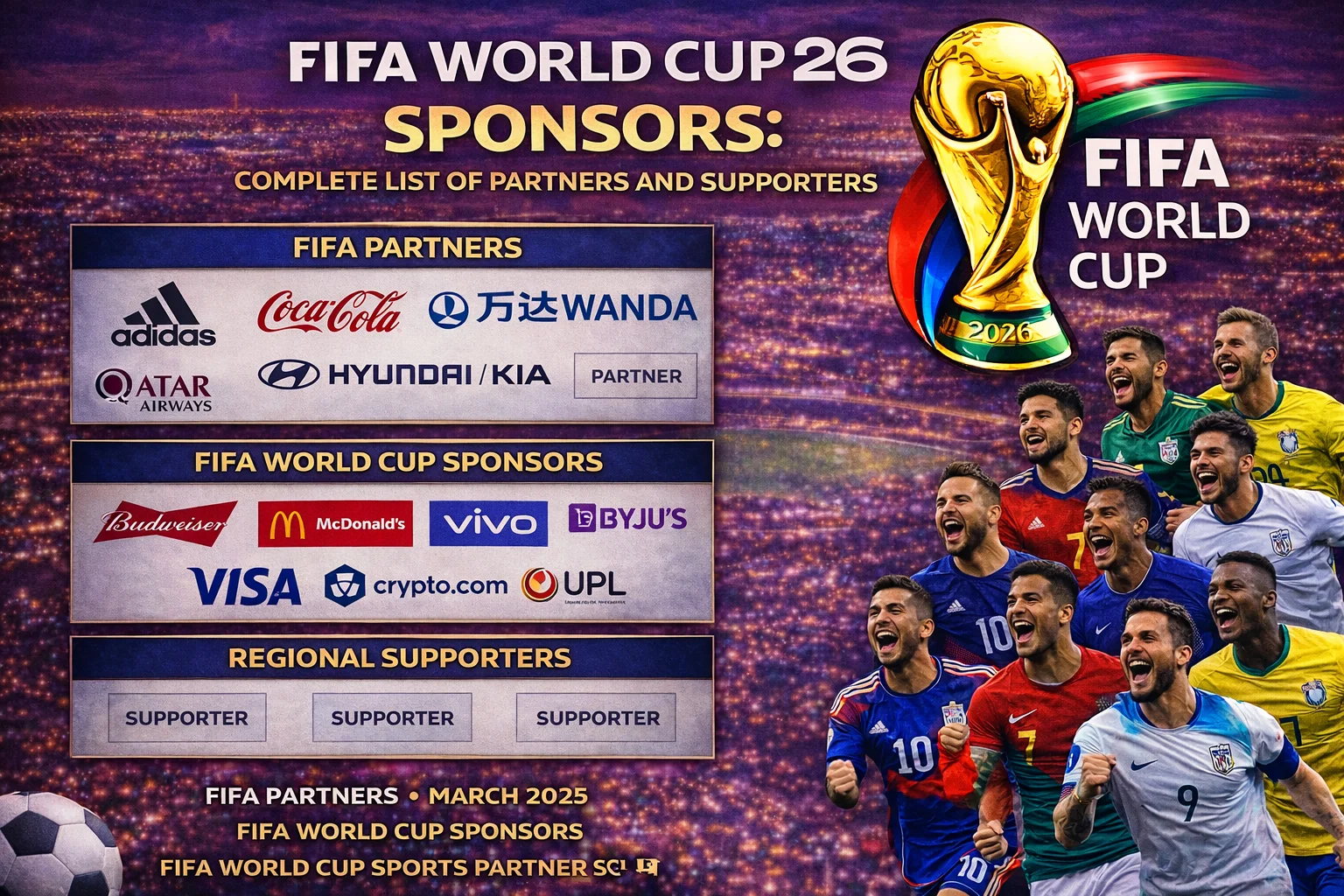
Here's a graphic showing the complete list of official FIFA World Cup 2026 sponsors and partners. See the full roster here!

FIFA World Cup 2026 Sponsors List, Partners, Official Sponsors, Supporters (2026)

The 2026 FIFA World Cup is set to be the largest and most commercially powerful football tournament staged so far. For the first time, 48 nations will compete across the United States, Canada, and Mexico from June 11 to July 19, 2026. A tournament with 104 matches, 16 host cities, and a global audience measured in billions needs more than great teams and stadiums. It needs funding, logistics, services, and technology at a massive scale.

That is where FIFA’s sponsors, partners, and supporters come in. Sponsorship may look like pitch-side boards, commercials, and social media campaigns. Behind the scenes, it also helps power payments, travel, accommodation, stadium upgrades, broadcast enhancements, fan festivals, and on-the-ground operations. This guide combines the full sponsor picture into one clear view, using the sponsorship tiers FIFA applies and the sponsor list confirmed through official announcements and partner pages as of February 2026.

FIFA’s sponsorship structure for World Cup 2026

FIFA groups commercial partners into tiers. Each tier comes with different rights, visibility, and responsibilities. This structure helps FIFA secure long-term global backing while still allowing tournament-specific and regional partners to contribute in focused ways.

Tier 1: FIFA Partners

FIFA Partners are the most influential brands in FIFA’s commercial ecosystem. They hold worldwide rights across FIFA competitions through the full cycle. They appear prominently in stadium branding, media broadcasts, digital campaigns, hospitality programs, and global fan engagement initiatives.

These brands tend to be closely tied to essential tournament systems like official match equipment, global payment flows, airline services, energy operations support, and technology infrastructure.

Tier 2: FIFA World Cup Sponsors

These sponsors receive worldwide marketing rights linked specifically to the 2026 World Cup. Their campaigns focus on this tournament rather than the full FIFA calendar. This tier is positioned as a major investment level, with investments typically ranging from 65 million to 95 million dollars for many deals.

In practical terms, this tier often includes brands tied to matchday culture, connectivity, food service, and home viewing technology.

Tier 3: Regional supporters and suppliers

Regional supporters and suppliers provide crucial services within specific continents, countries, or operational areas. Their marketing rights are limited to defined territories or categories, yet their impact can be significant.

This tier often includes stadium and venue development support, transportation support, logistics providers, accommodation platforms, and responsibility-driven fan initiatives.

FIFA World Cup 2026 sponsors list by tier

The sponsor list below is organized by tier and presented with categories and roles for clear tracking and future updates.

Tier 1: FIFA Partners

BrandCategoryKey role
AdidasSportswearMatch balls and team kits
Coca-ColaBeveragesDrinks services and Trophy Tour
Hyundai–KiaAutomotiveOfficial vehicle fleet
VisaFinancialGlobal payment systems
AramcoEnergyEnergy and operations support
LenovoTechnologyComputing hardware and integrated solutions
Qatar AirwaysAirlinesGlobal airline services

Tier 2: World Cup Sponsors

BrandCategoryKey role
Anheuser-Busch InBevAlcoholic beveragesOfficial beer
Bank of AmericaBankingFinancial services in North America
Frito-LaySnack foodsStadium snacks and fan-zone products
McDonald’sFast foodFood service and youth programs
Mengniu DairyDairyDairy products and Asian-market promotions
UnileverPersonal careDove Men+Care partnerships
VerizonTelecommunicationsConnectivity and network performance
HisenseElectronicsTV display and viewing technology

Tier 3: Regional supporters and suppliers

BrandCategoryKey role
The Home DepotRetailStadium and venue development
ValvolineAutomotiveMaintenance of the tournament’s vehicle fleet
Rock-It CargoLogisticsGlobal equipment and stage transportation
DiageoBeveragesResponsible drinking and fan safety initiatives
AirbnbAccommodationLodging solutions for visiting fans
American AirlinesAirlinesTravel and transportation across North America

Additional supporters and licensed partners mentioned in the sponsor ecosystem

Some tournament support roles and licensed or commerce-driven partnerships are also part of the wider World Cup sponsor picture in the provided data, including:

  • DoorDash: Food delivery services tied to matchday viewing parties
  • Boggi Milano: Apparel for official events and staff uniforms
  • Fanatics: E-commerce for merchandise and collectibles distribution
  • LEGO: Licensed products such as buildable trophies aimed at younger fans

Facts for the FIFA World Cup 2026

This tournament’s scale explains why sponsorship is so valuable and why partner categories matter.

CategoryInformation
Tournament datesJune 11 to July 19, 2026
Number of teams48
Total matches104
Host countriesUnited States, Canada, Mexico
Host cities16
Final venueMetLife Stadium, New Jersey
Economic impact13.9 billion dollars
Sponsorship revenue2.5 to 3 billion dollars
Expected audienceOver 5 billion viewers
US host cities11
Mexico host cities3
Canada host cities2

Key sponsor highlights that shape World Cup 2026

Some sponsors stand out because their role is closely tied to what fans see and feel during the tournament, at stadiums and at home.

Adidas and World Cup match innovation

Adidas has supplied the official World Cup match ball since 1970. For 2026, the focus in the provided information is on advanced aerodynamics and sustainability-focused materials. That includes recycled plastics and carbon-neutral production methods, tied to FIFA’s wider environmental commitments.

Match balls, kits, and fan merchandise are highly visible in every match. This partnership also shapes the retail side of the tournament because it influences official gear, replica shirts, and global campaigns that run before and during the competition.

Coca-Cola and global fan engagement

Coca-Cola’s partnership with FIFA spans nearly five decades. The brand’s work goes beyond beverages. It is linked to global fan engagement programs and the FIFA World Cup Trophy Tour. The tour, operated in partnership with Coca-Cola, is projected to visit over 50 countries during the 2026 cycle.

For fans, that means local moments of World Cup excitement long before kickoff. Trophy Tour events, promotional campaigns, and matchday branding are part of how the tournament stays present in global culture for months.

Hisense and broadcast viewing technology

Hisense joined as an official sponsor in September 2025, continuing its pattern of major sports investments. With a 104-match schedule, home viewing and screen quality matter more than ever. Hisense is positioned around display technology, improved broadcast quality, and next-generation home entertainment devices, including enhanced HDR displays.

This is the sponsor layer that affects how matches look for millions of viewers watching on big screens, during watch parties, and in public fan zones.

Airbnb and lodging demand across 16 host cities

Airbnb’s role includes lodging solutions for visiting fans. The provided information notes that more than 380,000 guests are expected to stay in Airbnb properties during the World Cup. This helps host cities manage visitor surges without overwhelming local hotels. Economic data cited in the content includes a projected 3.6 billion dollar boost to host communities tied directly to Airbnb usage.

For traveling supporters, accommodation capacity is a major part of planning. With matches spread across three countries and many cities, the lodging layer becomes central to the fan journey.

American Airlines and North American travel flow

American Airlines supports more than 2,200 daily flights across host cities. During the World Cup, the airline plans to expand schedules, coordinate with airport authorities, and provide fan-friendly travel packages. The partnership also connects with Qatar Airways to strengthen long-haul connections for visitors arriving from Asia, the Middle East, and Europe.

This is a practical sponsor role. Fans following their team across cities need reliable routes, flight frequency, and smoother connections.

How sponsors enhance the fan experience in 2026

Sponsors do not only advertise. Many provide the infrastructure that fans rely on, from buying tickets to finding food, to staying connected inside stadiums.

Ticketing and payments that shape access

Payment systems and ticketing partnerships influence how fans buy tickets and hospitality packages. Visa is closely associated with global payment systems, while Bank of America is positioned as a key banking sponsor with financial services tied to North America.

This category often connects to ticket opportunities, cardholder promotions, and special access windows, which can matter for fans planning early.

Stadium connectivity and digital engagement

Connectivity is becoming a core part of matchday experiences. Verizon’s role highlights connectivity and network performance. In an expanded tournament, connected services matter for live updates, mobile content, and interactive fan experiences inside venues and fan festival areas.

This is also part of how sponsors influence the modern World Cup feel. Strong networks enable data-heavy experiences and digital activations.

Food, drinks, and matchday culture

Food and beverage sponsors shape the everyday World Cup moments. McDonald’s supports food service and youth programs. Coca-Cola supports beverage services and broad fan activations. Frito-Lay supports stadium snacks and fan-zone products. AB InBev is positioned as official beer.

These brands become part of what fans see at stadium concessions, fan festivals, and viewing parties. Their campaigns often center on shared celebrations and matchday rituals.

Technology partners that boost viewing and operations

Technology partners contribute to both operations and entertainment. Lenovo provides computing hardware and integrated solutions. Hisense focuses on TVs and viewing technology. This combination supports both behind-the-scenes systems and the home viewing experience.

With more matches, more data, and higher global demand, technology support becomes one of the most important sponsor contributions.

Stadium and venue development support

The Home Depot supports stadium and venue development. This ties into facility upgrades, improved seating areas, and fan zones. In an event hosted across many cities, venue readiness and fan comfort are major priorities.

This category is less visible than a shirt logo, yet it can impact what fans experience when they arrive at a stadium.

Host city supporters and the local sponsor layer

The 2026 World Cup spans 16 host cities, so local supporter programs can be important. The content describes a model where host cities can bring in local brands, as long as they do not conflict with global category rights.

Host city supporters tend to activate at fan festivals, public events, and local promotions. Their presence can feel “everywhere” in one city even if they do not have worldwide FIFA Partner status.

FIFA’s expected earnings from World Cup 2026 sponsors

FIFA anticipates record-setting revenue during the 2026 cycle. Marketing and sponsorship contracts alone are projected to produce approximately 1.78 billion dollars. Overall sponsorship revenue is expected to reach between 2.5 and 3 billion dollars.

The 2023 to 2026 financial cycle is forecast to generate 11 billion dollars, with the 2026 World Cup accounting for nearly 8.9 billion dollars. These numbers reflect the expanded format, major North American viewership, and the scale of commercial activity tied to the event.

Revenue breakdown for World Cup 2026

Broadcast rights remain FIFA’s top revenue driver, expected to total 3.92 billion dollars. Ticketing and hospitality packages are projected at 3.097 billion dollars. Marketing and sponsorship revenue is projected to reach 2.693 billion dollars, showing a significant increase from the previous cycle.

A substantial portion of these earnings is reinvested into global football development. Through FIFA Forward 3.0, FIFA distributes 2.25 billion dollars to member associations. Each federation receives 1.5 million dollars to support grassroots programs, facility development, and youth academies.

FAQs

What are the main FIFA World Cup 2026 sponsors right now?

The confirmed list includes FIFA Partners such as Adidas, Coca-Cola, Hyundai–Kia, Visa, Aramco, Lenovo, and Qatar Airways, plus major sponsors like Bank of America, Verizon, Frito-Lay, AB InBev, McDonald’s, Mengniu Dairy, Unilever, and Hisense.

Are FIFA Partners the same as World Cup sponsors?

Not always. FIFA Partners hold broader rights across FIFA competitions. World Cup sponsors and supporters are tied specifically to the 2026 tournament or to regional roles.

Will more sponsors be added before the tournament starts?

The sponsor list can expand as FIFA continues announcements in waves. The core roster is already strong, but additions can happen closer to kickoff.

What do sponsors actually do for fans?

Sponsors support key systems like payments, connectivity, travel, accommodation, stadium upgrades, food services, and fan festivals, shaping the matchday and viewing experience.

Why do host city supporter deals matter in 2026?

Because the tournament spans 16 host cities, local supporter deals can be highly visible in one city through fan festivals, public events, and promotions, while still respecting global category rules.

Final overview

The FIFA World Cup 2026 sponsor ecosystem combines major global partners, tournament-specific sponsors, and regional supporters and suppliers. Together, they help FIFA deliver a tournament with more teams, more matches, and more host cities than ever before.

Longtime partners like Adidas and Coca-Cola sit alongside newer or recently confirmed sponsors such as Hisense, Verizon, and Bank of America. Supporters like Airbnb and American Airlines address travel and accommodation pressures created by a tri-nation tournament. Operational partners like The Home Depot and Rock-It Cargo support venue work and logistics.

The result is a commercial network built to match the scale of the 2026 World Cup, shaping how fans buy, travel, watch, connect, and celebrate from June 11 to July 19, 2026.

Similar Posts

Leave a Reply

Your email address will not be published. Required fields are marked *