Most World Cup Wins by Country, All-Time Rankings (2026)
The Most World Cup Wins by Country debate never stays quiet for long. One reason is simple: a small group of nations keeps rewriting football history, while the rest chase that one perfect tournament run.
Some teams win once and become legends. Others build dynasties across decades, styles, and generations. This guide gives you the all-time ranking, a fast comparison, and the context you need to talk about World Cup dominance with confidence.
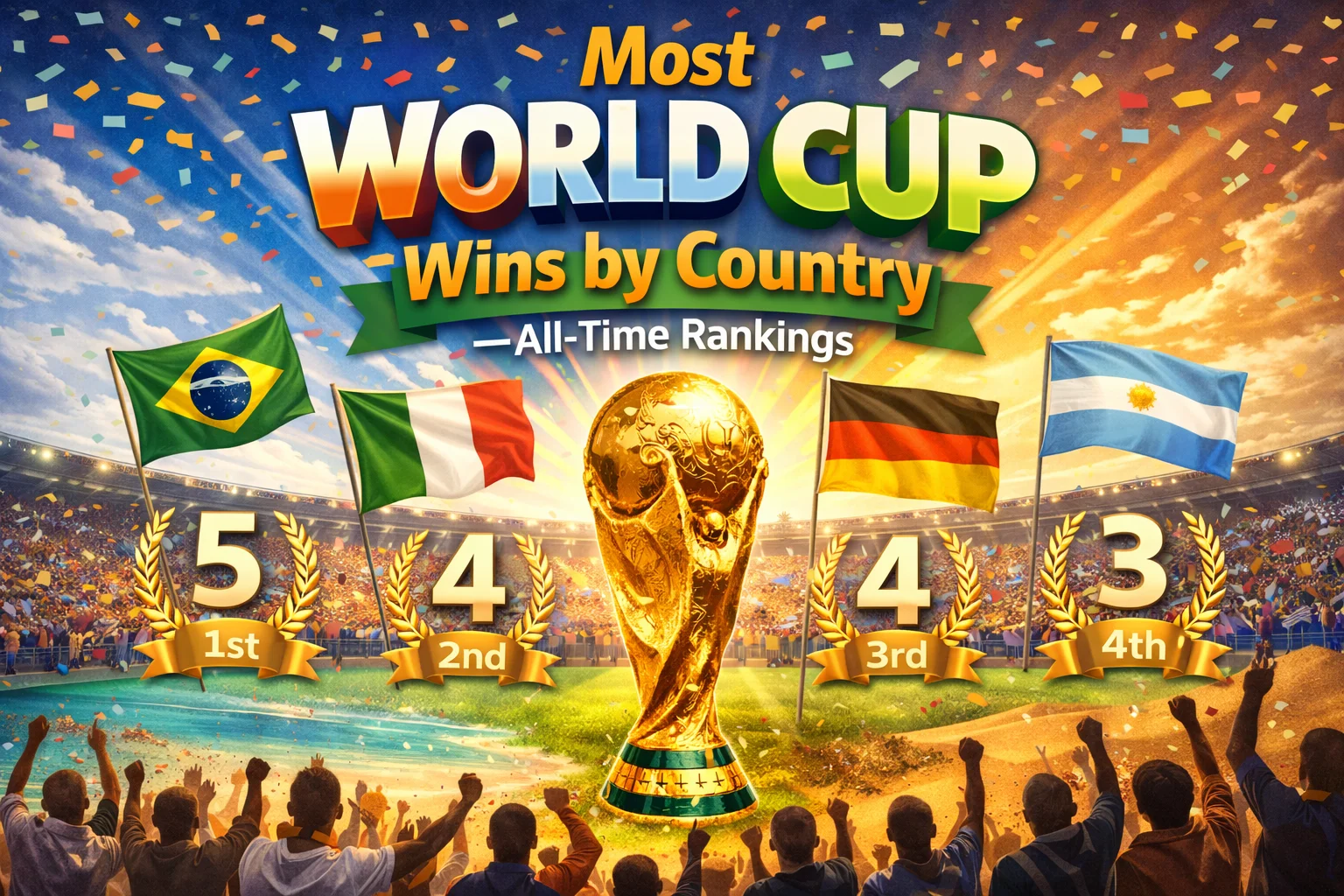
Brazil has the Most World Cup Wins by Country with five titles. Germany and Italy are tied next with four each, while Argentina sits on three after its 2022 win. This all-time ranking will not change until the 2026 tournament finishes and a new champion is crowned.
Most World Cup Wins by Country: All-Time Champions Table
Only eight nations have ever won the men’s World Cup title up to the last completed tournament (2022). That small list explains why World Cup winners all time topics stay popular year after year.
Read Also FIFA World Cup 2026 Favorites to Win
All time World Cup champions table (titles and winning years)
| Rank | Country | Titles | Winning Years |
|---|---|---|---|
| 1 | Brazil | 5 | 1958, 1962, 1970, 1994, 2002 |
| 2 | Germany | 4 | 1954, 1974, 1990, 2014 |
| 2 | Italy | 4 | 1934, 1938, 1982, 2006 |
| 4 | Argentina | 3 | 1978, 1986, 2022 |
| 5 | France | 2 | 1998, 2018 |
| 5 | Uruguay | 2 | 1930, 1950 |
| 7 | England | 1 | 1966 |
| 7 | Spain | 1 | 2010 |
The champions, explained like a listicle
Here is a quick, practical breakdown of the most successful national teams in World Cup history. Each country’s section focuses on what its trophy count represents, not just the number.
Brazil (5): the gold standard for World Cup dominance
Brazil sits alone at the top with five titles. It also holds a rare longevity marker: it has appeared in every tournament since 1930.
Brazil’s wins span different football eras, which makes the record hard to catch. It has been great with flair, with control, and with tournament efficiency. That range is why many fans call Brazil the most decorated World Cup team.
Germany (4): built for knockout pressure
Germany is tied second with four titles. It is often described as a tournament machine because it repeatedly reaches the biggest stages.
One detail that adds weight to Germany’s record is its consistency over time. Germany also has 20 World Cup appearances, which reflects how often it qualifies and stays competitive.
Italy (4): discipline that still wins titles
Italy matches Germany with four championships. Its wins spread from the early World Cups to the modern era, which shows long-term football identity.
Italy’s story is often connected to control in high-pressure games. Even when styles change, teams that manage moments well keep surviving knockout rounds.
Argentina (3): the newest champion with a modern boost
Argentina won in 1978, 1986, and then again in 2022. That third title matters because it clearly separates Argentina from the two-title group.
Argentina’s 2022 triumph also revived the all time football champions ranking conversation. It reminded everyone that the biggest teams can return to the top, even after long gaps.
France (2): modern power with two different generations
France has two titles: 1998 and 2018. The gap shows something important: France has produced elite squads more than once, not just in a single golden cycle.
When people compare World Cup winners all time, France often comes up as the team that looks “built for modern tournaments” due to its ability to refresh talent and stay near the top.
Uruguay (2): small nation, huge World Cup legacy
Uruguay won in 1930 and 1950. Those early titles still carry weight because they shaped the tournament’s myth and history.
Uruguay is also a reminder that “countries with multiple World Cup wins” is not only about population or size. It is about how a nation competes when the stage is at its brightest.
England (1): one win, a permanent place in history
England’s single title came in 1966. One trophy may look small next to Brazil or Germany, but one championship changes how a football nation is remembered forever.
That is why the World Cup winners comparison is not only about totals. It is also about moments that last for generations.
Spain (1): one peak that changed the global conversation
Spain won in 2010. Like England, one title still means you have done what most countries never do.
Spain’s win also shows how hard it is to become a first-time champion. The World Cup is short, intense, and unforgiving. One off day can erase four years of planning.
What separates title winners from strong teams
When fans argue about the greatest World Cup teams ever, they usually mix two things: trophies and sustained dominance. To keep it fair, compare nations using a small set of repeatable signals.
A simple way to compare World Cup title rankings by nation
Titles are the headline, but these factors often explain why the same countries keep returning to the top:
- Depth: teams that can rotate without dropping level survive better
- Game management: champions protect leads and handle pressure
- Coaching and identity: clear style reduces chaos in big moments
- Long-term development: a pipeline matters more than one star
What trophy counts often reflect (quick comparison)
| Title Tier | What it usually signals in World Cup history | Why it matters in knockouts |
|---|---|---|
| 5 titles | Dominance across multiple eras | Adapts to changing styles |
| 4 titles | Elite consistency under pressure | Peaks at the right time |
| 3 titles | High ceiling plus defining tournament runs | Can beat any era’s best |
| 2 titles | Strong legacy with at least two peak cycles | Proven ability to finish |
| 1 title | One perfect campaign that held up to pressure | Shows the door is not closed |
This framework keeps debates grounded while still respecting trophy count by country as the ultimate measure.
2026 outlook and what can realistically change
The 2026 World Cup will be played in an expanded format with 48 teams across the United States, Canada, and Mexico. More teams and more matches can add new stress to the favorites.
Still, one thing stays simple: the all-time champions table cannot change until the tournament ends. Until then, Brazil remains first with five, Germany and Italy stay tied on four, and Argentina stays on three as the reigning champion from 2022.
What outcomes in 2026 would change the all-time ranking
| 2026 Outcome | What changes in the rankings | Who benefits most |
|---|---|---|
| Brazil wins | Extends the all-time lead | Brazil |
| Germany or Italy wins | Breaks the tie at four and moves to five | Germany or Italy |
| Argentina wins | Moves from three to four and closes on second | Argentina |
| France or Uruguay wins | Moves from two to three | France or Uruguay |
| England or Spain wins | Moves from one to two | England or Spain |
| A new champion wins | Adds a ninth country to the winners list | First-time winner |
If you see early claims about a “new all-time leader” before the final, treat them as hype. For confirmed updates, check official announcements during the tournament.
FAQs
Brazil leads the all-time list with five World Cup titles. No other nation has reached five yet.
Eight nations have won it: Brazil, Germany, Italy, Argentina, France, Uruguay, England, and Spain.
Germany and Italy are tied with four championships each, making them joint-second in the trophy count by country.
Argentina has three titles after winning in 2022, placing it behind Brazil, Germany, and Italy in the all-time ranking.
Yes. Any past winner can add to its total, and a first-time champion would expand the winners list. The final ranking is only confirmed after the tournament ends, so check official announcements.
Conclusion
The all-time World Cup winners list is short because winning even once is brutally hard. Brazil still leads the Most World Cup Wins by Country race with five, with Germany and Italy closest behind on four. Argentina’s 2022 win tightened the top group and set up a huge storyline for 2026. If you want the smartest debates, start with titles, then add context like longevity, pressure results, and depth.
Read Also: Top FIFA World Cup Goals of All Time