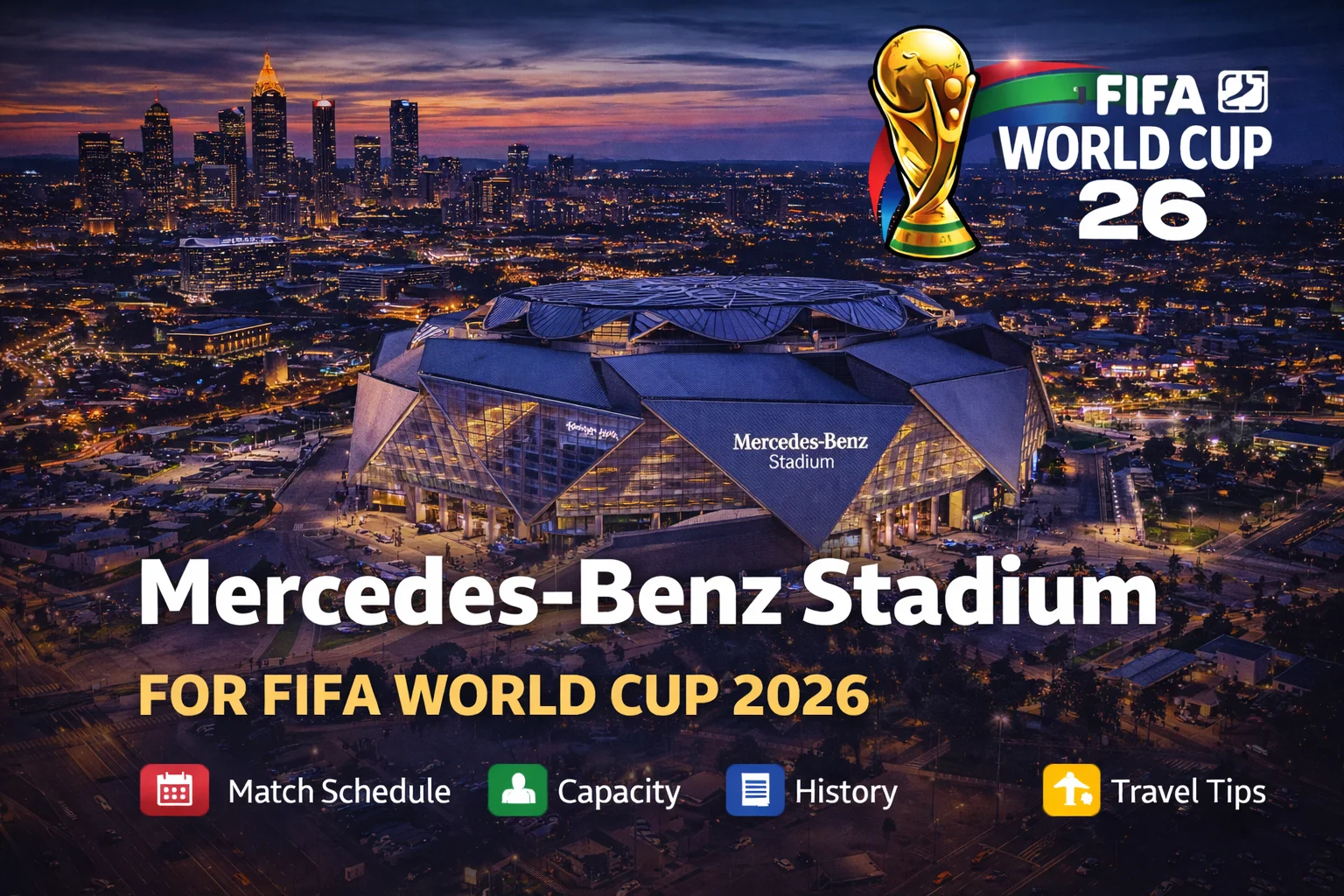
Mercedes-Benz Stadium World Cup 2026, Atlanta Schedule, Capacity, History & Travel Tips
As the excitement builds for the FIFA World Cup 2026, Mercedes-Benz Stadium in Atlanta stands out as a premier venue for global football. It is often seen as a hub for World Cup action in the southern United States, and it promises unforgettable moments for fans traveling from every continent. Because the tournament expands to 48 teams and 104 matches, demand will be intense across host cities. Therefore, planning early can reduce stress, improve matchday comfort, and help you build a smoother trip.
During the tournament, FIFA will use the neutral venue name Atlanta Stadium. This naming approach aligns with international event guidelines, while the location remains the same iconic stadium in downtown Atlanta. With modern operations, strong crowd-flow design, and a reputation for major events, this venue is set to deliver a world-class World Cup experience.
Mercedes-Benz Stadium as a FIFA World Cup 2026 venue
Mercedes-Benz Stadium sits in the heart of Atlanta, Georgia, and it will welcome thousands of international visitors during the tournament. In addition, the venue’s selection highlights Atlanta’s growing prominence in global soccer events. Since FIFA is staging a record-sized tournament across North America, host stadiums must support large crowds, broadcast needs, and a high level of stadium operations. Consequently, Atlanta’s flagship venue plays a major role in the tournament’s southern cluster.
Atlanta Stadium neutral naming during the World Cup
For the World Cup, Mercedes-Benz Stadium will be referred to as Atlanta Stadium. If you see both names online, they are pointing to the same place. This detail matters for ticket listings and travel planning, because official match materials will follow the neutral name. Meanwhile, fans and locals may still use the everyday stadium name in casual conversation.
Mercedes-Benz Stadium capacity and seating details
For FIFA World Cup 2026 matches, the official configuration is listed at 75,000 spectators. This is a big detail for matchday planning, because a larger crowd can bring louder energy and stronger atmosphere. At the same time, it can also mean heavier lines at entry gates, concourses, and concessions. Therefore, arrival timing becomes part of your ticket strategy.
Seating categories and matchday comfort
The stadium supports a wide range of seating experiences, from standard seats to premium areas. In addition, accessibility features are integrated across the venue, including wheelchair-friendly zones and companion seating. The stadium’s circular structure also helps minimize obstructed views, which improves sightlines from many sections.
| Seating category | Approximate capacity | Key features |
|---|---|---|
| General admission | 50,000 | Affordable entry, vibrant atmosphere, easy access to concessions |
| Club level | 10,000 | Enhanced comfort, private lounges, upscale dining options |
| Suites and premium | 5,000 | VIP services, personalized catering, exclusive entry points |
| Accessible seating | Integrated throughout | Wheelchair-friendly zones, companion seats, audio assistance |
Best viewing strategy for first-time visitors
If you want a balanced view of tactics and match flow, a central angle with some elevation can feel more complete. On the other hand, if you prefer louder energy, supporter-heavy zones often cluster behind goals. However, exact allocations can depend on ticket phases and match assignments. Either way, planning your entry time and in-stadium movement can make your seat feel even better.
Stadium history and why it fits a global tournament
Mercedes-Benz Stadium opened on August 26, 2017, replacing the historic Georgia Dome. Built at a cost of over $1.6 billion, it quickly became a landmark in Atlanta’s sports scene. It is home to Atlanta United in Major League Soccer and the Atlanta Falcons in the National Football League. Since opening, it has hosted multiple high-profile events that help prove its ability to run large-scale matchdays.
Major milestones and big-event experience
The venue staged Super Bowl LIII in 2019, drawing global attention. In addition, it has set major attendance records during MLS Cup finals, showing its pull for soccer crowds. It is also slated to host Super Bowl LXII in 2028. This track record matters because World Cup operations require strong security flow, reliable logistics, and a venue team that can handle huge audiences.
Upgrades and readiness for 2026
In preparation for FIFA World Cup 2026, upgrades focus on sustainability and technology. Recent enhancements include upgraded Wi-Fi for improved connectivity. In addition, FIFA has approved the pitch conversion to natural grass to meet tournament requirements. These updates reflect ongoing readiness as the tournament approaches.
Key facts and standout features
Mercedes-Benz Stadium is widely known for combining modern architecture with fan-focused design. Several venue features stand out for World Cup visitors, especially those attending a match here for the first time.
The retractable roof and signature design
One of the stadium’s most iconic elements is its retractable roof, designed like a camera aperture. The petal-like panels open and close, which can improve comfort during Atlanta’s humid summer conditions. Because World Cup matches will take place in June and July, that flexibility can be an important part of the matchday environment.
The Halo Board and in-stadium technology
The stadium features a massive circular halo video board designed for 360-degree viewing. It spans 1,100 feet and helps fans follow replays and key moments from nearly anywhere in the seating bowl. In addition, interactive apps can provide real-time updates on concessions and seating. Some fan experiences also include augmented reality tours for virtual previews of the venue.
Sustainability and fan-friendly pricing culture
Mercedes-Benz Stadium has earned LEED Platinum certification, which reflects top-level green building standards. Sustainability initiatives include solar panels, rainwater harvesting, and water conservation efforts that save millions of gallons annually. In addition, recycling programs aim to reduce waste during events.
The stadium is also known for fan-friendly food pricing compared to many other venues. That matters when you are budgeting for matchday, especially if you plan to attend more than one game.
Mercedes-Benz Stadium World Cup 2026 match schedule in Atlanta
Atlanta’s World Cup slate includes eight matches. The schedule begins in mid-June with group stage games, then moves into knockout rounds in early-to-mid July. Some match slots are listed with TBD teams, because qualification continues through the global qualifying calendar. Meanwhile, later rounds may use codes that reference winners of earlier matches.
Use this table to plan flights, hotel nights, and rest days around kickoffs:
| Date (2026) | Local time | Match listing | Stage |
|---|---|---|---|
| June 15 | 12:00 PM ET | Spain vs. Cabo Verde | Group stage |
| June 18 | 12:00 PM ET | TBD vs. South Africa | Group stage |
| June 21 | 12:00 PM ET | Spain vs. Saudi Arabia | Group stage |
| June 24 | 6:00 PM ET | Morocco vs. Haiti | Group stage |
| June 27 | 7:30 PM ET | TBD vs. Uzbekistan | Group stage |
| July 1 | 12:00 PM ET | 1L vs. 3EHIJK | Round of 32 |
| July 7 | 12:00 PM ET | W86 vs. W88 | Round of 16 |
| July 15 | 3:00 PM ET | W99 vs. W100 | Semi-final |
What TBD, 1L, and codes like W99 mean
TBD means the slot is reserved, but the team is not confirmed yet because qualifiers are still ongoing. Meanwhile, codes like W86 or W99 mean “winner of match 86” or “winner of match 99.” This is standard bracket labeling for knockout stages, and it will become clearer once the tournament’s final draw and match numbering are confirmed.
Travel tips for visiting
Atlanta is a major travel hub, so getting into the city is usually straightforward. However, match weeks can trigger price spikes and heavy congestion. Therefore, smart planning can improve your comfort and reduce last-minute costs.
Flying into Atlanta
Most visitors arrive through Hartsfield-Jackson Atlanta International Airport, which is located about 10 miles south of downtown. It offers broad direct connections from major cities and is a common entry point for international travelers. From there, you can reach downtown by rail or rideshare, depending on your budget and timing.
Getting to the stadium without headaches
Downtown traffic can be intense on event days. For that reason, public transit is often the most predictable choice for matchday timing. MARTA rail is widely used by visitors because it reduces parking stress and avoids many traffic bottlenecks. If you plan to use transit repeatedly, a Breeze Card can make fares easier.
If you must drive, expect higher parking costs near kickoff and potential road closures around stadium areas. Also, rideshare services like Uber and Lyft can be convenient, although delays and surge pricing often increase after the final whistle.
Where to stay for a smoother World Cup trip
To reduce commute friction, many fans choose areas that balance hotel options with food access and transit convenience:
Downtown
Downtown is closest to the stadium and many matchweek activities. However, it can be pricier during peak dates.
Midtown
Midtown offers a strong mix of hotels and nightlife, and it can still be manageable for stadium access via transit.
Near MARTA lines
Staying near MARTA routes can help you keep arrival times predictable when prices surge across the city.
Matchday timing plan that actually works
The biggest matchday mistake is arriving too close to kickoff. With a 75,000-person crowd, entry lines can define your first hour.
If kickoff is at 12:00 PM ET, this rhythm can work well:
- Arrive in the stadium area 2.5 to 3 hours early
- Enter the stadium 1.5 to 2 hours early
- Buy food before peak rush, then settle in
This approach helps you avoid the tightest security lines and the longest concession waits.
What to pack for June and July matches in Atlanta
Atlanta can feel heavier in summer due to humidity. Even if you are used to warm weather, comfort planning makes a difference. Therefore, consider packing:
- Light clothing you can re-wear comfortably
- Comfortable walking shoes for city exploring
- A small portable phone battery
- Sunscreen for outdoor fan zones and stadium approaches
- Weather-appropriate clothing, since summer can be humid
Staying hydrated also matters. Water stations are available throughout the stadium, and first-aid facilities support quick response if needed.
Fan experience, safety, and stadium policies to know
A smoother matchday comes from knowing the basics before you arrive.
Arrive early and learn bag policies
Gates typically open two hours before kickoff. Also, bag policies usually limit sizes for security screening. Since matchday crowds will be heavy, earlier entry can mean less stress and more time to find your seat.
Fan zones and pre-match atmosphere
Fan zones outside the stadium add energy before kickoff. These areas can include live music, merchandise, and a strong festival feel. In addition, FIFA is expected to establish an official Fan Fest in Atlanta, likely in Centennial Olympic Park, with live broadcasts, entertainment, and food.
Navigating the city and staying aware
Safety is always important in any major travel destination. Stick to well-lit areas, use official transport options, and keep your matchday plan simple. In addition, using navigation apps like Waze can help monitor real-time conditions when traffic builds.
Things to do around the stadium between matches
Atlanta blends sports, culture, and food in a way that suits a World Cup trip. If you build downtime into your schedule, you can enjoy the city without feeling rushed.
Nearby and popular choices include:
- National Center for Civil and Human Rights
- Georgia Aquarium
- World of Coca-Cola
Food is another highlight. Many visitors enjoy Southern favorites like barbecue and peach cobbler at local spots. Meanwhile, stadium concessions offer diverse options, which can be helpful if you are traveling with a group that has different tastes.
Tickets, hospitality, and smart budgeting for Atlanta matches
Ticket sales roll out in phases, and hospitality packages can appear earlier than general public sales. Prices can vary sharply based on match importance, day, and time. Therefore, build a full budget that includes transport and matchday basics, not only the seat.
How to avoid common ticket mistakes
- Do not assume your card will work internationally without alerts
- Avoid unofficial resale listings that lack clear buyer protections
- Budget for fees, local transport, and food, not only the ticket price
Planning for multiple matches in Atlanta
Because Atlanta hosts eight matches, it is a strong city for a multi-game itinerary. If you want both atmosphere and value, consider mixing one group-stage match with one knockout match. That approach can balance price and excitement, while still giving you a shot at a high-stakes World Cup night. You can visit also SoFi Stadium.
FAQs
Yes. During the tournament, FIFA will refer to the venue as Atlanta Stadium under neutral naming rules.
Atlanta is scheduled to host eight matches, including five group matches, knockout games, and one semifinal.
The World Cup configuration is listed at 75,000 spectators.
The semifinal in Atlanta is scheduled for July 15, 2026 at 3:00 PM ET, listed as W99 vs. W100.
Public transit is often easiest because downtown traffic and parking congestion rise sharply near kickoff. An early arrival helps even more.
Final thoughts
Mercedes-Benz Stadium brings together size, innovation, and big-event experience in a way that fits the World Cup stage. With a 75,000 capacity, a retractable-roof design, a massive halo video board, and strong transit access, it offers a matchday setup built for global football. Since Atlanta’s schedule includes group matches, knockout rounds, and a semifinal, this city can become a centerpiece of your World Cup journey. Plan early, arrive early, and you can focus on what matters most: the football.