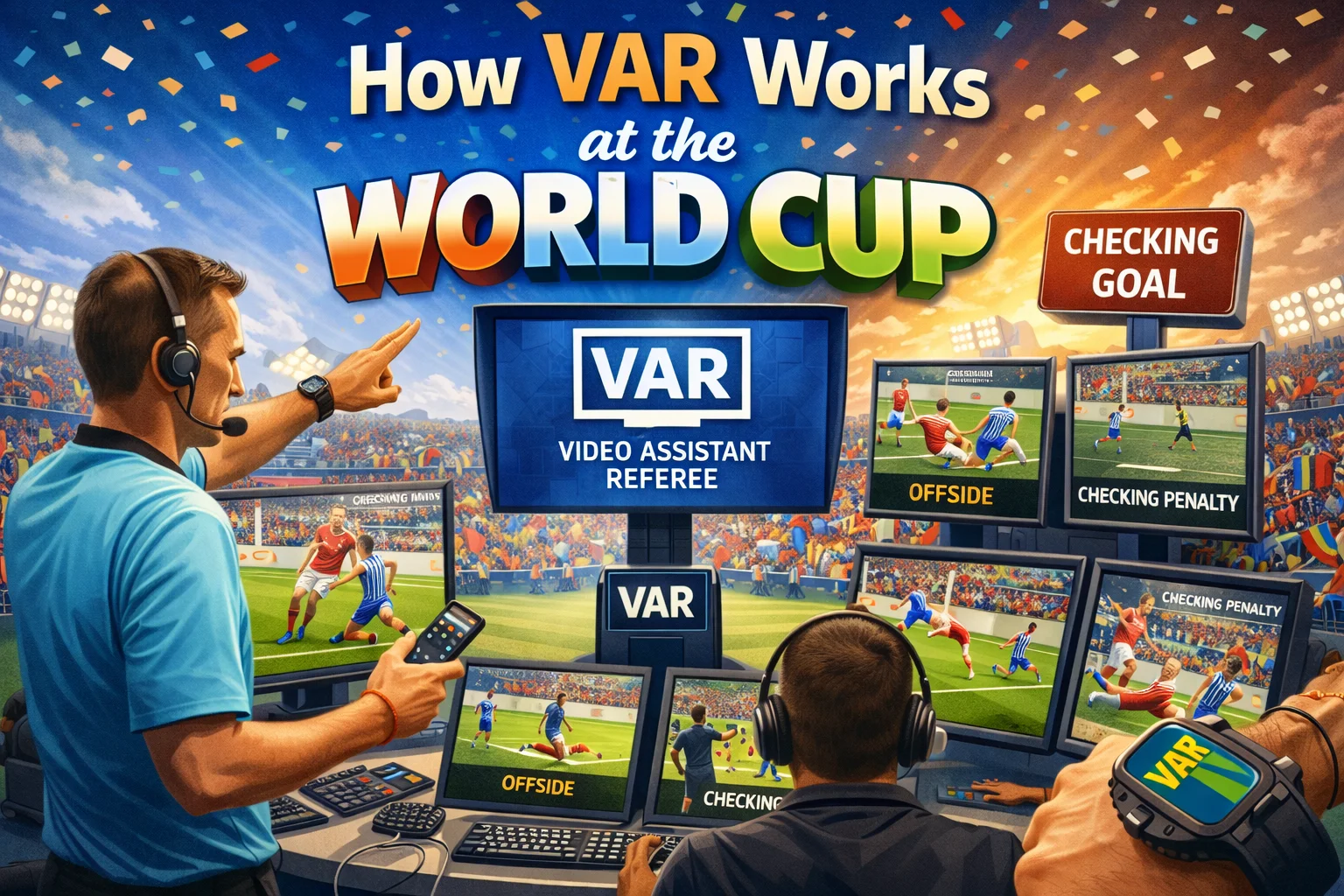
How VAR Works at the World Cup
How VAR Works at the World Cup is easier to follow once you know the order of events and what the system is allowed to review. VAR is not there to referee every tackle. It is there to reduce clear, match-changing mistakes while keeping the game moving.
At the World Cup, VAR at the World Cup works as a support team for the on-field referee. Video officials watch live feeds, run quick checks, and only step in for a small list of major incidents.
VAR checks key moments in the background while play continues. If the video team sees a clear and obvious error or a serious missed incident, they advise the referee, who can keep the decision or go to the pitchside monitor for an on-field review. The referee always makes the final call.
How VAR Works at the World Cup
VAR at the World Cup is a match-official team working with video replays. They do not stop the match for small calls. They focus on moments that can swing the result.
The World Cup VAR review system is built around two ideas:
- quick “silent” checks that often end with no change
- full reviews only when something looks clearly wrong
This balance is meant to improve fairness without turning football into constant stoppages.
What you need to know before you start watching VAR
To follow the VAR decision process World Cup matches use, you only need a few basics.
VAR is a team, not one person
Inside the assistant video referee booth setup (often called a Video Operation Room), the group usually includes:
- one main VAR (leads the process and talks to the referee)
- assistant video assistant referees (AVARs) who help track live play and key details
- replay operators who pull the best angles fast
This teamwork matters because World Cup pace is high and decisions must be consistent.
The referee stays in charge
Video assistant referee explained in one line: video officials advise, the on-field referee decides. Even when a review happens, the referee can accept the information directly or use the pitchside screen for an on-field review World Cup VAR moments.
Step-by-step: VAR checks explained in a World Cup match
This is the simplest way to understand the World Cup match review system from start to finish.
Step 1: The silent check
Most big moments trigger a fast check in the background. You may see a short pause before kickoff restarts after a goal, or before a penalty is taken. Often, you will hear nothing, and the match continues.
Step 2: The VAR flags a possible error
If the video team sees a clear issue, they communicate it to the referee through headset communication. This World Cup referee VAR communication is constant, but only key messages lead to action.
Step 3: Decision change or on-field review
There are two common outcomes:
- a direct change for factual situations, such as a clear offside position
- an on-field review when the referee wants to judge contact, handball, or intensity for themselves
The referee may watch clips at normal speed or slow motion, depending on what fits the decision.
Step 4: Final decision and restart
After the check or review, the referee signals the outcome and play restarts. The original decision stands unless the video evidence shows it should change.
What VAR can review at the World Cup (and what it cannot)
Fans often get frustrated because some mistakes are not reviewed. That is usually because the incident is outside the allowed categories.
VAR focuses on match-changing events like goals, penalties, and red cards. Some 2026 updates expand the list in limited ways, such as clearly incorrect second yellow situations that lead to a red, and quick checks on clearly wrong corner awards when the check can be immediate.
FIFA World Cup VAR rules and review categories (with 2026 updates)
| Situation | What VAR Checks | 2026 Updates |
|---|---|---|
| Goal or No Goal | Build-up offences, offside, ball out | No major change |
| Penalty or No Penalty | Location, build-up fouls, handball | No major change |
| Direct Red Card | Serious foul play, violent conduct | Now includes incorrect second yellow |
| Mistaken Identity | Wrong player cautioned or sent off | Clarified and strengthened |
| Corner Kick | Clearly wrong award | New quick-check option |
This is why many yellow-card debates, throw-ins, and small fouls stay with the referee’s original call. The system is designed to stay limited.
Offside decisions
Offside is where the World Cup adds extra tools to help speed and accuracy. Semi-automated offside World Cup decisions are built to reduce long delays and messy line drawing.
In this setup, dedicated tracking cameras follow player movement, and a sensor inside the match ball helps identify the exact kick moment. The system proposes an outcome, then video officials validate the details before the decision is confirmed.
Table 2: Semi-automated offside process and tools
| Part of the system | What it does | What humans still do |
|---|---|---|
| Tracking cameras | Track player positions using multiple body points over time | Confirm the correct player and moment |
| Ball sensor | Helps pinpoint the kick moment | Validate kick point in tricky plays |
| Automated alert | Flags a likely offside quickly | Review edge cases like deflections or interference |
| Visual output | Creates clear lines and 3D-style visuals for broadcast | Approve the final result before it is shown |
This is why some offside calls feel faster than older reviews. Still, the final confirmation remains with the VAR team and the referee.
Common World Cup VAR decisions fans notice most
Some topics come up again and again because they change matches.
Penalty decisions VAR World Cup moments
Penalties are among the most checked incidents. The video team looks at contact, possible fouls in the build-up, and key details such as where the offence happened. The referee may go to the monitor when the call needs a judgement, not just a fact check.
VAR handball rule World Cup situations
Handball calls can be tense because angles matter and interpretations vary. VAR can recommend a review if the footage suggests a clear mistake in awarding or denying a penalty.
Red card review VAR FIFA decisions
VAR can review direct red cards for serious foul play or violent conduct. With protocol updates for 2026, clearly incorrect second yellow situations that lead to red can also fall under review.
Common mistakes fans make when judging VAR
Understanding the rules helps you avoid the biggest misunderstandings.
Mistake 1: Thinking VAR looks at everything
It does not. VAR technology in football tournaments is limited on purpose to avoid constant interruptions.
Mistake 2: Expecting perfect agreement on subjective calls
Slow motion can make contact look worse. Normal speed can change how it feels. Two people can still see intensity differently, even with replays.
Mistake 3: Confusing a check with a review
A check is fast and often invisible. A review is a bigger moment that may include the pitchside screen and a longer pause.
Table 3: VAR timeline World Cup decision flow (what usually happens)
| Phase | What you might see | What it usually means |
|---|---|---|
| Check begins | Short delay, players waiting | VAR is reviewing angles quickly |
| Check complete | Play restarts normally | No clear error found |
| Review recommended | Referee pauses play | Possible clear error spotted |
| On-field review | Referee goes to monitor | Referee wants to judge it personally |
| Final decision | Signal and restart | Call stands or is changed |
FAQs
It runs quick checks on major incidents and only recommends a change or on-field review when a clear and obvious error or serious miss is spotted.
The on-field referee makes the final decision, even after advice from the video team.
Offside details, handball angles, and foul intensity can require more views and better camera angles before the referee decides.
No. Only match officials control checks and reviews, and players are expected to stay away from the monitor area.
No. Semi-automated tools propose an outcome, but the VAR team still validates it before it is confirmed.
Conclusion
VAR at the World Cup is built to correct the biggest errors, not to manage every moment. Once you know the review categories, the step-by-step workflow, and how semi-automated offside helps, VAR becomes much easier to follow. The key point stays the same: video supports the referee, but the referee decides. You can Read Also Countries Playing Their First Ever World Cup.