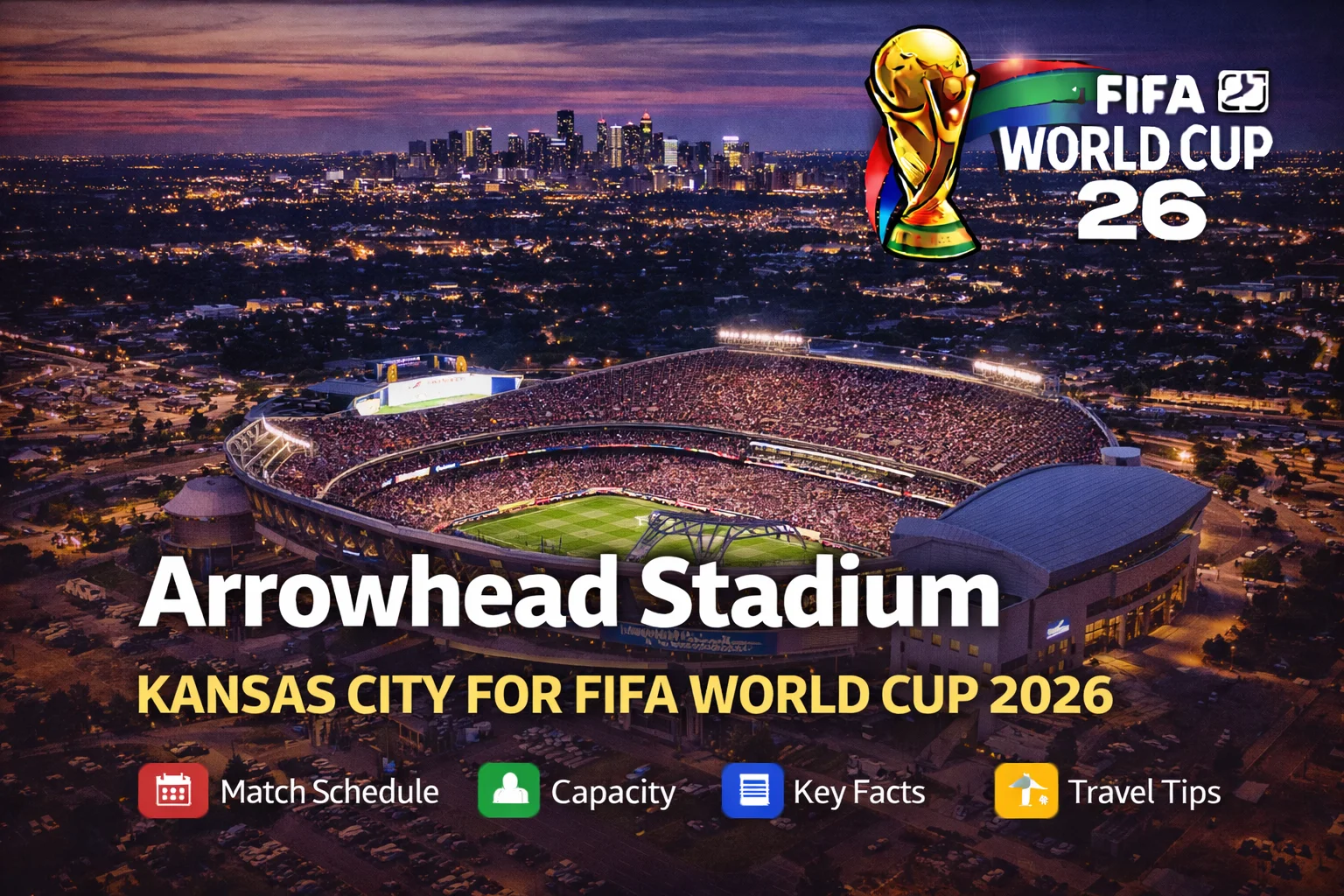
Arrowhead Stadium World Cup 2026, Kansas City Schedule, Capacity, Travel Tips
As excitement builds for the 2026 FIFA World Cup, Arrowhead Stadium is set to welcome the world to Kansas City, Missouri. Officially known as GEHA Field at Arrowhead Stadium, the venue is expected to be branded as Kansas City Stadium during the tournament because FIFA uses neutral venue names for its events. That shift in naming does not change what fans feel inside the bowl an intense atmosphere, a proud sports city, and a venue built for big moments.
Arrowhead has decades of history as an NFL home, yet it is preparing to adapt to football on the global stage. Visitors can look forward to a blend of tradition and modern upgrades, plus the signature energy the stadium is famous for. At the same time, Kansas City offers more than matchday action. The city’s barbecue identity and jazz heritage shape the trip, and the central U.S. location makes it a convenient destination for flights and road travel.
Arrowhead Stadium location and why Kansas City matters in 2026
Arrowhead Stadium sits in the Truman Sports Complex in Kansas City, Missouri, next to Kauffman Stadium. This complex is built for large crowds, with huge parking lots and a long tradition of tailgating culture. Because the venue is not a downtown walk-up stadium, planning transport is essential. Still, the layout is designed for controlled traffic flows and spacious entry zones, which can help when international crowds arrive.
Kansas City brings a unique flavor to the World Cup, powered by a passionate sports community and an event-ready reputation. The selection of Arrowhead Stadium highlights its history of high-energy events, while the host city status is set to draw a bigger international mix for group-stage and knockout-round action. Consequently, hotels, ride-share demand, and downtown nightlife often spike during match weeks, especially around the later rounds.
Arrowhead Stadium history, legacy, and architectural identity
Arrowhead Stadium opened on August 12, 1972, and quickly became a landmark in professional sports. Before it opened, the Kansas City Chiefs played at the aging Municipal Stadium. The drive for a modern venue led to a bold two-stadium complex concept. The project’s ambition included an early idea from architect Charles U. Deaton for a shared rolling roof that could move between the football and baseball stadiums on tracks. Although that concept was never built, it reflected how big the vision was.
The final design, executed by the firm Kivett and Myers, moved away from traditional box-like stadiums. Instead, it used sweeping curves and organic lines intended to harmonize with the landscape. Importantly, the steep seating bowl design helps keep fans close to the action and amplifies sound. Features like broad concourses, spiral ramps, and sightline-friendly geometry became part of the stadium’s long-standing identity.
Evolution from NFL fortress to World Cup venue
Arrowhead has been home to the Kansas City Chiefs for decades. It hosted its first game against the St. Louis Cardinals and later became a stage for massive events beyond football. Over the years, the stadium underwent significant renovations, including a $375 million upgrade in 2010 that added luxury suites and improved concourses while preserving the classic feel.
For the Arrowhead Stadium World Cup 2026 era, further enhancements are planned. One track of reporting points to additional improvements costing around $50 million, focused on seating configuration and facilities to better fit soccer requirements. Another note is that major planned renovations were dependent on a local sales tax extension that did not pass in 2024. Even with those realities, the stadium is expected to meet FIFA standards through targeted modifications and match operations.
Milestones, major events, and the stadium’s reputation for noise
Arrowhead is widely recognized for record-level crowd noise, and that reputation is tied to how sound behaves in the bowl. The stadium set a Guinness World Record for the loudest crowd roar at 142.2 decibels on September 29, 2014, during a Chiefs game. That legacy of intensity matters for the World Cup because chants, drum rhythms, and big reactions can feel amplified when the stands are full.
In addition to football, the stadium has hosted major concerts and large-scale events. It has welcomed artists such as Taylor Swift and The Rolling Stones, and it has staged high-profile sports moments that draw national attention. Now, the World Cup creates a new chapter, where American football tradition meets international football culture.
Arrowhead Stadium capacity for FIFA World Cup 2026
Arrowhead’s standard capacity is approximately 76,416 for NFL games, which already fits the scale of major global events. However, World Cup configurations can shift the number because soccer field requirements, broadcast platforms, media positions, and hospitality zones may change how seating is arranged. As a result, the net capacity is expected to adjust to around 67,513 to 73,000 for World Cup matches.
Facilities, premium areas, and fan comfort
Recent updates have focused on modern amenities like high-speed Wi-Fi, expanded concessions, and accessible seating. The stadium also features over 100 luxury suites and club levels for premium experiences. For the World Cup, temporary modifications are expected, including natural grass overlays on the usual turf to meet international standards. Even if you are not in premium seating, these operational upgrades matter because they shape concourse flow, service speed, and the overall matchday rhythm.
Capacity comparison across major venues
| Venue Name | Standard Capacity | World Cup Capacity | Host City |
|---|---|---|---|
| Arrowhead Stadium | 76,416 | 67,513-73,000 | Kansas City |
| MetLife Stadium | 82,500 | 82,500 | New York/New Jersey |
| AT&T Stadium | 80,000 | 92,967 | Dallas |
| Estadio Azteca | 87,523 | 87,523 | Mexico City |
This comparison highlights Arrowhead’s substantial size among North American host venues, even after soccer-specific adjustments.
Arrowhead Stadium World Cup 2026 schedule
Kansas City is scheduled to host six World Cup matches, spanning group stage and knockout rounds. Across different planning views, you will see two useful ways to think about the schedule:
- dates and stages for travel planning
- match listings that will be confirmed after the final draw
Because matchups depend on the tournament draw and final group assignments, it is smart to treat opponents as to be determined for planning purposes. Still, the match dates provide a strong base for flights, hotels, and time-off requests.
Kansas City match dates and planning table
| Date (2026) | Stage | Kickoff Time (Local) | Planning Note |
|---|---|---|---|
| June 16 | Group Stage | Evening | Expect heavy arrival traffic and long entry lines |
| June 20 | Group Stage | Evening | Weekend demand raises hotel and ride-share prices |
| June 25 | Group Stage | Early evening | Midweek matchday often has smoother airport flow |
| June 27 | Group Stage | Night | Late kickoff means late exits and slower rides home |
| July 3 | Round of 32 | Evening | Knockout matches create higher security and media presence |
| July 11 | Quarterfinal | Evening | Peak demand weekend with the largest crowd pressure |
Detailed match lineup view (Central Time)
The schedule below represents one detailed listing of games for Arrowhead Stadium World Cup 2026, including stages and kickoff times in Central Time.
| Date | Time (CT) | Stage | Matchup |
|---|---|---|---|
| June 16, 2026 | 8:00 PM | Group J | Argentina vs. Algeria |
| June 20, 2026 | 7:00 PM | Group E | Ecuador vs. Curacao |
| June 25, 2026 | 6:00 PM | Group F | Netherlands vs. Tunisia |
| June 27, 2026 | 9:00 PM | Group J | Austria vs. Algeria |
| July 3, 2026 | 8:30 PM | Round of 32 | Group K Winner vs. Third Place (D/E/I/J/L) |
| July 11, 2026 | 8:00 PM | Quarterfinal | Winner Match 95 vs. Winner Match 96 |
This view is especially helpful for fans who want to map match nights, late exits, and hotel nights. Moreover, the quarterfinal window on July 11 stands out as the high-demand date where the city and stadium will feel the most pressure.
Match-number schedule view
Another way the Kansas City Stadium slate is presented is through match numbers tied to the official schedule structure.
| Match Number | Stage of Tournament | Notes |
|---|---|---|
| 19 | Group Stage | |
| 34 | Group Stage | |
| 58 | Round of 32 | Knockout stage begins |
| 69 | Round of 16 | |
| 87 | Quarter-Final | Major elimination match |
| 100 | Quarter-Final | Major elimination match |
In this format, the key takeaway is the tournament weight: the venue is positioned for meaningful knockout-stage football, including quarter-final involvement.
How to use these dates smartly
If you want the easiest experience, arrive at least one full day before your match and leave the next morning. That buffer protects you from flight delays, traffic bottlenecks, and long stadium queues. Also, consider staying multiple nights if you plan to attend two group matches, because moving hotels can waste time. Finally, if you are targeting the Round of 32 or the quarterfinal window, book flexible lodging early, because demand can jump quickly.
Matchday rules, entry policies, and what to bring
World Cup matchdays move differently than regular events, so preparation matters. Tickets for events at GEHA Field at Arrowhead Stadium are mobile-only, which means your phone becomes essential. In addition, the venue follows a clear bag policy. Only small clutches or clear plastic, vinyl, or PVC bags up to 12″ x 6″ x 12″ are permitted. The stadium is also cashless and accepts major credit cards including Mastercard, American Express, Visa, and Discover.
Timing: parking, gates, and arrival strategy
Arrowhead’s parking lots typically open 4.5 hours before kickoff, while stadium gates open 2 hours before the event. Because entry lines can grow quickly, aim to be at the stadium two to three hours before kickoff if you want photos, food, and relaxed time to find your seat.
What to bring and what to avoid
Bring a fully charged phone, a power bank, and a small card-friendly wallet. Wear comfortable shoes because you will walk long distances, especially from parking areas. Check bag rules carefully and avoid anything that slows screening, because you may be turned back. Also, remember that networks can slow down when thousands of phones connect at once, so screenshot key details when possible.
Getting to Arrowhead Stadium
Because the venue is about 15 miles east of downtown at the Truman Sports Complex, transport planning is part of the matchday plan. You can drive, use rideshare, or use local bus services, but each choice comes with tradeoffs.
Driving and parking strategy
Driving can be convenient, especially if you plan to tailgate in the vast parking lots, which is a beloved tradition at the complex. However, commit to arriving early and staying patient after the match, because exits can move slowly. Park closer to your planned exit route rather than closer to the gates, because leaving can matter more than arriving. Also, keep snacks and water in the car, because post-match gridlock can be long.
Parking must be purchased in advance, and tailgating is permitted for ticketed guests only. This matters because it shapes your pre-match routine and where you set up your group meeting point.
Ride-share and taxis
Rideshare services like Uber or Lyft can reduce the stress of driving, yet surge pricing and waits are common after the final whistle. Ride-share works best if you walk away from the heaviest crowd zones after the match and agree on a meeting point with friends. For rideshare operations, one listed designated pick-up and drop-off zone is at the Missouri Welcome Center on Blue Ridge Cutoff.
Public transport and budget options
Public buses from the Kansas City Area Transportation Authority offer affordable options, although they may be crowded on match days. If you choose this route, build extra time into your plan so you are not rushing at security.
Where to stay in Kansas City for World Cup matches
Your best base depends on whether you want nightlife, convenience, or quieter rest. Downtown Kansas City offers restaurants, bars, and a lively scene, which is ideal if you want pre-match and post-match energy. Country Club Plaza is another area often mentioned for access to attractions and a polished visitor feel. Meanwhile, Overland Park and nearby suburbs can provide quieter stays with larger hotels and easier parking.
Hotel booking tips that save money
Book refundable rates early, because prices often rise after team matchups become official. If you are flexible, midweek stays around group matches can be easier on the budget, while weekends tend to be more expensive. If you attend multiple games, consider staying in one hotel rather than switching, because it reduces stress and wasted time.
Food, culture, and what to do between matches
Kansas City is famous for barbecue, and trying local spots is part of the trip. Visitors often look for iconic names such as Joe’s Kansas City or Arthur Bryant’s for the classic experience. Beyond food, the city has museums and entertainment districts that help break up the trip, especially if you are in town for multiple matches.
Popular stops include the Nelson-Atkins Museum of Art, the National WWI Museum, and the Power & Light District for shopping and nightlife. These options help turn a match visit into a fuller travel experience.
Simple two-day itinerary for match visitors
Day 1: Arrive, check in, explore downtown, and eat an early dinner to avoid late crowds.
Matchday: Eat a solid lunch, head to the stadium early, then return for a relaxed late-night snack.
Day after: Sleep in, visit a museum or market area, and fly out midday if possible.
Summer weather in late June and July
Kansas City in June and July can be warm, often in the 80s Fahrenheit, and storms are possible. Even for night matches, heat can linger during entry lines and in crowded concourses. Wear breathable clothing, hydrate early, and pack sunscreen for daytime movement. A light layer can also help if indoor areas feel cool.
Quick facts for Arrowhead Stadium World Cup 2026
| Category | Detail |
|---|---|
| Host city | Kansas City, Missouri |
| Tournament venue name | Often referred to as Kansas City Stadium during FIFA events |
| Matches hosted | Six total, including group stage and knockout rounds |
| Match weeks | Mid-June through mid-July 2026 |
| Fan identity | Known for intense crowd noise and tailgating culture |
| Best planning tip | Arrive early and build a time buffer for traffic and security |
FAQs
For FIFA events, the venue is expected to be referred to as Kansas City Stadium, reflecting neutral naming rules.
Kansas City is scheduled to host six matches, including group-stage games and knockout fixtures, with a quarterfinal included in the slate.
For World Cup configurations, capacity is expected to be adjusted to around 67,513 to 73,000 seats from the standard approximately 76,416.
Aiming for two to three hours before kickoff helps you clear security, find your seat, and enjoy the pre-match atmosphere.
Tickets are mobile-only, the stadium follows a clear bag policy with size limits, and the venue is cashless with major cards accepted.
Conclusion
Arrowhead Stadium is built for big moments, and the World Cup will amplify everything it does best: energy, noise, and spectacle. With Kansas City hosting six matches across group play and knockout rounds, smart planning is the difference between a stressful day and a smooth one. Focus on the basics that matter most: arrive early, expect long walks, choose a hotel base that fits your style, and build time buffers for traffic and security. Most importantly, embrace the atmosphere. This is a venue where the sound, emotion, and scale can turn even a group-stage match into a memory that feels global. You can check also NRG Stadium.