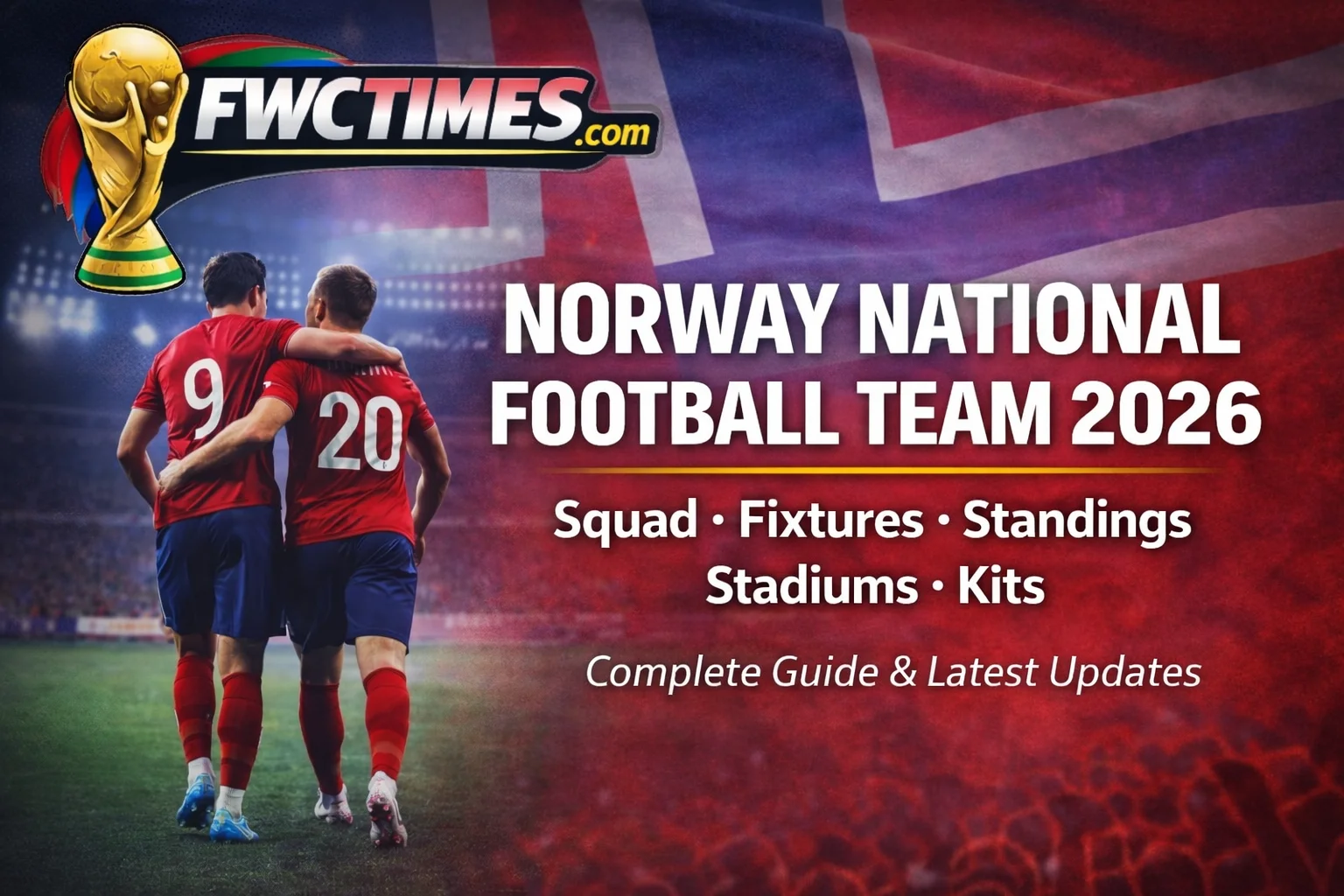
Norway National Football Team 2026 Squad, Fixtures, Standings, Kits, Tactics
The Norway national Football team heads into 2026 with a stronger core than in recent cycles. The squad blends proven stars with improved depth across key positions. That gives Norway more ways to win games, not just one plan.
Leadership is clear. Ståle Solbakken remains head coach, while Martin Ødegaard is captain and the main controller in midfield. In attack, Erling Haaland remains the headline finisher and the most feared scoring threat.
Norway’s 2026 story is built around a settled coach, a captain who sets the tempo, and elite striker options. Expect a 4-3-3 base shape, flexible roles for Ødegaard, and direct attacking patterns that try to reach Haaland early. Fixture dates and tournament scheduling can change, so treat match listings as subject to confirmation.
Norway coach 2026, captain, and team identity
Solbakken has shaped Norway into a pragmatic modern side. The team can stay compact without the ball, then attack quickly when space opens. Against stronger opponents, Norway often protects central zones first. Against weaker teams, the press can go higher and the ball circulation becomes calmer.
Ødegaard’s role is critical in every version of the plan. When he receives facing forward, Norway’s attacks speed up. When he drops deeper, he stabilizes the rhythm and helps Norway manage difficult phases.
Key leadership points in 2026:
- Head coach 2026: Ståle Solbakken
- Captain 2026: Martin Ødegaard
- Vice-captain option: Erling Haaland (listed in the squad details)
Norway national team squad roster 2026
Norway’s squad picture in this cycle is strong in three areas: goal threat, athletic full-backs, and midfield balance. The team has multiple striker profiles, plus wide players who can add pace and unpredictability.
Here is a clean roster-style guide using the named squad pool and key options mentioned in the source content.
Current Norway men’s national football team squad (primarily from their most recent call-ups for FIFA World Cup 2026 qualification matches and national team listings) — current as of late 2025/early 2026:
Goalkeepers
- Ørjan Nyland – Veteran keeper (Sevilla)
- Mathias Dyngeland – Brann
- Sander Tangvik – Rosenborg/Hamburger SV (depending on source)
- Egil Selvik – Watford FC
Defenders
- Kristoffer Ajer – Centre-back (Brentford)
- Leo Østigård – Centre-back (Genoa)
- Torbjørn Heggem – Centre-back (Bologna)
- David Møller Wolfe – Left-back (Wolverhampton Wanderers)
- Fredrik André Bjørkan – Left-back (Bodø/Glimt)
- Sondre Klingen Langås – Defender
- Andreas Hanche-Olsen – Centre-back/defender
- Eivind Helland – Defender (young squad member)
- Marcus Holmgren Pedersen – Defender
- Felix Horn Myhre – Defender/midfield utility player
Midfielders
- Martin Ødegaard – Captain & creative midfielder (Arsenal) (note: he has had injury issues recently)
- Morten Thorsby – Midfield anchor
- Patrick Berg – Midfielder
- Sander Berge – Midfielder
- Antonio Nusa – Midfielder/winger
- Oscar Bobb – Midfielder
- Lasse Berg Johnsen – Midfielder
- Thelo Aasgaard – Midfielder/forward role
Forwards
- Erling Haaland – Star striker (Manchester City)
- Alexander Sørloth – Forward
- Jørgen Strand Larsen – Forward
- Erik Botheim – Forward
- Jens Petter Hauge – Winger/forward
- Aune Heggebø – Forward
- Kristian Thorstvedt – Midfield/attack
- Aron Dønnum – Winger/forward
Notes
- This list reflects players called up mainly for 2026 World Cup qualification matches — squads can vary slightly by camps and competitions.
- Martin Ødegaard has been sidelined due to injury at times, so availability can change.
- Erling Haaland serves as captain and is Norway’s leading international goalscorer.
Norway starting XI
Norway’s best XI can look stable when the core is available. The most common idea is a 4-3-3 base shape. It can shift in possession, especially when Ødegaard moves into the right half-space and Norway builds attacks on one side.
A practical probable lineup shape:
- Goalkeeper: Nyland
- Back four: Ryerson, Ajer, Østigård, Bjørkan or Wolfe
- Midfield three: Berge, Ødegaard, Berg or Thorsby
- Front three: Nusa, Haaland, Bobb or another wide option
This is a guide, not a locked plan. Selection can change based on opponent and fitness. Squad announcements and injury updates can also shift the final XI close to matchday.
Norway tactics analysis
Norway’s tactical identity is direct and structured. The team wants to defend compactly, regain the ball, and attack with purpose. However, there is a second mode too. Norway can keep the ball longer when the opponent sits deep.
4-3-3 base shape
In the 4-3-3, two midfielders often stay connected to the center-backs. That helps with transitions and limits counterattacks. It also allows one full-back to push higher without exposing the team too easily.
Key benefits:
- Clear pressing shape
- Strong rest defense in transition
- Quick access to wide outlets and early crossing
4-2-3-1 in possession
Norway can resemble a 4-2-3-1 when Ødegaard plays as a clear central creator. This can happen through rotations rather than a strict formation change. The advantage is more central access behind the opposition midfield line.
Trade-offs:
- Wide coverage depends more on winger tracking
- Full-backs must choose moments carefully to avoid being caught high
The three main patterns that define Norway
- Early ball into the striker zone
Norway often looks for fast vertical passes to reach Haaland quickly. - Ødegaard as the rhythm controller
He connects phases, chooses tempo, and improves the quality of the final pass. - Wide pace and cutback chances
Wide players stretch the back line, then Norway attacks the box with runs and cutbacks.
Norway fixtures 2026
Norway’s calendar is typically shaped around international windows. In 2026, the schedule is presented in three blocks: March friendlies, a major summer tournament phase, and Nations League action later in the year. Exact timing can be adjusted by organizers, so match details should always be treated as subject to confirmation until officially finalized.
Table 2: Norway match schedule 2026 (listed fixtures)
| Date (2026) | Match | Competition |
|---|---|---|
| 27 March | Netherlands vs Norway | Friendly |
| 31 March | Norway vs Switzerland | Friendly |
| 16 June | IC Path 2 vs Norway | World Cup group match |
| 22 June | Norway vs Senegal | World Cup group match |
| 26 June | Norway vs France | World Cup group match |
| 24 September | Norway vs Denmark | Nations League |
| 27 September | Norway vs Portugal | Nations League |
| 1 October | Wales vs Norway | Nations League |
| 4 October | Portugal vs Norway | Nations League |
| 14 November | Norway vs Wales | Nations League |
| 17 November | Denmark vs Norway | Nations League |
Norway standings and points table
Norway’s qualifying run is described as dominant in the source content. One full table summary lists Norway finishing first with eight wins from eight matches. It also includes goals scored, goals conceded, and goal difference.
Because standings can be updated across competitions, treat this as a snapshot of the listed qualifying group finish, not a live table.
Group standings snapshot (listed qualifying table)
| Team | Played | W-D-L | GF-GA | Goal difference | Points |
|---|---|---|---|---|---|
| Norway | 8 | 8-0-0 | 37-5 | +32 | 24 |
| Italy | 8 | 6-0-2 | 21-12 | +9 | 18 |
| Israel | 8 | 4-0-4 | 19-20 | -1 | 12 |
| Estonia | 8 | 1-1-6 | 8-21 | -13 | 4 |
| Moldova | 8 | 0-1-7 | 5-32 | -27 | 1 |
Norway FIFA ranking, UEFA ranking
Norway is listed at FIFA ranking 32 in the provided content, with a noted movement down by three. Rankings do not guarantee tournament results, but they do give context. Norway is no longer treated as a low-tier side. They are closer to the group of teams that can upset stronger names when the match plan clicks.
Use rankings as a signal, not a prediction. Performance still depends on finishing, defensive spacing, and game management in key moments.
Norway home stadium 2026
Ullevaal Stadion in Oslo remains the national team’s main home ground. It is listed with a capacity of 27,182 and is treated as the reference venue for many big matches.
Norway can still use other venues at times. However, Ullevaal is the anchor for home atmosphere and the most recognized base for the team.
Norway kits 2026
Norway’s kit supplier in this cycle is Nike. The classic identity stays consistent across most years, with a red home look tied to national colors. The away kit is usually designed for contrast and can shift in tone from one release to the next.
In the provided kit details, the home design is described as red with navy and white accents, using a cross theme linked to the flag. Another description notes a darker away style, presented as an all-black look. Exact design details can vary by release timing, so treat visuals and final templates as release-dependent.
What to expect in simple terms:
- Norway home kit 2026: red base, national identity colors
- Norway away kit 2026: contrast look, can be darker in style
- Norway third kit 2026: not confirmed in the provided content, so treat as unannounced unless officially released
Norway key players 2026 to watch
Erling Haaland
Haaland is listed as Norway’s top scorer, with 55 goals shown in the team records. His presence shapes how opponents defend. Even when he does not score, he can force deeper lines and create space for runners.
Martin Ødegaard
Ødegaard is the tempo-setter and the captain. Norway’s best attacking phases often start with his ability to find the right pass at the right speed. He also helps Norway manage matches when pressure rises.
Antonio Nusa
Nusa adds unpredictability. That matters in tournaments where structured defenses are common. A player who can beat someone one-on-one can turn a tight match into a winning one.
FAQs
The provided content lists Norway as qualified after winning a qualifying group. Tournament details can still be subject to official competition confirmation.
Martin Ødegaard is listed as the captain for Norway in this cycle.
Ståle Solbakken is listed as head coach.
A 4-3-3 base shape is commonly shown, with a flexible in-possession look that can resemble a 4-2-3-1.
The home kit is described as a traditional red look with national-color accents. The away kit is described as a darker contrast style in the provided kit notes.
Conclusion
Norway’s 2026 outlook is built on leadership, structure, and elite finishing. The squad has better balance now, with real options in midfield, wide roles, and striker rotation. If Norway keep their defensive distances tight and feed Haaland with quality, they can compete with strong opponents in big moments.